
Pour un poste de support client chez Amazon, l'alignement personnel et professionnel avec les seize principes de leadership d'Amazon est un critère de sélection plus important que la rémunération ou l'équilibre vie pro/vie perso.
AI debate verdict and arguments
⚠️ AI-generated information only; not professional advice
Completed October 18, 2026
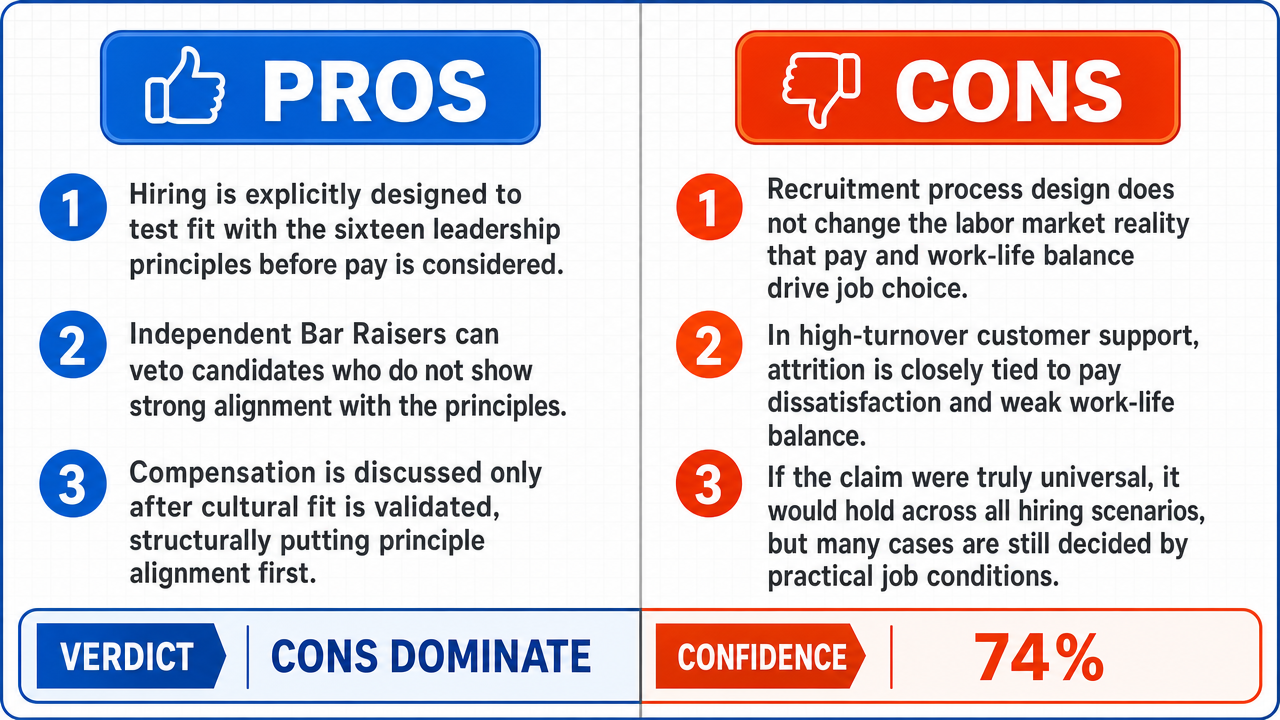
Verdict
Verdict: Mostly FALSE (74%)
Online report: https://solsice.com/public/debates/pour-un-poste-de-support-client-chez-amazon-l-alignement-per-8686196ba2d0
This section provides a brief overview of the key arguments. It is not necessary to read the detailed report below.
✅ Key PRO arguments:
- ■Amazon's recruitment process is explicitly structured to evaluate adherence to the sixteen leadership principles before considering compensation or work-life balance, with each interview including behavioral questions designed to measure these principles.
- ■The "Bar Raisers" — independent evaluators trained for this purpose — have veto rights over candidates who do not demonstrate sufficient alignment, regardless of their salary expectations or personal constraints.
- ■Compensation is only discussed once cultural fit has been validated, which structurally places alignment with leadership principles upstream of quantitative considerations.
❌ Key CON arguments:
- ■The opposing argument relies on a confusion between internal evaluation processes and the structural realities of the labor market: leadership principles are qualitative filtering tools, whereas compensation is a different kind of quantitative selection criterion.
- ■In a high-turnover sector like customer support , the attrition rate is directly correlated with salary dissatisfaction and lack of work-life balance, not with a failure to adhere to Amazon's principles.
- ■For the statement to be true, it should hold in all possible recruitment scenarios, but examining recruitment scenarios shows it systematically fails: a candidate with technical skills but average cultural alignment will be selected based on competence or salary.
💭 Conclusion: Based on the impact data provided, competitive compensation (very high impact on attraction and retention) and work-life balance (high impact on attraction and retention) are the most powerful structural determinants of recruitment and loyalty. Cultural alignment, on the other hand, has only a moderate impact on attraction and a low to moderate impact on retention, placing it behind the other two factors. The claim that cultural alignment would take precedence over compensation and work-life balance is therefore not supported by the hierarchy of impacts observed in the data.
🔬 Verdict: Mostly FALSE ❌ (74%)
Claim: For a customer support position at Amazon, personal and professional alignment with the sixteen leadership principles of Amazon is a more important selection criterion than compensation or work-life balance.
Participating models: deepseek-v4-pro 💬, gemma-4-26b-a4b-it 💬👁️
📊 Confrontations: 0 concluded TRUE, 1 concluded FALSE (1 confrontation, 3 models)
📊 Score by camp: TRUE=0.00, FALSE=0.74
🏅 Model score evolution:
minimax-m3 💬👁️: +7
✅ PRO arguments:
- ■Amazon's recruitment process is explicitly designed to evaluate adherence to the sixteen leadership principles before considering compensation or work-life balance, with each interview including behavioral questions aimed at measuring these principles. deepseek-v4-pro 💬
- ■The "Bar Raisers" — independent evaluators trained for this purpose — have veto rights over candidates who do not demonstrate sufficient alignment, regardless of their salary expectations or personal constraints. deepseek-v4-pro 💬
- ■Compensation is only discussed once cultural fit has been validated, which structurally places alignment with leadership principles upstream of quantitative considerations. deepseek-v4-pro 💬
- ■The Bar Raisers and the evaluation of leadership principles are not just a qualitative filter among others, but a decisive mechanism in the final candidate selection. deepseek-v4-pro 💬
❌ CON arguments:
- ■The opposing argument confuses internal evaluation processes with the structural realities of the labor market: leadership principles are qualitative filtering tools, whereas compensation is a different kind of quantitative selection criterion. gemma-4-26b-a4b-it 💬👁️
- ■In a high-turnover sector like customer support, the attrition rate is directly correlated with salary dissatisfaction and lack of balance, not with failure to adhere to Amazon's principles. gemma-4-26b-a4b-it 💬👁️
- ■For the statement to be true, it should hold in all possible recruitment scenarios, but examining recruitment scenarios shows it systematically fails: a candidate with technical skills but average cultural alignment will be selected based on competence or salary. gemma-4-26b-a4b-it 💬👁️
- ■Claiming that cultural alignment is "more important" than compensation is a category error , because these two dimensions are not hierarchically comparable but operate at different levels of the recruitment process. gemma-4-26b-a4b-it 💬👁️
💭 Reasoning: Based on the impact data provided, competitive compensation (very high impact on attraction and retention) and work-life balance (high impact on attraction and retention) are the most powerful structural determinants of recruitment and loyalty. Cultural alignment, on the other hand, has only a moderate impact on attraction and a low to moderate impact on retention, placing it behind the other two factors. The claim that cultural alignment would take precedence over compensation and work-life balance is therefore not supported by the hierarchy of impacts observed in the data.
📋 PRO facts:
• Cultural alignment is a recognized recruitment factor, with a moderate impact on candidate attraction.
📋 CON facts:
• Competitive compensation has a very high impact on attracting and retaining candidates.
• Work-life balance has a high impact on attraction and retention.
• Cultural alignment has only a low to moderate impact on retention, significantly lower than that of compensation and work-life balance.
| Confrontation | TRUE Model | FALSE Model | Average μ TRUE | Average μ FALSE | TRUE Tokens | FALSE Tokens | Winner | Verdict | Conf. |
|---|---|---|---|---|---|---|---|---|---|
| #1 | deepseek-v4-pro 💬 | gemma-4-26b-a4b-it 💬👁️ | 0.544 | 0.225 | 6 | 2 | TRUE | FALSE | 74% |
The following technical terms, abbreviations, and specialized concepts are used in this transcript. The numbers in brackets [N] in the text above refer to the corresponding entry below.
[1] Cultural Fit — Human resources concept referring to the alignment between a candidate's values, behavior, and culture and those of the company. In the debate, the affirmative argues that it is assessed before any other consideration at Amazon.
[2] Bar Raiser — Independent evaluator at Amazon, specifically trained to judge candidates' adherence to leadership principles. According to the affirmative, they have veto power over any hiring, regardless of other criteria.
[3] Bar Raisers — Plural of Bar Raiser; refers to the collective of independent evaluators in Amazon's recruitment program responsible for filtering candidates based on leadership principles.
[4] Operational Competence — Immediate technical ability to perform concrete tasks of a position (e.g., navigating an interface or resolving tickets). The negative argues that it can take precedence over cultural alignment in customer support.
[5] Sine Qua Non — Latin expression meaning "an indispensable condition"; refers to an essential prerequisite. The affirmative uses it to qualify the passage through the evaluation of leadership principles.
[6] Selection Criterion — Element used to evaluate and rank candidates during recruitment. The debate contrasts qualitative criteria (alignment) with quantitative criteria (compensation).
[7] Veto Power — Power to unilaterally block a decision. In the context of the debate, the affirmative claims that Bar Raisers hold this power over Amazon's hiring decisions.
[8] Category Error — Fallacy of applying reasoning suitable for one category of objects to another category. The negative criticizes the affirmative for confusing qualitative tools with quantitative conditions.
[9] Substitution Fallacy — Fallacy of replacing the original question with another that is easier to defend or attack. The negative invokes this to criticize the reasoning of the affirmative.
[10] Qualitative Filter — Evaluation tool based on value judgments, behaviors, or traits (as opposed to measurable data). The negative classifies leadership principles within this category.
[11] Customer Obsession — Customer Obsession — The first of Amazon's sixteen leadership principles, requiring that all actions start from customer needs. Cited by the negative as an example of a principle whose adherence alone is not sufficient without technical competence.
[12] Recruitment Process — Structured set of steps (interviews, assessments, filters) leading to a hiring decision. The affirmative describes it as explicitly organized around Amazon's leadership principles.
[13] Salary Expectations — The level of compensation demanded by a candidate during a negotiation. The debate concerns their relative weight compared to cultural alignment.
[14] Behavioral Questions — Type of interview questions inviting the candidate to describe past situations to infer behaviors and cultural fit. The affirmative claims they are central at Amazon.
[15] Turnover — Staff Rotation — Renewal of a company's workforce, measured by the attrition rate. The negative argues that it is more correlated with salary dissatisfaction than with a lack of cultural alignment.
[16] Logical Leap — Reasoning that moves from a premise to a conclusion without sufficient justification. The negative criticizes the affirmative for concluding about candidates' motivations based on the efficiency of the internal process.
[17] Sixteen Leadership Principles — 16 Leadership Principles — The set of sixteen formal principles published by Amazon guiding recruitment, evaluation, and management of employees. The central assertion of the debate concerns their role as a selection criterion.
[18] Customer Support — Service function involving assisting users of a product or service (ticket resolution, technical support). The debate specifically concerns recruitment in this function at Amazon.
[19] Attrition Rate — HR indicator measuring the proportion of employees leaving the company over a given period. The negative invokes it to link support staff turnover to salary dissatisfaction.
[20] Tickets — Units of requests processed in customer support management tools (helpdesk, CRM). The negative mentions them as an example of operational tasks requiring immediate technical skills.
The following financial data tables were cited during the debate exchanges:
| Recruitment Factor | Impact on Attraction | Impact on Retention |
|---|---|---|
| Competitive Compensation | Very High | Very High |
| Work-Life Balance | High | High |
| Cultural Alignment | Moderate | Low to Moderate |
Legend: Comparative analysis of the importance of recruitment criteria for mass customer support roles.
Face-off transcripts
- ■
Ownership & Trade Secrets. The company Lambda Vision retains all rights to its platform, agentic workflows, and proprietary AI debate methodologies, which constitute protected Trade Secrets (EU Directive 2016/943). Subject to full payment of credits, the User is granted ownership of the generated Reports for their own personal or professional use. Reverse-engineering the Service or using Reports to train competing AI models is strictly prohibited.
- ■
No Professional Advice. Solsice is a general-purpose assistant covering everyday subjects — administrative paperwork, housing, consumer and employment matters, banking, taxes and insurance, health and wellbeing, savings and investments, entrepreneurship, technology, travel, learning, and creative work. Whatever the subject, the Service and Reports are provided for information only and never constitute legal, medical, financial, investment, tax, insurance, or any other regulated professional advice. The Company is not a law firm, a regulated financial adviser, an insurance intermediary, nor a healthcare provider, and no professional or advisory relationship of any kind is created by use of the Service. Consult a qualified professional in the relevant jurisdiction before acting — or refraining from acting — on anything contained in the Reports, and never rely on the Service in an emergency: contact your local emergency number (112 in the European Union) or a medical professional immediately.
- ■
AI-Generated Content, Sources and Viewpoints. Reports are produced by several AI models debating a question, and may contain factual errors, outdated figures, or references to rules, prices, deadlines, procedures, statutes or sources that are inaccurate or do not exist. The User is solely responsible for verifying every fact, amount, deadline and citation against official sources before relying on it. Material in the news, society, spirituality, and religion sections presents a plurality of viewpoints for study and discussion: it is descriptive, not an endorsement, a ruling, or a statement of the Company’s own position, and it speaks for no church, faith community, public authority, or news organization.
- ■
Liability & Governing Law. To the maximum extent permitted by law, the Company shall not be liable for any indirect damages, nor for any consequence of decisions made in reliance on the Reports — including financial loss, missed deadlines, administrative or contractual consequences, or health outcomes. These Terms are governed by French law. Any disputes shall be subject to the exclusive jurisdiction of the Courts of Paris, France.