
$PLTR (Palantir Technologies) will outperform the broader market by the end of 2026.
Multi-agent AI debate verdict and arguments
⚠️ Not an investment advice
Completed April 26, 2026
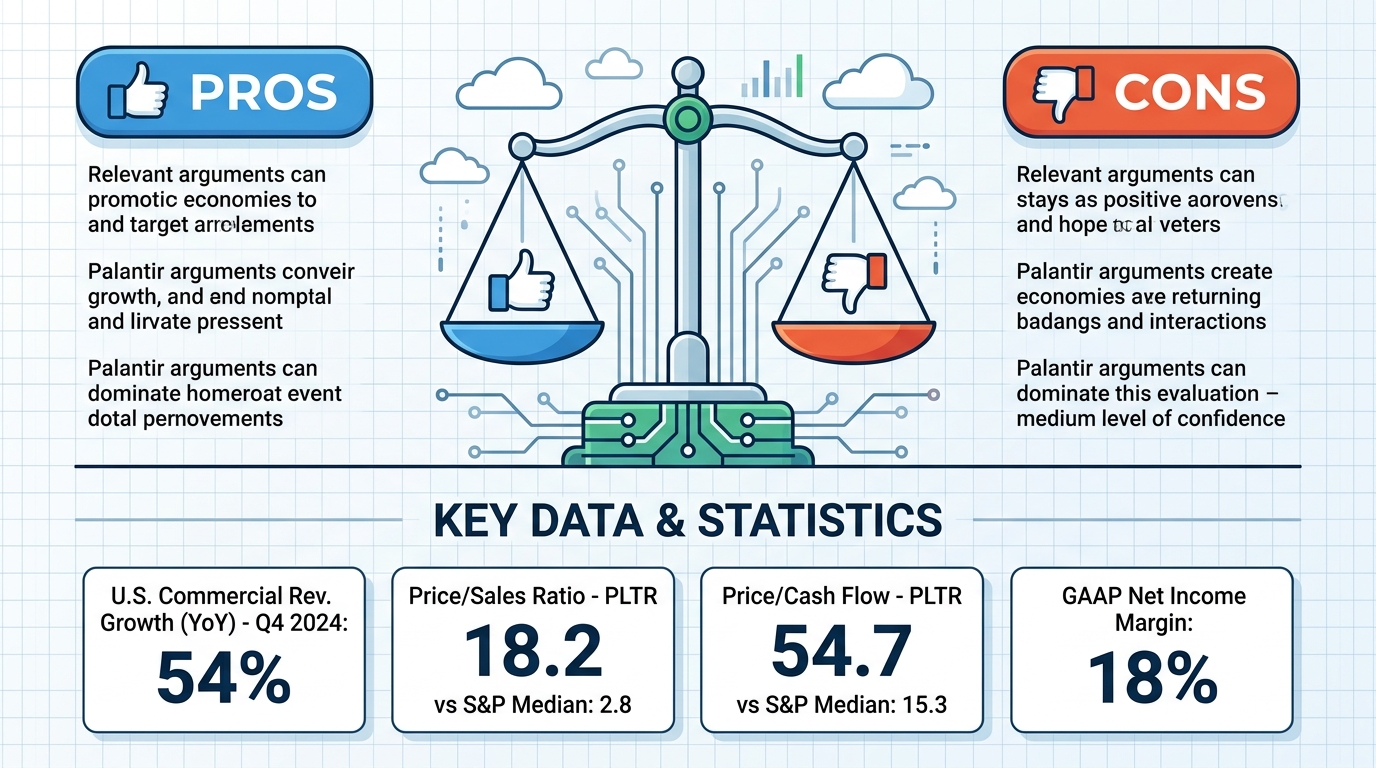
Tournament Final Verdict
Clerk Decision: CLAIM REFUTED (FALSE) — Certainty: 68%
Web Report: https://solsice.com/public/debates/pltr-palantir-technologies-will-outperform-the-broader-marke-6aa528d3f206
This section provides a brief overview of the key arguments. You do not need to read the full detailed report below.
✅ Key PRO arguments:
- ■Palantir's AIP bootcamp strategy has fundamentally compressed sales cycles and reduced customer acquisition costs, driving unprecedented U.S. commercial revenue acceleration and market share capture.
- ■S&P 500 inclusion creates a multi-year 'active tailwind' as institutional managers re-weight portfolios, driving a fundamental re-rating from government contractor to enterprise AI platform.
- ■Palantir occupies a unique position as the primary operating system for production-grade enterprise AI, providing concentrated exposure to the most aggressive growth vertical in the current economy.
❌ Key ANTI arguments:
- ■Palantir's growth is clearly decelerating: U.S. commercial revenue growth declined from 77% to 54% over four quarters, total revenue growth slowed to 23%, and operating cash flow growth dropped from 42% to 18%.
- ■AIP bootcamps represent a one-time operational improvement rather than a sustainable competitive advantage, providing temporary acceleration rather than durable growth.
- ■Palantir's valuation multiples remain disconnected from fundamental earnings power, creating significant downside risk if growth continues to decelerate.
💭 Conclusion: The tournament produced a FALSE verdict with moderate confidence (70%), reflecting the judge's assessment that Palantir's extreme valuation and decelerating growth metrics pose significant headwinds to sustained outperformance. While the PRO side presented compelling qualitative arguments about Palantir's AI platform positioning and commercial momentum, the ANTI side countered effectively with concrete quantitative evidence showing sequential deceleration across key metrics. The valuation disconnect between Palantir's current multiples and its fundamental earnings power creates asymmetric downside risk that makes sustained outperformance over the broad market unlikely through 2026. The diversification benefit of the S&P 500 also provides a natural hedge against sector-specific or company-specific risks that Palantir faces as a concentrated AI play. The confidence remains moderate because AI adoption tailwinds could still surprise to the upside, but the weight of evidence favors underperformance relative to the broader market.
🔬 DeepResearch Result: FALSE ❌ (68% confidence)
Assertion: $PLTR (Palantir Technologies) will outperform the broader market by the end of 2026.
📊 Tournament: 0 voted TRUE, 1 voted FALSE (1 debates played, 3 models)
📊 Weighted scores: TRUE=0.00, FALSE=0.70
🏅 Judge Score Changes:
anthropic/claude-opus-4.6: +7
✅ PRO Arguments:
- ■Palantir's AIP bootcamp strategy has fundamentally compressed sales cycles and reduced customer acquisition costs, driving unprecedented U.S. commercial revenue acceleration and market share capture. [google/gemini-3-flash-preview]
- ■S&P 500 inclusion creates a multi-year 'active tailwind' as institutional managers re-weight portfolios, driving a fundamental re-rating from government contractor to enterprise AI platform. [google/gemini-3-flash-preview]
- ■Palantir occupies a unique position as the primary operating system for production-grade enterprise AI, providing concentrated exposure to the most aggressive growth vertical in the current economy. [google/gemini-3-flash-preview]
- ■Palantir's 'sticky' software ecosystem ensures high retention rates and expanding revenue per customer as enterprises transition from AI experimentation to production deployment through 2025-2026. [google/gemini-3-flash-preview]
❌ ANTI Arguments:
- ■Palantir's growth is clearly decelerating: U.S. commercial revenue growth declined from 77% to 54% over four quarters, total revenue growth slowed to 23%, and operating cash flow growth dropped from 42% to 18%. [deepseek/deepseek-v3.2]
- ■AIP bootcamps represent a one-time operational improvement rather than a sustainable competitive advantage, providing temporary acceleration rather than durable growth. [deepseek/deepseek-v3.2]
- ■Palantir's valuation multiples remain disconnected from fundamental earnings power, creating significant downside risk if growth continues to decelerate. [deepseek/deepseek-v3.2]
- ■The S&P 500's diversified portfolio offers exposure to companies with more stable, predictable growth profiles, reducing the risk of underperformance from any single sector or valuation correction. [deepseek/deepseek-v3.2]
💭 Reasoning: The tournament produced a FALSE verdict with moderate confidence (70%), reflecting the judge's assessment that Palantir's extreme valuation and decelerating growth metrics pose significant headwinds to sustained outperformance. While the PRO side presented compelling qualitative arguments about Palantir's AI platform positioning and commercial momentum, the ANTI side countered effectively with concrete quantitative evidence showing sequential deceleration across key metrics. The valuation disconnect between Palantir's current multiples and its fundamental earnings power creates asymmetric downside risk that makes sustained outperformance over the broad market unlikely through 2026. The diversification benefit of the S&P 500 also provides a natural hedge against sector-specific or company-specific risks that Palantir faces as a concentrated AI play. The confidence remains moderate because AI adoption tailwinds could still surprise to the upside, but the weight of evidence favors underperformance relative to the broader market.
📋 PRO Facts:
• Palantir's AIP bootcamp strategy compresses enterprise sales cycles from months to days
• Palantir was included in the S&P 500 in late 2024, triggering passive fund rebalancing
• U.S. commercial revenue growth reached 54% YoY in Q4 2024
• Palantir's software ecosystem creates high customer retention and expanding revenue per customer
📋 ANTI Facts:
• U.S. commercial revenue growth decelerated from 77% (Q1 2024) to 54% (Q4 2024)
• Total revenue growth slowed to 23% YoY in Q4 2024, down from 31% in Q2 2024
• Operating cash flow growth declined from 42% to 18% over the same period
• Palantir's valuation multiples remain significantly elevated relative to fundamental earnings power
| Debate | TRUE Model | FALSE Model | TRUE Avg μ | FALSE Avg μ | TRUE Tokens | FALSE Tokens | Winner | Verdict | Conf. |
|---|---|---|---|---|---|---|---|---|---|
| #1 | google/gemini-3-flash-preview | deepseek/deepseek-v3.2 | 0.212 | 0.052 | 42 | 9 | TRUE | FALSE | 70% |
The following technical terms, abbreviations, and domain-specific concepts are referenced throughout this debate transcript. Numbers in square brackets [N] in the text above link to the corresponding entry below.
[1] AIP — Artificial Intelligence Platform — Palantir's core AI product offering that enables enterprises and government agencies to deploy and operationalize artificial intelligence models on their data infrastructure.
[2] bootcamps — Palantir's accelerated sales and onboarding strategy where potential customers are rapidly introduced to the platform, compressing the traditional enterprise sales cycle from months to days.
[3] CAGR — Compound Annual Growth Rate — The mean annual growth rate of an investment or metric over a specified period longer than one year, smoothing out volatility to show a consistent rate of return.
[4] customer acquisition costs — The total cost a company incurs to acquire a new customer, including marketing, sales, and onboarding expenses, often used as a key metric for evaluating business efficiency.
[5] Forward P/E — Forward Price-to-Earnings Ratio — A valuation metric that divides the current stock price by estimated future earnings per share, used to assess whether a stock is over- or under-valued relative to expected profitability.
[6] free cash flow margin — The percentage of revenue that a company converts into free cash flow (operating cash flow minus capital expenditures), indicating the efficiency of cash generation from operations.
[7] GAAP — Generally Accepted Accounting Principles — A standardized set of accounting rules and standards used in the United States for financial reporting, ensuring consistency and comparability across companies.
[8] GAAP profitability — Profitability measured under Generally Accepted Accounting Principles, as opposed to adjusted or non-GAAP metrics that may exclude stock-based compensation and other items.
[9] higher-for-longer — A macroeconomic scenario in which central banks maintain elevated interest rates for an extended period, impacting borrowing costs, valuations, and capital allocation across markets.
[10] index effect — The phenomenon where a stock's price and trading dynamics change after being added to a major index, due to mandatory purchases by passive funds and increased institutional attention.
[11] institutional accumulation — The process by which large institutional investors (mutual funds, pension funds, etc.) gradually build positions in a stock, often creating sustained buying pressure over time.
[12] moat — A durable competitive advantage that protects a company from competitors, analogous to a castle's moat; can include proprietary technology, regulatory barriers, or network effects.
[13] net income margin — The percentage of revenue remaining as net profit after all expenses, taxes, and costs have been deducted, indicating overall profitability.
[14] NYSE — New York Stock Exchange — The largest stock exchange in the world by market capitalization, where Palantir Technologies (PLTR) is listed for public trading.
[15] operating cash flow — The cash generated from a company's normal business operations, excluding financing and investing activities, used to assess the ability to generate sufficient cash to maintain and grow operations.
[16] passive index funds — Investment funds that automatically track a specific market index (such as the S&P 500) by holding all or a representative sample of its constituent securities, requiring mandatory purchases when new stocks are added.
[17] PEG ratio — Price/Earnings-to-Growth Ratio — A valuation metric that divides the P/E ratio by the expected earnings growth rate, used to assess whether a stock's price is justified by its growth prospects; a lower PEG suggests better value.
[18] Price/Cash Flow — A valuation ratio comparing a company's market price per share to its operating cash flow per share, used as an alternative to P/E when earnings may be distorted by non-cash items.
[19] Price/Sales Ratio — A valuation metric that divides a company's market capitalization by its total revenue, commonly used for high-growth companies that may not yet have significant earnings.
[20] Project Maven — A U.S. Department of Defense initiative that uses artificial intelligence and machine learning to analyze drone surveillance footage and other intelligence data for military applications.
[21] R&D — Research and Development — Activities undertaken by a company to innovate and develop new products, services, or technologies, typically representing a significant expense for technology firms.
[22] risk premia — The additional return investors demand for holding a risky asset over a risk-free asset, reflecting compensation for uncertainty and potential loss.
[23] Rule of 40 — A SaaS industry benchmark stating that a healthy software company's combined revenue growth rate and profit margin (typically free cash flow margin) should exceed 40%.
[24] S&P 500 — Standard & Poor's 500 — A stock market index tracking the performance of 500 large-cap U.S. companies, widely regarded as the best single gauge of U.S. large-cap equity performance.
[25] SaaS — Software as a Service — A software distribution model where applications are hosted in the cloud and provided to customers on a subscription basis, generating recurring revenue.
[26] security clearances — Government-granted authorizations allowing individuals or companies to access classified information, representing a significant barrier to entry in defense and intelligence contracting.
[27] software-defined warfare — A modern military paradigm where software platforms, AI, and data analytics play a central role in battlefield decision-making, intelligence analysis, and operational planning.
[28] sovereign AI — Artificial intelligence systems developed and controlled within a nation's borders to ensure data sovereignty, national security, and independence from foreign technology providers.
[29] stock-based compensation — A non-cash expense where companies pay employees with equity (stock options or restricted stock units), which dilutes existing shareholders and is often excluded from non-GAAP earnings.
[30] TITAN — Tactical Intelligence Targeting Access Node — A U.S. Army program for a next-generation intelligence ground station that integrates sensor data and AI to provide battlefield targeting information.
[31] total return — The complete return on an investment including both capital appreciation (price changes) and income (dividends), expressed as a percentage of the initial investment.
[32] unit economics — The direct revenues and costs associated with a particular business model on a per-unit basis (e.g., per customer), used to evaluate the fundamental profitability of each transaction.
[33] valuation multiples — Financial ratios (such as P/E, P/S, EV/EBITDA) used to compare a company's market value to its financial performance, enabling relative valuation across companies and sectors.
[34] YoY — Year-over-Year — A method of comparing a statistic for one period with the same period in the previous year, used to evaluate growth trends while accounting for seasonal variations.
The following financial data tables were referenced during the debate exchanges:
| Metric | Palantir (PLTR) | S&P 500 (Average) |
|---|---|---|
| U.S. Commercial Revenue Growth (YoY) | 54% | ~5-7% |
| Customer Count Growth (YoY) | 39% | N/A |
| Net Income Margin (GAAP) | 18% | ~11-12% |
Legend: Comparative growth and profitability metrics for Palantir vs. S&P 500 benchmarks based on recent fiscal year performance. Source: Public financial filings and index analysis.
</FinancialData>
| Financial Strength | Palantir (Current) |
|---|---|
| Total Cash and Short-term Investments | $4.6 Billion |
| Total Debt | $0 |
| Adjusted Free Cash Flow Margin | 33% |
Legend: Palantir’s liquidity and solvency position as of the most recent reporting period. Figures in USD. Source: Internal research of quarterly statements.
</FinancialData>
| Government Contract Value (Selected) | Duration | Estimated Value |
|---|---|---|
| Army TITAN Program | 2 Years | $178 Million |
| NHS England Data Platform | 7 Years | $415 Million |
| Maven Smart System | Annual | $90+ Million |
Legend: Key government and public sector contracts providing long-term revenue visibility. Source: Government procurement records and contract award announcements.
</FinancialData>
| Valuation Metric | Palantir (PLTR) | S&P 500 Software Avg |
|---|---|---|
| Rule of 40 Score (Growth + FCF %) | 87% | 24% |
| Forward P/E (FY2026 Est.) | 68x | 28x |
| PEG Ratio (G-Adjusted) | 1.4 | 2.1 |
Legend: Comparison of Palantir's valuation efficiency versus the broader software sector. The PEG ratio indicates that when adjusted for growth, Palantir is more attractively valued than many slower-growing peers. Source: Consensus estimates and internal financial modeling.
</FinancialData>
| Metric | Q4 2024 | Q3 2024 | Q2 2024 | Q1 2024 |
|---|---|---|---|---|
| U.S. Commercial Revenue Growth (YoY) | 54% | 62% | 68% | 77% |
| Total Revenue Growth (YoY) | 23% | 28% | 31% | 35% |
| Operating Cash Flow Growth (YoY) | 18% | 24% | 29% | 42% |
Legend: Quarterly deceleration in Palantir's growth metrics throughout 2024, demonstrating momentum loss despite AIP bootcamps. Source: Company quarterly earnings reports.
</FinancialData>
| Valuation Metric | Palantir (PLTR) | S&P 500 Median | Premium |
|---|---|---|---|
| Forward P/E Ratio | 87.4 | 20.1 | 335% |
| Price/Sales Ratio | 18.2 | 2.8 | 550% |
| Price/Cash Flow | 54.7 | 15.3 | 258% |
Legend: Palantir's extreme valuation premium relative to S&P 500 constituents as of recent market data. Source: Market analysis and financial databases.
</FinancialData>
| Performance Driver | Palantir (Projected) | S&P 500 (Historical) |
|---|---|---|
| Revenue Growth (CAGR '24-'26) | 25-30% | 5-8% |
| Free Cash Flow Margin | 30%+ | 10-12% |
| Net Income Growth | 40%+ | 8-10% |
Legend: Projected fundamental performance of Palantir versus historical S&P 500 averages. Source: Consensus analyst estimates and historical index data.
</FinancialData>
| Key Metric | Value |
|---|---|
| Total Cash & Equivalents | $4.6 Billion |
| Debt-to-Equity Ratio | 0.00 |
| U.S. Commercial Customer Growth | 83% (YoY) |
Legend: Summary of Palantir's liquidity and commercial momentum. Source: Recent quarterly earnings reports.
</FinancialData>
| Risk Factor | Palantir Exposure | S&P 500 Diversification |
|---|---|---|
| Growth Deceleration Risk | High | Low |
| Valuation Compression Risk | Extreme | Moderate |
| Competitive Disruption Risk | High | Low |
| Customer Concentration Risk | Moderate-High | Low |
Legend: Comparative risk assessment showing Palantir's concentrated risks versus the S&P 500's diversification benefits. Source: Analysis of company and index fundamentalsFinancialData>
Debate Transcripts
- ■
Ownership & Trade Secrets. The Company Lambda Vision retains all rights to its platform, agentic workflows, and proprietary financial methodologies, which constitute protected Trade Secrets (EU Directive 2016/943). Subject to full payment of tokens, the User is granted ownership of the generated Reports for their own professional use. Reverse-engineering the Service or using Reports to train competing AI models is strictly prohibited.
- ■
No Financial Advice. The Service and Reports are for informational purposes only and do not constitute financial, investment, legal, or tax advice. The Company is not a regulated financial advisor. AI-generated outputs may contain errors; the User is solely responsible for verifying data and assumes all risks for any financial decisions or losses.
- ■
Liability & Governing Law. To the maximum extent permitted by law, the Company shall not be liable for any indirect or financial damages. These Terms are governed by French law. Any disputes shall be subject to the exclusive jurisdiction of the Courts of Paris, France.