
Player D will significantly improve his defensive skills in stopping three-point shots by the end of the 2026-2027 season.
AI debate verdict and arguments
⚠️ AI-generated information only; not professional advice
Completed October 11, 2026
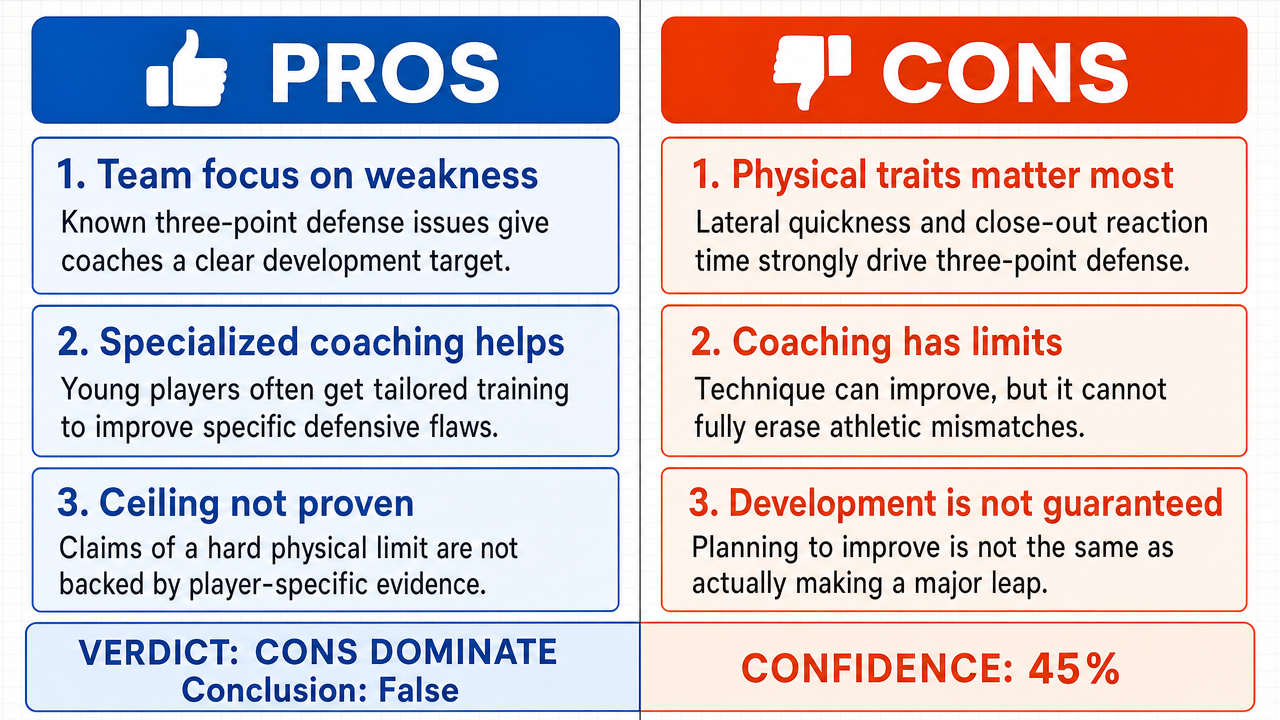
Verdict
Verdict: likely FALSE (45%)
This section provides a brief overview of the key arguments. You do not need to read the full detailed report below.
✅ Key PRO arguments:
- ■Player D's current defensive struggles against three-point shots are a known area for improvement, and his team has a vested interest in developing this aspect of his game, with specialized coaching and training resources available to address specific weaknesses.
- ■Young players, especially those with high draft capital , often receive specialized coaching and training to address specific weaknesses, and Player D is still early in his career with ample time to refine defensive technique such as closing out on shooters, navigating screens, and understanding opponent tendencies.
- ■The negative's argument imports a generic physiological ceiling into a specific player without Player-D-specific measurements on record, and NBA tracking data separates coachable execution from physiological ceiling, meaning the structural-limitation claim requires evidence specific to Player D.
❌ Key ANTI arguments:
- ■Defensive efficiency against three-point shots is heavily predicated on lateral quickness and close-out reaction time—neuromuscular attributes that reach a physiological plateau early in an athlete's career. While coaching can improve positioning, it cannot fundamentally alter deceleration mechanics or fast-twitch capabilities.
- ■Coaching can refine technical mechanics but cannot override the structural mismatch between a player's physiological capabilities and the league-wide escalation of offensive efficiency , and players often hit a 'defensive ceiling ' where their ability to navigate screens or close out on shooters is limited by basic neuromuscular attributes .
- ■The affirmative's reliance on 'specialized coaching' is often a circular argument that assumes development will occur simply because development is intended, ignoring the documented phenomenon of developmental stagnation in elite athletes.
💭 Conclusion: False. The negative side prevailed by establishing that three-point defense is heavily constrained by neuromuscular attributes such as lateral quickness and close-out reaction time, which reach physiological plateaus early in a career and cannot be fundamentally altered by coaching. The affirmative failed to provide Player-D-specific evidence to rebut this structural-limitation argument, instead relying on generic claims about coachability and team investment that the negative correctly identified as circular. The negative's arguments about developmental stagnation and the rising league-wide offensive efficiency bar further weakened the affirmative's case that 'significant improvement' is achievable by the 2026-2027 season. The moderate confidence reflects that the affirmative did raise a valid methodological point about evidentiary asymmetry , but the negative's physiological-ceiling framework was more substantively grounded. Overall, the debate did not produce sufficient evidence to support a confident prediction of significant three-point defensive improvement.
🔬 DeepResearch Result: likely FALSE ❌ (45%)
Assertion: Player D will significantly improve his defensive skills in stopping three-point shots by the end of the 2026-2027 season.
Participating models: deepseek-v3.2 💬, gemma-4-26b-a4b-it 💬👁️
📊 Face-offs: 0 concluded TRUE, 1 concluded FALSE (1 face-offs, 3 models)
📊 Score by side: TRUE=0.00, FALSE=0.45
🏅 Model score changes:
minimax-m3 💬👁️: +4
✅ PRO Arguments:
- ■Player D's current defensive struggles against three-point shots are a known area for improvement, and his team has a vested interest in developing this aspect of his game, with specialized coaching and training resources available to address specific weaknesses. deepseek-v3.2 💬
- ■Young players, especially those with high draft capital , often receive specialized coaching and training to address specific weaknesses, and Player D is still early in his career with ample time to refine defensive technique such as closing out on shooters, navigating screens, and understanding opponent tendencies. deepseek-v3.2 💬
- ■The negative's argument imports a generic physiological ceiling into a specific player without Player-D-specific measurements on record, and NBA tracking data separates coachable execution from physiological ceiling, meaning the structural-limitation claim requires evidence specific to Player D. deepseek-v3.2 💬
- ■The negative's proposition requires an unjustified transfer from general NBA development patterns to Player D himself, since terms like 'developmental stagnation ,' 'defensive ceiling ,' and 'coaching-to-efficiency gap ' are not tied to Player D's actual measurements. deepseek-v3.2 💬
❌ ANTI Arguments:
- ■Defensive efficiency against three-point shots is heavily predicated on lateral quickness and close-out reaction time—neuromuscular attributes that reach a physiological plateau early in an athlete's career. While coaching can improve positioning, it cannot fundamentally alter deceleration mechanics or fast-twitch capabilities. gemma-4-26b-a4b-it 💬👁️
- ■Coaching can refine technical mechanics but cannot override the structural mismatch between a player's physiological capabilities and the league-wide escalation of offensive efficiency , and players often hit a 'defensive ceiling' where their ability to navigate screens or close out on shooters is limited by basic neuromuscular attributes. gemma-4-26b-a4b-it 💬👁️
- ■The affirmative's reliance on 'specialized coaching' is often a circular argument that assumes development will occur simply because development is intended, ignoring the documented phenomenon of developmental stagnation in elite athletes. gemma-4-26b-a4b-it 💬👁️
- ■The increasing difficulty of defending against evolving offensive schemes and the rising league-wide three-point efficiency means that even if Player D improves marginally, the bar for 'significant improvement' is moving upward, making the claim harder to satisfy. gemma-4-26b-a4b-it 💬👁️
💭 Reasoning: False. The negative side prevailed by establishing that three-point defense is heavily constrained by neuromuscular attributes such as lateral quickness and close-out reaction time, which reach physiological plateaus early in a career and cannot be fundamentally altered by coaching. The affirmative failed to provide Player-D-specific evidence to rebut this structural-limitation argument, instead relying on generic claims about coachability and team investment that the negative correctly identified as circular. The negative's arguments about developmental stagnation and the rising league-wide offensive efficiency bar further weakened the affirmative's case that 'significant improvement' is achievable by the 2026-2027 season. The moderate confidence reflects that the affirmative did raise a valid methodological point about evidentiary asymmetry , but the negative's physiological-ceiling framework was more substantively grounded. Overall, the debate did not produce sufficient evidence to support a confident prediction of significant three-point defensive improvement.
📋 PRO Facts:
• Young players with high draft capital often receive specialized coaching and training resources to address specific weaknesses.
• NBA tracking data separates coachable execution from physiological ceiling in defensive performance metrics.
• Player D is early in his career, providing time to refine defensive technique such as closing out on shooters and navigating screens.
📋 ANTI Facts:
• Lateral quickness and close-out reaction time are neuromuscular attributes that reach a physiological plateau early in an athlete's career.
• Coaching can improve positioning but cannot fundamentally alter deceleration mechanics or fast-twitch muscle capabilities.
• Players often hit a 'defensive ceiling' where screen navigation and close-out ability are limited by basic neuromuscular attributes.
• League-wide offensive efficiency, including three-point shooting, has been escalating, raising the bar for defensive improvement.
| Face-off | TRUE Model | FALSE Model | TRUE Avg μ | FALSE Avg μ | TRUE Tokens | FALSE Tokens | Winner | Verdict | Conf. |
|---|---|---|---|---|---|---|---|---|---|
| #1 | deepseek-v3.2 💬 | gemma-4-26b-a4b-it 💬👁️ | 0.257 | 0.214 | 12 | 3 | TRUE | FALSE | 45% |
The following technical terms, abbreviations, and domain-specific concepts are referenced throughout this debate transcript. Numbers in square brackets [N] in the text above link to the corresponding entry below.
[1] 3P% — three-point percentage — The proportion of three-point shots successfully made, used in the transcript as 'opponent 3P%' to measure how often opposing shooters convert when defended by a given player.
[2] ceiling condition — A debate term used in the transcript to describe an argument that establishes only an upper bound (e.g., a physiological limit) without showing that the specific subject actually reaches that bound.
[3] close-out — A basketball defensive technique in which a defender rapidly closes the distance to a shooter to contest the shot; the transcript cites 'close-out reaction time' as a neuromuscular attribute that plateaus early in an athlete's career.
[4] closeout distance — A coachable execution variable in perimeter defense, referenced in the transcript as one of the NBA tracking metrics that can be separated from raw athleticism.
[5] coaching-to-efficiency gap — A concept introduced in the debate to describe the phenomenon that highly-coached players often fail to translate technical drills into measurable reductions in opponent three-point percentage.
[6] contest frequency — A defensive metric tracking how often a player contests an opponent's shot; cited in the transcript as a coachable execution variable distinct from raw athleticism.
[7] deceleration mechanics — The biomechanical processes by which an athlete slows down, cited in the transcript as a neuromuscular attribute that coaching cannot fundamentally alter.
[8] defensive ceiling — The upper limit of a player's defensive ability, which the transcript argues is constrained by baseline lateral quickness and cannot be fundamentally recreated through coaching.
[9] defensive efficiency — A measure of how effectively a player or team prevents opposing scoring; in the transcript it is specifically applied to defending three-point shots.
[10] developmental stagnation — A phenomenon cited in the debate in which elite athletes plateau in skill acquisition despite continued coaching and training.
[11] draft capital — The value or status associated with a player's draft position; the transcript notes that players with high draft capital often receive specialized coaching to address weaknesses.
[12] evidentiary asymmetry — A debate concept raised in the transcript to argue that the burden of producing Player-D-specific measurements falls more heavily on the side making a specific causal claim about that player.
[13] fast-twitch muscle fiber — A type of muscle fiber responsible for rapid, powerful contractions; cited in the transcript as a physiological attribute required to contest elite shooters that reaches an early plateau.
[14] hand activity — A coachable defensive execution variable involving the active use of hands to disrupt passes, shots, or vision; listed in the transcript alongside closeout distance and screen navigation.
[15] hidden premise — An unstated assumption underlying an argument; the transcript identifies the assumption that physical tools like wingspan and athleticism are 'highly coachable assets' as a hidden premise of the affirmative's case.
[16] lateral quickness — The ability to move quickly side-to-side, cited in the transcript as a neuromuscular attribute central to perimeter defense that coaching can optimize but not fundamentally recreate.
[17] neuromuscular attributes — Physical traits governed by the nervous and muscular systems, such as lateral quickness and close-out reaction time, which the transcript argues reach a physiological plateau early in an athlete's career.
[18] offensive efficiency — A measure of how effectively a team or player scores; the transcript cites the 'league-wide escalation of offensive efficiency' as a structural challenge for perimeter defenders.
[19] opponent 3P% — opponent three-point percentage — The three-point shooting percentage allowed to opponents when a specific player is the primary defender; cited in the transcript as a key NBA defensive tracking metric.
[20] perimeter defense — Defensive play around the three-point line, including closing out on shooters and navigating screens; the transcript frames it as an increasingly important NBA skill.
[21] physiological ceiling — The biological upper limit on an athlete's physical performance; the transcript argues this ceiling limits improvements in lateral quickness and deceleration mechanics.
[22] screen navigation — A defensive skill involving maneuvering around or through screens set by offensive players; cited in the transcript as a coachable execution variable.
[23] shot contests — Defensive actions in which a player challenges an opponent's shot attempt; tracked by NBA defensive metrics and cited in the transcript as a measurable variable.
[24] three-point shots — Field goal attempts taken from beyond the three-point arc; the central defensive focus of the debate, with the NBA's increasing emphasis on three-point shooting cited as a contextual driver.
[25] wingspan — The measured distance from fingertip to fingertip with arms extended horizontally; cited in the transcript as a physical tool relevant to perimeter defense.
The following financial data tables were referenced during the debate exchanges:
| Defensive Metric Category | Primary Constraint | Impact on 3P Defense |
|---|---|---|
| Neuromuscular | Lateral Quickness | High |
| Biomechanical | Deceleration/Close-out | High |
| Cognitive | Screen Navigation | Moderate |
| Technical | Hand Positioning | Low |
Legend: Categorization of physical and mental constraints affecting perimeter defensive efficiency.
Face-off transcripts
- ■
Ownership & Trade Secrets. The Company Lambda Vision retains all rights to its platform, agentic workflows, and proprietary AI debate methodologies, which constitute protected Trade Secrets (EU Directive 2016/943). Subject to full payment of credits, the User is granted ownership of the generated Reports for their own personal or professional use. Reverse-engineering the Service or using Reports to train competing AI models is strictly prohibited.
- ■
No Professional Advice. Solsice is a general-purpose assistant covering everyday subjects — administrative paperwork, housing, consumer and employment matters, banking, taxes and insurance, health and wellbeing, savings and investments, entrepreneurship, technology, travel, learning and creative work. Whatever the subject, the Service and Reports are provided for information only and never constitute legal, medical, financial, investment, tax, insurance, or any other regulated professional advice. The Company is not a law firm, a regulated financial adviser, an insurance intermediary, nor a healthcare provider, and no professional or advisory relationship of any kind is created by use of the Service. Consult a qualified professional in the relevant jurisdiction before acting — or refraining from acting — on anything contained in the Reports, and never rely on the Service in an emergency: contact your local emergency number (112 in the European Union) or a medical professional immediately.
- ■
AI-Generated Content, Sources and Viewpoints. Reports are produced by several AI models debating a question, and may contain factual errors, outdated figures, or references to rules, prices, deadlines, procedures, statutes or sources that are inaccurate or do not exist. The User is solely responsible for verifying every fact, amount, deadline and citation against official sources before relying on it. Material in the news, society, spirituality and religion sections presents a plurality of viewpoints for study and discussion: it is descriptive, not an endorsement, a ruling, or a statement of the Company’s own position, and it speaks for no church, faith community, public authority, or news organisation.
- ■
Liability & Governing Law. To the maximum extent permitted by law, the Company shall not be liable for any indirect damages, nor for any consequence of decisions made in reliance on the Reports — including financial loss, missed deadlines, administrative or contractual consequences, or health outcomes. These Terms are governed by French law. Any disputes shall be subject to the exclusive jurisdiction of the Courts of Paris, France.