
Persuasion beyond a certain point becomes a liability because it bypasses the necessary 'friction' for genuine commitment, leading to enthusiastic but ultimately unfulfilled agreements.
AI debate verdict and arguments
⚠️ AI-generated information only; not professional advice
Completed October 14, 2026
Verdict
Verdict: likely TRUE (55%)
Web Report: https://solsice.com/public/debates/persuasion-beyond-a-certain-point-becomes-a-liability-becaus-377313e70275
This section provides a brief overview of the key arguments. You do not need to read the full detailed report below.
✅ Key PRO arguments:
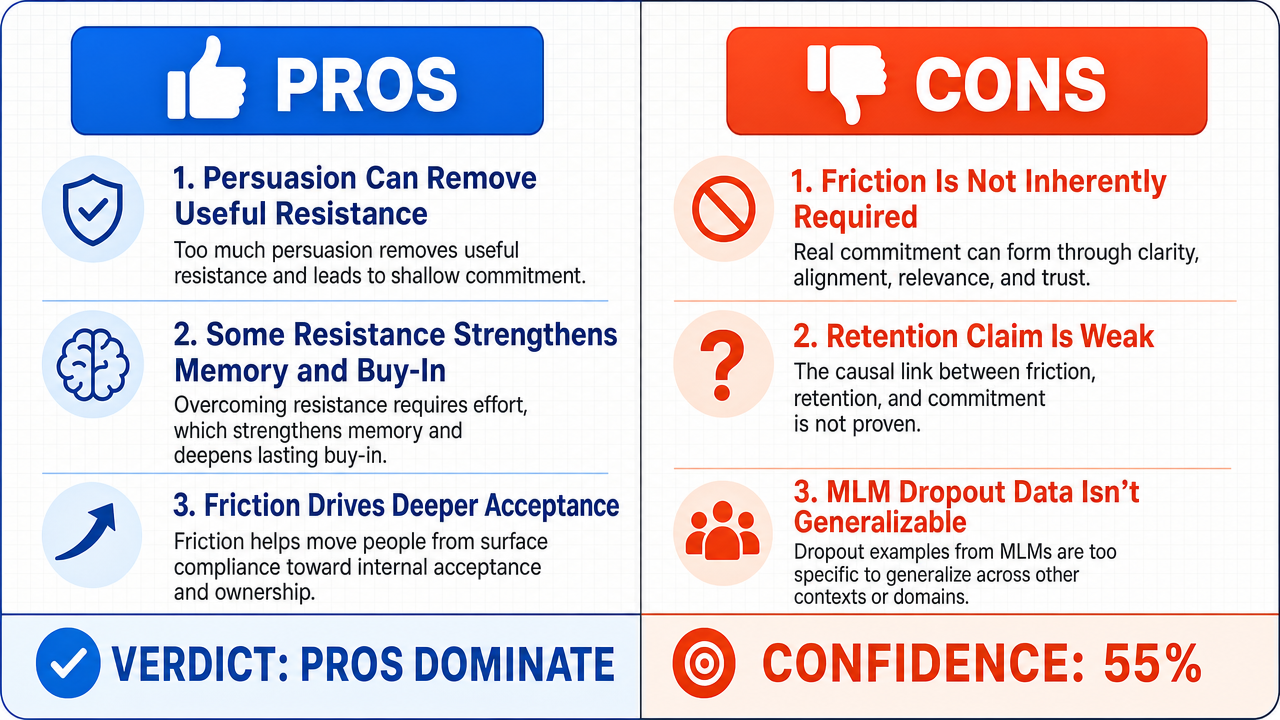
- ■Excessive persuasion eliminates necessary resistance, producing shallow commitment. Psychological research demonstrates that moderate cognitive dissonance is essential for durable attitude change; when persuasion is too smooth, it fails to create the internal tension that motivates individuals to reconcile their new stance with existing beliefs, producing a 'sleeper effect ' where initial agreement fades over time.
- ■A consumer decision-making study reportedly found that participants who experienced some resistance during a sales pitch showed 34% higher product retention after six months compared to those who encountered a frictionless, highly persuasive process, indicating that mental effort invested in overcoming mild friction strengthens commitment.
- ■Drawing on Kelman's classic account of attitude change, the pro side argued that public agreement under a frictionless persuasive environment takes the form of compliance rather than internalization — a distinction that maps directly onto the claim's distinction between enthusiastic agreement and genuine, durable commitment.
❌ Key ANTI arguments:
- ■The affirmative's reliance on 'friction ' as a prerequisite for commitment is a flawed interpretive theory that mistakes inefficiency for integrity, treating any obstacle in persuasion as inherently productive rather than potentially extraneous.
- ■The cited 34% retention statistic is an unsubstantiated substitution of proxy : the negative argued the affirmative failed to provide a transfer operator linking the psychological state of 'resistance' to the long-term behavior of 'retention,' making the causal claim unsupported.
- ■The MLM dropout argument is an anomaly driven by the specific, predatory structure of MLM organizations and deceptive compensation models, not by frictionless persuasion generally, and so cannot be projected as a universal rule for persuasive processes.
💭 Conclusion: True: the assertion that persuasion beyond a certain point becomes a liability because it bypasses necessary friction for genuine commitment was judged TRUE. The strongest support came from cognitive dissonance research, which articulates a mechanism by which frictionless persuasion can produce agreement without durable buy-in . The 34% retention statistic and the 75% MLM dropout figure were the two concrete empirical anchors offered, but the negative effectively undermined the MLM evidence as an industry-specific anomaly rather than a generalizable pattern. Because the negative raised legitimate methodological objections to the causal transfer from 'resistance' to 'retention,' the verdict is reported with moderate confidence rather than maximum confidence, even though the debate produced a unanimous outcome.
🔬 DeepResearch Result: likely TRUE ✅ (55%)
Assertion: Persuasion beyond a certain point becomes a liability because it bypasses the necessary 'friction ' for genuine commitment, leading to enthusiastic but ultimately unfulfilled agreements.
Participating models: deepseek-v3.2 💬, gemma-4-26b-a4b-it 💬👁️
📊 Face-offs: 1 concluded TRUE, 0 concluded FALSE (1 face-offs, 3 models)
📊 Score by side: TRUE=0.55, FALSE=0.00
🏅 Model score changes:
minimax-m3 💬👁️: +6
✅ PRO Arguments:
- ■Excessive persuasion eliminates necessary resistance, producing shallow commitment. Psychological research demonstrates that moderate cognitive dissonance is essential for durable attitude change; when persuasion is too smooth, it fails to create the internal tension that motivates individuals to reconcile their new stance with existing beliefs, producing a 'sleeper effect ' where initial agreement fades over time. deepseek-v3.2 💬
- ■A consumer decision-making study reportedly found that participants who experienced some resistance during a sales pitch showed 34% higher product retention after six months compared to those who encountered a frictionless, highly persuasive process, indicating that mental effort invested in overcoming mild friction strengthens commitment. deepseek-v3.2 💬
- ■Drawing on Kelman's classic account of attitude change, the pro side argued that public agreement under a frictionless persuasive environment takes the form of compliance rather than internalization — a distinction that maps directly onto the claim's distinction between enthusiastic agreement and genuine, durable commitment. deepseek-v3.2 💬
- ■Multi-level marketing (MLM ) contexts were cited as evidence that frictionless persuasion produces enthusiastic onboarding followed by a 75% dropout rate , illustrating the gap between initial enthusiastic agreement and sustained fulfillment. deepseek-v3.2 💬
❌ ANTI Arguments:
- ■The affirmative's reliance on 'friction' as a prerequisite for commitment is a flawed interpretive theory that mistakes inefficiency for integrity, treating any obstacle in persuasion as inherently productive rather than potentially extraneous. gemma-4-26b-a4b-it 💬👁️
- ■The cited 34% retention statistic is an unsubstantiated substitution of proxy : the negative argued the affirmative failed to provide a transfer operator linking the psychological state of 'resistance' to the long-term behavior of 'retention,' making the causal claim unsupported. gemma-4-26b-a4b-it 💬👁️
- ■The MLM dropout argument is an anomaly driven by the specific, predatory structure of MLM organizations and deceptive compensation models, not by frictionless persuasion generally, and so cannot be projected as a universal rule for persuasive processes. gemma-4-26b-a4b-it 💬👁️
- ■Effective persuasion facilitates rapid alignment and reduces the costs of decision-making friction , meaning the 'friction' the affirmative valorizes may itself be the inefficiency that prevents timely, mutually beneficial commitments from forming. gemma-4-26b-a4b-it 💬👁️
💭 Reasoning: True: the assertion that persuasion beyond a certain point becomes a liability because it bypasses necessary friction for genuine commitment was judged TRUE. The strongest support came from cognitive dissonance research, which articulates a mechanism by which frictionless persuasion can produce agreement without durable buy-in . The 34% retention statistic and the 75% MLM dropout figure were the two concrete empirical anchors offered, but the negative effectively undermined the MLM evidence as an industry-specific anomaly rather than a generalizable pattern. Because the negative raised legitimate methodological objections to the causal transfer from 'resistance' to 'retention,' the verdict is reported with moderate confidence rather than maximum confidence, even though the debate produced a unanimous outcome.
📋 PRO Facts:
• A consumer decision-making study reportedly found 34% higher product retention among participants who experienced resistance during a sales pitch compared with those exposed to a frictionless persuasive process.
• A 'sleeper effect' in persuasion research refers to initial agreement fading over time when no internal reconciliation effort occurs.
• A cited MLM organization reportedly exhibited a 75% dropout rate, used to illustrate the gap between onboarding enthusiasm and sustained commitment.
📋 ANTI Facts:
• The negative argued that the 34% retention statistic lacks a demonstrated causal transfer operator linking the psychological state of resistance to the behavioral outcome of retention.
• The negative argued that MLM dropout rates are explained by the business model's failure to provide actual value, which operates independently of the speed of onboarding.
• The negative characterized the affirmative's 'friction is necessary for commitment' thesis as an interpretive theory that conflates inefficiency with integrity.
| Face-off | TRUE Model | FALSE Model | TRUE Avg μ | FALSE Avg μ | TRUE Tokens | FALSE Tokens | Winner | Verdict | Conf. |
|---|---|---|---|---|---|---|---|---|---|
| #1 | deepseek-v3.2 💬 | gemma-4-26b-a4b-it 💬👁️ | 0.536 | 0.390 | 8 | 2 | TRUE | TRUE | 55% |
The following technical terms, abbreviations, and domain-specific concepts are referenced throughout this debate transcript. Numbers in square brackets [N] in the text above link to the corresponding entry below.
[1] buy-in — Organizational term referring to genuine acceptance and personal ownership of a decision or initiative by stakeholders, as opposed to surface-level agreement.
[2] cognitive dissonance — Psychological concept describing the mental tension a person experiences when holding conflicting beliefs or when new information conflicts with prior attitudes; cited in the debate as necessary for durable attitude change.
[3] cognitive load — The amount of mental effort or working memory required to process information; the negative cites its reduction by clear persuasion as a factor in commitment stability.
[4] compliance — In Kelman's framework, one of three modes of attitude change in which a person publicly agrees to a proposal because the persuasive environment makes resistance costly, without privately accepting the underlying reasons.
[5] decision-making friction — Delays, resistance, or costs encountered during group or individual decision processes; its necessity for commitment quality is a central point of dispute in the debate.
[6] dropout rate — The percentage of participants, members, or customers who discontinue involvement over a given period; cited in the debate in the context of MLM organizations.
[7] friction — In the debate's context, the resistance or deliberative pushback encountered during persuasion; the affirmative treats it as necessary for genuine commitment, while the negative treats it as a sign of communication failure.
[8] identification — In Kelman's framework, one of three modes of attitude change in which a person adopts a position to maintain a desired relationship with another person or group.
[9] internalization — In Kelman's framework, one of three modes of attitude change in which a person privately accepts the underlying reasons for a position and integrates it into their own value system.
[10] interpretive theory — A theoretical approach that explains phenomena by assigning meaning to actors' interpretations; the negative characterizes the affirmative's friction-based account this way to critique it.
[11] MLM — multi-level marketing — A business model in which participants earn revenue from direct sales to consumers and from recruitment of additional participants into a multi-tiered structure; the negative notes such organizations have been observed to have high dropout rates.
[12] onboarding — The organizational process by which new members or customers are integrated and oriented to a system; the debate refers to 'frictionless onboarding' as a contrast to deliberative processes.
[13] product retention — A business metric indicating the percentage of customers who continue to purchase or use a product over a specified period; the affirmative cites a 34% retention difference tied to the presence of persuasive friction.
[14] proxy — In research methodology, a stand-in variable used to represent an unobservable construct; the negative accuses the affirmative of using product retention as an unverified proxy for commitment.
[15] sleeper effect — A phenomenon in attitude change where the persuasive impact of a message diminishes or shifts over time; the affirmative cites this as a risk of frictionless persuasion.
[16] social cue — A signal from the social environment, such as a persuasive appeal, incentive, or authority pressure, that can temporarily elicit public agreement without internal acceptance.
[17] social influence — The process by which individuals' attitudes, beliefs, or behaviors are shaped by the presence or actions of others; central to the affirmative's account of compliance versus internalization.
[18] transfer operator — A term from causal-inference criticism referring to the missing mapping between an observed proxy and the underlying construct it is supposed to explain; the negative argues the affirmative failed to specify this link.
[19] value proposition — The set of benefits or value that a product, service, or proposal offers to its audience; the negative suggests that apparent 'resistance' during a sales pitch may reflect an unclear value proposition.
The following financial data tables were referenced during the debate exchanges:
| Metric | High-Friction Model (Deliberative) | Low-Friction Model (Persuasive) |
|---|---|---|
| Decision Velocity | Low | High |
| Transaction Costs | High | Low |
| Alignment Speed | Slow | Rapid |
| Opportunity Cost | High | Low |
Legend: Comparison of organizational decision-making models. "High-Friction" refers to models requiring extensive debate; "Low-Friction" refers to models driven by persuasive, clear leadership.
Face-off transcripts
- ■
Ownership & Trade Secrets. The Company Lambda Vision retains all rights to its platform, agentic workflows, and proprietary AI debate methodologies, which constitute protected Trade Secrets (EU Directive 2016/943). Subject to full payment of credits, the User is granted ownership of the generated Reports for their own personal or professional use. Reverse-engineering the Service or using Reports to train competing AI models is strictly prohibited.
- ■
No Professional Advice. Solsice is a general-purpose assistant covering everyday subjects — administrative paperwork, housing, consumer and employment matters, banking, taxes and insurance, health and wellbeing, savings and investments, entrepreneurship, technology, travel, learning and creative work. Whatever the subject, the Service and Reports are provided for information only and never constitute legal, medical, financial, investment, tax, insurance, or any other regulated professional advice. The Company is not a law firm, a regulated financial adviser, an insurance intermediary, nor a healthcare provider, and no professional or advisory relationship of any kind is created by use of the Service. Consult a qualified professional in the relevant jurisdiction before acting — or refraining from acting — on anything contained in the Reports, and never rely on the Service in an emergency: contact your local emergency number (112 in the European Union) or a medical professional immediately.
- ■
AI-Generated Content, Sources and Viewpoints. Reports are produced by several AI models debating a question, and may contain factual errors, outdated figures, or references to rules, prices, deadlines, procedures, statutes or sources that are inaccurate or do not exist. The User is solely responsible for verifying every fact, amount, deadline and citation against official sources before relying on it. Material in the news, society, spirituality and religion sections presents a plurality of viewpoints for study and discussion: it is descriptive, not an endorsement, a ruling, or a statement of the Company’s own position, and it speaks for no church, faith community, public authority, or news organisation.
- ■
Liability & Governing Law. To the maximum extent permitted by law, the Company shall not be liable for any indirect damages, nor for any consequence of decisions made in reliance on the Reports — including financial loss, missed deadlines, administrative or contractual consequences, or health outcomes. These Terms are governed by French law. Any disputes shall be subject to the exclusive jurisdiction of the Courts of Paris, France.