
Perplexity Comet transforms the browser into a vulnerability due to its susceptibility to 'Cometjacking' attacks via prompt injection, a risk absent in traditional browsers.
AI debate verdict and arguments
⚠️ AI-generated information only; not professional advice
Completed October 11, 2026
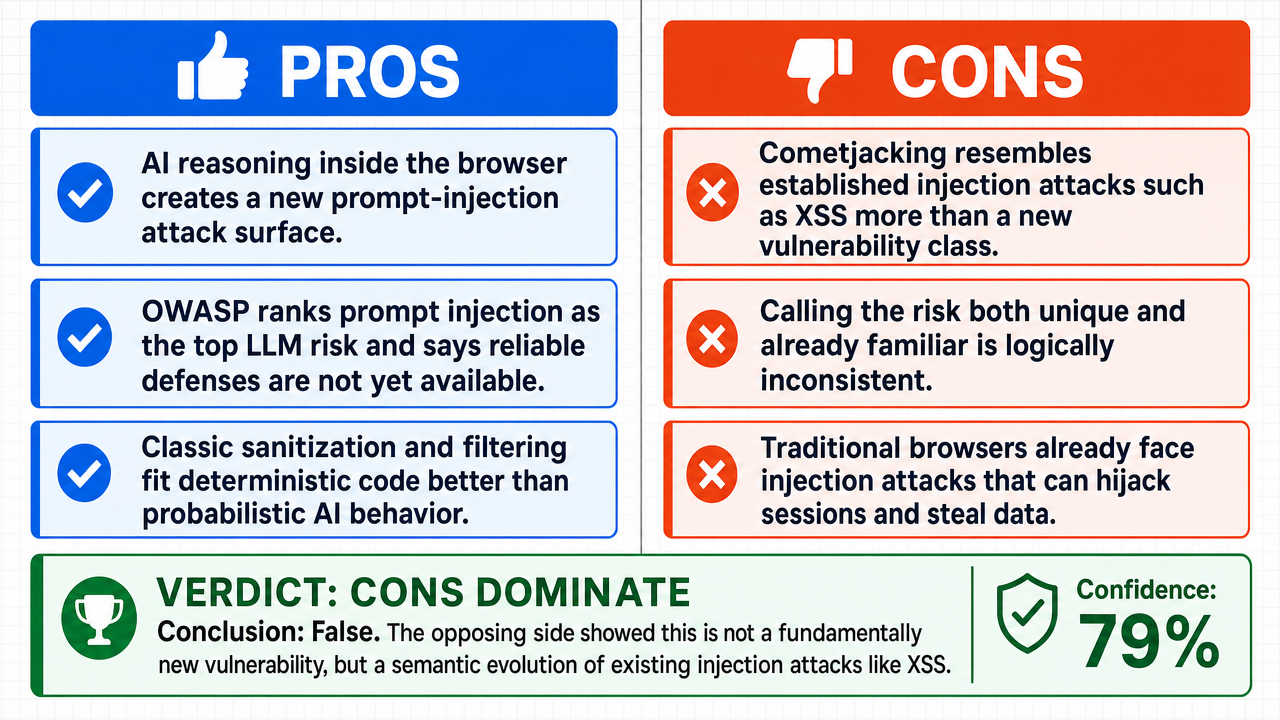
Verdict
Verdict: likely FALSE (79%)
This section provides a brief overview of the key arguments. You do not need to read the full detailed report below.
✅ Key PRO arguments:
- ■Perplexity Comet integrates a natural language AI reasoning engine directly into the browser, creating a novel attack surface for prompt injection —a manipulation of semantic understanding that is structurally impossible for a traditional, deterministic browser that merely interprets code.
- ■The OWASP Top 10 for Large Language Model Applications lists prompt injection as the number one risk and acknowledges there is 'no reliable defense yet,' providing definitive evidence that Comet faces a qualitatively distinct threat.
- ■Defenses like input sanitization and output filtering are designed for predictable code syntax, but are structurally incompatible with probabilistic AI behavior, meaning traditional browser security models cannot adequately address Comet's vulnerabilities.
❌ Key ANTI arguments:
- ■'Cometjacking ' is not a novel phenomenon but a semantic evolution of established injection attacks such as Cross-Site Scripting (XSS); the underlying mechanism—the manipulation of an interpreter to perform unauthorized actions—is the exact definition of injection-based exploitation that already exists in traditional browsers.
- ■The TRUE position is logically incoherent, simultaneously maintaining that Comet introduces a unique, unmitigated attack surface while also claiming this risk does not exceed traditional browser risks—if Cometjacking were truly structurally impossible in conventional browsers, its risk profile would necessarily exceed theirs.
- ■Traditional browsers are already subject to XSS and various forms of injection attacks that allow malicious scripts to hijack user sessions, steal cookies , and exfiltrate data , meaning the risk of data exfiltration via injection is not absent in traditional browsers.
💭 Conclusion: False. The FALSE side prevailed because it successfully demonstrated that 'Cometjacking ' is not a fundamentally novel vulnerability class but rather a semantic evolution of pre-existing injection-based attacks like Cross-Site Scripting (XSS), which have long threatened traditional browsers. The FALSE side exposed a critical logical contradiction in the TRUE position, which simultaneously claimed Cometjacking is structurally unique to AI browsers while also arguing its risk does not exceed traditional browser risks—two claims that cannot coexist coherently. The evidence shows that the underlying mechanism of injection attacks —manipulating an interpreter to perform unauthorized actions—already exists in conventional browsers through XSS and similar exploits, undermining the assertion that this risk is 'absent' in traditional browsers. The distinction between mitigation difficulty and the existence of a new vulnerability class further weakened the TRUE side's argument, as difficulty patching does not equate to a qualitatively new threat category. While the TRUE side correctly noted that prompt injection poses serious challenges, it failed to establish that this constitutes a risk entirely absent from the traditional browser threat landscape.
🔬 DeepResearch Result: likely FALSE ❌ (79%)
Assertion: Perplexity Comet transforms the browser into a vulnerability due to its susceptibility to 'Cometjacking ' attacks via prompt injection , a risk absent in traditional browsers.
Participating models: deepseek-v3.2 💬, gemma-4-26b-a4b-it 💬👁️
📊 Face-offs: 0 concluded TRUE, 1 concluded FALSE (1 face-offs, 3 models)
📊 Score by side: TRUE=0.00, FALSE=0.79
🏅 Model score changes:
minimax-m3 💬👁️: +8
✅ PRO Arguments:
- ■Perplexity Comet integrates a natural language AI reasoning engine directly into the browser, creating a novel attack surface for prompt injection—a manipulation of semantic understanding that is structurally impossible for a traditional, deterministic browser that merely interprets code. deepseek-v3.2 💬
- ■The OWASP Top 10 for Large Language Model Applications lists prompt injection as the number one risk and acknowledges there is 'no reliable defense yet,' providing definitive evidence that Comet faces a qualitatively distinct threat. deepseek-v3.2 💬
- ■Defenses like input sanitization and output filtering are designed for predictable code syntax, but are structurally incompatible with probabilistic AI behavior , meaning traditional browser security models cannot adequately address Comet's vulnerabilities. deepseek-v3.2 💬
- ■Attackers can craft prompts that manipulate the AI to extract sensitive user data from the current browsing session or redirect users to malicious sites, effectively transforming the browser into an accomplice in the attack. deepseek-v3.2 💬
❌ ANTI Arguments:
- ■'Cometjacking' is not a novel phenomenon but a semantic evolution of established injection attacks such as Cross-Site Scripting (XSS); the underlying mechanism—the manipulation of an interpreter to perform unauthorized actions—is the exact definition of injection-based exploitation that already exists in traditional browsers. gemma-4-26b-a4b-it 💬👁️
- ■The TRUE position is logically incoherent, simultaneously maintaining that Comet introduces a unique, unmitigated attack surface while also claiming this risk does not exceed traditional browser risks—if Cometjacking were truly structurally impossible in conventional browsers, its risk profile would necessarily exceed theirs. gemma-4-26b-a4b-it 💬👁️
- ■Traditional browsers are already subject to XSS and various forms of injection attacks that allow malicious scripts to hijack user sessions, steal cookies , and exfiltrate data , meaning the risk of data exfiltration via injection is not absent in traditional browsers. gemma-4-26b-a4b-it 💬👁️
- ■There is a critical distinction between mitigation difficulty and the existence of a new vulnerability class ; the difficulty of patching a flaw is a quantitative difference, not a qualitative distinction that fundamentally alters the risk profile. gemma-4-26b-a4b-it 💬👁️
- ■AI-integrated browsers are adopting layered defenses akin to Content Security Policy (CSP), demonstrating that existing browser security models can be extended to address AI-related threats without requiring an entirely new vulnerability classification. gemma-4-26b-a4b-it 💬👁️
💭 Reasoning: False. The FALSE side prevailed because it successfully demonstrated that 'Cometjacking' is not a fundamentally novel vulnerability class but rather a semantic evolution of pre-existing injection-based attacks like Cross-Site Scripting (XSS), which have long threatened traditional browsers. The FALSE side exposed a critical logical contradiction in the TRUE position, which simultaneously claimed Cometjacking is structurally unique to AI browsers while also arguing its risk does not exceed traditional browser risks—two claims that cannot coexist coherently. The evidence shows that the underlying mechanism of injection attacks—manipulating an interpreter to perform unauthorized actions—already exists in conventional browsers through XSS and similar exploits, undermining the assertion that this risk is 'absent' in traditional browsers. The distinction between mitigation difficulty and the existence of a new vulnerability class further weakened the TRUE side's argument, as difficulty patching does not equate to a qualitatively new threat category. While the TRUE side correctly noted that prompt injection poses serious challenges, it failed to establish that this constitutes a risk entirely absent from the traditional browser threat landscape.
📋 PRO Facts:
• OWASP Top 10 for Large Language Model Applications lists prompt injection as the number one risk
• OWASP acknowledges there is 'no reliable defense yet' against prompt injection
• Perplexity Comet integrates a natural language AI reasoning engine directly into the browser
📋 ANTI Facts:
• Cross-Site Scripting (XSS) is a pre-existing injection attack in traditional browsers that allows malicious scripts to hijack sessions, steal cookies, and exfiltrate data
• The underlying mechanism of injection attacks—manipulation of an interpreter to perform unauthorized actions—is the same across XSS and prompt injection
• AI-integrated browsers are adopting layered defenses similar to Content Security Policy (CSP)
| Face-off | TRUE Model | FALSE Model | TRUE Avg μ | FALSE Avg μ | TRUE Tokens | FALSE Tokens | Winner | Verdict | Conf. |
|---|---|---|---|---|---|---|---|---|---|
| #1 | deepseek-v3.2 💬 | gemma-4-26b-a4b-it 💬👁️ | 0.259 | 0.297 | 12 | 3 | FALSE | FALSE | 79% |
The following technical terms, abbreviations, and domain-specific concepts are referenced throughout this debate transcript. Numbers in square brackets [N] in the text above link to the corresponding entry below.
[1] AI — Artificial Intelligence — Computer systems designed to perform tasks that typically require human intelligence, such as reasoning, learning, and understanding natural language.
[2] AI integration — Artificial Intelligence integration — The embedding of AI capabilities directly into a software product, such as incorporating an AI reasoning engine into a web browser.
[3] AI reasoning engine — Artificial Intelligence reasoning engine — A component of an AI system that processes inputs (such as natural language prompts) and produces outputs by interpreting meaning and context, as opposed to executing deterministic code.
[4] attack surface — The sum of all points where an unauthorized user can attempt to enter or extract data from a system; a larger or novel attack surface indicates more potential vulnerabilities.
[5] attack vector — The path or method by which an attacker gains access to a system or delivers a malicious payload.
[6] browsing session — The period during which a user interacts with a browser, including associated state such as open tabs, cookies, and page content.
[7] Cometjacking — A term used in the debate to describe an attack that exploits Perplexity Comet's AI layer via prompt injection to manipulate the browser into performing unintended actions, such as extracting sensitive data or redirecting users.
[8] Content Security Policy (CSP) — Content Security Policy — A browser security mechanism that restricts which resources a web page can load or execute, used as a layered defense against injection attacks.
[9] contextual awareness — An AI capability to understand and incorporate surrounding information—such as browsing history and current page content—when interpreting user prompts.
[10] cookies — Small pieces of data stored by a browser on behalf of websites, often used for session management and authentication, and frequently targeted in injection-based attacks.
[11] Cross-Site Scripting (XSS) — Cross-Site Scripting — A web vulnerability in which malicious scripts are injected into trusted web pages, allowing attackers to hijack sessions, steal cookies, and exfiltrate data.
[12] deterministic security models — Security frameworks built on predictable, rule-based logic (e.g., code parsing and syntax checks), as opposed to systems whose behavior is probabilistic.
[13] exfiltrate data — The unauthorized transfer of data from a system to an attacker, often the goal of injection-based exploits.
[14] injection attacks — A class of exploits in which untrusted input is supplied to an interpreter, causing it to execute unintended commands or actions.
[15] input sanitization — A security technique that cleans or filters untrusted input to remove or neutralize potentially malicious content before it is processed.
[16] interpreter — A component that parses and executes instructions—such as code or natural language prompts—provided as input; injection attacks target the interpreter's parsing logic.
[17] Large Language Model (LLM) — Large Language Model — An AI model trained on large text corpora that generates and interprets natural language, forming the basis of systems like Perplexity Comet.
[18] layered defenses — A security strategy employing multiple overlapping protective measures (e.g., CSP, input sanitization, output filtering) to mitigate different attack vectors.
[19] malicious code execution — The running of unauthorized or harmful code on a target system, a common risk in traditional browser threat models.
[20] natural language prompts — Inputs to an AI system expressed in human language rather than formal code, which the AI interprets semantically.
[21] natural language reasoning — The process by which an AI interprets meaning, context, and intent from human-language inputs, as opposed to executing deterministic code.
[22] output filtering — A security technique that inspects and restricts the content produced by a system before it is delivered to a user or another component.
[23] OWASP Top 10 for Large Language Model Applications — A security awareness document published by the Open Worldwide Application Security Project that lists the most critical vulnerabilities in LLM-based systems, with prompt injection cited as the primary risk.
[24] phishing — A social engineering attack in which a user is deceived into revealing credentials or performing actions on a fraudulent or malicious site.
[25] probabilistic AI behavior — The non-deterministic nature of AI outputs, which depend on statistical inference rather than fixed rules, making rule-based filtering difficult to apply reliably.
[26] prompt injection — An attack technique in which crafted inputs manipulate an AI system into ignoring prior instructions or performing unintended actions, exploiting the AI's interpretive layer.
[27] risk profile — The overall set and severity of security risks associated with a system, used to compare the threat exposure of different architectures.
[28] rule-based filtering — Security controls that apply predefined patterns or rules to detect and block malicious input or output, effective against predictable code syntax but less reliable against semantic ambiguity.
[29] security boundaries — Logical perimeters that separate trusted from untrusted components or contexts, which injection attacks attempt to bypass.
[30] semantic ambiguity — The presence of multiple possible meanings in natural language, which prompt injection exploits to cause an AI to interpret instructions in unintended ways.
[31] semantic understanding — An AI's ability to interpret the meaning of inputs rather than merely matching syntax, which is the target of prompt injection attacks.
[32] session hijacking — An attack in which an adversary takes over a user's active browsing session, often by stealing session cookies or tokens.
[33] vulnerability class — A category of security flaws sharing a common underlying mechanism or principle, used to classify and reason about new threats.
[34] web architecture — The structural design of web systems, including browsers, servers, and protocols, within which injection-based threats have existed for decades.
Face-off transcripts
- ■
Ownership & Trade Secrets. The Company Lambda Vision retains all rights to its platform, agentic workflows, and proprietary AI debate methodologies, which constitute protected Trade Secrets (EU Directive 2016/943). Subject to full payment of credits, the User is granted ownership of the generated Reports for their own personal or professional use. Reverse-engineering the Service or using Reports to train competing AI models is strictly prohibited.
- ■
No Professional Advice. Solsice is a general-purpose assistant covering everyday subjects — administrative paperwork, housing, consumer and employment matters, banking, taxes and insurance, health and wellbeing, savings and investments, entrepreneurship, technology, travel, learning and creative work. Whatever the subject, the Service and Reports are provided for information only and never constitute legal, medical, financial, investment, tax, insurance, or any other regulated professional advice. The Company is not a law firm, a regulated financial adviser, an insurance intermediary, nor a healthcare provider, and no professional or advisory relationship of any kind is created by use of the Service. Consult a qualified professional in the relevant jurisdiction before acting — or refraining from acting — on anything contained in the Reports, and never rely on the Service in an emergency: contact your local emergency number (112 in the European Union) or a medical professional immediately.
- ■
AI-Generated Content, Sources and Viewpoints. Reports are produced by several AI models debating a question, and may contain factual errors, outdated figures, or references to rules, prices, deadlines, procedures, statutes or sources that are inaccurate or do not exist. The User is solely responsible for verifying every fact, amount, deadline and citation against official sources before relying on it. Material in the news, society, spirituality and religion sections presents a plurality of viewpoints for study and discussion: it is descriptive, not an endorsement, a ruling, or a statement of the Company’s own position, and it speaks for no church, faith community, public authority, or news organisation.
- ■
Liability & Governing Law. To the maximum extent permitted by law, the Company shall not be liable for any indirect damages, nor for any consequence of decisions made in reliance on the Reports — including financial loss, missed deadlines, administrative or contractual consequences, or health outcomes. These Terms are governed by French law. Any disputes shall be subject to the exclusive jurisdiction of the Courts of Paris, France.