
Perplexity Comet's AI-driven analysis of user data poses a greater privacy risk than traditional browser data collection.
AI debate verdict and arguments
⚠️ AI-generated information only; not professional advice
Completed October 11, 2026
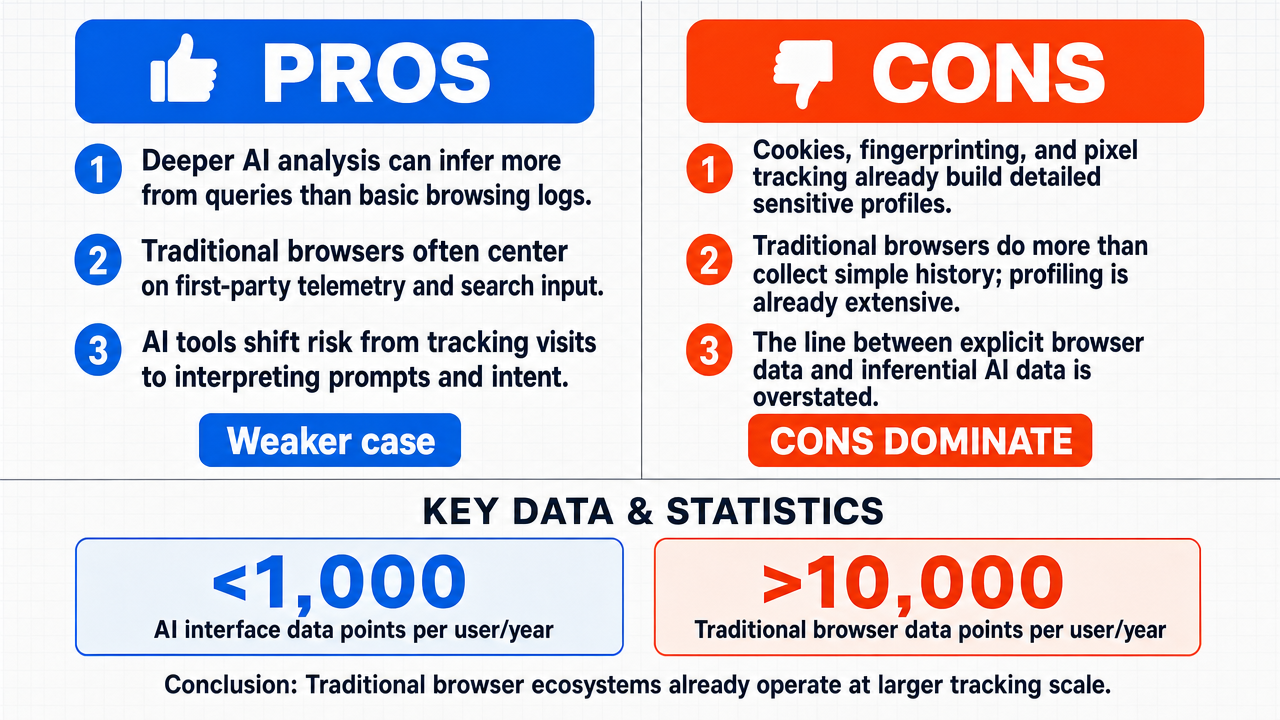
Verdict
Verdict: likely FALSE (77%)
This section provides a brief overview of the key arguments. You do not need to read the full detailed report below.
✅ Key PRO arguments:
- ■Perplexity Comet's AI-driven analysis involves deeper, more inferential data processing than traditional browsers, which primarily collect explicit browsing history , search queries , and cookie data . AI models can infer complex user profiles including sensitive personal attributes such as health conditions and political leanings from seemingly innocuous data points, amplifying privacy risks in ways that are less transparent to users.
- ■Traditional browser vendors' own collection practices are principally first-party telemetry , crash reports , and user-initiated search or address-bar interactions — fundamentally different in scope and nature from AI-driven inferential analysis that interprets what users say, ask, and repeatedly reveal.
- ■Comet's AI-driven analysis changes the nature of privacy risk from merely recording what a user visits to actively interpreting what a user says, asks, and reveals, representing a qualitative shift in the type of privacy exposure users face.
❌ Key ANTI arguments:
- ■Traditional browser data collection through cross-site cookies , fingerprinting , and pixel tracking already constructs precise profiles of sensitive attributes such as health and politics with extreme precision. The claim that AI uniquely enables such profiling ignores that the existing web ecosystem already performs this function.
- ■The affirmative's position contains a logical contradiction: it asserts traditional browsers 'mainly collect explicit browsing history and cookies' while simultaneously claiming AI is uniquely capable of deriving complex profiles — but the very mechanisms of the web (cookies, fingerprinting , pixel tracking ) already enable this profiling , making the two regimes not mutually exclusive categories.
- ■The distinction between 'explicit' browser data and 'inferential' AI data is a false dichotomy. Traditional browsing environments, through cookies, fingerprinting , and real-time bidding , already facilitate the construction of complex user profiles that reveal sensitive attributes , meaning AI-driven analysis is a continuation rather than a novel escalation of privacy risk .
💭 Conclusion: False. The FALSE side prevailed because it successfully demonstrated that traditional browser ecosystems already perform extensive inferential profiling through cross-site cookies , fingerprinting , and real-time bidding systems, undermining the claim that AI-driven analysis represents a categorically novel privacy risk . The PRO side's argument contained an internal contradiction by characterizing traditional browsers as primarily collecting 'explicit' data while simultaneously acknowledging that the web's existing mechanisms already derive sensitive user profiles . The judge found that the distinction between 'explicit' browser data collection and 'inferential' AI analysis is a false dichotomy, since both regimes ultimately produce comparable sensitive inferences about users. Furthermore, the FALSE side effectively reframed the debate to show that the specialized AI interface's analysis is a continuation of pervasive tracking rather than a qualitative leap in privacy exposure. The confidence level reflects strong but not overwhelming agreement, as the PRO side did raise legitimate points about the inferential depth of AI processing.
🔬 DeepResearch Result: likely FALSE ❌ (77%)
Assertion: Perplexity Comet's AI-driven analysis of user data poses a greater privacy risk than traditional browser data collection .
Participating models: deepseek-v3.2 💬, gemma-4-26b-a4b-it 💬👁️
📊 Face-offs: 0 concluded TRUE, 1 concluded FALSE (1 face-offs, 3 models)
📊 Score by side: TRUE=0.00, FALSE=0.77
🏅 Model score changes:
minimax-m3 💬👁️: +8
✅ PRO Arguments:
- ■Perplexity Comet's AI-driven analysis involves deeper, more inferential data processing than traditional browsers, which primarily collect explicit browsing history , search queries , and cookie data . AI models can infer complex user profiles including sensitive personal attributes such as health conditions and political leanings from seemingly innocuous data points, amplifying privacy risks in ways that are less transparent to users. deepseek-v3.2 💬
- ■Traditional browser vendors' own collection practices are principally first-party telemetry , crash reports , and user-initiated search or address-bar interactions — fundamentally different in scope and nature from AI-driven inferential analysis that interprets what users say, ask, and repeatedly reveal. deepseek-v3.2 💬
- ■Comet's AI-driven analysis changes the nature of privacy risk from merely recording what a user visits to actively interpreting what a user says, asks, and reveals, representing a qualitative shift in the type of privacy exposure users face. deepseek-v3.2 💬
❌ ANTI Arguments:
- ■Traditional browser data collection through cross-site cookies , fingerprinting , and pixel tracking already constructs precise profiles of sensitive attributes such as health and politics with extreme precision. The claim that AI uniquely enables such profiling ignores that the existing web ecosystem already performs this function. gemma-4-26b-a4b-it 💬👁️
- ■The affirmative's position contains a logical contradiction: it asserts traditional browsers 'mainly collect explicit browsing history and cookies' while simultaneously claiming AI is uniquely capable of deriving complex profiles — but the very mechanisms of the web (cookies, fingerprinting, pixel tracking) already enable this profiling, making the two regimes not mutually exclusive categories. gemma-4-26b-a4b-it 💬👁️
- ■The distinction between 'explicit' browser data and 'inferential' AI data is a false dichotomy. Traditional browsing environments, through cookies, fingerprinting, and real-time bidding , already facilitate the construction of complex user profiles that reveal sensitive attributes, meaning AI-driven analysis is a continuation rather than a novel escalation of privacy risk. gemma-4-26b-a4b-it 💬👁️
💭 Reasoning: False. The FALSE side prevailed because it successfully demonstrated that traditional browser ecosystems already perform extensive inferential profiling through cross-site cookies, fingerprinting, and real-time bidding systems, undermining the claim that AI-driven analysis represents a categorically novel privacy risk. The PRO side's argument contained an internal contradiction by characterizing traditional browsers as primarily collecting 'explicit' data while simultaneously acknowledging that the web's existing mechanisms already derive sensitive user profiles. The judge found that the distinction between 'explicit' browser data collection and 'inferential' AI analysis is a false dichotomy, since both regimes ultimately produce comparable sensitive inferences about users. Furthermore, the FALSE side effectively reframed the debate to show that the specialized AI interface's analysis is a continuation of pervasive tracking rather than a qualitative leap in privacy exposure. The confidence level reflects strong but not overwhelming agreement, as the PRO side did raise legitimate points about the inferential depth of AI processing.
📋 PRO Facts:
• AI models can derive new, potentially sensitive information from seemingly innocuous data points through inferential processing.
📋 ANTI Facts:
• Cross-site cookies, fingerprinting, and real-time bidding already construct precise profiles of sensitive attributes with high precision.
• Real-time bidding systems in the advertising ecosystem already facilitate complex user profiling based on behavioral signals .
• Traditional browser data collection constitutes a continuous stream of behavioral signals that allow third-party trackers to infer sensitive categories about users.
| Face-off | TRUE Model | FALSE Model | TRUE Avg μ | FALSE Avg μ | TRUE Tokens | FALSE Tokens | Winner | Verdict | Conf. |
|---|---|---|---|---|---|---|---|---|---|
| #1 | deepseek-v3.2 💬 | gemma-4-26b-a4b-it 💬👁️ | 0.437 | 0.208 | 12 | 3 | TRUE | FALSE | 77% |
The following technical terms, abbreviations, and domain-specific concepts are referenced throughout this debate transcript. Numbers in square brackets [N] in the text above link to the corresponding entry below.
[1] address-bar interactions — User actions involving the URL/address bar of a browser, cited in the debate as a category of first-party data collected by browser vendors.
[2] AI-driven analysis — artificial intelligence-driven analysis — The use of AI models to process and interpret user data, which the affirmative argues enables deeper, more inferential profiling than traditional data collection.
[3] behavioral signals — Streams of user activity data (such as clicks, navigation patterns, and engagement) that the negative side argues are already used by traditional tracking systems to construct sensitive user profiles.
[4] black box — A system whose internal workings are opaque or not transparent to outside observers; in the debate, the affirmative argues AI models present a 'black box' risk, while the negative contends traditional advertising systems are equally opaque.
[5] browsing history — A record of the websites and pages a user has visited, characterized in the debate as 'explicit' data traditionally collected by browsers.
[6] cookie data — Data stored in or transmitted via browser cookies, including tracking cookies used to monitor user activity across sites.
[7] crash reports — Diagnostic data sent by a browser when it encounters errors or failures, cited as an example of limited first-party telemetry collected by browser vendors.
[8] cross-site cookies — Cookies that track a user across multiple websites, cited by the negative as a mechanism through which traditional browsers already enable sensitive profiling.
[9] data brokers — Third-party entities that aggregate and trade user data; the affirmative distinguishes these from browser vendors' own first-party collection practices.
[10] data collection — The practice of gathering user information, central to the debate's comparison between AI-driven analysis and traditional browser practices.
[11] feature diagnostics — Usage data about browser features, cited alongside crash reports and telemetry as part of traditional browsers' disclosed first-party data collection.
[12] fingerprinting — browser/device fingerprinting — A tracking technique that identifies users based on unique combinations of device and browser characteristics, cited as a method already used to construct sensitive profiles in traditional browsing.
[13] first-party telemetry — Data collected directly by the browser vendor (such as crash reports and usage statistics), which the affirmative argues is the principal scope of traditional browser data collection, distinct from third-party tracking.
[14] inferences — inferential data processing — Derived conclusions or profiles generated from raw data; the affirmative argues AI uniquely performs sensitive inferences, while the negative contends such inferences already occur via traditional tracking.
[15] modern web ecosystem — The contemporary environment of web technologies, advertising networks, and tracking systems, which the negative describes as already characterized by pervasive profiling.
[16] personal attributes — Characteristics of a user (such as interests, behaviors, or sensitive traits) that can be inferred from data; the debate disputes whether AI or traditional tracking better reveals these.
[17] pixel tracking — The use of invisible tracking pixels embedded in web pages to monitor user behavior, cited as a traditional mechanism for constructing sensitive user profiles.
[18] privacy risk — The potential for harm to user privacy through data exposure or misuse; the central comparative metric in the debate.
[19] profiling — user profiling — The construction of detailed user profiles from collected data, which both sides agree occurs but dispute regarding which system does it more invasively.
[20] programmatic advertising — The automated buying and selling of ad inventory, cited by the negative as an ecosystem within browsers that is equally opaque and difficult to audit as AI systems.
[21] real-time bidding — real-time bidding (RTB) — An automated auction process in programmatic advertising where ad impressions are bought and sold in real time, cited as part of the existing tracking infrastructure.
[22] search queries — Terms or phrases entered by a user into a search engine, cited as a category of explicit data traditionally collected by browsers.
[23] semantic profile — An AI-derived understanding of a user's meaning, intent, or attributes from their queries and interactions, contrasted in the debate with traditional browsers' feature-tied data collection.
[24] sensitive attributes — Personal characteristics such as health conditions or political leanings whose inference from data raises heightened privacy concerns; both sides debate whether AI or traditional tracking better reveals these.
[25] third-party trackers — External entities (such as ad networks and data brokers) that track users via mechanisms embedded in web pages; the affirmative distinguishes these from browser vendors' own collection.
[26] tracking — The monitoring of user activity across the web, central to the debate's comparison of AI-driven analysis versus traditional browser-based tracking.
[27] user profiles — Compiled representations of a user's interests, behaviors, and attributes, which the affirmative argues AI can derive more deeply than traditional browsers.
[28] web architecture — The structural design of the web and its underlying technologies, cited by the negative as already embedding pervasive tracking and profiling capabilities.
The following financial data tables were referenced during the debate exchanges:
| Entity Type | Primary Data Collection Method | Estimated Data Points per User/Year | Privacy Risk Profile |
|---|---|---|---|
| Traditional Browser Ecosystem | Cookies, Fingerprinting, RTB | >10,000 | High (Systemic) |
| Specialized AI Interface | User Queries, Session Metadata | <1,000 | Moderate (Targeted) |
Legend: Comparison of data collection scale between general-purpose browsers and specialized AI tools. Data points represent estimated unique tracking identifiers and behavioral signals.
Face-off transcripts
- ■
Ownership & Trade Secrets. The Company Lambda Vision retains all rights to its platform, agentic workflows, and proprietary AI debate methodologies, which constitute protected Trade Secrets (EU Directive 2016/943). Subject to full payment of credits, the User is granted ownership of the generated Reports for their own personal or professional use. Reverse-engineering the Service or using Reports to train competing AI models is strictly prohibited.
- ■
No Professional Advice. Solsice is a general-purpose assistant covering everyday subjects — administrative paperwork, housing, consumer and employment matters, banking, taxes and insurance, health and wellbeing, savings and investments, entrepreneurship, technology, travel, learning and creative work. Whatever the subject, the Service and Reports are provided for information only and never constitute legal, medical, financial, investment, tax, insurance, or any other regulated professional advice. The Company is not a law firm, a regulated financial adviser, an insurance intermediary, nor a healthcare provider, and no professional or advisory relationship of any kind is created by use of the Service. Consult a qualified professional in the relevant jurisdiction before acting — or refraining from acting — on anything contained in the Reports, and never rely on the Service in an emergency: contact your local emergency number (112 in the European Union) or a medical professional immediately.
- ■
AI-Generated Content, Sources and Viewpoints. Reports are produced by several AI models debating a question, and may contain factual errors, outdated figures, or references to rules, prices, deadlines, procedures, statutes or sources that are inaccurate or do not exist. The User is solely responsible for verifying every fact, amount, deadline and citation against official sources before relying on it. Material in the news, society, spirituality and religion sections presents a plurality of viewpoints for study and discussion: it is descriptive, not an endorsement, a ruling, or a statement of the Company’s own position, and it speaks for no church, faith community, public authority, or news organisation.
- ■
Liability & Governing Law. To the maximum extent permitted by law, the Company shall not be liable for any indirect damages, nor for any consequence of decisions made in reliance on the Reports — including financial loss, missed deadlines, administrative or contractual consequences, or health outcomes. These Terms are governed by French law. Any disputes shall be subject to the exclusive jurisdiction of the Courts of Paris, France.