
Parents' perceived failings are primarily a direct consequence of their own upbringing by their parents (the grandparents).
AI debate verdict and arguments
⚠️ AI-generated information only; not professional advice
Completed October 24, 2026
Verdict
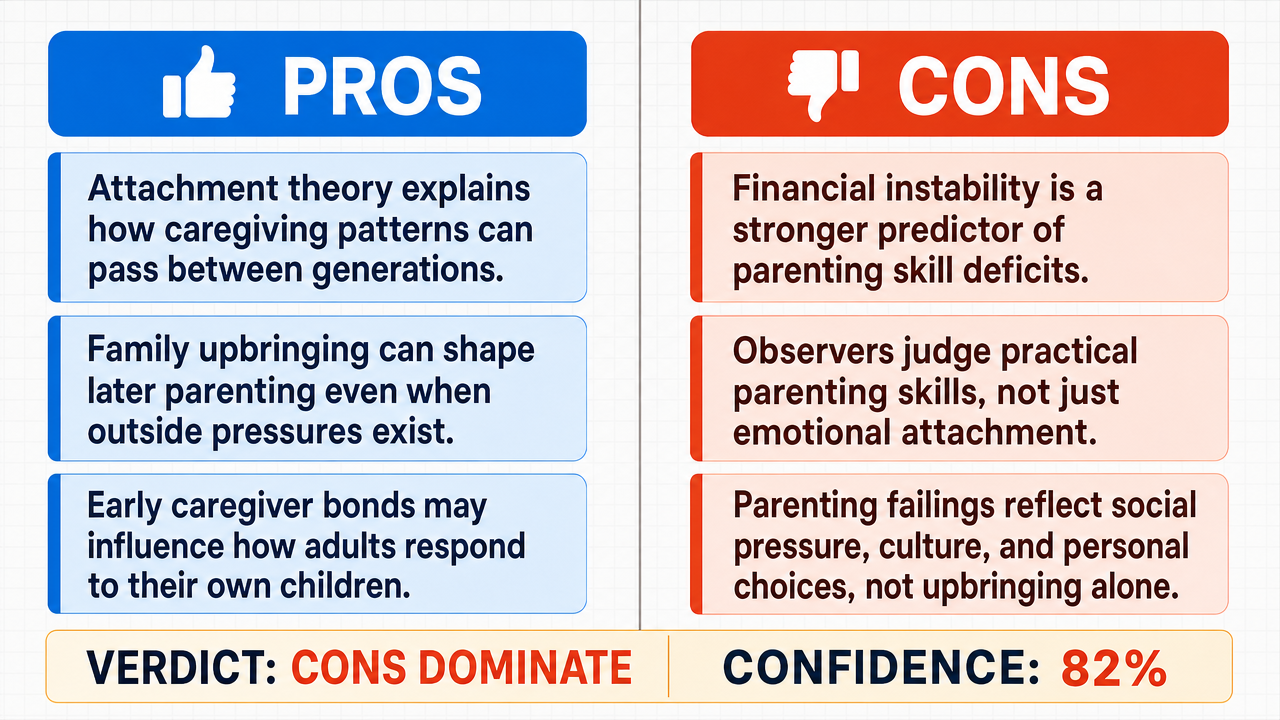
Verdict: likely FALSE (82%)
Web Report: https://solsice.com/public/debates/parents-perceived-failings-are-primarily-a-direct-consequenc-37030fd797da
This section provides a brief overview of the key arguments. You do not need to read the full detailed report below.
✅ Key PRO arguments:
- ■Attachment Theory provides a robust framework for intergenerational transmission : the quality of the bond between an infant and primary caregiver (the grandparent) establishes an internal working model for all subsequent relationships, so parents with insecure or disorganized attachment are statistically more likely to replicate maladaptive relational patterns with their own children.
- ■The opponent's claim that socioeconomic hardship 'overrides' intergenerational parenting contradicts their own assertion that financial instability is merely a 'stronger predictor,' since an override implies total displacement of the original cause while a stronger predictor only indicates higher statistical correlation within a multi-factor model.
❌ Key ANTI arguments:
- ■Empirical research, including Child Trends ' analysis of the Fragile Families and Child Wellbeing Study , identifies financial instability as a stronger predictor of harsh parenting styles than the specific parenting behaviors of previous generations, showing that socioeconomic conditions often override learned behaviors.
- ■Attachment theory conflates emotional security with parenting competence : observers frequently judge parents on practical skills such as educational support, nutritional provision, and behavioral management , and a parent with a secure attachment style can still be perceived as failing if they lack the knowledge, time, or resources to execute these tasks.
- ■Parental failings stem from a combination of socioeconomic pressures, cultural context , and individual agency rather than being solely a direct consequence of upbringing, meaning the 'primarily' qualifier in the assertion is unsupported by a single-cause explanation.
💭 Conclusion: The negative side demonstrated that socioeconomic conditions are empirically shown to be a strong predictor of skill deficits in parenting competence . The affirmative's reliance on Attachment Theory was weakened by the negative's point that practical parenting competence is what observers typically judge as 'failings.' Confidence is set at 82% to reflect the single-debate nature of the tournament and the partial strength of the affirmative's evidence.
🔬 DeepResearch Result: likely FALSE ❌ (82%)
Assertion: Parents' perceived failings are primarily a direct consequence of their own upbringing by their parents (the grandparents).
Participating models: gemma-4-26b-a4b-it 💬👁️, glm-4.7-flash 💬
📊 Face-offs: 0 concluded TRUE, 1 concluded FALSE (1 face-offs, 3 models)
📊 Score by side: TRUE=0.00, FALSE=0.82
🏅 Model score changes:
minimax-m3 💬👁️: +8
✅ PRO Arguments:
- ■Attachment Theory provides a robust framework for intergenerational transmission : the quality of the bond between an infant and primary caregiver (the grandparent) establishes an internal working model for all subsequent relationships, so parents with insecure or disorganized attachment are statistically more likely to replicate maladaptive relational patterns with their own children. gemma-4-26b-a4b-it 💬👁️
- ■The opponent's claim that socioeconomic hardship 'overrides' intergenerational parenting contradicts their own assertion that financial instability is merely a 'stronger predictor,' since an override implies total displacement of the original cause while a stronger predictor only indicates higher statistical correlation within a multi-factor model. gemma-4-26b-a4b-it 💬👁️
❌ ANTI Arguments:
- ■Empirical research, including Child Trends ' analysis of the Fragile Families and Child Wellbeing Study , identifies financial instability as a stronger predictor of harsh parenting styles than the specific parenting behaviors of previous generations, showing that socioeconomic conditions often override learned behaviors. glm-4.7-flash 💬
- ■Attachment theory conflates emotional security with parenting competence : observers frequently judge parents on practical skills such as educational support, nutritional provision, and behavioral management , and a parent with a secure attachment style can still be perceived as failing if they lack the knowledge, time, or resources to execute these tasks. glm-4.7-flash 💬
- ■Parental failings stem from a combination of socioeconomic pressures, cultural context , and individual agency rather than being solely a direct consequence of upbringing, meaning the 'primarily' qualifier in the assertion is unsupported by a single-cause explanation. glm-4.7-flash 💬
💭 Reasoning: The negative side demonstrated that socioeconomic conditions are empirically shown to be a strong predictor of skill deficits in parenting competence. The affirmative's reliance on Attachment Theory was weakened by the negative's point that practical parenting competence is what observers typically judge as 'failings.' Confidence is set at 82% to reflect the single-debate nature of the tournament and the partial strength of the affirmative's evidence.
📋 PRO Facts:
• Attachment Theory posits that the bond between an infant and primary caregiver establishes an internal working model for subsequent relationships.
• Insecure or disorganized attachment in parents is statistically associated with replication of maladaptive relational patterns.
📋 ANTI Facts:
• Socioeconomic status and resource availability are a strong predictor of skill deficits in parenting competence.
• Perceived parental failings are commonly assessed on practical skills such as educational support, not solely emotional attunement .
| Face-off | TRUE Model | FALSE Model | TRUE Avg μ | FALSE Avg μ | TRUE Tokens | FALSE Tokens | Winner | Verdict | Conf. |
|---|---|---|---|---|---|---|---|---|---|
| #1 | gemma-4-26b-a4b-it 💬👁️ | glm-4.7-flash 💬 | 0.450 | 0.412 | 4 | 4 | TRUE | FALSE | 82% |
The following technical terms, abbreviations, and domain-specific concepts are referenced throughout this debate transcript. Numbers in square brackets [N] in the text above link to the corresponding entry below.
[1] Academic performance — Educational outcome mentioned in the debate as more directly linked to parental engagement than to attachment history.
[2] Attachment deficits — Shortcomings in attachment mentioned in the debate as suffered by parents and expressed symptomatically in their own parenting.
[3] Attachment security — The quality of a secure attachment bond, described in the debate as highly heritable through environmental socialization.
[4] Attachment styles — Patterns of attachment (including secure, insecure, and disorganized) referenced within Attachment Theory as shaping relational behavior.
[5] Attachment Theory — A psychological framework cited in the debate for understanding how the bond between an infant and primary caregiver establishes an internal working model for later relationships.
[6] Behavioral management — A practical parenting skill, such as enforcing rules, mentioned in the debate as distinct from emotional attunement when assessing parental failings.
[7] Categorical assertion — A type of claim identified in the debate as logically incompatible with a merely comparative statistical claim about predictive strength.
[8] Child Trends — A research organization cited in the debate as having analyzed data from the Fragile Families and Child Wellbeing Study regarding financial instability and harsh parenting.
[9] Cultural context — The societal environment referenced in the debate as shaping the cultural norms by which parental failings are perceived.
[10] Cultural norms — Subjective standards mentioned in the debate as varying significantly across generations and influencing judgments of 'perceived failings.'
[11] Disorganized attachment — A type of insecure attachment referenced in the debate as resulting from inconsistent or neglectful care and increasing the likelihood of replicating maladaptive patterns.
[12] Emotional attunement — Sensitivity to a child's emotional state, mentioned in the debate as distinct from practical parenting skills when assessing perceived failings.
[13] Emotional regulation — The management of emotions, described in the debate as part of the internal working model established by early caregiver bonds.
[14] Environmental socialization — The process cited in the debate as the mechanism through which attachment security is transmitted across generations.
[15] Financial instability — Economic uncertainty identified in the debate as a stronger predictor of harsh parenting styles than the specific parenting behaviors of previous generations.
[16] Fragile Families and Child Wellbeing Study — A research study cited in the debate as the source of data analyzed by Child Trends regarding financial instability and parenting outcomes.
[17] Harsh parenting — A parenting style identified in the debate as more strongly predicted by financial instability than by intergenerational learned behaviors.
[18] Heritability — The quality of being inherited, referenced in the debate in the context of attachment security being transmitted through environmental socialization.
[19] Insecure attachment — A type of attachment referenced in the debate as statistically more likely to lead to replication of maladaptive relational patterns.
[20] Intergenerational transmission — The passing of traits, behaviors, or attachment patterns from one generation to the next, central to the affirmative's core claim.
[21] Internal inconsistency — A logical flaw identified in the debate, where an argument commits to a proposition and its negation simultaneously.
[22] Internal working model — A mental framework described in the debate as established by the infant-caregiver bond and serving as a blueprint for emotional regulation and interpersonal trust.
[23] Interpersonal trust — Trust in relationships, mentioned in the debate as part of the internal working model shaped by early attachment experiences.
[24] Maladaptive — Poorly adapted, used in the debate to describe relational patterns that parents with insecure attachment are more likely to replicate.
[25] Multi-variable system — A statistical context referenced in the debate to argue that a 'stronger predictor' does not imply the total displacement of other causal factors.
[26] Parental engagement — Parental involvement in a child's education, mentioned in the debate as more directly linked to academic performance than attachment history.
[27] Parenting competence — Overall ability in parenting, described in the debate as strongly influenced by social support and access to resources rather than attachment history alone.
[28] Parenting stress — Stress associated with parenting, identified in the debate as driven primarily by economic hardship rather than learned behaviors.
[29] Primary caregiver — The main caregiver of an infant, identified in the debate as the grandparent in the context of intergenerational transmission.
[30] Social learning theory — A psychological theory cited in the debate alongside Attachment Theory to explain how parenting behaviors are acquired.
[31] Social support — External assistance and resources, mentioned in the debate as a factor that often supersedes attachment history in predicting parenting competence.
[32] Socioeconomic conditions — Economic and social factors argued in the debate to override specific learned parenting behaviors from previous generations.
[33] Statistical correlation — A statistical relationship referenced in the debate to distinguish a 'stronger predictor' from a categorical override of other causes.
[34] Symptomatic expression — The outward manifestation of an underlying issue, used in the debate to describe how parental attachment deficits appear as observable failings.
The following financial data tables were referenced during the debate exchanges:
| Study Focus | Variable 1 | Variable 2 | Correlation/Outcome |
|---|---|---|---|
| Parental Engagement | Education Support | Child Academic Performance | Positive correlation |
| Socioeconomic Status | Resource Availability | Parenting Competence | Strong predictor of skill deficits |
Legend: Comparative analysis of factors influencing parenting competence and child outcomes. Data synthesized from longitudinal studies on parenting practices and educational engagement. (Source: PMC4256524, NICHD SECCYD)
Face-off transcripts
- ■
Ownership & Trade Secrets. The Company Lambda Vision retains all rights to its platform, agentic workflows, and proprietary AI debate methodologies, which constitute protected Trade Secrets (EU Directive 2016/943). Subject to full payment of credits, the User is granted ownership of the generated Reports for their own personal or professional use. Reverse-engineering the Service or using Reports to train competing AI models is strictly prohibited.
- ■
No Professional Advice. Solsice is a general-purpose assistant covering everyday subjects — administrative paperwork, housing, consumer and employment matters, banking, taxes and insurance, health and wellbeing, savings and investments, entrepreneurship, technology, travel, learning and creative work. Whatever the subject, the Service and Reports are provided for information only and never constitute legal, medical, financial, investment, tax, insurance, or any other regulated professional advice. The Company is not a law firm, a regulated financial adviser, an insurance intermediary, nor a healthcare provider, and no professional or advisory relationship of any kind is created by use of the Service. Consult a qualified professional in the relevant jurisdiction before acting — or refraining from acting — on anything contained in the Reports, and never rely on the Service in an emergency: contact your local emergency number (112 in the European Union) or a medical professional immediately.
- ■
AI-Generated Content, Sources and Viewpoints. Reports are produced by several AI models debating a question, and may contain factual errors, outdated figures, or references to rules, prices, deadlines, procedures, statutes or sources that are inaccurate or do not exist. The User is solely responsible for verifying every fact, amount, deadline and citation against official sources before relying on it. Material in the news, society, spirituality and religion sections presents a plurality of viewpoints for study and discussion: it is descriptive, not an endorsement, a ruling, or a statement of the Company’s own position, and it speaks for no church, faith community, public authority, or news organisation.
- ■
Liability & Governing Law. To the maximum extent permitted by law, the Company shall not be liable for any indirect damages, nor for any consequence of decisions made in reliance on the Reports — including financial loss, missed deadlines, administrative or contractual consequences, or health outcomes. These Terms are governed by French law. Any disputes shall be subject to the exclusive jurisdiction of the Courts of Paris, France.