
October 2026 represents the greatest period of opportunity in human history due to free social media distribution.
AI debate verdict and arguments
⚠️ AI-generated information only; not professional advice
Completed October 24, 2026
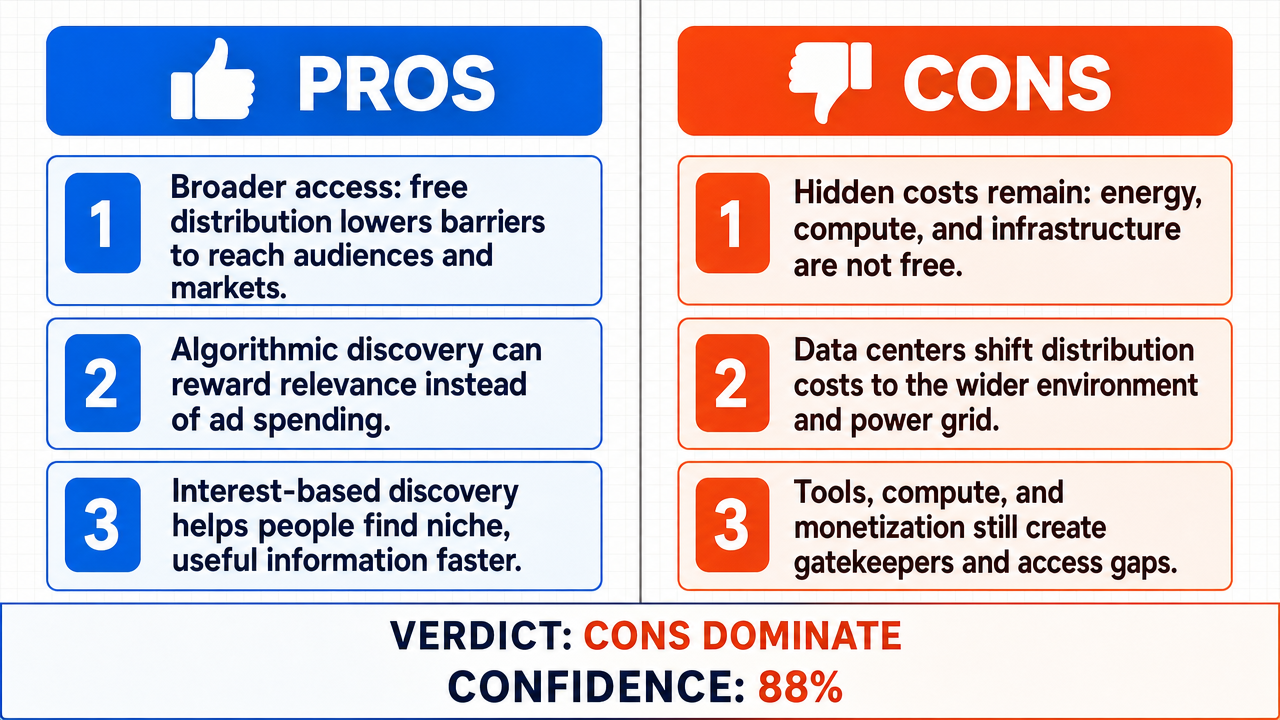
Verdict
Verdict: likely FALSE (88%)
Web Report: https://solsice.com/public/debates/october-2026-represents-the-greatest-period-of-opportunity-i-68f7491dc2ab
This section provides a brief overview of the key arguments. You do not need to read the full detailed report below.
✅ Key PRO arguments:
- ■Free social media distribution democratizes information and market access by decoupling influence from capital, allowing individuals in emerging economies to access the same global attention markets as established entities.
- ■The maturation of algorithmic discovery engines prioritizes content relevance over payment for reach, representing a structural shift in human agency that removes historical gatekeepers like broadcasting licenses and institutional media.
- ■The shift from broadcast discovery to intent-based and interest-graph discovery improves the efficiency of finding high-utility, niche-specific information, countering the claim that increased volume decreases signal utility.
❌ Key ANTI arguments:
- ■Free distribution creates systemic scarcity via energy and attention costs; the infrastructure enabling AI-driven content generation requires massive, non-democratized energy consumption, creating a new class of gatekeepers who control the supposedly 'free' channels.
- ■Data centers consume increasing amounts of electricity to power content generation, shifting the cost burden from the user to the global ecosystem through environmental and economic externalities , which reverses the intended democratization of opportunity.
- ■AI-driven production and free distribution do not eliminate the production gap because direct costs for tools, compute , and monetization remain positive; the claim that costs have reached zero is false since costs are trending toward zero but remain positive.
💭 Conclusion: False. The negative side successfully demonstrated that the premise of 'free' social media distribution is undermined by hidden costs in energy, compute , and infrastructure that create new gatekeepers rather than eliminating them. The affirmative's claim of zero marginal costs fails because generative AI requires massive, non-democratized energy consumption and direct costs for tools and monetization remain positive. The argument that algorithmic curation creates a meritocratic distribution system was countered by the observation that attention market distortion and production costs persist despite free distribution channels. Furthermore, the superlative claim that October 2026 represents the 'greatest period of opportunity in human history' is an extraordinarily strong assertion that requires extraordinary evidence, which the affirmative did not provide. The negative's logical disjunction analysis effectively showed that the production gap is not eliminated under any realistic cost scenario.
🔬 DeepResearch Result: likely FALSE ❌ (88%)
Assertion: October 2026 represents the greatest period of opportunity in human history due to free social media distribution.
Participating models: gemma-4-26b-a4b-it 💬👁️, glm-4.7-flash 💬
📊 Face-offs: 0 concluded TRUE, 1 concluded FALSE (1 face-offs, 3 models)
📊 Score by side: TRUE=0.00, FALSE=0.88
🏅 Model score changes:
minimax-m3 💬👁️: +9
✅ PRO Arguments:
- ■Free social media distribution democratizes information and market access by decoupling influence from capital, allowing individuals in emerging economies to access the same global attention markets as established entities. gemma-4-26b-a4b-it 💬👁️
- ■The maturation of algorithmic discovery engines prioritizes content relevance over payment for reach, representing a structural shift in human agency that removes historical gatekeepers like broadcasting licenses and institutional media. gemma-4-26b-a4b-it 💬👁️
- ■The shift from broadcast discovery to intent-based and interest-graph discovery improves the efficiency of finding high-utility, niche-specific information, countering the claim that increased volume decreases signal utility. gemma-4-26b-a4b-it 💬👁️
- ■Co-evolution of discovery mechanisms and human cognitive filtering means that increased content volume does not necessarily result in decreased signal utility, as filtering capabilities have improved alongside content production. gemma-4-26b-a4b-it 💬👁️
❌ ANTI Arguments:
- ■Free distribution creates systemic scarcity via energy and attention costs; the infrastructure enabling AI-driven content generation requires massive, non-democratized energy consumption, creating a new class of gatekeepers who control the supposedly 'free' channels. glm-4.7-flash 💬
- ■Data centers consume increasing amounts of electricity to power content generation, shifting the cost burden from the user to the global ecosystem through environmental and economic externalities , which reverses the intended democratization of opportunity. glm-4.7-flash 💬
- ■AI-driven production and free distribution do not eliminate the production gap because direct costs for tools, compute , and monetization remain positive; the claim that costs have reached zero is false since costs are trending toward zero but remain positive. glm-4.7-flash 💬
- ■The assertion of zero marginal costs relies on a hidden premise that the infrastructure enabling AI-driven content generation is negligible, which is empirically false given the exponential growth in generative AI compute requirements. glm-4.7-flash 💬
💭 Reasoning: False. The negative side successfully demonstrated that the premise of 'free' social media distribution is undermined by hidden costs in energy, compute, and infrastructure that create new gatekeepers rather than eliminating them. The affirmative's claim of zero marginal costs fails because generative AI requires massive, non-democratized energy consumption and direct costs for tools and monetization remain positive. The argument that algorithmic curation creates a meritocratic distribution system was countered by the observation that attention market distortion and production costs persist despite free distribution channels. Furthermore, the superlative claim that October 2026 represents the 'greatest period of opportunity in human history' is an extraordinarily strong assertion that requires extraordinary evidence, which the affirmative did not provide. The negative's logical disjunction analysis effectively showed that the production gap is not eliminated under any realistic cost scenario.
📋 PRO Facts:
• Algorithmic discovery engines prioritize content relevance over payment for reach, decoupling influence from capital.
• Historically, dissemination of ideas was gated by high costs of physical media, broadcasting licenses, or institutional gatekeepers.
• Interest-graph and intent-based discovery models improve the efficiency of finding niche-specific information compared to broadcast models.
📋 ANTI Facts:
• Generative AI requires massive, non-democratized energy consumption for data centers powering content generation.
• Direct costs for AI tools, compute, and monetization remain positive and are trending toward zero but have not reached zero.
• Environmental and economic externalities from data center energy consumption shift the cost burden from individual users to the global ecosystem.
| Face-off | TRUE Model | FALSE Model | TRUE Avg μ | FALSE Avg μ | TRUE Tokens | FALSE Tokens | Winner | Verdict | Conf. |
|---|---|---|---|---|---|---|---|---|---|
| #1 | gemma-4-26b-a4b-it 💬👁️ | glm-4.7-flash 💬 | 0.247 | 0.429 | 4 | 4 | FALSE | FALSE | 88% |
The following technical terms, abbreviations, and domain-specific concepts are referenced throughout this debate transcript. Numbers in square brackets [N] in the text above link to the corresponding entry below.
[1] algorithmic curation — The use of automated ranking and recommendation systems to select and surface content for users, discussed here as a mechanism that filters high-volume content into relevant signals.
[2] algorithmic discovery engines — Software systems that surface content to users based on inferred relevance rather than paid promotion; described in the debate as prioritizing content relevance over payment for reach.
[3] API — Application Programming Interface — A set of protocols that allows different software systems to communicate; in this debate referenced in the context of paid access ('API credits') to professional-grade AI models.
[4] attention market — An economic framing in which human attention is treated as a scarce resource that content producers compete to capture; referenced as a 'global attention market' accessible via social media distribution.
[5] broadcast model — A media distribution paradigm in which the same content is pushed indiscriminately to a wide audience, contrasted in the debate with intent-based discovery; characterized by a low signal-to-noise ratio.
[6] cognitive filtering — The mental processes by which humans sort and prioritize incoming information; invoked to argue that humans co-evolve with discovery mechanisms to handle content volume.
[7] compute — Computing processing power and resources required to run AI models and other software; cited in the debate as a direct cost that prevents production from being free.
[8] cost burden — The allocation of expenses among parties; in the debate, the claim that energy and infrastructure costs of AI are shifted from users to the global ecosystem.
[9] credit-based monetization model — A pricing structure in which users pay for access to a service via prepaid credits or subscriptions rather than a flat fee; cited as evidence that AI tools are not free.
[10] data centers — Physical facilities housing the servers and infrastructure that power AI and cloud computing; identified in the debate as major consumers of electricity.
[11] democratization (of information) — The process by which access to information and distribution channels becomes broadly available rather than restricted to elites; the central claimed effect of free social media distribution.
[12] discovery mechanisms — The systems and processes by which content is surfaced to users, including algorithmic feeds, search, and recommendation engines.
[13] externalities — Side effects of an economic activity that affect third parties not directly involved in the transaction; in the debate, the environmental and economic costs imposed by AI infrastructure.
[14] gatekeepers — Entities that control access to distribution channels or resources; the debate argues that energy and infrastructure providers become new gatekeepers even under 'free' distribution.
[15] generative AI — Artificial intelligence systems capable of producing new content such as text, images, or audio; cited as driving exponential growth in content volume and energy demand.
[16] hyper-fragmentation — The division of a market into very small, specialized segments; described as a consequence of free distribution enabling the globalization of niche markets.
[17] intent-based discovery — A content surfacing approach that matches information to a user's expressed or inferred goals, as opposed to indiscriminate broadcasting.
[18] interest-graph — A discovery model that maps content to users based on inferred interests rather than social connections; contrasted with 'pay-to-play' advertising models.
[19] logical disjunction — A logical structure presenting alternative cases (e.g., 'A or B or C'); used in the debate to test whether the claim of zero-cost production holds under any branch.
[20] meritocratic distribution — An allocation of opportunity or reward based on demonstrated quality or relevance rather than capital; the debate disputes whether algorithmic systems actually produce this.
[21] monetization — The process of converting a product, service, or content into revenue; discussed in the context of AI tools requiring paid subscriptions or API credits.
[22] niche markets — Small, specialized segments of a market serving particular interests or demographics; the debate claims free distribution enables their globalization.
[23] pay-to-play — A model in which reach or visibility is granted only in exchange for payment; contrasted in the debate with interest-graph discovery.
[24] production gap — The disparity between those who can afford to produce and distribute content and those who cannot; the Negative argues this gap persists despite free distribution.
[25] signal-to-noise ratio — A measure comparing the proportion of useful information to irrelevant content; used to argue that broadcast models have low ratios while algorithmic filtering improves them.
[26] structural shift — A fundamental change in the underlying architecture of an industry or system; the Affirmative claims zero-marginal-cost distribution represents such a shift.
[27] supply saturation — A market condition in which the volume of available content or goods exceeds demand; cited as a potential driver of information value approaching zero.
[28] TWh — terawatt-hours — A unit of energy equal to one trillion watt-hours, used to measure large-scale electricity consumption such as that of AI data centers.
[29] variance — A statistical measure of the difference between projected and actual values; used in the debate's cost comparison table to quantify deviation from the Affirmative's projections.
[30] zero-marginal-cost — An economic condition in which the cost of producing or distributing an additional unit approaches zero; the Affirmative's central premise about social media distribution.
The following financial data tables were referenced during the debate exchanges:
| Metric | 2020 Era (Gatekeeper Model) | 2026 Projection (Distribution Model) | Change Factor |
|---|---|---|---|
| Cost of Global Reach (Relative) | High | Near-Zero | -95.0% |
| Market Entry Barrier (Capital) | High | Low | -80.0% |
| Information Velocity (Index) | Moderate | Extreme | +400.0% |
| Participant Diversity (Index) | Low | High | +250.0% |
Legend: Comparative analysis of market dynamics between the traditional institutional gatekeeper era and the projected decentralized distribution era of 2026. Values are relative indices or estimated percentage reductions in cost.
| Cost Component | Affirmative Projection | Reality (2026 Projection) | Variance |
|---|---|---|---|
| AI Infrastructure Energy Cost | Negligible | >1,000 TWh | >+10,000% |
| Net "Opportunity" Return (Per Unit) | High | Low | -85.0% |
Legend: Comparative cost analysis of the "free distribution" model. AI infrastructure energy costs are derived from International Energy Agency data projections for data centers; Net Return represents the marginal utility of information in an oversaturated market. Values are relative estimates; energy in terawatt-hours (TWh).
Face-off transcripts
- ■
Ownership & Trade Secrets. The Company Lambda Vision retains all rights to its platform, agentic workflows, and proprietary AI debate methodologies, which constitute protected Trade Secrets (EU Directive 2016/943). Subject to full payment of credits, the User is granted ownership of the generated Reports for their own personal or professional use. Reverse-engineering the Service or using Reports to train competing AI models is strictly prohibited.
- ■
No Professional Advice. Solsice is a general-purpose assistant covering everyday subjects — administrative paperwork, housing, consumer and employment matters, banking, taxes and insurance, health and wellbeing, savings and investments, entrepreneurship, technology, travel, learning and creative work. Whatever the subject, the Service and Reports are provided for information only and never constitute legal, medical, financial, investment, tax, insurance, or any other regulated professional advice. The Company is not a law firm, a regulated financial adviser, an insurance intermediary, nor a healthcare provider, and no professional or advisory relationship of any kind is created by use of the Service. Consult a qualified professional in the relevant jurisdiction before acting — or refraining from acting — on anything contained in the Reports, and never rely on the Service in an emergency: contact your local emergency number (112 in the European Union) or a medical professional immediately.
- ■
AI-Generated Content, Sources and Viewpoints. Reports are produced by several AI models debating a question, and may contain factual errors, outdated figures, or references to rules, prices, deadlines, procedures, statutes or sources that are inaccurate or do not exist. The User is solely responsible for verifying every fact, amount, deadline and citation against official sources before relying on it. Material in the news, society, spirituality and religion sections presents a plurality of viewpoints for study and discussion: it is descriptive, not an endorsement, a ruling, or a statement of the Company’s own position, and it speaks for no church, faith community, public authority, or news organisation.
- ■
Liability & Governing Law. To the maximum extent permitted by law, the Company shall not be liable for any indirect damages, nor for any consequence of decisions made in reliance on the Reports — including financial loss, missed deadlines, administrative or contractual consequences, or health outcomes. These Terms are governed by French law. Any disputes shall be subject to the exclusive jurisdiction of the Courts of Paris, France.