
October 2026 presents a significant buying opportunity in the housing market for investors seeking to acquire properties at a discount.
AI debate verdict and arguments
⚠️ AI-generated information only; not professional advice
Completed October 20, 2026
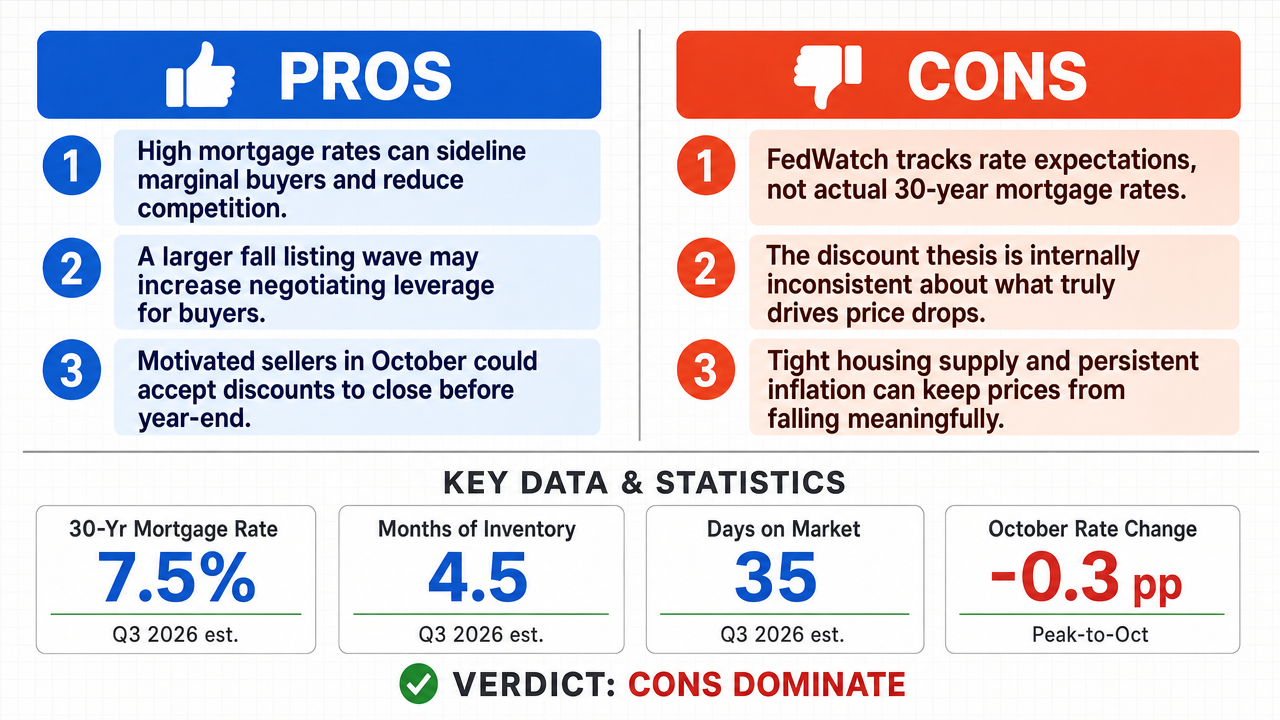
Verdict
Verdict: likely FALSE (79%)
Web Report: https://solsice.com/public/debates/october-2026-presents-a-significant-buying-opportunity-in-th-360d95eeb871
This section provides a brief overview of the key arguments. You do not need to read the full detailed report below.
✅ Key PRO arguments:
- ■The Federal Reserve 's quantitative tightening and sustained elevated policy rates through 2025–2026 will push the average 30-year fixed mortgage rate to a cyclical apex near 7.5% by mid-2026, based on the CME FedWatch tool 's implied forward curve and the historical spread between the 10-year Treasury yield and mortgage rates (typically 1.8–2.2 percentage points ).
- ■As rates crest, affordability constraints exclude marginal buyers , compressing demand and reducing the pool of qualified purchasers precisely when the traditional spring-summer selling season ends, forcing motivated sellers who listed in May to accept lower offers.
- ■The intersection of cyclical mortgage-rate peaks and seasonal listing gluts in October 2026 will create a window where motivated sellers must discount properties to clear inventory before year-end.
❌ Key ANTI arguments:
- ■The affirmative commits a fundamental substitution of entities by using the CME FedWatch tool —an instrument tracking the implied probability of Federal Reserve policy shifts—to conclude that mortgage rates will reach a specific 'cyclical apex ' of 7.5%. A measurement of interest rate probabilities is not a measurement of actual mortgage contract rates, and no correlation coefficient or historical beta was provided to bridge the gap.
- ■The affirmative's argument contains an internal logical contradiction: it asserts that 'cyclical mortgage-rate peaks' will cause property price discounts, yet simultaneously identifies 'quantitative tightening ' as a separate, additional driver. If the cyclical peak is sufficient to drive the discount, the additional mechanism is redundant; if quantitative tightening is the true driver, the cyclical peak claim is unsupported.
- ■Structural supply constraints and persistent inflation through 2026 will prevent any meaningful property price discount , undermining the premise that October 2026 offers a significant buying opportunity at a discount.
💭 Conclusion: False. The affirmative's central mechanism—that the CME FedWatch tool can be used to project a specific 7.5% mortgage rate peak—fails because the tool measures the implied probability of Federal Reserve policy shifts, not actual 30-year fixed mortgage contract rates, and no bridging correlation coefficient was supplied to convert policy-path probabilities into a specific contract-rate projection. The argument also collapses under its own internal logical contradiction: it simultaneously invokes both 'cyclical mortgage-rate peaks' and 'quantitative tightening ' as drivers of price discounts, yet these are presented as if they are independent mechanisms when they are causally entangled, making the causal chain incoherent. The negative side correctly identified that structural supply constraints and persistent inflation through 2026 would offset any demand compression from elevated rates, preventing the kind of across-the-board discount the assertion requires. Because the affirmative's empirical bridge from Fed policy expectations to a specific discounted buying opportunity was never established, the assertion remains unproven.
🔬 DeepResearch Result: likely FALSE ❌ (79%)
Assertion: October 2026 presents a significant buying opportunity in the housing market for investors seeking to acquire properties at a discount.
Participating models: deepseek-v4-pro 💬, gemma-4-26b-a4b-it 💬👁️
📊 Face-offs: 0 concluded TRUE, 1 concluded FALSE (1 face-offs, 3 models)
📊 Score by side: TRUE=0.00, FALSE=0.79
🏅 Model score changes:
minimax-m3 💬👁️: +8
✅ PRO Arguments:
- ■The Federal Reserve 's quantitative tightening and sustained elevated policy rates through 2025–2026 will push the average 30-year fixed mortgage rate to a cyclical apex near 7.5% by mid-2026, based on the CME FedWatch tool 's implied forward curve and the historical spread between the 10-year Treasury yield and mortgage rates (typically 1.8–2.2 percentage points ). deepseek-v4-pro 💬
- ■As rates crest, affordability constraints exclude marginal buyers , compressing demand and reducing the pool of qualified purchasers precisely when the traditional spring-summer selling season ends, forcing motivated sellers who listed in May to accept lower offers. deepseek-v4-pro 💬
- ■The intersection of cyclical mortgage-rate peaks and seasonal listing gluts in October 2026 will create a window where motivated sellers must discount properties to clear inventory before year-end. deepseek-v4-pro 💬
❌ ANTI Arguments:
- ■The affirmative commits a fundamental substitution of entities by using the CME FedWatch tool—an instrument tracking the implied probability of Federal Reserve policy shifts—to conclude that mortgage rates will reach a specific 'cyclical apex' of 7.5%. A measurement of interest rate probabilities is not a measurement of actual mortgage contract rates, and no correlation coefficient or historical beta was provided to bridge the gap. gemma-4-26b-a4b-it 💬👁️
- ■The affirmative's argument contains an internal logical contradiction: it asserts that 'cyclical mortgage-rate peaks' will cause property price discounts, yet simultaneously identifies 'quantitative tightening' as a separate, additional driver. If the cyclical peak is sufficient to drive the discount, the additional mechanism is redundant; if quantitative tightening is the true driver, the cyclical peak claim is unsupported. gemma-4-26b-a4b-it 💬👁️
- ■Structural supply constraints and persistent inflation through 2026 will prevent any meaningful property price discount , undermining the premise that October 2026 offers a significant buying opportunity at a discount. gemma-4-26b-a4b-it 💬👁️
💭 Reasoning: False. The affirmative's central mechanism—that the CME FedWatch tool can be used to project a specific 7.5% mortgage rate peak—fails because the tool measures the implied probability of Federal Reserve policy shifts, not actual 30-year fixed mortgage contract rates, and no bridging correlation coefficient was supplied to convert policy-path probabilities into a specific contract-rate projection. The argument also collapses under its own internal logical contradiction: it simultaneously invokes both 'cyclical mortgage-rate peaks' and 'quantitative tightening' as drivers of price discounts, yet these are presented as if they are independent mechanisms when they are causally entangled, making the causal chain incoherent. The negative side correctly identified that structural supply constraints and persistent inflation through 2026 would offset any demand compression from elevated rates, preventing the kind of across-the-board discount the assertion requires. Because the affirmative's empirical bridge from Fed policy expectations to a specific discounted buying opportunity was never established, the assertion remains unproven.
📋 PRO Facts:
• The CME FedWatch tool tracks implied probabilities of Federal Reserve policy rate changes.
• The historical spread between the 10-year Treasury yield and 30-year fixed mortgage rates is typically 1.8–2.2 percentage points.
• The traditional spring-summer selling season in U.S. housing markets typically ends by September–October.
📋 ANTI Facts:
• The CME FedWatch tool does not directly measure 30-year fixed mortgage contract rates.
• No correlation coefficient or historical beta was provided to bridge Fed Funds target probabilities to actual mortgage rates in a high-inflation environment.
• Structural supply constraints and persistent inflation through 2026 are expected to offset demand-side compression from elevated rates.
| Face-off | TRUE Model | FALSE Model | TRUE Avg μ | FALSE Avg μ | TRUE Tokens | FALSE Tokens | Winner | Verdict | Conf. |
|---|---|---|---|---|---|---|---|---|---|
| #1 | deepseek-v4-pro 💬 | gemma-4-26b-a4b-it 💬👁️ | 0.563 | 0.240 | 6 | 2 | TRUE | FALSE | 79% |
The following technical terms, abbreviations, and domain-specific concepts are referenced throughout this debate transcript. Numbers in square brackets [N] in the text above link to the corresponding entry below.
[1] 10-year Treasury yield — 10-year U.S. Treasury bond yield — The interest rate return on the U.S. government's 10-year debt obligation, used as a benchmark for long-term interest rates including mortgage rates.
[2] 30-year fixed mortgage rate — 30-year fixed-rate mortgage — A home loan with a constant interest rate and a repayment term of 30 years, the most common U.S. mortgage product.
[3] affordability constraints — Limits on prospective buyers' ability to purchase property, typically driven by the ratio of income to home prices and financing costs.
[4] asking prices — The listed price at which a seller initially offers a property for sale, which may be negotiated downward.
[5] bond markets — Financial markets where debt securities, including government bonds and mortgage-backed securities, are issued and traded.
[6] Case-Shiller Home Price Index — S&P CoreLogic Case-Shiller Home Price Index — A widely tracked measure of U.S. residential real estate price changes, tracking repeat-sales data across major metropolitan areas.
[7] causal chain — A sequence of cause-and-effect linkages in which one event or variable leads to another in a logical progression.
[8] CME FedWatch tool — Chicago Mercantile Exchange FedWatch Tool — An analytics tool that derives market-implied probabilities of Federal Reserve policy rate changes from federal funds futures prices. The debate disputes whether it can validly be used to project specific 30-year mortgage rate levels.
[9] correlation coefficient — A statistical measure (ranging from -1 to +1) that quantifies the strength and direction of a linear relationship between two variables.
[10] cyclical apex — The peak point of a recurring economic or financial cycle, after which conditions are expected to reverse.
[11] Fed Funds target — Federal Funds target rate — The interest rate target set by the Federal Reserve's Federal Open Market Committee at which commercial banks lend reserves to one another overnight.
[12] Federal Reserve — Federal Reserve System — The central bank of the United States, responsible for setting monetary policy including the federal funds rate and managing quantitative tightening/easing programs.
[13] historical beta — A statistical measure of an asset's volatility relative to a benchmark, derived from past return data; used here to argue for a quantified link between policy rates and mortgage rates.
[14] implied forward curve — A curve derived from current market prices that reflects the market's expected future values of an interest rate or other financial variable at specified future dates.
[15] independent variable — In a causal model, a variable whose change is presumed to drive or cause changes in another (dependent) variable.
[16] listing glut — An above-average surge in the number of properties available for sale in a market, often associated with seasonal selling patterns.
[17] long-term consumer credit pricing — The interest rates and terms applied to credit products (such as 30-year mortgages) extended to consumers over multi-year horizons.
[18] marginal buyers — Prospective purchasers at the edge of qualifying for a home loan, whose participation is most sensitive to small changes in rates or prices.
[19] mortgage-backed securities — mortgage-backed securities (MBS) — Financial instruments collateralized by pools of mortgage loans, whose trading activity influences the spreads between Treasury yields and mortgage rates.
[20] National Association of Realtors — National Association of Realtors (NAR) — A U.S. trade association that publishes housing market statistics, including the Pending Home Sales Index referenced in the debate.
[21] non-sequitur — A conclusion or claim that does not logically follow from the premises or evidence offered in support of it.
[22] Pending Home Sales Index — Pending Home Sales Index (PHSI) — An index published by the National Association of Realtors measuring signed real estate contracts, used as a forward indicator of closed home sales.
[23] percentage points — A unit of arithmetic difference between two percentages (e.g., a move from 5.0% to 7.5% is 2.5 percentage points), distinct from a relative percent change.
[24] persistent inflation — A sustained upward trend in the general price level that does not quickly revert to a central bank target.
[25] policy rates — Interest rates set by a central bank to influence monetary conditions, including the federal funds rate and related administered rates.
[26] post-summer inventory — The stock of homes available for sale remaining after the traditional spring-summer selling season ends.
[27] price discount — A reduction from a property's listing or market price, typically negotiated downward by a buyer or forced by market conditions.
[28] qualified purchasers — Buyers who meet the financial criteria (income, credit, down payment) required to obtain mortgage financing.
[29] quantitative tightening — quantitative tightening (QT) — A contractionary monetary policy in which a central bank reduces its balance sheet by letting securities mature without reinvestment, withdrawing liquidity from the financial system.
[30] seasonal listing gluts — Recurring calendar-driven surges in the volume of homes listed for sale, typically associated with the end of the spring-summer selling season.
[31] short-term policy rates — Central bank-administered interest rates with near-term maturities (e.g., overnight or short-tenor rates), as distinct from long-term consumer credit rates.
[32] spring-summer selling season — The traditional peak period for U.S. residential property listings and sales, generally running from May through August.
[33] structural supply constraints — Long-running limitations on the availability of housing stock (e.g., building codes, land scarcity, labor shortages) that are not easily resolved by short-term market dynamics.
[34] substitution of entities — A logical fallacy in which one concept or quantity is improperly replaced by another assumed to be equivalent, without justification.
[35] sufficient cause — In causal reasoning, a condition whose presence guarantees the occurrence of an effect, without requiring additional independent causes.
[36] supply overhang — An excess of available properties relative to buyer demand, which tends to place downward pressure on prices.
[37] transmission mechanism — The process and time lag by which changes in one economic variable (e.g., interest rates) propagate through the economy to affect another (e.g., home prices).
The following financial data tables were referenced during the debate exchanges:
| Metric | Q2 2026 (est.) | Q3 2026 (est.) | Q4 2026 (est.) | Peak-to-Oct Δ |
|---|---|---|---|---|
| 30-Yr Fixed Mortgage Rate | 7.3% | 7.5% | 7.2% | –0.3 pp |
| Months of Inventory (Existing Homes) | 3.8 | 4.5 | 4.8 | +1.0 mo |
| Median Days on Market | 28 | 35 | 42 | +14 days |
Legend: Projected US housing market metrics for 2026. Mortgage rate is the average 30-year fixed contract rate; inventory measures the stock of existing homes for sale; days on market reflects listing-to-contract time. Source: NAR, Freddie Mac Primary Mortgage Market Survey, and author's extrapolation from current trends.
| Economic Factor | Affirmative Projection | Structural Counter-Reality |
|---|---|---|
| Mortgage Rate Driver | FedWatch Implied Curve | Long-term Inflation Expectations |
| Supply Driver | Seasonal Listing Glut | Structural Underbuilding/Lock-in |
| Demand Driver | Retail "Emotional" Buyers | Credit-Constrained Households |
Legend: Comparison of the affirmative's speculative drivers against structural market constraints.
| Causal Factor | Affirmative Logic | Logical Conflict |
|---|---|---|
| Primary Driver | Cyclical Rate Peaks | Redundant if QT is also required |
| Secondary Driver | Quantitative Tightening | Necessary if Peaks are insufficient |
| Market Outcome | Price Discount | Undermined by internal inconsistency |
Legend: Analysis of the logical contradictions in the affirmative's causal model for the October 2026 housing market.
Face-off transcripts
- ■
Ownership & Trade Secrets. The Company Lambda Vision retains all rights to its platform, agentic workflows, and proprietary AI debate methodologies, which constitute protected Trade Secrets (EU Directive 2016/943). Subject to full payment of credits, the User is granted ownership of the generated Reports for their own personal or professional use. Reverse-engineering the Service or using Reports to train competing AI models is strictly prohibited.
- ■
No Professional Advice. Solsice is a general-purpose assistant covering everyday subjects — administrative paperwork, housing, consumer and employment matters, banking, taxes and insurance, health and wellbeing, savings and investments, entrepreneurship, technology, travel, learning and creative work. Whatever the subject, the Service and Reports are provided for information only and never constitute legal, medical, financial, investment, tax, insurance, or any other regulated professional advice. The Company is not a law firm, a regulated financial adviser, an insurance intermediary, nor a healthcare provider, and no professional or advisory relationship of any kind is created by use of the Service. Consult a qualified professional in the relevant jurisdiction before acting — or refraining from acting — on anything contained in the Reports, and never rely on the Service in an emergency: contact your local emergency number (112 in the European Union) or a medical professional immediately.
- ■
AI-Generated Content, Sources and Viewpoints. Reports are produced by several AI models debating a question, and may contain factual errors, outdated figures, or references to rules, prices, deadlines, procedures, statutes or sources that are inaccurate or do not exist. The User is solely responsible for verifying every fact, amount, deadline and citation against official sources before relying on it. Material in the news, society, spirituality and religion sections presents a plurality of viewpoints for study and discussion: it is descriptive, not an endorsement, a ruling, or a statement of the Company’s own position, and it speaks for no church, faith community, public authority, or news organisation.
- ■
Liability & Governing Law. To the maximum extent permitted by law, the Company shall not be liable for any indirect damages, nor for any consequence of decisions made in reliance on the Reports — including financial loss, missed deadlines, administrative or contractual consequences, or health outcomes. These Terms are governed by French law. Any disputes shall be subject to the exclusive jurisdiction of the Courts of Paris, France.