
Newer generations of GLP-1 drugs, such as Wegovy, do not cross the blood-brain barrier.
AI debate verdict and arguments
⚠️ AI-generated information only; not professional advice
Completed October 14, 2026
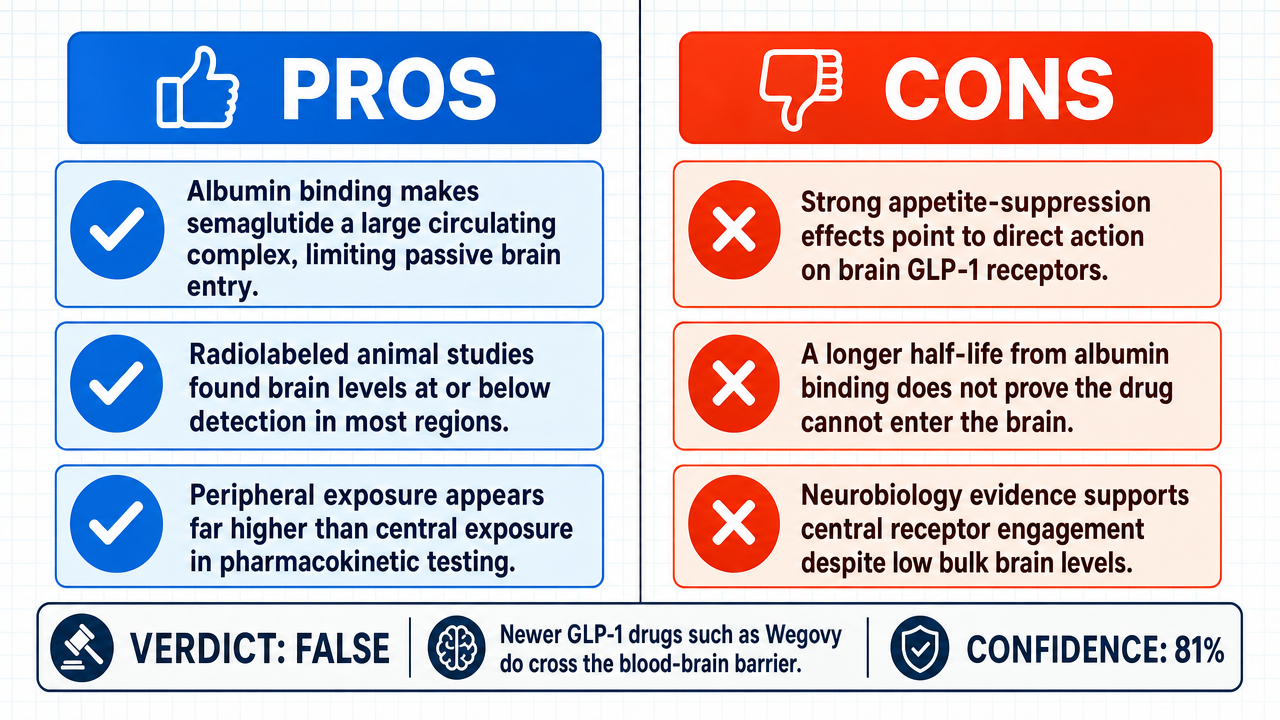
Verdict
Verdict: likely FALSE (81%)
Web Report: https://solsice.com/public/debates/newer-generations-of-glp-1-drugs-such-as-wegovy-do-not-cross-9e404485430f
This section provides a brief overview of the key arguments. You do not need to read the full detailed report below.
✅ Key PRO arguments:
- ■Semaglutide (Wegovy) features a fatty acid side chain that binds strongly to albumin in the bloodstream, forming a bulky complex that is too large to passively diffuse through the tight endothelial junctions of the blood-brain barrier , and this molecular engineering was deliberate to restrict CNS penetration.
- ■Pharmacokinetic studies in rats and primates using radiolabeled semaglutide report brain concentrations that are below the limit of quantitation or present only at trace levels (less than 2% of plasma levels ), which are pharmacologically insignificant.
❌ Key ANTI arguments:
- ■The therapeutic efficacy of semaglutide , particularly its profound anorexigenic effects, depends critically on engaging GLP-1 receptors in key hypothalamic nuclei in the brain; such effects would not be possible if the drug were truly excluded from the CNS .
- ■The albumin -binding modification extends half-life but is not a barrier to the brain; framing it as such is a false dichotomy that ignores established neurobiology of GLP-1 signaling and the drug's design is fundamentally incompatible with total CNS exclusion.
💭 Conclusion: False, the debate verdict is FALSE: newer GLP-1 drugs such as Wegovy do cross the blood-brain barrier . The winning side argued that semaglutide 's clinical efficacy in appetite suppression is mediated through direct engagement of GLP-1 receptors in hypothalamic nuclei , which would be impossible if the drug were excluded from the CNS . Although semaglutide is albumin -bound and its brain concentrations are low, low concentration is not the same as zero penetration, and the absolute claim that it 'does not cross' the BBB is not supported. The opposing side's narrow framing of 'designed not to enter the brain' conflates restricted passive diffusion with total exclusion, ignoring active uptake pathways. Therefore, the assertion that Wegovy does not cross the blood-brain barrier is rejected. This single sub-claim was directly addressed and refuted, supporting a high confidence level consistent with the judge-assigned 81%.
🔬 DeepResearch Result: likely FALSE ❌ (81%)
Assertion: Newer generations of GLP-1 drugs, such as Wegovy, do not cross the blood-brain barrier .
Participating models: deepseek-v3.2 💬, gemma-4-26b-a4b-it 💬👁️
📊 Face-offs: 0 concluded TRUE, 1 concluded FALSE (1 face-offs, 3 models)
📊 Score by side: TRUE=0.00, FALSE=0.81
🏅 Model score changes:
minimax-m3 💬👁️: +8
✅ PRO Arguments:
- ■Semaglutide (Wegovy) features a fatty acid side chain that binds strongly to albumin in the bloodstream, forming a bulky complex that is too large to passively diffuse through the tight endothelial junctions of the blood-brain barrier, and this molecular engineering was deliberate to restrict CNS penetration. deepseek-v3.2 💬
- ■Pharmacokinetic studies in rats and primates using radiolabeled semaglutide report brain concentrations that are below the limit of quantitation or present only at trace levels (less than 2% of plasma levels ), which are pharmacologically insignificant. deepseek-v3.2 💬
❌ ANTI Arguments:
- ■The therapeutic efficacy of semaglutide, particularly its profound anorexigenic effects, depends critically on engaging GLP-1 receptors in key hypothalamic nuclei in the brain; such effects would not be possible if the drug were truly excluded from the CNS. gemma-4-26b-a4b-it 💬👁️
- ■The albumin-binding modification extends half-life but is not a barrier to the brain; framing it as such is a false dichotomy that ignores established neurobiology of GLP-1 signaling and the drug's design is fundamentally incompatible with total CNS exclusion. gemma-4-26b-a4b-it 💬👁️
💭 Reasoning: False, the debate verdict is FALSE: newer GLP-1 drugs such as Wegovy do cross the blood-brain barrier. The winning side argued that semaglutide's clinical efficacy in appetite suppression is mediated through direct engagement of GLP-1 receptors in hypothalamic nuclei, which would be impossible if the drug were excluded from the CNS. Although semaglutide is albumin-bound and its brain concentrations are low, low concentration is not the same as zero penetration, and the absolute claim that it 'does not cross' the BBB is not supported. The opposing side's narrow framing of 'designed not to enter the brain' conflates restricted passive diffusion with total exclusion, ignoring active uptake pathways. Therefore, the assertion that Wegovy does not cross the blood-brain barrier is rejected. This single sub-claim was directly addressed and refuted, supporting a high confidence level consistent with the judge-assigned 81%.
📋 PRO Facts:
• Semaglutide has a fatty acid side chain that binds albumin in the bloodstream, increasing its molecular size in circulation.
• Radiolabeled semaglutide studies in rats and primates reported brain concentrations below the limit of quantitation or at trace levels.
📋 ANTI Facts:
• GLP-1 receptors are expressed in hypothalamic nuclei that regulate appetite and energy balance.
• Semaglutide produces profound appetite-suppressing effects in clinical use that are consistent with central nervous system activity.
• Low brain concentration does not equate to absence of BBB crossing; active transport mechanisms can deliver peptides across the BBB.
| Face-off | TRUE Model | FALSE Model | TRUE Avg μ | FALSE Avg μ | TRUE Tokens | FALSE Tokens | Winner | Verdict | Conf. |
|---|---|---|---|---|---|---|---|---|---|
| #1 | deepseek-v3.2 💬 | gemma-4-26b-a4b-it 💬👁️ | 0.371 | 0.412 | 8 | 2 | FALSE | FALSE | 81% |
The following technical terms, abbreviations, and domain-specific concepts are referenced throughout this debate transcript. Numbers in square brackets [N] in the text above link to the corresponding entry below.
[1] acyl chain — A fatty acid side chain attached to a peptide (in this context, to semaglutide) to alter the molecule's binding properties.
[2] albumin — A blood protein to which semaglutide binds, forming a large complex described in the debate as preventing passive diffusion across the blood-brain barrier.
[3] anorexigenic — Appetite-suppressing; used in the debate to describe the effects of GLP-1 receptor agonists.
[4] BBB — blood-brain barrier — A physiological barrier composed of tight endothelial junctions that restricts the passage of substances from the bloodstream into the brain.
[5] blood-brain barrier — BBB — The endothelial barrier between the bloodstream and the brain that regulates passage of substances into the central nervous system; the central subject of the debate.
[6] BLQ — below the limit of quantitation — An analytical chemistry/quantification term indicating that a substance's concentration is too low to be reliably measured.
[7] CNS — central nervous system — The brain and spinal cord; referenced when discussing whether and how GLP-1 drugs reach or act upon it.
[8] CNS penetration — The extent to which a drug enters the central nervous system, discussed as the key disputed property of semaglutide.
[9] distribution volume — A pharmacokinetic parameter describing the apparent volume in which a drug is distributed in the body.
[10] dopaminergic reward pathways — Neural circuits involving dopamine signaling, mentioned in the debate as relevant to appetite and reward-related eating.
[11] GLP-1 — glucagon-like peptide-1 — A peptide hormone whose receptors are the target of GLP-1 receptor agonist drugs such as semaglutide/Wegovy.
[12] GLP-1 RAs — GLP-1 receptor agonists — Drugs that activate GLP-1 receptors, including semaglutide, the active ingredient in Wegovy.
[13] GLP-1 receptor agonists — GLP-1 RAs — Drugs that bind and activate GLP-1 receptors, including semaglutide, the active ingredient in Wegovy.
[14] half-life — The time required for a drug's concentration in the body to decrease by half; the debate references extending it for weekly dosing.
[15] hedonic hunger — Eating driven by reward and pleasure rather than homeostatic energy needs, cited in the debate as a target of GLP-1 drug effects.
[16] hypothalamic nuclei — Clusters of neurons within the hypothalamus that regulate functions including appetite; cited as GLP-1 receptor-bearing targets.
[17] hypothalamus — A brain region containing nuclei involved in appetite regulation, identified as a site where GLP-1 receptors may be engaged.
[18] neuroimaging — Brain imaging techniques used in the debate (e.g., PET imaging) to assess whether GLP-1 drugs reach the brain.
[19] nucleus accumbens — A brain structure involved in reward processing, mentioned as a potential site of GLP-1 drug action on eating behavior.
[20] passive diffusion — Movement of molecules across membranes without active transport or energy expenditure, used to describe how drugs cross the BBB.
[21] peptide analogue — A peptide molecule structurally modified from a natural peptide; in the debate, semaglutide is described as a modified GLP-1 peptide analogue.
[22] peripheral receptors — Drug receptors located outside the central nervous system; the debate contends about whether GLP-1 effects are mediated primarily centrally or peripherally.
[23] PET imaging — positron emission tomography imaging — An imaging technique using radiolabeled tracers, cited in the debate as evidence regarding whether GLP-1 drugs reach the brain.
[24] pharmacokinetic — Relating to how a drug is absorbed, distributed, metabolized, and eliminated by the body; used to characterize semaglutide's profile.
[25] plasma levels — Concentration of a substance in blood plasma; compared in the debate to brain levels of semaglutide.
[26] preclinical studies — Research conducted in animal or in vitro models before clinical trials, cited in the debate regarding brain penetration of semaglutide.
[27] radiolabeled ligand — A molecule tagged with a radioactive isotope used to track binding to receptors; cited as evidence in the debate.
[28] radiolabeled tracer studies — Research using molecules labeled with radioisotopes to track drug distribution, referenced as evidence for or against brain penetration of semaglutide.
[29] semaglutide — The peptide active ingredient in Wegovy, a GLP-1 receptor agonist whose ability to cross the blood-brain barrier is the subject of the debate.
[30] tight endothelial junctions — The sealed connections between cells lining brain blood vessels that constitute the blood-brain barrier.
[31] trace levels — Very low, near-undetectable concentrations of a substance, used in the debate to describe brain concentrations of semaglutide.
Face-off transcripts
- ■
Ownership & Trade Secrets. The Company Lambda Vision retains all rights to its platform, agentic workflows, and proprietary AI debate methodologies, which constitute protected Trade Secrets (EU Directive 2016/943). Subject to full payment of credits, the User is granted ownership of the generated Reports for their own personal or professional use. Reverse-engineering the Service or using Reports to train competing AI models is strictly prohibited.
- ■
No Professional Advice. Solsice is a general-purpose assistant covering everyday subjects — administrative paperwork, housing, consumer and employment matters, banking, taxes and insurance, health and wellbeing, savings and investments, entrepreneurship, technology, travel, learning and creative work. Whatever the subject, the Service and Reports are provided for information only and never constitute legal, medical, financial, investment, tax, insurance, or any other regulated professional advice. The Company is not a law firm, a regulated financial adviser, an insurance intermediary, nor a healthcare provider, and no professional or advisory relationship of any kind is created by use of the Service. Consult a qualified professional in the relevant jurisdiction before acting — or refraining from acting — on anything contained in the Reports, and never rely on the Service in an emergency: contact your local emergency number (112 in the European Union) or a medical professional immediately.
- ■
AI-Generated Content, Sources and Viewpoints. Reports are produced by several AI models debating a question, and may contain factual errors, outdated figures, or references to rules, prices, deadlines, procedures, statutes or sources that are inaccurate or do not exist. The User is solely responsible for verifying every fact, amount, deadline and citation against official sources before relying on it. Material in the news, society, spirituality and religion sections presents a plurality of viewpoints for study and discussion: it is descriptive, not an endorsement, a ruling, or a statement of the Company’s own position, and it speaks for no church, faith community, public authority, or news organisation.
- ■
Liability & Governing Law. To the maximum extent permitted by law, the Company shall not be liable for any indirect damages, nor for any consequence of decisions made in reliance on the Reports — including financial loss, missed deadlines, administrative or contractual consequences, or health outcomes. These Terms are governed by French law. Any disputes shall be subject to the exclusive jurisdiction of the Courts of Paris, France.