
Neuralink will enable quadriplegic individuals with spinal cord injuries to control external electronic devices with their motor intentions by 2029.
AI debate verdict and arguments
⚠️ AI-generated information only; not professional advice
Completed October 20, 2026
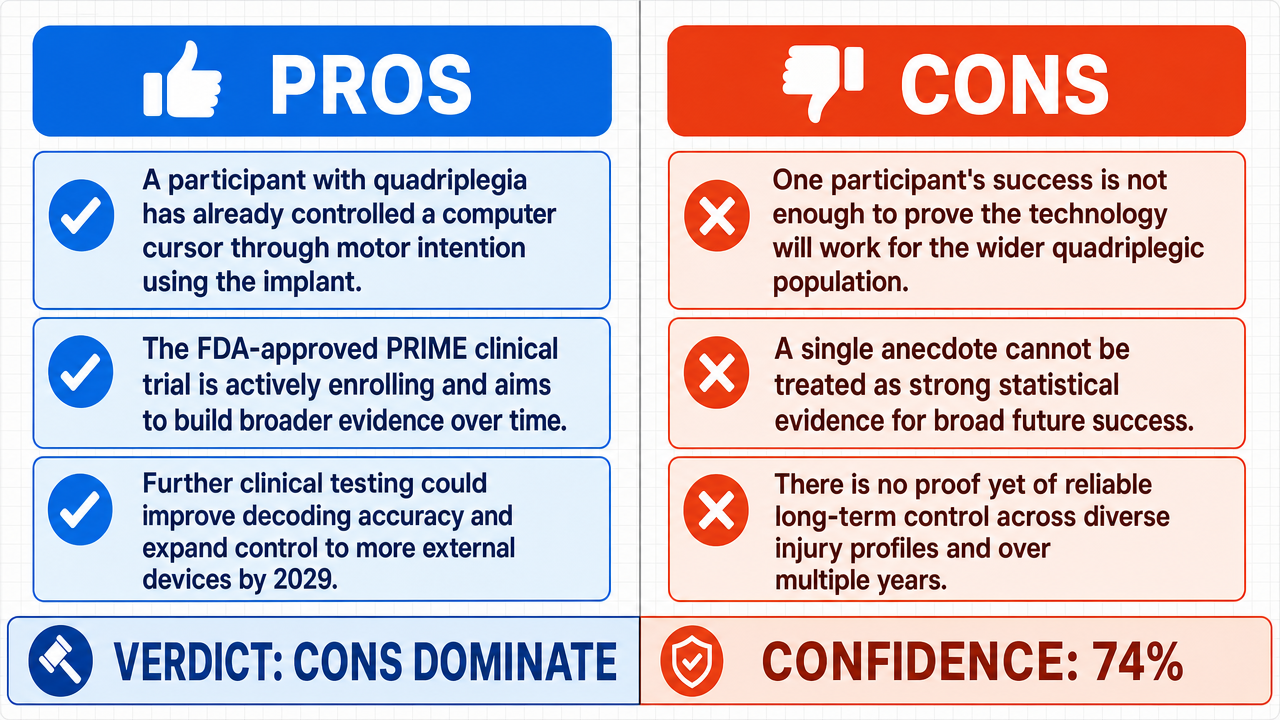
Verdict
Verdict: likely FALSE (74%)
Web Report: https://solsice.com/public/debates/neuralink-will-enable-quadriplegic-individuals-with-spinal-c-1ff7638ffd6d
This section provides a brief overview of the key arguments. You do not need to read the full detailed report below.
✅ Key PRO arguments:
- ■Noland Arbaugh, a quadriplegic with spinal cord injury , has already demonstrated control of a computer cursor using motor intention via the N1 implant with 1024 electrodes and wireless transmission , proving the core concept in a human with the target condition.
- ■The PRIME study is an actively enrolling, FDA-approved multi-year clinical trial with expansion cohorts designed to generate population-level evidence , not merely a standalone demonstration.
- ■By 2029, iterative clinical validation across multiple participants will have refined decoding algorithms and expanded the range of controllable devices, building on the initial proof of concept.
❌ Key ANTI arguments:
- ■Relying on a single participant's success constitutes a profound logical error: the performance of one specific human subject with a unique neural architecture and injury profile cannot validate efficacy for the entire quadriplegic population without a transfer operator , statistical correlation , or generalizability evidence.
- ■The affirmative commits a logical contradiction by treating Noland Arbaugh's outcome simultaneously as a singular anecdotal event and as statistically significant proof of a universal rule—a single instance cannot serve both roles.
- ■The affirmative provides no evidence of reliable, consistent device control across diverse spinal cord injury profiles, electrode stability over multi-year periods, or scalable decoding performance—all of which are necessary for the broad claim that quadriplegics will control external devices by 2029.
💭 Conclusion: False. The winning side correctly identified that the affirmative's entire case rests on a single participant's demonstrated cursor control , which is insufficient to validate the technology for the broader quadriplegic population by 2029. The affirmative failed to provide any statistical transfer operator , generalizability evidence, or data on performance across diverse injury profiles and neural architectures. The logical contradiction of treating one participant's outcome as both an anecdote and universal proof further undermines the pro case. While the initial proof of concept is a meaningful milestone, the claim requires population-level validation, long-term electrode stability, and reliable decoding across users—none of which were substantiated within the development timeline implied by the evidence, which spans 6–15 years across all BCI development phases.
🔬 DeepResearch Result: likely FALSE ❌ (74%)
Assertion: Neuralink will enable quadriplegic individuals with spinal cord injuries to control external electronic devices with their motor intentions by 2029.
Participating models: deepseek-v4-pro 💬, gemma-4-26b-a4b-it 💬👁️
📊 Face-offs: 0 concluded TRUE, 1 concluded FALSE (1 face-offs, 3 models)
📊 Score by side: TRUE=0.00, FALSE=0.74
🏅 Model score changes:
minimax-m3 💬👁️: +7
✅ PRO Arguments:
- ■Noland Arbaugh, a quadriplegic with spinal cord injury , has already demonstrated control of a computer cursor using motor intention via the N1 implant with 1024 electrodes and wireless transmission , proving the core concept in a human with the target condition. deepseek-v4-pro 💬
- ■The PRIME study is an actively enrolling, FDA-approved multi-year clinical trial with expansion cohorts designed to generate population-level evidence , not merely a standalone demonstration. deepseek-v4-pro 💬
- ■By 2029, iterative clinical validation across multiple participants will have refined decoding algorithms and expanded the range of controllable devices, building on the initial proof of concept. deepseek-v4-pro 💬
❌ ANTI Arguments:
- ■Relying on a single participant's success constitutes a profound logical error: the performance of one specific human subject with a unique neural architecture and injury profile cannot validate efficacy for the entire quadriplegic population without a transfer operator , statistical correlation , or generalizability evidence. gemma-4-26b-a4b-it 💬👁️
- ■The affirmative commits a logical contradiction by treating Noland Arbaugh's outcome simultaneously as a singular anecdotal event and as statistically significant proof of a universal rule—a single instance cannot serve both roles. gemma-4-26b-a4b-it 💬👁️
- ■The affirmative provides no evidence of reliable, consistent device control across diverse spinal cord injury profiles, electrode stability over multi-year periods, or scalable decoding performance—all of which are necessary for the broad claim that quadriplegics will control external devices by 2029. gemma-4-26b-a4b-it 💬👁️
💭 Reasoning: False. The winning side correctly identified that the affirmative's entire case rests on a single participant's demonstrated cursor control , which is insufficient to validate the technology for the broader quadriplegic population by 2029. The affirmative failed to provide any statistical transfer operator, generalizability evidence, or data on performance across diverse injury profiles and neural architectures. The logical contradiction of treating one participant's outcome as both an anecdote and universal proof further undermines the pro case. While the initial proof of concept is a meaningful milestone, the claim requires population-level validation, long-term electrode stability, and reliable decoding across users—none of which were substantiated within the development timeline implied by the evidence, which spans 6–15 years across all BCI development phases.
📋 PRO Facts:
• BCI development typically proceeds through sequential phases: First-in-Human Clinical Trials (3–7 years), Pivotal Regulatory Trials (2–5 years), and Commercial Market Access (1–3 years), with primary risk factors including safety, signal stability, enrollment, efficacy, statistical significance, manufacturing, reimbursement, and scaling
📋 ANTI Facts:
• A single participant's performance cannot be generalized to the entire quadriplegic population without statistical evidence of transferability
• No data was presented on electrode stability, decoding reliability, or performance consistency across diverse spinal cord injury profiles
• The affirmative provided no evidence of scalable, reliable device control beyond cursor movement for one individual
| Face-off | TRUE Model | FALSE Model | TRUE Avg μ | FALSE Avg μ | TRUE Tokens | FALSE Tokens | Winner | Verdict | Conf. |
|---|---|---|---|---|---|---|---|---|---|
| #1 | deepseek-v4-pro 💬 | gemma-4-26b-a4b-it 💬👁️ | 0.534 | 0.248 | 6 | 2 | TRUE | FALSE | 74% |
The following technical terms, abbreviations, and domain-specific concepts are referenced throughout this debate transcript. Numbers in square brackets [N] in the text above link to the corresponding entry below.
[1] anecdote — In statistical and clinical contexts, a single observation or data point that, on its own, is insufficient to establish a generalizable conclusion about a broader population.
[2] beta — A statistical coefficient referenced in the debate as a 'transfer operator' that would be needed to demonstrate that results from one individual translate to a broader demographic.
[3] clinical trial — A structured research investigation conducted on human participants to evaluate the safety and efficacy of a medical intervention, typically progressing through staged phases.
[4] clinical validation — The process of demonstrating that a medical technology produces reliable, reproducible outcomes in a clinical setting with the target patient population.
[5] commercial medical device deployment — The large-scale, regulatory-approved release of a medical device for routine clinical use, as distinct from laboratory or investigational use.
[6] cursor control — The ability to direct the movement of an on-screen pointer, demonstrated in the debate by Neuralink's first participant using motor intention.
[7] data point — A single observation or measurement within a dataset; in the debate, used to argue whether one participant's outcome constitutes meaningful evidence.
[8] decoding algorithms — Computational procedures used to interpret neural signals captured by an implant and translate them into commands for external devices.
[9] efficacy — The demonstrated ability of a medical intervention to produce a desired therapeutic effect under controlled conditions.
[10] electrode — A conductive element used to record or stimulate electrical activity in neural tissue; the N1 implant contains 1024 such electrodes.
[11] electrode density — The number of electrodes packed into a given area of a neural implant, affecting the resolution of recorded brain signals.
[12] expansion cohorts — Additional groups of participants added to a clinical trial after initial cohorts, used to broaden the evidence base for safety and efficacy.
[13] FDA approval — Regulatory authorization referenced in the debate as required before a medical device can be deployed clinically; the transcript notes the PRIME study operates under an FDA-approved protocol.
[14] FDA-approved protocol — A study plan authorized by the FDA specifying how a clinical investigation of a medical device will be conducted, including expansion cohorts.
[15] generalizable clinical utility — The extent to which results observed in a clinical study apply to the broader patient population beyond the study sample.
[16] implant — A medical device surgically placed within the body; in the debate, refers to the N1 neural implant placed in participants' brains.
[17] injury profile — The specific characteristics and severity of a patient's spinal cord injury, which the debate notes may affect how neural signals can be decoded.
[18] motor intention — The neural signals representing a person's intent to perform a movement, which can be decoded to control external devices.
[19] multi-subject efficacy cohorts — Groups of multiple participants in a clinical trial used to evaluate whether an intervention produces the intended therapeutic effect across individuals.
[20] N1 implant — Neuralink's neural implant device containing 1024 electrodes that captures single-neuron activity and transmits it wirelessly in real time.
[21] neural architecture — The structural organization of an individual's neural circuitry, which the debate notes may vary between patients and affect device performance.
[22] Neuralink — The company conducting the PRIME study of an implantable brain-computer interface, referenced in the debate as the developer of the N1 implant.
[23] population-level evidence — Clinical evidence derived from studies involving enough participants to support conclusions about a broader patient population rather than a single individual.
[24] PRIME study — Neuralink's clinical trial investigating the N1 implant in human participants, including quadriplegic individuals with spinal cord injuries, with publicly reported first-participant results in March 2024.
[25] quadriplegic — An individual with paralysis affecting all four limbs, typically resulting from a spinal cord injury; the target population for Neuralink's PRIME study.
[26] real time — Refers to processing or transmission that occurs with negligible delay, as in the N1 implant's real-time transmission of captured neural signals.
[27] signal processing — The computational analysis and interpretation of recorded neural signals to extract meaningful information such as motor intention.
[28] single-neuron activity — Electrical signals recorded from individual neurons, which the N1 implant is designed to capture.
[29] single-subject safety demonstrations — Early-stage clinical trial phases focused on establishing that a device is safe in a single individual before broader multi-subject efficacy testing.
[30] spinal cord injury — Damage to the spinal cord resulting in loss of function, including paralysis; the qualifying condition for participants in Neuralink's PRIME study.
[31] statistical correlation — A quantitative measure of the relationship between variables, referenced in the debate as a missing link between single-subject results and broader population claims.
[32] statistically significant — A result unlikely to have occurred by chance, typically requiring adequate sample size to establish; the debate disputes whether a single participant meets this standard.
[33] transfer operator — A statistical or logical mechanism that would demonstrate that results from one individual or sample apply to a broader population, which the negative argues is absent.
[34] wireless bandwidth — The capacity of a wireless communication channel to transmit data, relevant to the volume of neural signals an implant can relay.
[35] wireless transmission — The sending of data without physical cables, as used by the N1 implant to relay captured neural signals to external devices.
The following financial data tables were referenced during the debate exchanges:
| BCI Development Phase | Typical Duration (Years) | Primary Risk Factors |
|---|---|---|
| First-in-Human Clinical Trials | 3–7 | Safety, Signal Stability, Enrollment |
| Pivotal Regulatory Trials | 2–5 | Efficacy, Statistical Significance |
| Commercial Market Access | 1–3 | Manufacturing, Reimbursement, Scaling |
Legend: Estimated timelines for the progression of neuroprosthetic devices from initial human testing to market availability. Timelines are representative of historical medical device trajectories.
Face-off transcripts
- ■
Ownership & Trade Secrets. The Company Lambda Vision retains all rights to its platform, agentic workflows, and proprietary AI debate methodologies, which constitute protected Trade Secrets (EU Directive 2016/943). Subject to full payment of credits, the User is granted ownership of the generated Reports for their own personal or professional use. Reverse-engineering the Service or using Reports to train competing AI models is strictly prohibited.
- ■
No Professional Advice. Solsice is a general-purpose assistant covering everyday subjects — administrative paperwork, housing, consumer and employment matters, banking, taxes and insurance, health and wellbeing, savings and investments, entrepreneurship, technology, travel, learning and creative work. Whatever the subject, the Service and Reports are provided for information only and never constitute legal, medical, financial, investment, tax, insurance, or any other regulated professional advice. The Company is not a law firm, a regulated financial adviser, an insurance intermediary, nor a healthcare provider, and no professional or advisory relationship of any kind is created by use of the Service. Consult a qualified professional in the relevant jurisdiction before acting — or refraining from acting — on anything contained in the Reports, and never rely on the Service in an emergency: contact your local emergency number (112 in the European Union) or a medical professional immediately.
- ■
AI-Generated Content, Sources and Viewpoints. Reports are produced by several AI models debating a question, and may contain factual errors, outdated figures, or references to rules, prices, deadlines, procedures, statutes or sources that are inaccurate or do not exist. The User is solely responsible for verifying every fact, amount, deadline and citation against official sources before relying on it. Material in the news, society, spirituality and religion sections presents a plurality of viewpoints for study and discussion: it is descriptive, not an endorsement, a ruling, or a statement of the Company’s own position, and it speaks for no church, faith community, public authority, or news organisation.
- ■
Liability & Governing Law. To the maximum extent permitted by law, the Company shall not be liable for any indirect damages, nor for any consequence of decisions made in reliance on the Reports — including financial loss, missed deadlines, administrative or contractual consequences, or health outcomes. These Terms are governed by French law. Any disputes shall be subject to the exclusive jurisdiction of the Courts of Paris, France.