
Nerve, if not supported by 'constructive audacity,' amounts to nothing more than 'the babbling of a beginner.'
AI debate verdict and arguments
⚠️ AI-generated information only; not professional advice
Completed October 11, 2026
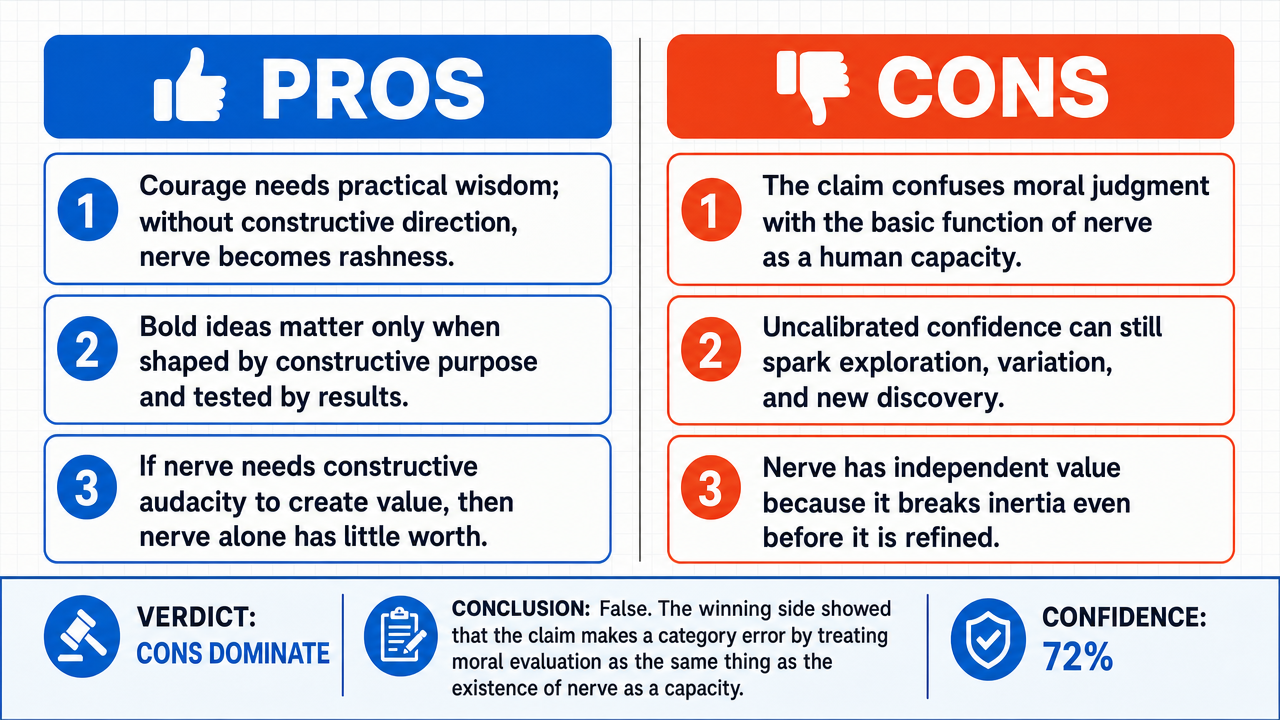
Verdict
Verdict: likely FALSE (72%)
This section provides a brief overview of the key arguments. You do not need to read the full detailed report below.
✅ Key PRO arguments:
- ■Aristotle's virtue ethics supports the claim because courage is a mean concerning fear and confidence that requires practical wisdom ; rashness is the vice of excessive confidence without right reason , so unguided nerve is morally empty rather than admirable.
- ■Popper's account of scientific discovery shows that bold conjectures only become discoveries when disciplined by constructive intent and tested against results, so nerve cannot function as an independent catalyst apart from constructive audacity .
- ■The two cases exhaust nerve 's relation to constructive intent: if accompanied by it, nerve is not independent; if not accompanied by it, nerve reduces to unprincipled boldness that lacks substantive value.
❌ Key ANTI arguments:
- ■The claim commits a category error by conflating the moral quality of an act with the functional essence of the capacity that drives it; Aristotle and Confucius evaluate the character of the agent, not the ontological status of nerve itself, so moral critique cannot collapse nerve into 'nothing.'
- ■Applying the Dunning-Kruger effect to dismiss uncalibrated confidence as 'babbling' ignores the essential role of unguided variance in initiating epistemic and systemic change; beginners' bold attempts are often the seed of breakthroughs.
- ■Nerve possesses an independent functional essence as a stochastic driver and catalyst for breaking inertia , regardless of whether it is morally calibrated; even rash confidence is misapplied confidence, not non-existent confidence.
💭 Conclusion: False. The FALSE side won because it successfully identified a category error at the heart of the assertion: the claim conflates the moral evaluation of an agent's character with the functional existence of the psychological capacity called nerve . Aristotle's distinction between courage and rashness , and Confucius's distinction between the gentleman and the petty person, both evaluate how boldness is applied within a moral framework, not whether the boldness itself exists or has causal power. The PRO side's appeal to Popper similarly addresses when bold conjectures yield discovery, not whether unguided nerve has any functional role. The ANTI side further argued, and the judge accepted, that nerve serves as a stochastic driver and inertia -breaker whose value is not extinguished by the absence of constructive intent, and that dismissing beginners' bold attempts as mere 'babbling' overlooks the role of unguided variance in initiating change. Because the assertion is compound (nerve amounts to nothing AND it is merely babbling), confidence is set at the judge's 72% rather than higher, reflecting that while the category-error argument is strong, the moral-functional distinction is a matter of interpretive framing rather than demonstrable fact.
🔬 DeepResearch Result: likely FALSE ❌ (72%)
Assertion: Nerve , if not supported by 'constructive audacity ,' amounts to nothing more than 'the babbling of a beginner.'
Participating models: deepseek-v3.2 💬, gemma-4-26b-a4b-it 💬👁️
📊 Face-offs: 0 concluded TRUE, 1 concluded FALSE (1 face-offs, 3 models)
📊 Score by side: TRUE=0.00, FALSE=0.72
🏅 Model score changes:
minimax-m3 💬👁️: +7
✅ PRO Arguments:
- ■Aristotle's virtue ethics supports the claim because courage is a mean concerning fear and confidence that requires practical wisdom ; rashness is the vice of excessive confidence without right reason , so unguided nerve is morally empty rather than admirable. deepseek-v3.2 💬
- ■Popper's account of scientific discovery shows that bold conjectures only become discoveries when disciplined by constructive intent and tested against results, so nerve cannot function as an independent catalyst apart from constructive audacity. deepseek-v3.2 💬
- ■The two cases exhaust nerve's relation to constructive intent: if accompanied by it, nerve is not independent; if not accompanied by it, nerve reduces to unprincipled boldness that lacks substantive value. deepseek-v3.2 💬
- ■Confucian ethics similarly distinguishes the gentleman (righteousness with nerve) from the petty person (nerve without righteousness), reinforcing that constructive direction is what gives boldness its moral and practical weight. deepseek-v3.2 💬
❌ ANTI Arguments:
- ■The claim commits a category error by conflating the moral quality of an act with the functional essence of the capacity that drives it; Aristotle and Confucius evaluate the character of the agent, not the ontological status of nerve itself, so moral critique cannot collapse nerve into 'nothing.' gemma-4-26b-a4b-it 💬👁️
- ■Applying the Dunning-Kruger effect to dismiss uncalibrated confidence as 'babbling' ignores the essential role of unguided variance in initiating epistemic and systemic change; beginners' bold attempts are often the seed of breakthroughs. gemma-4-26b-a4b-it 💬👁️
- ■Nerve possesses an independent functional essence as a stochastic driver and catalyst for breaking inertia , regardless of whether it is morally calibrated; even rash confidence is misapplied confidence, not non-existent confidence. gemma-4-26b-a4b-it 💬👁️
- ■History of discovery shows that nerve unaccompanied by constructive intent still functions as a vital catalyst for breakthroughs, because the initial impulse to act precedes and enables later refinement rather than being subordinate to it. gemma-4-26b-a4b-it 💬👁️
💭 Reasoning: False. The FALSE side won because it successfully identified a category error at the heart of the assertion: the claim conflates the moral evaluation of an agent's character with the functional existence of the psychological capacity called nerve. Aristotle's distinction between courage and rashness, and Confucius's distinction between the gentleman and the petty person, both evaluate how boldness is applied within a moral framework, not whether the boldness itself exists or has causal power. The PRO side's appeal to Popper similarly addresses when bold conjectures yield discovery, not whether unguided nerve has any functional role. The ANTI side further argued, and the judge accepted, that nerve serves as a stochastic driver and inertia-breaker whose value is not extinguished by the absence of constructive intent, and that dismissing beginners' bold attempts as mere 'babbling' overlooks the role of unguided variance in initiating change. Because the assertion is compound (nerve amounts to nothing AND it is merely babbling), confidence is set at the judge's 72% rather than higher, reflecting that while the category-error argument is strong, the moral-functional distinction is a matter of interpretive framing rather than demonstrable fact.
📋 PRO Facts:
• Aristotle's Nicomachean Ethics defines courage as a mean concerning fear and confidence, with rashness as excess of confidence without right reason.
• Popper's account of scientific discovery treats bold conjectures as requiring critical testing to become knowledge.
• Confucian ethics distinguishes the gentleman, who combines righteousness with nerve, from the petty person, who has nerve without righteousness.
📋 ANTI Facts:
• The Dunning-Kruger effect describes how unskilled individuals overestimate their competence, but this is a cognitive bias observation, not a claim that the underlying confidence lacks functional effect.
• Stochastic drivers in exploratory processes can produce useful variance even when unguided by a constructive end.
• Moral frameworks evaluate the character of an agent and the quality of an act, not the ontological status of the psychological capacities involved.
| Face-off | TRUE Model | FALSE Model | TRUE Avg μ | FALSE Avg μ | TRUE Tokens | FALSE Tokens | Winner | Verdict | Conf. |
|---|---|---|---|---|---|---|---|---|---|
| #1 | deepseek-v3.2 💬 | gemma-4-26b-a4b-it 💬👁️ | 0.540 | 0.380 | 12 | 3 | TRUE | FALSE | 72% |
The following technical terms, abbreviations, and domain-specific concepts are referenced throughout this debate transcript. Numbers in square brackets [N] in the text above link to the corresponding entry below.
[1] Analects — A collection of sayings and ideas attributed to Confucius and his disciples, forming the foundational text of Confucian philosophy; referenced in the debate via the citation to the 'wei-yang' chapter.
[2] Aristotelian virtue ethics — An ethical framework developed by Aristotle that defines moral virtue as a mean between extremes of excess and deficiency, requiring practical wisdom (phronesis) to guide action.
[3] bold conjecture — In Karl Popper's philosophy of science, a daring and testable hypothesis whose scientific value depends on rigorous attempts at refutation rather than on the confidence with which it is proposed.
[4] category error — A philosophical mistake of assigning a property or concept to something that belongs to an entirely different category or domain; in the debate, the negative argues the affirmative commits this by treating moral evaluation as a statement about functional existence.
[5] Confucian — Relating to the ethical and philosophical system developed by Confucius, which emphasizes moral cultivation, social harmony, and righteousness as the proper guide for courage.
[6] constructive audacity — A term used in the debate to denote boldness that is directed toward building something and tested by results, as opposed to untested or unguided boldness.
[7] Dunning-Kruger effect — A cognitive bias in which people with limited skill or knowledge in a domain overestimate their own ability, while experts tend to underestimate theirs; cited in the debate as relevant to uncalibrated confidence.
[8] epistemic — Relating to knowledge, its acquisition, justification, and the conditions under which beliefs are warranted; used in the debate to describe change driven by nerve.
[9] fallacy of relevance — A logical fallacy in which an argument relies on premises that are logically irrelevant to the conclusion, even if persuasive; the negative accuses the affirmative of this by conflating moral quality with functional essence.
[10] functional essence — In the debate, the inherent operational role or purpose of a capacity (such as nerve), distinguished from its moral evaluation.
[11] functional utility — The practical usefulness or operational role of a capacity or action, independent of its moral quality; the negative argues nerve possesses this regardless of constructive intent.
[12] gentleman — junzi — In Confucian ethics, a morally cultivated person who embodies righteousness, propriety, and benevolent conduct; courage without righteousness is said to produce disorder in such a person.
[13] inertia — In the debate, used metaphorically to describe resistance to change in a system; nerve is described as capable of breaking such inertia.
[14] moral mean — golden mean — In Aristotle's ethics, the desirable middle ground between two extremes of excess and deficiency in which virtue lies; courage is a mean between cowardice and rashness.
[15] nerve — In the debate, the psychological readiness to act in the face of uncertainty, treated as a functional capacity whose moral status depends on whether it is disciplined by constructive intent.
[16] Nicomachean Ethics — Aristotle's principal work on ethics, which defines virtue as a mean between extremes and emphasizes the role of practical wisdom in directing courage.
[17] ontological — Relating to ontology, the branch of philosophy concerned with the nature of being, existence, and reality; used in the debate to distinguish what nerve 'is' from how it is morally evaluated.
[18] ontological status — The nature of a thing's existence or reality, as distinct from its moral or functional evaluation; the negative argues the affirmative confuses moral critique with a claim about ontological status.
[19] Popperian — Relating to the philosophy of science developed by Karl Popper, which emphasizes falsifiability and bold conjectures subjected to severe testing.
[20] practical wisdom — phronesis — In Aristotelian ethics, the intellectual virtue that enables a person to deliberate well about what is good and beneficial in particular situations; required to direct courage rightly.
[21] psychological readiness — The mental preparedness to initiate action under conditions of uncertainty or risk; offered in the debate as a functional definition of nerve.
[22] rashness — In Aristotle's ethics, the vice of excessive confidence in the face of danger without right reason, contrasted with courage as a mean.
[23] refutation — The act of disproving a hypothesis or claim by demonstrating that it is false or inconsistent with evidence; in Popperian philosophy, the severe testing through which bold conjectures gain scientific value.
[24] right reason — In Aristotelian ethics, the correct rational principle that guides virtuous action, distinguishing courage from rashness.
[25] righteousness — In Confucian ethics, the moral quality of acting in accordance with what is just and proper; courage without righteousness is said to produce disorder or robbery.
[26] stochastic — Relating to randomness or probability; in the debate, nerve is described as a stochastic driver of change.
[27] unguided variance — In the debate, variation or boldness that is not directed by constructive intent, argued by the negative to play an essential role in initiating epistemic and systemic change.
[28] vice — In virtue ethics, a moral deficiency or excess that falls outside the mean of virtuous action; rashness is classified as a vice.
[29] virtue — In virtue ethics, a moral excellence lying between extremes of excess and deficiency, requiring practical wisdom to achieve.
[30] virtue ethics — A branch of normative ethics that focuses on the moral character of the agent rather than duties or consequences, with roots in Aristotle's philosophy.
Face-off transcripts
- ■
Ownership & Trade Secrets. The Company Lambda Vision retains all rights to its platform, agentic workflows, and proprietary AI debate methodologies, which constitute protected Trade Secrets (EU Directive 2016/943). Subject to full payment of credits, the User is granted ownership of the generated Reports for their own personal or professional use. Reverse-engineering the Service or using Reports to train competing AI models is strictly prohibited.
- ■
No Professional Advice. Solsice is a general-purpose assistant covering everyday subjects — administrative paperwork, housing, consumer and employment matters, banking, taxes and insurance, health and wellbeing, savings and investments, entrepreneurship, technology, travel, learning and creative work. Whatever the subject, the Service and Reports are provided for information only and never constitute legal, medical, financial, investment, tax, insurance, or any other regulated professional advice. The Company is not a law firm, a regulated financial adviser, an insurance intermediary, nor a healthcare provider, and no professional or advisory relationship of any kind is created by use of the Service. Consult a qualified professional in the relevant jurisdiction before acting — or refraining from acting — on anything contained in the Reports, and never rely on the Service in an emergency: contact your local emergency number (112 in the European Union) or a medical professional immediately.
- ■
AI-Generated Content, Sources and Viewpoints. Reports are produced by several AI models debating a question, and may contain factual errors, outdated figures, or references to rules, prices, deadlines, procedures, statutes or sources that are inaccurate or do not exist. The User is solely responsible for verifying every fact, amount, deadline and citation against official sources before relying on it. Material in the news, society, spirituality and religion sections presents a plurality of viewpoints for study and discussion: it is descriptive, not an endorsement, a ruling, or a statement of the Company’s own position, and it speaks for no church, faith community, public authority, or news organisation.
- ■
Liability & Governing Law. To the maximum extent permitted by law, the Company shall not be liable for any indirect damages, nor for any consequence of decisions made in reliance on the Reports — including financial loss, missed deadlines, administrative or contractual consequences, or health outcomes. These Terms are governed by French law. Any disputes shall be subject to the exclusive jurisdiction of the Courts of Paris, France.