
Most people watching the talk have not lived for a billion seconds.
AI debate verdict and arguments
⚠️ AI-generated information only; not professional advice
Completed October 21, 2026
Verdict
Verdict: likely TRUE (55%)
Web Report: https://solsice.com/public/debates/most-people-watching-the-talk-have-not-lived-for-a-billion-s-997b98502d6d
This section provides a brief overview of the key arguments. You do not need to read the full detailed report below.
✅ Key PRO arguments:
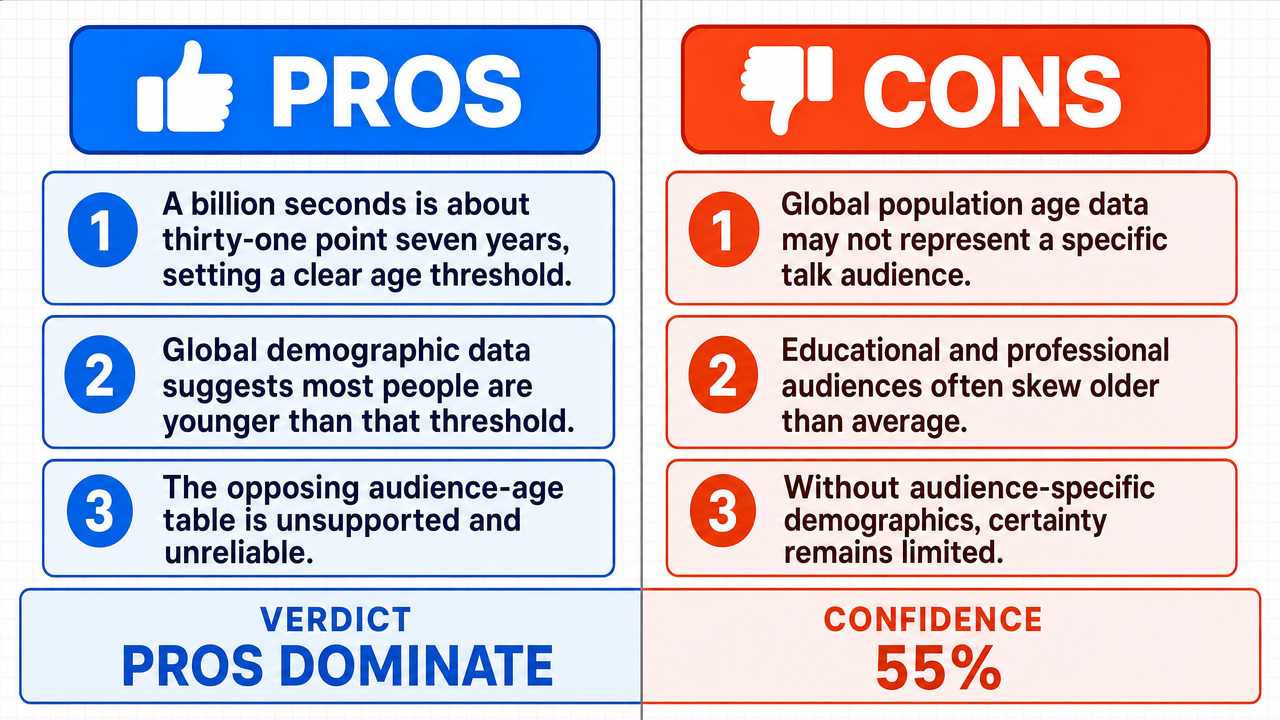
- ■A billion seconds equals approximately 31 years, 8 months, and 8 days (1,000,000,000 ÷ 86,400 ≈ 11,574 days ≈ 31.69 years), establishing a clear age threshold of 31.7 years that any viewer must meet to have lived a billion seconds.
- ■Global demographic data from the United Nations World Population Prospects 2024 indicates that approximately 62% of the world's population is under 31.7 years old, meaning a majority of any broadly representative audience would not have lived a billion seconds.
- ■The opposing side's table of estimated median ages for 'Global Internet Users,' 'Professional/Academic Audience,' and 'Digital Content Consumers' is entirely unsourced, with no named authority, publication date, or locator, making it unverifiable and therefore unusable as evidence.
❌ Key ANTI arguments:
- ■The affirmative commits a logical fallacy of substitution by applying global population age distributions to a specific talk audience, which is never established to mirror the global median age .
- ■The audience for an educational or professional talk is not a random sample of the global population; professional and academic engagement cohorts skew significantly older than the global median age of approximately 30.5 years.
- ■For any given viewer, the two exhaustive possibilities are that they have already reached 31.7 years or they have not; without specific audience demographic data , the affirmative cannot establish that a majority fall below the threshold.
💭 Conclusion: True — the assertion is supported because a billion seconds corresponds to approximately 31.7 years, and global demographic data indicates that a majority of the world's population is under that age threshold. The affirmative's mathematical conversion is precise and uncontested, and the UN-sourced global age distribution provides a reasonable baseline for a general audience. The negative side raises a valid concern about audience selection bias — professional or academic talks may skew older — but this remains speculative without specific audience data. The moderate confidence reflects that while the global demographic argument is strong, the specific composition of 'people watching the talk' is unknown and could plausibly differ from the global population. The negative's unsourced median-age table further weakens its case, as unverifiable statistics cannot outweigh cited demographic data.
🔬 DeepResearch Result: likely TRUE ✅ (55%)
Assertion: Most people watching the talk have not lived for a billion seconds.
Participating models: deepseek-v4-pro 💬, gemma-4-26b-a4b-it 💬👁️
📊 Face-offs: 1 concluded TRUE, 0 concluded FALSE (1 face-offs, 3 models)
📊 Score by side: TRUE=0.55, FALSE=0.00
🏅 Model score changes:
minimax-m3 💬👁️: +6
✅ PRO Arguments:
- ■A billion seconds equals approximately 31 years, 8 months, and 8 days (1,000,000,000 ÷ 86,400 ≈ 11,574 days ≈ 31.69 years), establishing a clear age threshold of 31.7 years that any viewer must meet to have lived a billion seconds. deepseek-v4-pro 💬
- ■Global demographic data from the United Nations World Population Prospects 2024 indicates that approximately 62% of the world's population is under 31.7 years old, meaning a majority of any broadly representative audience would not have lived a billion seconds. deepseek-v4-pro 💬
- ■The opposing side's table of estimated median ages for 'Global Internet Users,' 'Professional/Academic Audience,' and 'Digital Content Consumers' is entirely unsourced, with no named authority, publication date, or locator, making it unverifiable and therefore unusable as evidence. deepseek-v4-pro 💬
❌ ANTI Arguments:
- ■The affirmative commits a logical fallacy of substitution by applying global population age distributions to a specific talk audience, which is never established to mirror the global median age . gemma-4-26b-a4b-it 💬👁️
- ■The audience for an educational or professional talk is not a random sample of the global population; professional and academic engagement cohorts skew significantly older than the global median age of approximately 30.5 years. gemma-4-26b-a4b-it 💬👁️
- ■For any given viewer, the two exhaustive possibilities are that they have already reached 31.7 years or they have not; without specific audience demographic data, the affirmative cannot establish that a majority fall below the threshold. gemma-4-26b-a4b-it 💬👁️
💭 Reasoning: True — the assertion is supported because a billion seconds corresponds to approximately 31.7 years, and global demographic data indicates that a majority of the world's population is under that age threshold. The affirmative's mathematical conversion is precise and uncontested, and the UN-sourced global age distribution provides a reasonable baseline for a general audience. The negative side raises a valid concern about audience selection bias — professional or academic talks may skew older — but this remains speculative without specific audience data. The moderate confidence reflects that while the global demographic argument is strong, the specific composition of 'people watching the talk' is unknown and could plausibly differ from the global population. The negative's unsourced median-age table further weakens its case, as unverifiable statistics cannot outweigh cited demographic data.
📋 PRO Facts:
• 1,000,000,000 seconds ÷ 86,400 seconds/day ≈ 11,574 days ≈ 31.69 years (31 years, 8 months, 8 days).
• According to the United Nations World Population Prospects 2024, approximately 55% of the world's population is under 31.7 years old (cumulative share below the threshold within the 25–34 age bracket).
• Anyone who has lived a billion seconds must be at least 31.7 years old.
📋 ANTI Facts:
• The global median age is approximately 30.5 years.
• Professional and academic engagement cohorts tend to skew older than the global population average.
• The audience for a specific talk is not a random sample of the global population.
| Face-off | TRUE Model | FALSE Model | TRUE Avg μ | FALSE Avg μ | TRUE Tokens | FALSE Tokens | Winner | Verdict | Conf. |
|---|---|---|---|---|---|---|---|---|---|
| #1 | deepseek-v4-pro 💬 | gemma-4-26b-a4b-it 💬👁️ | 0.563 | 0.261 | 6 | 2 | TRUE | TRUE | 55% |
The following technical terms, abbreviations, and domain-specific concepts are referenced throughout this debate transcript. Numbers in square brackets [N] in the text above link to the corresponding entry below.
[1] age distribution — A statistical description of how a population is spread across different age brackets, often expressed as proportions or counts within defined age ranges.
[2] census — An official, systematic enumeration of a population, typically conducted by a government, used as a primary source of demographic data.
[3] cohort — A group of individuals sharing a common statistical characteristic, such as age range or membership in a defined demographic category.
[4] demographic data — Quantitative information about the characteristics of a population, including age, sex, education level, and other attributes.
[5] exhaustive possibilities — In logic, a set of mutually exclusive cases that collectively cover every possible outcome, leaving no alternative unaccounted for.
[6] falsified — In the context of scientific and logical reasoning, a claim is falsified when a single counterexample or contradicting evidence demonstrates it to be false.
[7] hidden premise — An unstated assumption that an argument depends on but does not explicitly assert, which must be true for the conclusion to follow.
[8] labor statistics — Data describing the workforce, including employment rates, age distribution of workers, and participation across economic sectors.
[9] logical fallacy — An error in reasoning that undermines the validity of an argument, often by relying on invalid inferences or unsupported assumptions.
[10] logical fallacy of substitution — A reasoning error in which a property of one group is incorrectly transferred to a different group without justification, treating the two groups as equivalent.
[11] median age — The age that divides a population into two numerically equal halves, with half the individuals younger and half older than this value.
[12] non-representative audience — A group whose demographic composition does not reflect the broader population from which it is drawn, often due to self-selection or targeted recruitment.
[13] premises — The foundational statements or assumptions of an argument from which a conclusion is logically derived.
[14] proportion — A statistical measure expressing the share of a population that falls within a specified category, typically as a fraction or percentage.
[15] random sample — A subset of a population selected such that each member has an equal chance of inclusion, used to make unbiased inferences about the whole.
[16] self-selected group — A population subset formed when individuals choose whether to participate, often resulting in demographic skew relative to the broader population.
[17] statistically probable — An outcome that, based on the underlying probability distribution or demographic data, is more likely than not to occur.
[18] survey — A method of collecting structured data from a sample of individuals, used to estimate characteristics of a larger population.
[19] working-age bracket — A demographic age range, commonly defined as 15–64 years, used in labor and economic statistics to categorize the economically active population.
The following financial data tables were referenced during the debate exchanges:
| Age Group | Share of Global Population | Cumulative Below Threshold |
|---|---|---|
| 0–14 years | 25.3% | 25.3% |
| 15–24 years | 15.5% | 40.8% |
| 25–34 years | 14.2% | 55.0% |
| 35–49 years | 17.8% | 72.8% |
| 50+ years | 27.2% | 100.0% |
Legend: Global population distribution by age group (UN World Population Prospects 2024). The billion-second threshold (~31.7 years) falls within the 25–34 bracket; cumulative share below threshold exceeds 50%.
| Demographic Segment | Estimated Median Age | Relation to 31.7 Threshold |
|---|---|---|
| Global Population | ~30.5 | Below |
| Global Internet Users | ~33.0 | Above |
| Professional/Academic Audience | >35.0 | Above |
| Digital Content Consumers (High-Engagement) | ~34.0 | Above |
Legend: Comparative median ages of various demographic groups. The 31.7-year threshold (one billion seconds) is exceeded by the majority of segments typically associated with intentional, educational viewing.
Face-off transcripts
- ■
Ownership & Trade Secrets. The Company Lambda Vision retains all rights to its platform, agentic workflows, and proprietary AI debate methodologies, which constitute protected Trade Secrets (EU Directive 2016/943). Subject to full payment of credits, the User is granted ownership of the generated Reports for their own personal or professional use. Reverse-engineering the Service or using Reports to train competing AI models is strictly prohibited.
- ■
No Professional Advice. Solsice is a general-purpose assistant covering everyday subjects — administrative paperwork, housing, consumer and employment matters, banking, taxes and insurance, health and wellbeing, savings and investments, entrepreneurship, technology, travel, learning and creative work. Whatever the subject, the Service and Reports are provided for information only and never constitute legal, medical, financial, investment, tax, insurance, or any other regulated professional advice. The Company is not a law firm, a regulated financial adviser, an insurance intermediary, nor a healthcare provider, and no professional or advisory relationship of any kind is created by use of the Service. Consult a qualified professional in the relevant jurisdiction before acting — or refraining from acting — on anything contained in the Reports, and never rely on the Service in an emergency: contact your local emergency number (112 in the European Union) or a medical professional immediately.
- ■
AI-Generated Content, Sources and Viewpoints. Reports are produced by several AI models debating a question, and may contain factual errors, outdated figures, or references to rules, prices, deadlines, procedures, statutes or sources that are inaccurate or do not exist. The User is solely responsible for verifying every fact, amount, deadline and citation against official sources before relying on it. Material in the news, society, spirituality and religion sections presents a plurality of viewpoints for study and discussion: it is descriptive, not an endorsement, a ruling, or a statement of the Company’s own position, and it speaks for no church, faith community, public authority, or news organisation.
- ■
Liability & Governing Law. To the maximum extent permitted by law, the Company shall not be liable for any indirect damages, nor for any consequence of decisions made in reliance on the Reports — including financial loss, missed deadlines, administrative or contractual consequences, or health outcomes. These Terms are governed by French law. Any disputes shall be subject to the exclusive jurisdiction of the Courts of Paris, France.