
Monetization for 'shorts' creators on the popular video-sharing platform is poor, requiring an immense volume of content for minimal income.
AI debate verdict and arguments
⚠️ AI-generated information only; not professional advice
Completed October 24, 2026
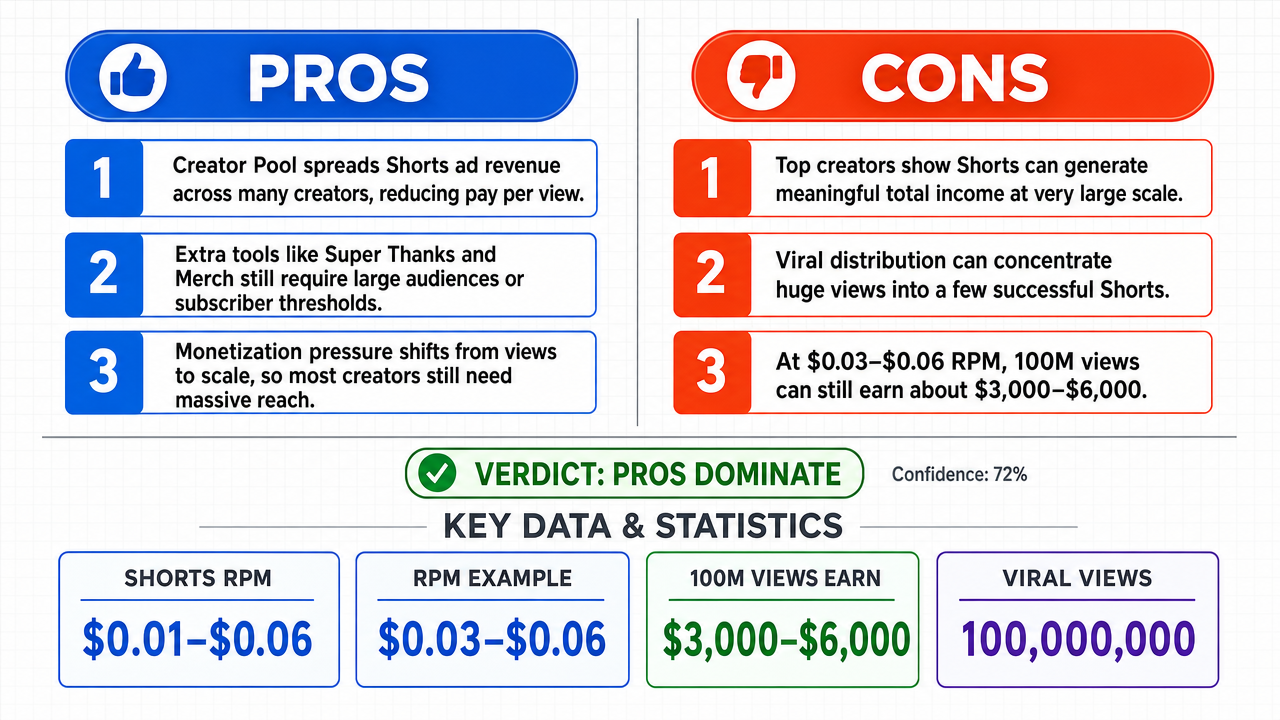
Verdict
Verdict: likely TRUE (72%)
Web Report: https://solsice.com/public/debates/monetization-for-shorts-creators-on-the-popular-video-sharin-6c90debade89
This section provides a brief overview of the key arguments. You do not need to read the full detailed report below.
✅ Key PRO arguments:
- ■Shorts monetization operates on a 'Creator Pool ' model where all ad revenue from the Shorts Feed is aggregated, a portion is deducted for music licensing , and the remainder is distributed based on each creator's share of total views. This structural dilution means that even high view counts do not translate to proportionally high earnings, as revenue is spread across a massive global pool of creators.
- ■Direct monetization tools like 'Super Thanks ' and the 'Merch Shelf ' do not actually bypass the volume requirement. The Merch Shelf itself requires a minimum of 10,000 subscribers , meaning a creator cannot claim to have escaped the need for scale while relying on a tool that is gated by a significant audience-size threshold.
- ■The dependency on scale is not eliminated by alternative monetization tools; it is merely shifted from raw view volume to subscriber count thresholds, reinforcing the structural requirement for immense audience size before meaningful income is achievable.
❌ Key ANTI arguments:
- ■Top-tier creators demonstrate that Shorts monetization can produce substantial aggregate earnings. Analysis of MrBeast's financial performance indicates his total YouTube revenue exceeded $100 million in 2023, with Shorts serving as a primary driver of this financial success, showing the platform can support significant income.
- ■The 'Volume Trap ' argument incorrectly assumes monetization requires continuous, linear accumulation of views. The Shorts algorithm is designed to amplify viral content , meaning a single high-performing video can generate hundreds of millions of views within days, producing burst income without requiring constant high-frequency production .
- ■At an estimated RPM of $0.03 to $0.06, a single viral short with 100 million views can yield between $3,000 and $6,000, which is not 'minimal' income and does not require a cycle of constant high-frequency production to monetize the views already received.
💭 Conclusion: True — the structural argument that Shorts monetization is inadequate for the vast majority of creators was judged more compelling than the counterexamples of top earners. The Creator Pool model fundamentally dilutes per-view earnings by aggregating revenue, deducting music licensing costs, and distributing the remainder proportionally across all Shorts views globally, meaning even high view counts yield minimal individual returns. While the opposing side cited MrBeast's millions in Shorts revenue and viral-burst income of $3,000–$6,000 per 100 million views, these represent exceptional outliers rather than the typical creator experience. The Merch Shelf 's 10,000-subscriber gate further demonstrates that even alternative monetization channels are themselves scaled behind audience thresholds. The moderate confidence reflects that the structural dilution argument is strong for average creators, though the existence of viral outliers and top earners prevents a higher confidence level.
🔬 DeepResearch Result: likely TRUE ✅ (72%)
Assertion: Monetization for 'shorts' creators on the popular video-sharing platform is poor, requiring an immense volume of content for minimal income.
Participating models: gemma-4-26b-a4b-it 💬👁️, glm-4.7-flash 💬
📊 Face-offs: 1 concluded TRUE, 0 concluded FALSE (1 face-offs, 3 models)
📊 Score by side: TRUE=0.72, FALSE=0.00
🏅 Model score changes:
minimax-m3 💬👁️: +7
✅ PRO Arguments:
- ■Shorts monetization operates on a 'Creator Pool ' model where all ad revenue from the Shorts Feed is aggregated, a portion is deducted for music licensing , and the remainder is distributed based on each creator's share of total views. This structural dilution means that even high view counts do not translate to proportionally high earnings, as revenue is spread across a massive global pool of creators. gemma-4-26b-a4b-it 💬👁️
- ■Direct monetization tools like 'Super Thanks ' and the 'Merch Shelf ' do not actually bypass the volume requirement. The Merch Shelf itself requires a minimum of 10,000 subscribers , meaning a creator cannot claim to have escaped the need for scale while relying on a tool that is gated by a significant audience-size threshold. gemma-4-26b-a4b-it 💬👁️
- ■The dependency on scale is not eliminated by alternative monetization tools; it is merely shifted from raw view volume to subscriber count thresholds, reinforcing the structural requirement for immense audience size before meaningful income is achievable. gemma-4-26b-a4b-it 💬👁️
❌ ANTI Arguments:
- ■Top-tier creators demonstrate that Shorts monetization can produce substantial aggregate earnings. Analysis of MrBeast's financial performance indicates his total YouTube revenue exceeded $100 million in 2023, with Shorts serving as a primary driver of this financial success, showing the platform can support significant income. glm-4.7-flash 💬
- ■The 'Volume Trap ' argument incorrectly assumes monetization requires continuous, linear accumulation of views. The Shorts algorithm is designed to amplify viral content , meaning a single high-performing video can generate hundreds of millions of views within days, producing burst income without requiring constant high-frequency production . glm-4.7-flash 💬
- ■At an estimated RPM of $0.03 to $0.06, a single viral short with 100 million views can yield between $3,000 and $6,000, which is not 'minimal' income and does not require a cycle of constant high-frequency production to monetize the views already received. glm-4.7-flash 💬
💭 Reasoning: True — the structural argument that Shorts monetization is inadequate for the vast majority of creators was judged more compelling than the counterexamples of top earners. The Creator Pool model fundamentally dilutes per-view earnings by aggregating revenue, deducting music licensing costs, and distributing the remainder proportionally across all Shorts views globally, meaning even high view counts yield minimal individual returns. While the opposing side cited MrBeast's millions in Shorts revenue and viral-burst income of $3,000–$6,000 per 100 million views, these represent exceptional outliers rather than the typical creator experience. The Merch Shelf's 10,000-subscriber gate further demonstrates that even alternative monetization channels are themselves scaled behind audience thresholds. The moderate confidence reflects that the structural dilution argument is strong for average creators, though the existence of viral outliers and top earners prevents a higher confidence level.
📋 PRO Facts:
• Shorts use a 'Creator Pool' revenue distribution model where aggregated ad revenue is split after music licensing costs are deducted
• The Merch Shelf requires a minimum of 10,000 subscribers to access
• Revenue in the Creator Pool model is distributed based on each creator's share of total Shorts views globally
📋 ANTI Facts:
• Top-tier creators like MrBeast generate millions in revenue from Shorts alone
• Shorts RPM is estimated at $0.03 to $0.06
• A single viral short with 100 million views can yield between $3,000 and $6,000 in estimated revenue
| Face-off | TRUE Model | FALSE Model | TRUE Avg μ | FALSE Avg μ | TRUE Tokens | FALSE Tokens | Winner | Verdict | Conf. |
|---|---|---|---|---|---|---|---|---|---|
| #1 | gemma-4-26b-a4b-it 💬👁️ | glm-4.7-flash 💬 | 0.317 | 0.370 | 4 | 4 | FALSE | TRUE | 72% |
The following technical terms, abbreviations, and domain-specific concepts are referenced throughout this debate transcript. Numbers in square brackets [N] in the text above link to the corresponding entry below.
[1] ad impressions — advertising impressions — Individual instances of an advertisement being displayed to a viewer; a core unit used to measure advertising reach and calculate revenue in digital platforms.
[2] ad-revenue sharing — advertising revenue sharing — A monetization model in which a platform distributes a portion of the advertising income it generates to content creators, typically based on views or engagement metrics.
[3] algorithm — In the context of social media platforms, the recommendation system that determines which content is surfaced to users; the debate references its role in amplifying viral Shorts.
[4] burst income — A pattern of revenue characterized by large, concentrated earnings from a single event (such as a viral video) rather than steady, continuous accumulation.
[5] continuous scroll — A user interface pattern in which content plays automatically in sequence as the viewer scrolls, characteristic of short-form video feeds like YouTube Shorts.
[6] Creator Pool — YouTube's revenue distribution model for Shorts, in which advertising revenue from the Shorts Feed is aggregated, a portion is allocated to music licensing, and the remainder is divided among creators based on their share of total views.
[7] direct monetization tools — Platform features that allow creators to earn revenue outside of traditional ad-revenue sharing, such as tips, merchandise sales, or paid interactions with viewers.
[8] high-frequency production — A content creation strategy involving the rapid, repeated release of new videos, often discussed in the context of Shorts creators needing constant output to accumulate views.
[9] impression — A single instance of an advertisement or piece of content being displayed to a user; the debate notes that Shorts impressions have lower monetary value due to rapid consumption patterns.
[10] livable income — An earnings level sufficient to cover basic living expenses; referenced in the debate as the threshold Shorts creators must reach through secondary channels.
[11] long-form video — Video content of extended duration (typically over 10 minutes on YouTube), which the debate contrasts with Shorts as having a different and more favorable monetization structure.
[12] Merch Shelf — Merchandise Shelf — A YouTube feature that allows eligible creators to display and sell branded merchandise directly beneath their videos; the debate notes it requires a minimum of 10,000 subscribers.
[13] monetization — The process by which content creators generate revenue from their content, typically through advertising, tips, merchandise, or platform-specific programs.
[14] music licensing — The legal arrangement permitting the use of copyrighted music in content; under the Creator Pool model, a portion of Shorts ad revenue is allocated to cover these licensing costs before distribution to creators.
[15] niche audiences — Small, specialized viewer segments defined by specific interests; cited in the debate as a potential basis for revenue through direct monetization tools rather than mass ad impressions.
[16] revenue distribution models — The structural frameworks platforms use to allocate advertising income among creators; the debate contrasts the Creator Pool model used for Shorts with direct ad-revenue sharing used for long-form video.
[17] Revenue Per Mille (RPM) — Revenue Per Mille — A metric representing the estimated revenue earned per one thousand views; the debate cites Shorts RPM as significantly lower than long-form RPM, with industry estimates of $0.03 to $0.06.
[18] RPM — Revenue Per Mille — Abbreviation for Revenue Per Mille, a metric representing estimated earnings per one thousand views; central to the debate's comparison of Shorts versus long-form earnings.
[19] Shorts Feed — The vertical, scrollable interface on YouTube where short-form videos are displayed and from which all Shorts advertising revenue is aggregated under the Creator Pool model.
[20] subscribers — Users who have opted to follow a creator's channel; the debate notes that certain monetization features like the Merch Shelf are gated by a minimum subscriber threshold.
[21] Super Thanks — A YouTube feature that allows viewers to send monetary tips to creators on individual videos, cited as a direct monetization tool that bypasses ad-revenue sharing.
[22] viral content — Content that achieves rapid, widespread distribution through algorithmic amplification and social sharing; the debate argues viral Shorts can generate substantial 'burst income' from a single upload.
[23] viral scale — The level of audience reach and view volume associated with viral content; cited as the threshold at which Shorts monetization becomes financially significant.
[24] viral spikes — Sudden, sharp increases in viewership that can occur when content is amplified by a platform's algorithm; the debate uses this concept to argue against the necessity of constant content production.
[25] Volume Trap — A concept introduced in the debate describing the alleged requirement for Shorts creators to produce an immense volume of content to achieve meaningful income due to low per-view earnings.
The following financial data tables were referenced during the debate exchanges:
| Content Format | Estimated RPM Range (USD) | Revenue Model Type | Scalability Requirement |
|---|---|---|---|
| Long-form Video | $2.00 - $10.00+ | Direct Ad-Share | Moderate |
| YouTube Shorts | $0.01 - $0.06 | Creator Pool | Extreme |
Legend: Estimated RPM (Revenue Per Mille) represents earnings per 1,000 views. Values are approximations based on industry creator reports and platform mechanics.
| Metric | Value | Calculation Basis |
|---|---|---|
| Viral Views | 100,000,000 | Example viral short |
| RPM | $0.03 - $0.06 | Industry estimate (midpoint $0.045) |
| Estimated Earnings | $3,000 - $6,000 | 100M views × RPM range |
Legend: Earnings calculated using the midpoint of the $0.01-$0.06 RPM range and a viral view count of 100 million. RPM stands for Revenue Per Mille (per 1,000 views).
Face-off transcripts
- ■
Ownership & Trade Secrets. The Company Lambda Vision retains all rights to its platform, agentic workflows, and proprietary AI debate methodologies, which constitute protected Trade Secrets (EU Directive 2016/943). Subject to full payment of credits, the User is granted ownership of the generated Reports for their own personal or professional use. Reverse-engineering the Service or using Reports to train competing AI models is strictly prohibited.
- ■
No Professional Advice. Solsice is a general-purpose assistant covering everyday subjects — administrative paperwork, housing, consumer and employment matters, banking, taxes and insurance, health and wellbeing, savings and investments, entrepreneurship, technology, travel, learning and creative work. Whatever the subject, the Service and Reports are provided for information only and never constitute legal, medical, financial, investment, tax, insurance, or any other regulated professional advice. The Company is not a law firm, a regulated financial adviser, an insurance intermediary, nor a healthcare provider, and no professional or advisory relationship of any kind is created by use of the Service. Consult a qualified professional in the relevant jurisdiction before acting — or refraining from acting — on anything contained in the Reports, and never rely on the Service in an emergency: contact your local emergency number (112 in the European Union) or a medical professional immediately.
- ■
AI-Generated Content, Sources and Viewpoints. Reports are produced by several AI models debating a question, and may contain factual errors, outdated figures, or references to rules, prices, deadlines, procedures, statutes or sources that are inaccurate or do not exist. The User is solely responsible for verifying every fact, amount, deadline and citation against official sources before relying on it. Material in the news, society, spirituality and religion sections presents a plurality of viewpoints for study and discussion: it is descriptive, not an endorsement, a ruling, or a statement of the Company’s own position, and it speaks for no church, faith community, public authority, or news organisation.
- ■
Liability & Governing Law. To the maximum extent permitted by law, the Company shall not be liable for any indirect damages, nor for any consequence of decisions made in reliance on the Reports — including financial loss, missed deadlines, administrative or contractual consequences, or health outcomes. These Terms are governed by French law. Any disputes shall be subject to the exclusive jurisdiction of the Courts of Paris, France.