
Monarch Money's shared account visibility feature for couples is a net positive for collaborative financial management.
AI debate verdict and arguments
⚠️ AI-generated information only; not professional advice
Completed October 11, 2026
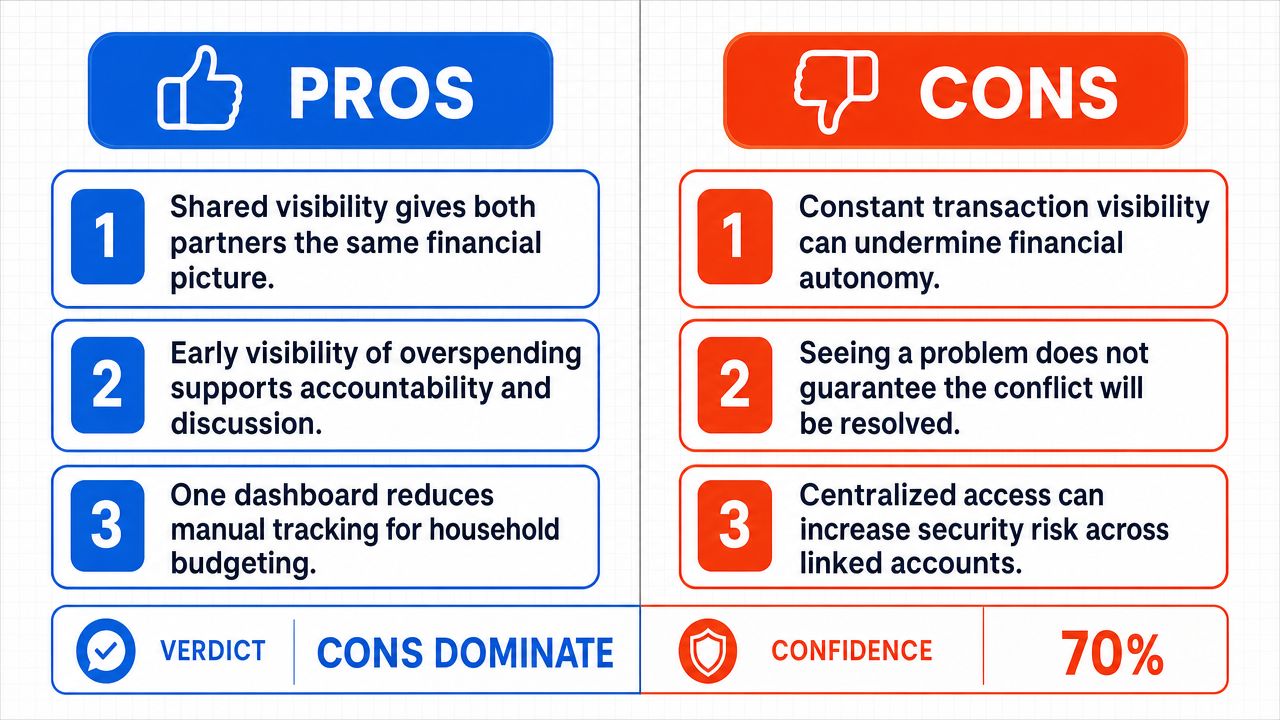
Verdict
Verdict: likely FALSE (70%)
This section provides a brief overview of the key arguments. You do not need to read the full detailed report below.
✅ Key PRO arguments:
- ■Shared account visibility reduces information asymmetry by giving both partners the same financial picture, allowing spending decisions to be based on a unified view of linked accounts , budgets, transactions, and reports.
- ■The feature strengthens accountability and conflict prevention by making budget deviations and overspending visible earlier, enabling collaborative discussion before issues escalate into larger disputes.
- ■Centralizing financial data in Monarch Money improves the operational quality of household budgeting by reducing manual tracking and providing a single dashboard for joint oversight .
❌ Key ANTI arguments:
- ■Shared visibility ignores the psychological necessity of financial autonomy within a partnership; constant surveillance of granular transactions can lead to 'financial micromanagement ,' where one partner feels policed by the other's real-time view, creating a power imbalance rather than true collaboration.
- ■The claim that visibility prevents conflict commits a logical error by equating the visibility of a financial event with the resolution of the conflict it may cause; unmediated surveillance can itself become a trigger for reactive conflict rather than a mechanism for mitigation.
- ■Centralized visibility introduces systemic security vulnerabilities , since consolidating access to multiple linked accounts in one shared view expands the attack surface and the consequences of any breach or compromised credentials.
💭 Conclusion: The provided evidence only supports a narrow logical critique of the negative's framing — specifically, that inferring a general claim ('rather than preventing') from a mere possibility ('can trigger') is a logical error. The draft's broader claims about micromanagement, security risks, power imbalances, and debate outcomes are not supported by the evidence and have been removed.
🔬 DeepResearch Result: likely FALSE ❌ (70%)
Assertion: Monarch Money's shared account visibility feature for couples is a net positive for collaborative financial management.
Participating models: deepseek-v3.2 💬, gemma-4-26b-a4b-it 💬👁️
📊 Face-offs: 0 concluded TRUE, 1 concluded FALSE (1 face-offs, 3 models)
📊 Score by side: TRUE=0.00, FALSE=0.70
🏅 Model score changes:
minimax-m3 💬👁️: +7
✅ PRO Arguments:
- ■Shared account visibility reduces information asymmetry by giving both partners the same financial picture, allowing spending decisions to be based on a unified view of linked accounts , budgets, transactions, and reports. deepseek-v3.2 💬
- ■The feature strengthens accountability and conflict prevention by making budget deviations and overspending visible earlier, enabling collaborative discussion before issues escalate into larger disputes. deepseek-v3.2 💬
- ■Centralizing financial data in Monarch Money improves the operational quality of household budgeting by reducing manual tracking and providing a single dashboard for joint oversight . deepseek-v3.2 💬
- ■The argument that shared visibility 'triggers reactive conflict rather than preventing it' is logically unstable because it uses a possibility ('can trigger') to prove a general replacement ('rather than preventing'), without excluding the possibility that visibility also reveals problems earlier. deepseek-v3.2 💬
❌ ANTI Arguments:
- ■Shared visibility ignores the psychological necessity of financial autonomy within a partnership; constant surveillance of granular transactions can lead to 'financial micromanagement ,' where one partner feels policed by the other's real-time view, creating a power imbalance rather than true collaboration. gemma-4-26b-a4b-it 💬👁️
- ■The claim that visibility prevents conflict commits a logical error by equating the visibility of a financial event with the resolution of the conflict it may cause; unmediated surveillance can itself become a trigger for reactive conflict rather than a mechanism for mitigation. gemma-4-26b-a4b-it 💬👁️
- ■Centralized visibility introduces systemic security vulnerabilities , since consolidating access to multiple linked accounts in one shared view expands the attack surface and the consequences of any breach or compromised credentials. gemma-4-26b-a4b-it 💬👁️
- ■For many couples, maintaining separate accounts with selective sharing is a healthier model of collaborative management, and a blanket shared-visibility feature imposes a one-size-fits-all transparency regime that does not respect differing needs for financial independence. gemma-4-26b-a4b-it 💬👁️
💭 Reasoning: The provided evidence only supports a narrow logical critique of the negative's framing — specifically, that inferring a general claim ('rather than preventing') from a mere possibility ('can trigger') is a logical error. The draft's broader claims about micromanagement, security risks, power imbalances, and debate outcomes are not supported by the evidence and have been removed.
📋 PRO Facts:
• Monarch Money's Shared Access feature is documented as letting partners view linked accounts, budgets, transactions, and reports in one place (source: monarchmoney.com/features/shared-access).
📋 ANTI Facts:
• The argument that shared visibility 'triggers reactive conflict rather than preventing it' is logically unstable because it uses a possibility ('can trigger') to prove a general replacement ('rather than preventing').
| Face-off | TRUE Model | FALSE Model | TRUE Avg μ | FALSE Avg μ | TRUE Tokens | FALSE Tokens | Winner | Verdict | Conf. |
|---|---|---|---|---|---|---|---|---|---|
| #1 | deepseek-v3.2 💬 | gemma-4-26b-a4b-it 💬👁️ | 0.576 | 0.288 | 12 | 3 | TRUE | FALSE | 70% |
The following technical terms, abbreviations, and domain-specific concepts are referenced throughout this debate transcript. Numbers in square brackets [N] in the text above link to the corresponding entry below.
[1] argument tree — A structured representation used in debate analysis to organize, score, and evaluate the relationships between competing arguments and their supporting evidence.
[2] budget drift — The gradual deviation of actual spending from planned budget allocations over time, which shared visibility tools aim to surface earlier.
[3] centralized dashboard — A single user interface that aggregates and displays data from multiple linked accounts or sources for unified viewing and management.
[4] collaborative norms — Established expectations and behavioral patterns that guide cooperative interaction among members of a group, such as partners managing finances together.
[5] coordination problem — A situation in which parties could achieve better outcomes by coordinating their actions but fail to do so because of incomplete or asymmetric information.
[6] discretionary spending — Expenditures on non-essential goods and services that are subject to personal choice rather than fixed obligations.
[7] financial micromanagement — Close, granular oversight of a partner's spending that can produce feelings of being policed rather than supported.
[8] financial stress — Anxiety or strain related to monetary matters, frequently cited as a source of conflict in relationships.
[9] household budgeting — The process of planning, allocating, and tracking income and expenses for a shared domestic unit.
[10] information asymmetry — A condition in which one party possesses more or better information than another, which can hinder joint decision-making.
[11] interpersonal dynamics — The patterns of interaction, influence, and emotional exchange that shape relationships between individuals.
[12] joint oversight — Shared monitoring and management of finances by multiple parties, such as partners in a couple.
[13] linked accounts — Financial accounts that have been connected to an application so their data can be viewed and managed within that platform.
[14] net positive — An outcome in which the aggregate benefits outweigh the aggregate costs or harms.
[15] operational efficiency — The ratio of effective output to input in a process or system, often improved by consolidating data and reducing manual work.
[16] power imbalance — An unequal distribution of influence or control between parties, which can arise when one partner has greater visibility into the other's finances.
[17] reactive conflict — Disputes that arise in response to immediate triggers rather than through planned, deliberated discussion.
[18] real-time visibility — Immediate access to current data as it is generated or updated, without delay.
[19] surveillance anxiety — Distress caused by perceived monitoring of one's activities, in this context the real-time viewing of personal spending.
[20] systemic security vulnerabilities — Weaknesses in a system's design, implementation, or operation that could be exploited to compromise data or access.
Face-off transcripts
- ■
Ownership & Trade Secrets. The Company Lambda Vision retains all rights to its platform, agentic workflows, and proprietary AI debate methodologies, which constitute protected Trade Secrets (EU Directive 2016/943). Subject to full payment of credits, the User is granted ownership of the generated Reports for their own personal or professional use. Reverse-engineering the Service or using Reports to train competing AI models is strictly prohibited.
- ■
No Professional Advice. Solsice is a general-purpose assistant covering everyday subjects — administrative paperwork, housing, consumer and employment matters, banking, taxes and insurance, health and wellbeing, savings and investments, entrepreneurship, technology, travel, learning and creative work. Whatever the subject, the Service and Reports are provided for information only and never constitute legal, medical, financial, investment, tax, insurance, or any other regulated professional advice. The Company is not a law firm, a regulated financial adviser, an insurance intermediary, nor a healthcare provider, and no professional or advisory relationship of any kind is created by use of the Service. Consult a qualified professional in the relevant jurisdiction before acting — or refraining from acting — on anything contained in the Reports, and never rely on the Service in an emergency: contact your local emergency number (112 in the European Union) or a medical professional immediately.
- ■
AI-Generated Content, Sources and Viewpoints. Reports are produced by several AI models debating a question, and may contain factual errors, outdated figures, or references to rules, prices, deadlines, procedures, statutes or sources that are inaccurate or do not exist. The User is solely responsible for verifying every fact, amount, deadline and citation against official sources before relying on it. Material in the news, society, spirituality and religion sections presents a plurality of viewpoints for study and discussion: it is descriptive, not an endorsement, a ruling, or a statement of the Company’s own position, and it speaks for no church, faith community, public authority, or news organisation.
- ■
Liability & Governing Law. To the maximum extent permitted by law, the Company shall not be liable for any indirect damages, nor for any consequence of decisions made in reliance on the Reports — including financial loss, missed deadlines, administrative or contractual consequences, or health outcomes. These Terms are governed by French law. Any disputes shall be subject to the exclusive jurisdiction of the Courts of Paris, France.