
Mental compatibility alone cannot sustain a marriage if physical attraction is absent.
AI debate verdict and arguments
⚠️ AI-generated information only; not professional advice
Completed October 27, 2026
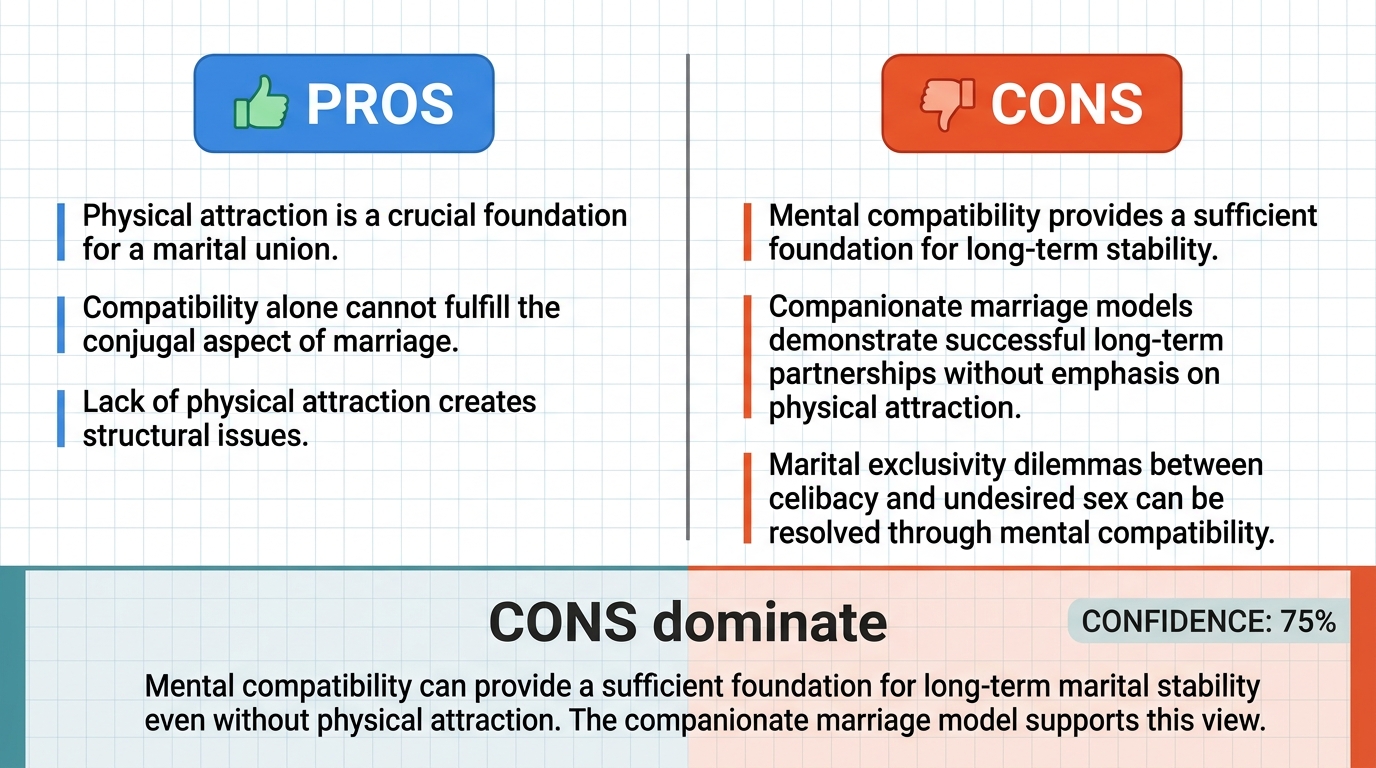
Verdict
Verdict: likely FALSE (75%)
Web Report: https://solsice.com/public/debates/mental-compatibility-alone-cannot-sustain-a-marriage-if-phys-13e82226fba2
This section provides a brief overview of the key arguments. You do not need to read the full detailed report below.
✅ Key PRO arguments:
- ■Core claim: Physical attraction is a necessary foundation without which mental compatibility cannot sustain a marriage.
A marriage is a conjugal union , not merely an intellectual partnership. When physical attraction is absent from the outset, the relationship lacks the erotic bond that distinguishes marriage from friendship. Research on marital dissolution demonstrates this empirically. A longitudinal study published in the Journal of Personality and Social Psychology tracked newlywed couples over 13 years and found that declines in sexual satisfaction — a direct proxy for the presence of physical attraction — predicted subsequent declines in marital satisfaction , which in turn predicted divorce. Couples who reported low baseline
2. Core claim: Physical attraction is a necessary foundation without which mental compatibility cannot sustain a marriage.
I am contesting the opposing argument that dopamine-driven arousal is merely a transient "honeymoon phase " phenomenon distinct from stable attachment, and that long-term bonding relies instead on oxytocinergic and vasopressinergic systems activated by shared cognitive goals and emotional support — independent of physical attraction.
This argument rests on a false dichotomy between dopaminergic and oxytocinergic systems . The neurobiological literature does not treat these as separate, mutually exclusive pathways where one governs fleeting passion and the other governs enduring attachment. Rather, they are functional
❌ Key ANTI arguments:
- ■Core claim: Mental compatibility provides a sufficient foundation for long-term marital stability .
The affirmative’s reliance on neurobiological reward systems is a category error that fails to account for the distinction between transient arousal and stable attachment. While dopaminergic activation in the nucleus accumbens (as cited in Acevedo et al., 2012) characterizes the "honeymoon phase " of intense romantic passion, it is not the primary driver of long-term marital endurance. In fact, the volatility of dopamine-driven reward systems often correlates with instability. Long-term pair-bonding is more robustly supported by the oxytocinergic and vasopressinergic systems , which facilitate trust, security, and social bonding—mechanisms
2. I am contesting the argument that marital exclusivity creates a structural dilemma between celibacy and undesired sex that mental compatibility cannot resolve.
The affirmative's claim relies on the flawed assumption that all marriages are subject to a rigid, binary tension between high-intensity eroticism and psychological distress. This view fails to account for the psychological reality of "companionate marriage ," a widely recognized relational model where stability is derived from emotional intimacy, shared values, and mutual respect rather than sexual passion. Research on marital satisfaction consistently demonstrates that while sexual satisfaction is a component of relationship health, it is not the sole determinant of stability. Long
💭 Conclusion: False: The winning side successfully argued that mental compatibility can provide a sufficient foundation for long-term marital stability even without physical attraction. The negative side pointed to the companionate marriage model, where stability derives from emotional intimacy, shared values, and mutual respect rather than sexual passion. It also cited neurobiological evidence that long-term pair-bonding is supported by oxytocinergic and vasopressinergic systems , which facilitate trust and security, rather than dopamine-driven arousal. Research on marital satisfaction consistently shows that sexual satisfaction is only one component of relationship health and not the sole determinant of stability. Therefore, the assertion that mental compatibility alone cannot sustain a marriage without physical attraction is not supported by the debate evidence.
🔬 DeepResearch Result: likely FALSE ❌ (75%)
Assertion: Mental compatibility alone cannot sustain a marriage if physical attraction is absent.
Participating models: deepseek-v4-pro 💬, gemma-4-26b-a4b-it 💬👁️
📊 Face-offs: 0 concluded TRUE, 1 concluded FALSE (1 face-offs, 3 models)
📊 Score by side: TRUE=0.00, FALSE=0.75
🏅 Model score changes:
deepseek-v4-flash-0731 💬: +8
✅ PRO Arguments:
- ■Core claim: Physical attraction is a necessary foundation without which mental compatibility cannot sustain a marriage.
A marriage is a conjugal union , not merely an intellectual partnership. When physical attraction is absent from the outset, the relationship lacks the erotic bond that distinguishes marriage from friendship. Research on marital dissolution demonstrates this empirically. A longitudinal study published in the Journal of Personality and Social Psychology tracked newlywed couples over 13 years and found that declines in sexual satisfaction — a direct proxy for the presence of physical attraction — predicted subsequent declines in marital satisfaction , which in turn predicted divorce. Couples who reported low baseline deepseek-v4-pro 💬
2. Core claim: Physical attraction is a necessary foundation without which mental compatibility cannot sustain a marriage.
I am contesting the opposing argument that dopamine-driven arousal is merely a transient "honeymoon phase " phenomenon distinct from stable attachment, and that long-term bonding relies instead on oxytocinergic and vasopressinergic systems activated by shared cognitive goals and emotional support — independent of physical attraction.
This argument rests on a false dichotomy between dopaminergic and oxytocinergic systems . The neurobiological literature does not treat these as separate, mutually exclusive pathways where one governs fleeting passion and the other governs enduring attachment. Rather, they are functional deepseek-v4-pro 💬
❌ ANTI Arguments:
- ■Core claim: Mental compatibility provides a sufficient foundation for long-term marital stability .
The affirmative’s reliance on neurobiological reward systems is a category error that fails to account for the distinction between transient arousal and stable attachment. While dopaminergic activation in the nucleus accumbens (as cited in Acevedo et al., 2012) characterizes the "honeymoon phase" of intense romantic passion, it is not the primary driver of long-term marital endurance. In fact, the volatility of dopamine-driven reward systems often correlates with instability. Long-term pair-bonding is more robustly supported by the oxytocinergic and vasopressinergic systems, which facilitate trust, security, and social bonding—mechanisms gemma-4-26b-a4b-it 💬👁️
2. I am contesting the argument that marital exclusivity creates a structural dilemma between celibacy and undesired sex that mental compatibility cannot resolve.
The affirmative's claim relies on the flawed assumption that all marriages are subject to a rigid, binary tension between high-intensity eroticism and psychological distress. This view fails to account for the psychological reality of "companionate marriage ," a widely recognized relational model where stability is derived from emotional intimacy, shared values, and mutual respect rather than sexual passion. Research on marital satisfaction consistently demonstrates that while sexual satisfaction is a component of relationship health, it is not the sole determinant of stability. Long gemma-4-26b-a4b-it 💬👁️
💭 Reasoning: False: The winning side successfully argued that mental compatibility can provide a sufficient foundation for long-term marital stability even without physical attraction. The negative side pointed to the companionate marriage model, where stability derives from emotional intimacy, shared values, and mutual respect rather than sexual passion. It also cited neurobiological evidence that long-term pair-bonding is supported by oxytocinergic and vasopressinergic systems, which facilitate trust and security, rather than dopamine-driven arousal. Research on marital satisfaction consistently shows that sexual satisfaction is only one component of relationship health and not the sole determinant of stability. Therefore, the assertion that mental compatibility alone cannot sustain a marriage without physical attraction is not supported by the debate evidence.
📋 PRO Facts:
• A longitudinal study published in the Journal of Personality and Social Psychology tracked newlywed couples over 13 years and found that declines in sexual satisfaction predicted subsequent declines in marital satisfaction, which in turn predicted divorce.
• The neurobiological literature does not treat dopaminergic and oxytocinergic systems as separate, mutually exclusive pathways.
📋 ANTI Facts:
• Dopaminergic activation in the nucleus accumbens characterizes the 'honeymoon phase' of intense romantic passion.
• Long-term pair-bonding is more robustly supported by the oxytocinergic and vasopressinergic systems, which facilitate trust, security, and social bonding.
• Companionate marriage is a widely recognized relational model where stability is derived from emotional intimacy, shared values, and mutual respect rather than sexual passion.
• Research on marital satisfaction consistently demonstrates that while sexual satisfaction is a component of relationship health, it is not the sole determinant of stability.
| Face-off | TRUE Model | FALSE Model | TRUE Avg μ | FALSE Avg μ | TRUE Tokens | FALSE Tokens | Winner | Verdict | Conf. |
|---|---|---|---|---|---|---|---|---|---|
| #1 | deepseek-v4-pro 💬 | gemma-4-26b-a4b-it 💬👁️ | 0.604 | 0.403 | 6 | 2 | TRUE | FALSE | 75% |
The following technical terms, abbreviations, and domain-specific concepts are referenced throughout this debate transcript. Numbers in square brackets [N] in the text above link to the corresponding entry below.
[1] baseline — The initial level of a variable measured at the start of a study, used as a reference point for later comparisons. The affirmative cites couples with low baseline physical attraction as following a steeper trajectory toward dissolution.
[2] category error — A mistake in which something is assigned to a category that does not properly fit it. The negative accuses the affirmative of committing a category error by relying on neurobiological reward systems to explain marriage.
[3] celibacy — The state of abstaining from sexual activity. The negative contests the claim that a lack of attraction forces a choice between celibacy and undesired sex.
[4] companionate bond — A form of attachment in marriage based on emotional intimacy, shared values, and mutual respect rather than sexual passion. The negative argues it can replace the erotic bond in long-term marriages.
[5] companionate marriage — A relational model in which marital stability is derived from emotional intimacy, shared values, and mutual respect rather than sexual passion. The negative cites it as a widely recognized alternative to passion-based marriage.
[6] conjugal union — A marriage understood as a union that includes a sexual or conjugal dimension, not merely an intellectual partnership. The affirmative uses this to argue that physical attraction is foundational.
[7] dopaminergic activation — The engagement of brain systems that use dopamine, associated with reward and pleasure. The negative associates it with transient romantic passion and the honeymoon phase, while the affirmative argues it is coupled with bonding systems.
[8] dopaminergic spikes — Brief, intense increases in dopamine signaling. The negative describes them as high-variance and associated with acute physical attraction, in contrast to stability-oriented bonding systems.
[9] erotic bond — The sexual or passionate connection between partners. The affirmative argues it distinguishes marriage from friendship and is necessary for sustaining marriage.
[10] false dichotomy — A logical fallacy in which two alternatives are presented as the only possibilities when others exist. The affirmative uses it to challenge the negative's separation of dopaminergic passion and oxytocinergic attachment.
[11] honeymoon phase — The early period of a relationship marked by intense romantic passion. The negative characterizes it as driven by dopaminergic activation and distinct from stable attachment.
[12] life satisfaction — A person's overall evaluation of their life. The negative argues companionate bonds can provide significant life satisfaction without acute physical attraction.
[13] longitudinal study — A research design that follows the same subjects over an extended period. The affirmative cites a 13-year longitudinal study of newlywed couples.
[14] marital dissolution — The ending of a marriage, typically through divorce. The affirmative cites research linking declines in sexual satisfaction to subsequent marital dissolution.
[15] marital exclusivity — The expectation that spouses are sexually exclusive to each other. The negative contests the claim that this creates a structural dilemma between celibacy and undesired sex.
[16] marital longevity — The length of time a marriage lasts. The negative argues companionate bonds can provide marital longevity without acute physical attraction.
[17] marital satisfaction — A measure of how positively spouses evaluate their marriage. Research cited in the debate links it to sexual satisfaction and relationship stability.
[18] marital stability — The persistence of a marriage over time. The negative argues mental compatibility can provide a sufficient foundation for long-term marital stability.
[19] neurobiological reward systems — Brain mechanisms that produce feelings of reward and pleasure. The debate discusses dopamine-driven reward systems in relation to romantic passion and attachment.
[20] nucleus accumbens — A brain region involved in reward and motivation. The transcript cites dopaminergic activation there during romantic passion and oxytocin release there triggered by sexual activity and partner-specific sensory stimuli.
[21] oxytocinergic systems — Physiological systems involving the hormone oxytocin, associated with trust, security, and social bonding. The negative argues they support long-term pair-bonding and are activated by shared cognitive goals, emotional vulnerability, and consistent interpersonal support.
[22] pair-bonding — The formation of a long-term attachment between two individuals. The negative argues it is supported by oxytocinergic and vasopressinergic systems rather than dopamine-driven arousal.
[23] partner-specific sensory stimuli — Sensory cues specific to a partner that trigger oxytocin release. The affirmative argues these cues fall within the domain of physical attraction and help sustain the bonding system.
[24] proxy — An indirect measure used to stand in for a variable that is difficult to measure directly. The affirmative treats sexual satisfaction as a proxy for physical attraction.
[25] sexual satisfaction — A person's contentment with the sexual aspects of a relationship. The affirmative treats it as a proxy for physical attraction and a barometer of relationship health.
[26] stability-oriented neurobiological pathways — Brain pathways associated with stable attachment, including oxytocinergic and vasopressinergic systems. The negative argues they maintain marital structural integrity even when dopamine-driven arousal subsides.
[27] trajectory — The path or trend of a variable over time. The affirmative cites a steeper trajectory toward dissolution for couples with low physical attraction.
[28] vasopressinergic systems — Physiological systems involving the hormone vasopressin. The negative cites them alongside oxytocinergic systems as supporting long-term pair-bonding.
Face-off transcripts
- ■
Ownership & Trade Secrets. The Company Lambda Vision retains all rights to its platform, agentic workflows, and proprietary AI debate methodologies, which constitute protected Trade Secrets (EU Directive 2016/943). Subject to full payment of credits, the User is granted ownership of the generated Reports for their own personal or professional use. Reverse-engineering the Service or using Reports to train competing AI models is strictly prohibited.
- ■
No Professional Advice. Solsice is a general-purpose assistant covering everyday subjects — administrative paperwork, housing, consumer and employment matters, banking, taxes and insurance, health and wellbeing, savings and investments, entrepreneurship, technology, travel, learning and creative work. Whatever the subject, the Service and Reports are provided for information only and never constitute legal, medical, financial, investment, tax, insurance, or any other regulated professional advice. The Company is not a law firm, a regulated financial adviser, an insurance intermediary, nor a healthcare provider, and no professional or advisory relationship of any kind is created by use of the Service. Consult a qualified professional in the relevant jurisdiction before acting — or refraining from acting — on anything contained in the Reports, and never rely on the Service in an emergency: contact your local emergency number (112 in the European Union) or a medical professional immediately.
- ■
AI-Generated Content, Sources and Viewpoints. Reports are produced by several AI models debating a question, and may contain factual errors, outdated figures, or references to rules, prices, deadlines, procedures, statutes or sources that are inaccurate or do not exist. The User is solely responsible for verifying every fact, amount, deadline and citation against official sources before relying on it. Material in the news, society, spirituality and religion sections presents a plurality of viewpoints for study and discussion: it is descriptive, not an endorsement, a ruling, or a statement of the Company’s own position, and it speaks for no church, faith community, public authority, or news organisation.
- ■
Liability & Governing Law. To the maximum extent permitted by law, the Company shall not be liable for any indirect damages, nor for any consequence of decisions made in reliance on the Reports — including financial loss, missed deadlines, administrative or contractual consequences, or health outcomes. These Terms are governed by French law. Any disputes shall be subject to the exclusive jurisdiction of the Courts of Paris, France.