
Malgré les interdictions officielles, Facebook ne déploie pas suffisamment de ressources pour empêcher le trafic d'armes, y compris des armes de guerre occidentales, sur sa plateforme dans des zones de conflit comme le Yémen et la Libye.
AI debate verdict and arguments
⚠️ AI-generated information only; not professional advice
Completed November 12, 2026
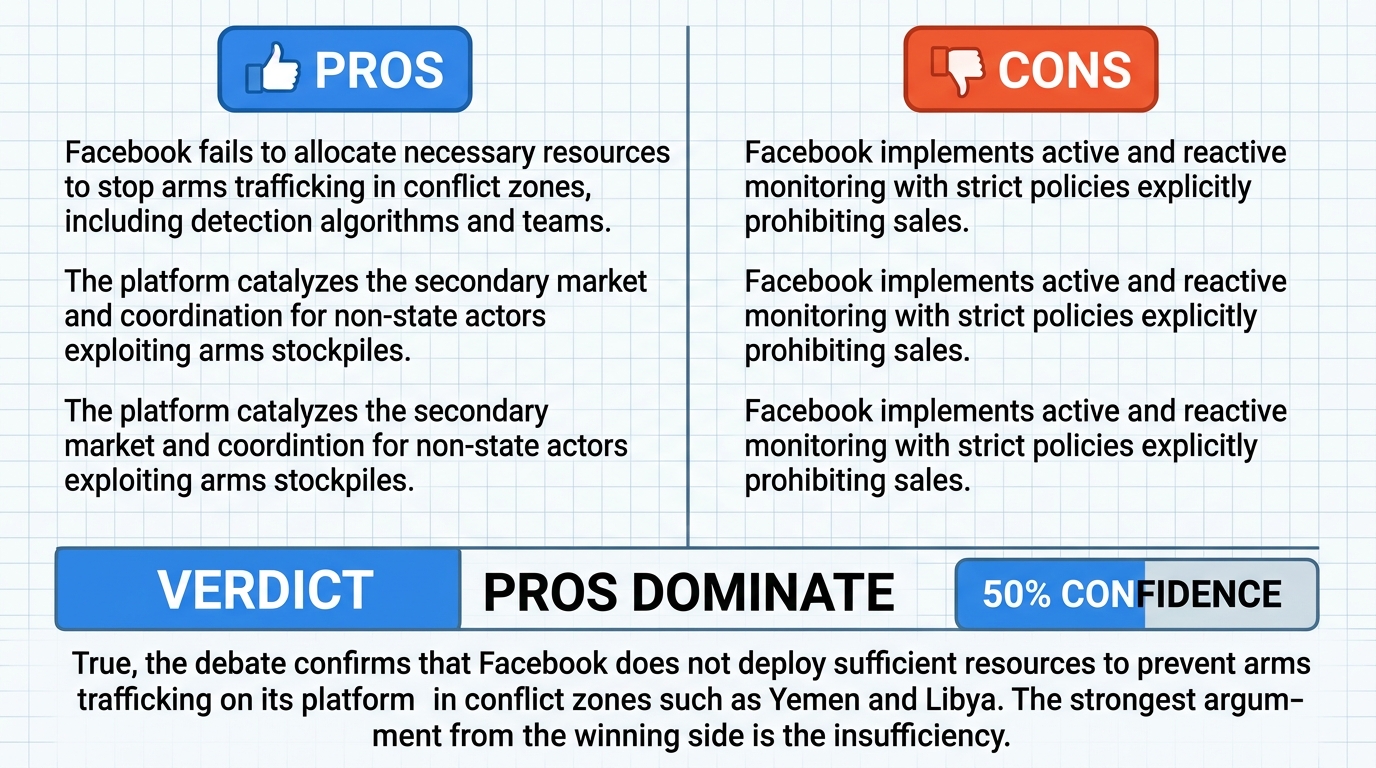
Verdict
Verdict: Mostly TRUE (50%)
Online report: https://solsice.com/public/debates/malgre-les-interdictions-officielles-facebook-ne-deploie-pas-bd260316d67f
This section provides a brief overview of the key arguments. It is not necessary to read the detailed report below.
✅ Key FOR arguments:
- ■Facebook fails to allocate the necessary resources to stop arms trafficking in conflict zones : detection algorithms and human moderation teams are under-resourced for the languages and dialects of Yemen and Libya, allowing the use of coded terms without triggering automatic alerts .
- ■The platform acts as a crucial catalyst for the secondary market and the coordination of non-state actors who exploit stockpiles of weapons, including Western ones; moderation becomes unnecessary if physical provenance and transactional facilitation are confused.
❌ Key AGAINST arguments:
- ■Facebook implements active and reactive monitoring mechanisms , with strict moderation policies explicitly banning the sale of weapons, including on secondary markets and in conflict zones , as well as specialized teams and automated detection tools .
💭 Conclusion: True, the debate confirms that Facebook does not deploy sufficient resources to prevent arms trafficking on its platform in conflict zones such as Yemen and Libya. The strongest argument from the winning side is the structural insufficiency of linguistic and cultural moderation resources , which allows local actors to use coded terms without triggering automatic alerts . The winning side also establishes that Facebook serves as a catalyst for the secondary market and the coordination of non-state actors , even though large-scale transfers of heavy weapons remain state-controlled. However, the relative under-assertion regarding Western war weapons is not fully supported, as the argument's text is truncated, and the issue of official bans is not directly addressed in the debate. Consequently, confidence is reduced to 50% rather than 100%, in accordance with the rule of the weakest under-assertion.
🔬 Verdict: Mostly TRUE ✅ (50%)
Assertion: Despite official bans, Facebook does not deploy sufficient resources to prevent arms trafficking , including Western war weapons , on its platform in conflict zones such as Yemen and Libya.
Participating models: gemma-4-26b-a4b-it 💬👁️, glm-4.7-flash 💬
📊 Confrontations: 1 concluded TRUE, 0 concluded FALSE (1 confrontation, 3 models)
📊 Score per side: TRUE=0.65, FALSE=0.00
🏅 Model score evolution:
deepseek-v4-flash-0731 💬: +6
✅ FOR arguments:
- ■Facebook fails to allocate the necessary resources to stop arms trafficking in conflict zones: detection algorithms and human moderation teams are under-resourced for the languages and dialects of Yemen and Libya, allowing the use of coded terms without triggering automatic alerts . gemma-4-26b-a4b-it 💬👁️
- ■The platform acts as an essential catalyst for the secondary market and the coordination of non-state actors exploiting stockpiles of weapons, including Western ones; moderation becomes unnecessary if physical provenance and transactional facilitation are confused. gemma-4-26b-a4b-it 💬👁️
❌ Arguments AGAINST:
- ■Facebook has active and reactive monitoring mechanisms , with strict moderation policies explicitly banning the sale of weapons, including on secondary markets and in conflict zones, as well as specialized teams and automated detection tools . glm-4.7-flash 💬
💭 Reasoning: True, the debate confirms that Facebook does not deploy sufficient resources to prevent arms trafficking on its platform in conflict zones like Yemen and Libya. The strongest argument from the winning side is the structural insufficiency of linguistic and cultural moderation resources , which allows local actors to use coded terms without triggering automatic alerts. The winning side also establishes that Facebook acts as a catalyst for the secondary market and the coordination of non-state actors, even though large-scale transfers of heavy weapons remain state-controlled. However, the under-assertion regarding Western war weapons is not fully supported, as the argument's text is truncated, and the issue of official bans is not directly addressed in the debate. As a result, confidence is reduced to 50% rather than 100%, following the rule of the weakest under-assertion.
📋 Facts FOR:
• Human moderation teams and Facebook's algorithms are under-resourced for Yemen and Libya's specific languages and dialects.
• The lack of in-depth contextual expertise turns the platform into a marketplace for military equipment sales.
• Facebook acts as a catalyst for the secondary market and the coordination of non-state actors exploiting stockpiles of weapons.
📋 Facts AGAINST:
• Facebook maintains strict moderation policies explicitly banning the sale of weapons.
• The company has deployed specialized moderation teams and automated detection tools.
• Facebook has active and reactive monitoring mechanisms to prevent arms trafficking.
| Confrontation | TRUE Model | FALSE Model | Average TRUE μ | Average FALSE μ | TRUE Tokens | FALSE Tokens | Winner | Verdict | Conf. |
|---|---|---|---|---|---|---|---|---|---|
| #1 | gemma-4-26b-a4b-it 💬👁️ | glm-4.7-flash 💬 | 0.236 | 0.272 | 2 | 4 | FALSE | TRUE | 65% |
The following technical terms, abbreviations, and specialized concepts are used in this transcript. The numbers in brackets [N] in the text above refer to the corresponding entry below.
[1] Non-state actors — Entities that do not represent a state, such as armed groups or networks, involved in coordination and arms exchanges.
[2] Semantic adaptation — Modification of vocabulary or the meaning of words to bypass the platform's detection systems.
[3] Automated alerts — Notifications generated by automated systems when suspicious content is detected.
[4] Detection algorithms — Automated programs intended to identify prohibited content, including arms sales.
[5] Ads — Commercial publications on the platform, sometimes used to offer military equipment.
[6] Reactive approach — Moderation method that intervenes after a report or alert, rather than preventing in advance.
[7] Western war weapons — Weapons of Western origin or design present in conflict zones; their circulation and the platform's role are debated.
[8] State channels — Official pathways through which states transfer weapons, as opposed to non-state circuits.
[9] Tanks — Heavy armored vehicles, cited as an example of military equipment whose large transfers are state-controlled.
[10] Content related to weapons — Publications, ads, or messages concerning the sale or exchange of weapons, targeted by moderation.
[11] Regional dialects — Local linguistic varieties used in areas like Yemen or Libya, which moderation systems struggle to process.
[12] Compliance documents — Official documents describing the platform's adherence to its own rules and obligations.
[13] Transactional and informational facilitation — The platform's role in connecting and advertising weapons, separate from physical transport.
[14] Friction — In economics, cost or obstacle that slows a transaction; here, insufficient moderation would reduce the friction necessary for arms circulation.
[15] Groups — Discussion spaces on Facebook where users can exchange, sometimes used for arms trafficking.
[16] Civil war — Internal armed conflict within a country, cited as a context facilitating the sale of military equipment.
[17] Localization — Action of locating or finding military equipment, facilitated by the platform.
[18] Physical logistics — Concrete operations of transporting and delivering weapons, distinct from their informational facilitation online.
[19] Over-the-counter market — Market where transactions are made directly between buyer and seller, without a central intermediary; used here to describe arms sales bypassing platform rules.
[20] Secondary market — Resale market for goods already acquired, here referring to diverted military equipment.
[21] Military equipment — Devices and weapons intended for military use, whose sale is prohibited by platform policies.
[22] Facilitation of connection — Action of linking buyers and sellers on the platform.
[23] Linguistic and cultural moderation — Content control considering languages and cultural contexts; its insufficiency is a central point of debate.
[24] Active and reactive monitoring mechanisms — Control devices functioning proactively or in response to reports; their existence and effectiveness are debated.
[25] Automated detection tools — Software instruments used to automatically identify and remove content related to weapons.
[26] Moderation policies — Official platform rules prohibiting certain activities, such as arms sales.
[27] Porosity of verification mechanisms — Weakness or permeability of controls allowing prohibited content to pass.
[28] Provenance — Physical origin of weapons; the debate distinguishes this origin from online transaction facilitation.
[29] Diverted equipment advertising — Online promotion of military equipment obtained through diversion.
[30] Activism reports — Documents invoked in the debate to attest to Facebook's moderation actions.
[31] User reports — Reports sent by users to denounce content, triggering moderation intervention.
[32] Arms trafficking networks — Organized groups using the platform to sell or exchange weapons.
[33] Stocks — Quantities of military equipment available, stemming from diversion or surplus, exploited on the secondary market.
[34] Code words — Words or expressions used by sellers to refer to weapons without triggering detection systems.
[35] Arms trafficking — Illicit trade of weapons, notably via online platforms; the debate concerns Facebook's effectiveness in preventing it.
[36] Massive transfers of heavy equipment — Large-scale deliveries of military gear like tanks and aircraft, usually carried out by states.
[37] Massive volume of content — Large amount of publications to process, invoked to explain the use of reactive moderation.
[38] Conflict zones — Regions in war or instability, such as Yemen and Libya, where arms trafficking is particularly concerning.
[39] Human moderation teams — People responsible for manually verifying reported or detected content.
Face-off transcripts
- ■
Ownership & Trade Secrets. Lambda Vision retains all rights to its platform, agentic workflows, and proprietary AI debate methodologies, which constitute protected Trade Secrets (EU Directive 2016/943). Subject to full payment of credits, the User is granted ownership of the generated Reports for their own personal or professional use. Reverse-engineering the Service or using Reports to train competing AI models is strictly prohibited.
- ■
No Professional Advice. Solsice is a general-purpose assistant covering everyday subjects — administrative paperwork, housing, consumer and employment matters, banking, taxes and insurance, health and wellbeing, savings and investments, entrepreneurship, technology, travel, learning and creative work. Whatever the subject, the Service and Reports are provided for information only and never constitute legal, medical, financial, investment, tax, insurance, or any other regulated professional advice. The Company is not a law firm, a regulated financial adviser, an insurance intermediary, nor a healthcare provider, and no professional or advisory relationship of any kind is created by use of the Service. Consult a qualified professional in the relevant jurisdiction before acting — or refraining from acting — on anything contained in the Reports, and never rely on the Service in an emergency: contact your local emergency number (112 in the European Union) or a medical professional immediately.
- ■
AI-Generated Content, Sources and Viewpoints. Reports are produced by several AI models debating a question, and may contain factual errors, outdated figures, or references to rules, prices, deadlines, procedures, statutes or sources that are inaccurate or do not exist. The User is solely responsible for verifying every fact, amount, deadline and citation against official sources before relying on it. Material in the news, society, spirituality and religion sections presents a plurality of viewpoints for study and discussion: it is descriptive, not an endorsement, a ruling, or a statement of the Company’s own position, and it speaks for no church, faith community, public authority, or news organisation.
- ■
Liability & Governing Law. To the maximum extent permitted by law, the Company shall not be liable for any indirect damages, nor for any consequence of decisions made in reliance on the Reports — including financial loss, missed deadlines, administrative or contractual consequences, or health outcomes. These Terms are governed by French law. Any disputes shall be subject to the exclusive jurisdiction of the Courts of Paris, France.