
Live shopping will gradually impact traditional retail to the extent that it will significantly diminish the market share of established brick-and-mortar stores by 2030.
AI debate verdict and arguments
⚠️ AI-generated information only; not professional advice
Completed October 8, 2026
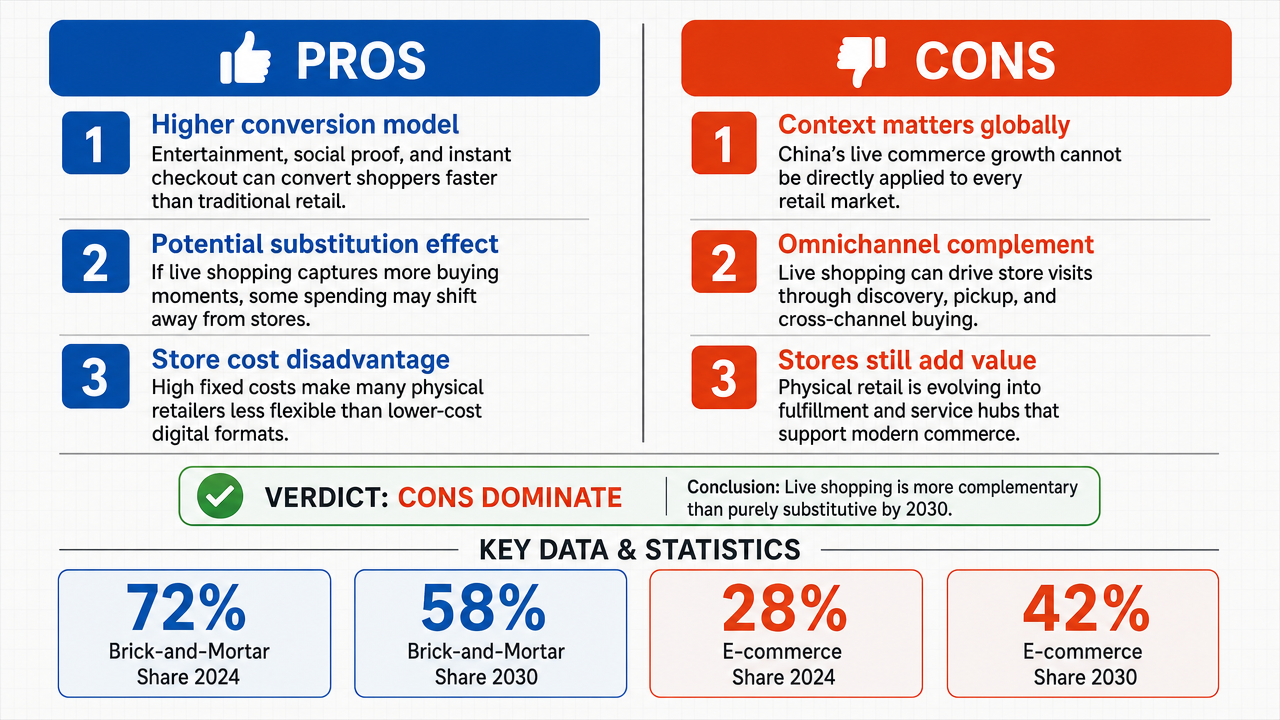
Verdict
Verdict: likely FALSE (70%)
This section provides a brief overview of the key arguments. You do not need to read the full detailed report below.
✅ Key PRO arguments:
- ■Live shopping merges entertainment, social proof, and instant purchasing into a superior conversion model that traditional retail cannot match, accelerating structural shifts in consumer spending toward digital-first channels.
- ■The relationship between live shopping and physical retail is binary: either complementary and additive, or substitutive and reductive. Since live shopping does not generate purely incremental spending, its exponential growth directly cannibalizes brick-and-mortar revenue.
- ■Brick-and-mortar retailers face unsustainable margin pressure due to their high fixed-cost structure , which makes them unable to compete with live shopping 's lower-overhead engagement model .
❌ Key ANTI arguments:
- ■Extrapolating China's live commerce growth to predict global brick-and-mortar erosion is a fundamental error of scale and context, since China's digitally-integrated ecosystem does not replicate in Western markets where physical retail is deeply embedded in logistics and consumer habits.
- ■Live shopping functions as an omnichannel discovery layer that drives physical store traffic through models like BOPIS (Buy Online, Pickup In Store), rather than purely substituting for in-person purchases.
- ■Physical stores are evolving into vital micro-fulfillment hubs that mitigate last-mile delivery costs and stabilize the role of brick-and-mortar within integrated retail networks.
💭 Conclusion: False. The winning side convincingly argued that live shopping functions as a complementary omnichannel layer rather than a purely substitutive force that will significantly erode brick-and-mortar market share by 2030. The affirmative's reliance on China's live commerce GMV projections ($423B to $1.2T, 16% CAGR ) failed to establish a valid transfer mechanism to Western retail landscapes, where physical stores remain deeply embedded in logistics and consumer behavior. The negative demonstrated that live shopping drives physical store traffic through BOPIS models, reframing the relationship as synergistic rather than zero-sum. The demographic inevitability argument was weakened by the absence of evidence that digitally-native consumers abandon tactile evaluation and immediate fulfillment entirely. While live shopping will undoubtedly impact traditional retail, the claim that it will significantly diminish brick-and-mortar market share by 2030 overstates the speed and completeness of displacement given the structural resilience of physical retail in omnichannel ecosystems.
🔬 DeepResearch Result: likely FALSE ❌ (70%)
Assertion: Live shopping will gradually impact traditional retail to the extent that it will significantly diminish the market share of established brick-and-mortar stores by 2030.
Participating models: deepseek-v3.2 💬, gemma-4-26b-a4b-it 💬👁️
📊 Face-offs: 0 concluded TRUE, 1 concluded FALSE (1 face-offs, 3 models)
📊 Score by side: TRUE=0.00, FALSE=0.70
🏅 Model score changes:
minimax-m3 💬👁️: +7
✅ PRO Arguments:
- ■Live shopping merges entertainment, social proof, and instant purchasing into a superior conversion model that traditional retail cannot match, accelerating structural shifts in consumer spending toward digital-first channels. deepseek-v3.2 💬
- ■The relationship between live shopping and physical retail is binary: either complementary and additive, or substitutive and reductive. Since live shopping does not generate purely incremental spending, its exponential growth directly cannibalizes brick-and-mortar revenue. deepseek-v3.2 💬
- ■Brick-and-mortar retailers face unsustainable margin pressure due to their high fixed-cost structure , which makes them unable to compete with live shopping's lower-overhead engagement model . deepseek-v3.2 💬
- ■Demographic inevitability ensures displacement, as digitally-native generations become the dominant consumer base and gravitate toward live commerce formats over physical stores. deepseek-v3.2 💬
- ■China's live commerce GMV is projected to grow from $423B in 2023 to $1.2T by 2030 (16% CAGR ), with global ex-China live commerce projected to grow from $68B to $500B (33% CAGR), demonstrating accelerating capture of consumer spending. deepseek-v3.2 💬
❌ ANTI Arguments:
- ■Extrapolating China's live commerce growth to predict global brick-and-mortar erosion is a fundamental error of scale and context, since China's digitally-integrated ecosystem does not replicate in Western markets where physical retail is deeply embedded in logistics and consumer habits. gemma-4-26b-a4b-it 💬👁️
- ■Live shopping functions as an omnichannel discovery layer that drives physical store traffic through models like BOPIS (Buy Online, Pickup In Store), rather than purely substituting for in-person purchases. gemma-4-26b-a4b-it 💬👁️
- ■Physical stores are evolving into vital micro-fulfillment hubs that mitigate last-mile delivery costs and stabilize the role of brick-and-mortar within integrated retail networks. gemma-4-26b-a4b-it 💬👁️
- ■The zero-sum framing of digital growth equaling physical loss ignores the omnichannel synergy where live streaming events generate awareness and intent that converts into both online and in-store purchases. gemma-4-26b-a4b-it 💬👁️
- ■Live shopping is a transformative complementary tool for modern retail rather than a purely substitutive force, augmenting rather than diminishing the market share of established physical stores. gemma-4-26b-a4b-it 💬👁️
💭 Reasoning: False. The winning side convincingly argued that live shopping functions as a complementary omnichannel layer rather than a purely substitutive force that will significantly erode brick-and-mortar market share by 2030. The affirmative's reliance on China's live commerce GMV projections ($423B to $1.2T, 16% CAGR) failed to establish a valid transfer mechanism to Western retail landscapes, where physical stores remain deeply embedded in logistics and consumer behavior. The negative demonstrated that live shopping drives physical store traffic through BOPIS models, reframing the relationship as synergistic rather than zero-sum. The demographic inevitability argument was weakened by the absence of evidence that digitally-native consumers abandon tactile evaluation and immediate fulfillment entirely. While live shopping will undoubtedly impact traditional retail, the claim that it will significantly diminish brick-and-mortar market share by 2030 overstates the speed and completeness of displacement given the structural resilience of physical retail in omnichannel ecosystems.
📋 PRO Facts:
• China's live commerce GMV was $423B in 2023, projected to reach $1.2T by 2030 at a 16% CAGR.
• Global ex-China live commerce GMV was $68B in 2023, projected to reach $500B by 2030 at a 33% CAGR.
• Live shopping merges entertainment, social proof, and instant purchasing into a single conversion model.
• Brick-and-mortar retailers operate with high fixed-cost structures that constrain margin flexibility.
📋 ANTI Facts:
• China's live commerce ecosystem is culturally and technologically distinct from Western retail markets.
• Live shopping events can drive Buy Online, Pickup In Store (BOPIS) traffic to physical locations.
• Omnichannel retail models integrate live streaming with both online and in-store purchase conversion.
| Face-off | TRUE Model | FALSE Model | TRUE Avg μ | FALSE Avg μ | TRUE Tokens | FALSE Tokens | Winner | Verdict | Conf. |
|---|---|---|---|---|---|---|---|---|---|
| #1 | deepseek-v3.2 💬 | gemma-4-26b-a4b-it 💬👁️ | 0.378 | 0.204 | 12 | 3 | TRUE | FALSE | 70% |
The following technical terms, abbreviations, and domain-specific concepts are referenced throughout this debate transcript. Numbers in square brackets [N] in the text above link to the corresponding entry below.
[1] Basket size — The total monetary value of items purchased by a customer in a single transaction, often used as a retail performance metric.
[2] BOPIS — Buy Online, Pick Up In-Store — A retail fulfillment model in which a customer places an order online and collects it from a physical store location, blending digital and physical retail channels.
[3] Brick-and-mortar — Refers to traditional physical retail stores and establishments, as opposed to online or digital retail operations.
[4] CAGR — Compound Annual Growth Rate — The mean year-over-year growth rate of an investment, market, or metric over a specified period longer than one year, assuming reinvestment of returns.
[5] Cannibalization — In retail, the phenomenon where sales growth of one channel or product reduces sales of another channel or product within the same market or company.
[6] Click-and-collect — A shopping model where customers purchase items online and pick them up at a designated physical location, commonly a retail store.
[7] Cointegration — A statistical property of two or more time series that move together in a stable long-run relationship, even if they diverge in the short term; used in econometric analysis.
[8] Conversion model — A framework describing the rate or process by which prospective customers complete a desired action, such as making a purchase, often expressed as a conversion rate.
[9] Customer acquisition costs — Customer Acquisition Costs (CAC) — The total cost of persuading a consumer to purchase a product or service, including marketing, advertising, and related expenses.
[10] Demographic inevitability — An argument asserting that shifts in population composition (e.g., digitally-native generations becoming dominant consumers) make certain market outcomes unavoidable.
[11] Digitally-native generations — Demographic cohorts, such as Gen Z and Gen Alpha, who have grown up using digital technologies and the internet as integral parts of daily life.
[12] Discovery layer — A stage in the customer journey where consumers encounter and explore new products or brands, often through engaging content such as live streams.
[13] Discretionary spending — Consumer expenditure on non-essential goods and services, which can be reduced or redirected more easily than spending on necessities.
[14] E-commerce — Electronic commerce — The buying and selling of goods or services conducted over the internet, encompassing online storefronts, marketplaces, and live shopping platforms.
[15] Engagement model — A business framework describing how a company interacts with, attracts, and retains customers, often measured through metrics such as time spent, interaction rate, and conversion.
[16] Fixed-cost structure — A business cost profile in which expenses such as rent, utilities, and salaries remain constant regardless of sales volume, characteristic of physical retail operations.
[17] Foot traffic — The number of customers or visitors who physically enter a retail location, commonly measured by traffic analytics systems.
[18] GMV — Gross Merchandise Value — The total monetary value of goods sold through a marketplace or platform over a given period, before deducting fees, returns, or other adjustments.
[19] Impulse purchases — Unplanned buying decisions made by customers at the point of sale, often triggered by in-store displays, promotions, or live shopping interactions.
[20] Last-mile delivery — The final stage of the delivery process, in which goods are transported from a distribution hub to the customer's final destination; typically the most expensive leg of fulfillment.
[21] Live commerce — A form of e-commerce in which products are marketed and sold through interactive live video broadcasts, allowing viewers to purchase in real time.
[22] Live shopping — The practice of selling products via live-streamed video events that combine entertainment, social interaction, and instant purchasing capabilities.
[23] Logistical hub — A centralized facility used for the storage, sorting, and distribution of goods, often serving as a node in a broader supply chain network.
[24] Margin pressure — The reduction or compression of a company's profit margins caused by rising costs, competitive pricing, or shifts in consumer spending patterns.
[25] Market share — The percentage or proportion of total sales in a given market captured by a particular company, channel, or product category.
[26] Micro-fulfillment — Small, often automated distribution centers located close to customers, designed to enable rapid order processing and last-mile delivery.
[27] Omnichannel — A retail strategy that integrates multiple sales and engagement channels (physical, online, mobile, live) into a unified customer experience.
[28] Prime Day — An annual sales event operated by Amazon offering time-limited discounts exclusively to its Prime subscription members.
[29] Singles' Day — A major Chinese shopping festival held on November 11, characterized by large-scale promotional sales across e-commerce and live shopping platforms.
[30] Substitution thesis — The argument that growth in one product, channel, or technology directly replaces or displaces another, rather than coexisting with it.
[31] Tactile evaluation — The physical examination of a product by touch, feel, or in-person inspection prior to purchase, a capability unique to brick-and-mortar retail.
[32] Transfer operator — A mathematical operator used in dynamical systems and functional analysis to describe how a function evolves under iteration; in the debate, the term is used loosely to describe a missing analytical link between two market contexts.
[33] Zero-sum game — A situation in which one participant's gain is exactly balanced by another participant's loss, implying that total resources or value remain constant.
The following financial data tables were referenced during the debate exchanges:
| Market | Live Commerce GMV 2023 | Projected GMV 2030 | CAGR (2023-2030) |
|---|---|---|---|
| China | $423B | $1.2T | 16% |
| Global (ex-China) | $68B | $500B | 33% |
Legend: Gross Merchandise Value (GMV) of live shopping markets. Figures in USD billions. CAGR = Compound Annual Growth Rate. Source: industry analyst reports and market forecasts.
| Channel | Estimated Share 2024 | Projected Share 2030 | Point Change |
|---|---|---|---|
| Brick-and-Mortar | 72% | 58% | -14% |
| E-commerce (total) | 28% | 42% | +14% |
| of which Live Shopping | 3% | 15% | +12% |
Legend: Projected retail market share by channel (global). Figures are percentages of total retail sales. Source: synthesis of market forecasts from eMarketer and Coresight Research (2024-2030 outlook).
Face-off transcripts
- ■
Ownership & Trade Secrets. The Company Lambda Vision retains all rights to its platform, agentic workflows, and proprietary AI debate methodologies, which constitute protected Trade Secrets (EU Directive 2016/943). Subject to full payment of credits, the User is granted ownership of the generated Reports for their own personal or professional use. Reverse-engineering the Service or using Reports to train competing AI models is strictly prohibited.
- ■
No Professional Advice. Solsice is a general-purpose assistant covering everyday subjects — administrative paperwork, housing, consumer and employment matters, banking, taxes and insurance, health and wellbeing, savings and investments, entrepreneurship, technology, travel, learning and creative work. Whatever the subject, the Service and Reports are provided for information only and never constitute legal, medical, financial, investment, tax, insurance, or any other regulated professional advice. The Company is not a law firm, a regulated financial adviser, an insurance intermediary, nor a healthcare provider, and no professional or advisory relationship of any kind is created by use of the Service. Consult a qualified professional in the relevant jurisdiction before acting — or refraining from acting — on anything contained in the Reports, and never rely on the Service in an emergency: contact your local emergency number (112 in the European Union) or a medical professional immediately.
- ■
AI-Generated Content, Sources and Viewpoints. Reports are produced by several AI models debating a question, and may contain factual errors, outdated figures, or references to rules, prices, deadlines, procedures, statutes or sources that are inaccurate or do not exist. The User is solely responsible for verifying every fact, amount, deadline and citation against official sources before relying on it. Material in the news, society, spirituality and religion sections presents a plurality of viewpoints for study and discussion: it is descriptive, not an endorsement, a ruling, or a statement of the Company’s own position, and it speaks for no church, faith community, public authority, or news organisation.
- ■
Liability & Governing Law. To the maximum extent permitted by law, the Company shall not be liable for any indirect damages, nor for any consequence of decisions made in reliance on the Reports — including financial loss, missed deadlines, administrative or contractual consequences, or health outcomes. These Terms are governed by French law. Any disputes shall be subject to the exclusive jurisdiction of the Courts of Paris, France.