
Live shopping platforms like TikTok Shop will enable individuals earning under $20 an hour to achieve $1 million in profit by October 2028 by selling wholesale items.
AI debate verdict and arguments
⚠️ AI-generated information only; not professional advice
Completed October 8, 2026
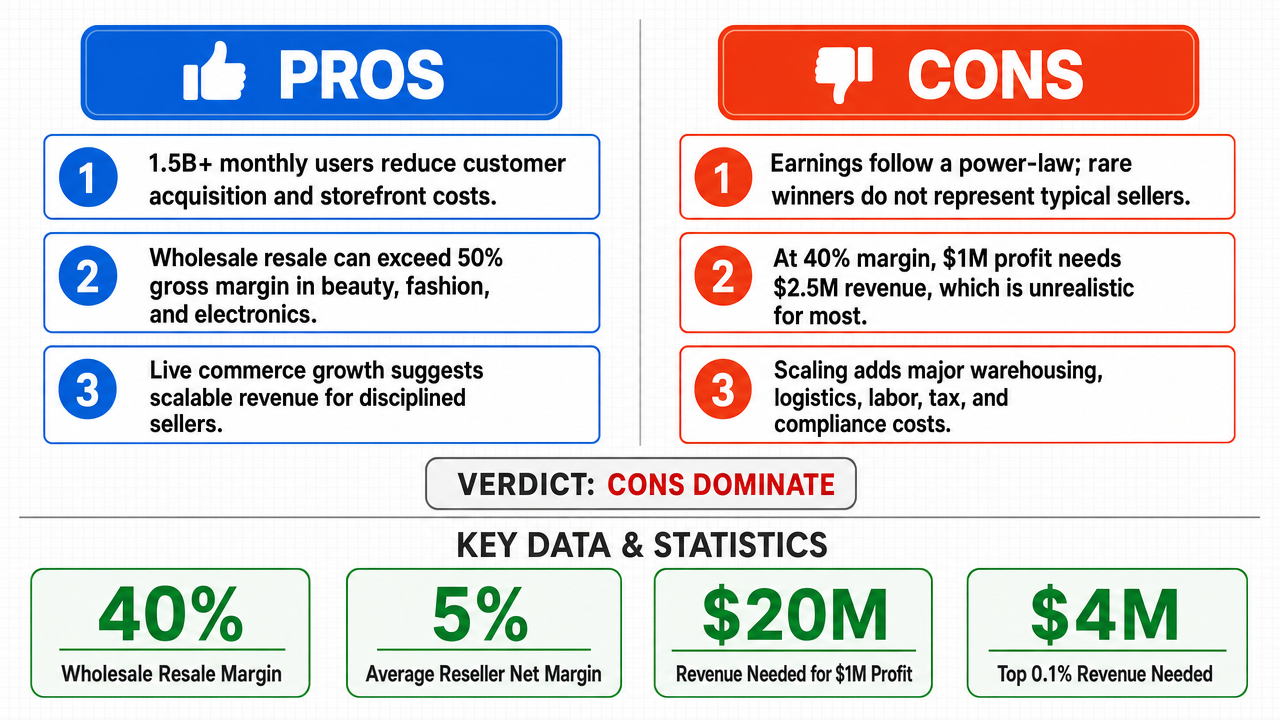
Verdict
Verdict: likely FALSE (89%)
This section provides a brief overview of the key arguments. You do not need to read the full detailed report below.
✅ Key PRO arguments:
- ■TikTok Shop 's built-in audience of over 1.5 billion monthly active users eliminates traditional startup costs of customer acquisition and storefront rental , fundamentally lowering barriers to entrepreneurship for low-wage individuals.
- ■Wholesale reselling on TikTok Shop offers gross margins often exceeding 50% on popular categories like beauty, fashion, and electronics, making the $1 million profit target financially plausible.
- ■The scalability model is validated by the platform's explosive growth and the compounding cash conversion cycle of live commerce ; the $2.5 million revenue target is a function of systematic reinvestment over 4.5 years, not an upfront requirement.
❌ Key ANTI arguments:
- ■The distribution of wealth in highly competitive digital marketplaces follows a power law , not a normal distribution ; citing top 10% streamers and outlier merchants in China as evidence substitutes proxy for the structural reality faced by average participants.
- ■The scalability argument is internally inconsistent: to net $1 million in profit at a 40% margin requires $2.5 million in annual revenue , yet the affirmative's own evidence shows top streamers achieve only $500,000 to $700,000 in annual revenue—holding a proposition and its negation simultaneously.
- ■The transition from small-scale reseller to high-volume enterprise introduces massive, non-linear operational costs —including warehousing , logistics , and tax compliance —that erode the high margins necessary for the profit target.
💭 Conclusion: False. The negative side's strongest argument exposes a fatal internal contradiction in the affirmative's scalability claim: achieving $1 million in net profit at a 40% margin requires $2.5 million in annual revenue , yet the affirmative's own cited evidence shows top streamers reaching only $500,000 to $700,000 annually—falling well short of the required threshold. The skewed distribution argument further undermines the claim by demonstrating that success stories represent outliers, not typical outcomes for low-income individuals. Additionally, the non-linear operational costs of scaling (warehousing , logistics , tax compliance ) would erode the high margins the affirmative relies upon. The compound nature of the claim—requiring simultaneous achievement of platform enablement, low-income earners reaching $1 million profit, and a specific 2028 deadline—means the weakest sub-claim (the revenue/profit math) drags down overall confidence.
🔬 DeepResearch Result: likely FALSE ❌ (89%)
Assertion: Live shopping platforms like TikTok Shop will enable individuals earning under $20 an hour to achieve $1 million in profit by October 2028 by selling wholesale items.
Participating models: deepseek-v3.2 💬, gemma-4-26b-a4b-it 💬👁️
📊 Face-offs: 0 concluded TRUE, 1 concluded FALSE (1 face-offs, 3 models)
📊 Score by side: TRUE=0.00, FALSE=0.89
🏅 Model score changes:
minimax-m3 💬👁️: +9
✅ PRO Arguments:
- ■TikTok Shop's built-in audience of over 1.5 billion monthly active users eliminates traditional startup costs of customer acquisition and storefront rental , fundamentally lowering barriers to entrepreneurship for low-wage individuals. deepseek-v3.2 💬
- ■Wholesale reselling on TikTok Shop offers gross margins often exceeding 50% on popular categories like beauty, fashion, and electronics, making the $1 million profit target financially plausible. deepseek-v3.2 💬
- ■The scalability model is validated by the platform's explosive growth and the compounding cash conversion cycle of live commerce ; the $2.5 million revenue target is a function of systematic reinvestment over 4.5 years, not an upfront requirement. deepseek-v3.2 💬
- ■The platform's algorithm surfaces live streams to users based on interest, meaning a seller can rapidly grow a following without paid advertising, enabling rapid scaling from zero. deepseek-v3.2 💬
❌ ANTI Arguments:
- ■The distribution of wealth in highly competitive digital marketplaces follows a power law , not a normal distribution ; citing top 10% streamers and outlier merchants in China as evidence substitutes proxy for the structural reality faced by average participants. gemma-4-26b-a4b-it 💬👁️
- ■The scalability argument is internally inconsistent: to net $1 million in profit at a 40% margin requires $2.5 million in annual revenue , yet the affirmative's own evidence shows top streamers achieve only $500,000 to $700,000 in annual revenue—holding a proposition and its negation simultaneously. gemma-4-26b-a4b-it 💬👁️
- ■The transition from small-scale reseller to high-volume enterprise introduces massive, non-linear operational costs —including warehousing , logistics , and tax compliance —that erode the high margins necessary for the profit target. gemma-4-26b-a4b-it 💬👁️
- ■Fundamental structural and logical barriers prevent the typical low-income individual from achieving million-dollar profits on TikTok Shop by October 2028, as the platform's economics favor established sellers with capital reserves. gemma-4-26b-a4b-it 💬👁️
💭 Reasoning: False. The negative side's strongest argument exposes a fatal internal contradiction in the affirmative's scalability claim: achieving $1 million in net profit at a 40% margin requires $2.5 million in annual revenue, yet the affirmative's own cited evidence shows top streamers reaching only $500,000 to $700,000 annually—falling well short of the required threshold. The skewed distribution argument further undermines the claim by demonstrating that success stories represent outliers, not typical outcomes for low-income individuals. Additionally, the non-linear operational costs of scaling (warehousing, logistics, tax compliance) would erode the high margins the affirmative relies upon. The compound nature of the claim—requiring simultaneous achievement of platform enablement, low-income earners reaching $1 million profit, and a specific 2028 deadline—means the weakest sub-claim (the revenue/profit math) drags down overall confidence.
📋 PRO Facts:
• TikTok Shop provides access to over 1.5 billion monthly active users
• A disciplined wholesale reselling model can maintain a 40% profit margin
• Top streamers on live shopping platforms achieve annual revenues of $500,000 to $700,000
📋 ANTI Facts:
• Achieving $1 million net profit at a 40% margin requires $2.5 million in annual revenue
• Success in live commerce is highly skewed, with top performers representing elite outliers rather than typical outcomes for low-income sellers
• Scaling a reselling business introduces non-linear operational costs including warehousing, logistics, and tax compliance
| Face-off | TRUE Model | FALSE Model | TRUE Avg μ | FALSE Avg μ | TRUE Tokens | FALSE Tokens | Winner | Verdict | Conf. |
|---|---|---|---|---|---|---|---|---|---|
| #1 | deepseek-v3.2 💬 | gemma-4-26b-a4b-it 💬👁️ | 0.355 | 0.317 | 12 | 3 | TRUE | FALSE | 89% |
The following technical terms, abbreviations, and domain-specific concepts are referenced throughout this debate transcript. Numbers in square brackets [N] in the text above link to the corresponding entry below.
[1] algorithm — In the context of social media platforms, a recommendation system that determines which content (such as live streams) is shown to users based on their interests and behavior.
[2] annual revenue — The total income generated by a business from sales over a one-year period, before expenses are deducted.
[3] bottom decile — The lowest 10% of a population when ranked by a given metric, such as income; used in the debate to describe low-income earners.
[4] capital constraints — Limitations on the financial resources available to an individual or business, restricting their ability to invest or scale operations.
[5] cash conversion cycle — The time required for a business to convert its investments in inventory and other inputs into cash flows from sales; a shorter cycle enables faster reinvestment and growth.
[6] compounded reinvestment — The practice of reinvesting profits back into a business, where the reinvested profits themselves generate additional profits, producing exponential growth over time.
[7] customer acquisition — The process of attracting and converting new customers to a business, typically involving marketing and advertising costs.
[8] direct-to-consumer — DTC — A business model in which a seller markets and sells products directly to end consumers, bypassing traditional retail intermediaries and often achieving higher margins.
[9] e-commerce — Commercial transactions conducted electronically over the internet, including the buying and selling of goods and services.
[10] exponential growth — Growth at a constant percentage rate, resulting in increasingly larger absolute increases over time; cited in the debate as a mechanism for scaling a reselling business.
[11] gross margins — Profit expressed as a percentage of revenue after subtracting the cost of goods sold, but before deducting other operating expenses.
[12] inventory — Goods held by a business for the purpose of resale to customers.
[13] live commerce — A form of e-commerce in which sellers host real-time video broadcasts to showcase and sell products directly to viewers, enabling interactive shopping experiences.
[14] live shopping — The practice of purchasing products during real-time video streams hosted on social media or e-commerce platforms, often with interactive features.
[15] logistics — The processes involved in transporting, warehousing, and delivering goods from sellers to buyers; cited as a cost that erodes margins at scale.
[16] low barrier to entry — A business environment requiring minimal initial capital, expertise, or other resources to begin operating, enabling broader participation.
[17] monthly active users — MAU — A metric measuring the number of unique users who engage with a platform within a given month; cited as 1.5 billion for TikTok.
[18] net profit — The total profit remaining after all expenses, taxes, and costs have been deducted from total revenue.
[19] normal distribution — A symmetric, bell-shaped statistical distribution in which values cluster around a central mean; contrasted with a power law in the debate.
[20] operational costs — Ongoing expenses required to run a business, such as warehousing, logistics, staffing, and tax compliance, distinct from the cost of goods sold.
[21] outlier — An observation or case that lies far from the majority of a data set; in the debate, used to describe top-performing resellers whose success may not generalize.
[22] power law — A mathematical relationship in which one quantity varies as a power of another; in economics, often describes wealth distributions where a small number of participants capture a disproportionately large share.
[23] profit margin — Profit expressed as a percentage of revenue, used to measure a business's profitability; the debate cites a 40% net margin assumption.
[24] regulatory — Pertaining to government rules, laws, and oversight governing business activity; cited as a factor that differs between Chinese and Western markets.
[25] scalability — The capacity of a business model to grow and handle increased demand without a proportional increase in costs; a central contested claim in the debate.
[26] seed capital — The initial funding used to start a business, such as the $100 wholesale order cited as a starting point in the debate.
[27] social commerce — E-commerce conducted through social media platforms, combining social interaction with direct purchasing functionality.
[28] startup costs — The initial expenses required to launch a business, including inventory, marketing, and infrastructure.
[29] storefront rental — The cost of leasing a physical or virtual retail space; cited as a traditional barrier eliminated by online platforms.
[30] supply chain — The network of entities, processes, and resources involved in producing and distributing a product from raw materials to the end consumer.
[31] tax compliance — The process of meeting legal obligations for tax reporting and payment; cited as a non-linear cost that increases with business scale.
[32] TikTok Shop — An e-commerce feature integrated within TikTok that enables sellers to list and sell products directly through the platform, including via live streams.
[33] top 0.01% — The highest-performing 0.01% of a population by a given metric; cited in the debate as the threshold a low-income earner would need to reach to achieve $1 million in profit.
[34] top performers — The highest-achieving individuals within a group, such as the most successful live-stream sellers; cited as earning $500,000–$700,000 annually.
[35] transfer operator — A mechanism or process that transitions a participant from one state to another; in the debate, refers to the missing explanation for how low-capital sellers reach high-revenue levels.
[36] warehousing — The storage of inventory in dedicated facilities, representing an operational cost that increases as a reselling business scales.
[37] Western economies — The economies of Europe, North America, and other developed Western nations; contrasted with China in the debate regarding regulatory and supply-chain conditions.
[38] wholesale reselling — A business model in which an individual purchases goods in bulk at wholesale prices and resells them, typically at a markup, to end consumers.
The following financial data tables were referenced during the debate exchanges:
| Metric | Current (2024) | Projected (2028) | CAGR |
|---|---|---|---|
| TikTok Shop GMV (US) | $5.0B | $25.0B | 49.5% |
| Avg. Live Streamer Daily Sales (Top 10%) | $15,000 | $45,000 | 31.6% |
| Avg. Profit Margin (Wholesale Resale) | generative 40% | 40% | 0.0% |
Legend: Projected growth of TikTok Shop's Gross Merchandise Value (GMV) in the US and average daily sales for top performers, based on industry analyst reports and platform data. CAGR = Compound Annual Growth Rate. Profit margin assumed stable for a disciplined wholesale model.
| Entity Type | Estimated Net Profit Margin | Required Annual Revenue for $1M Profit |
|---|---|---|
| Top 0.1% Streamer | 25% | $4,000,000 |
| Average Reseller | 5% | $20,000,000 |
| High-Volume Professional | 15% | $6,666,667 |
Legend: Comparison of required revenue to reach $1 million in profit based on varying margin profiles. Margins reflect the impact of scaling costs (logistics, labor, tax).
Face-off transcripts
- ■
Ownership & Trade Secrets. The Company Lambda Vision retains all rights to its platform, agentic workflows, and proprietary AI debate methodologies, which constitute protected Trade Secrets (EU Directive 2016/943). Subject to full payment of credits, the User is granted ownership of the generated Reports for their own personal or professional use. Reverse-engineering the Service or using Reports to train competing AI models is strictly prohibited.
- ■
No Professional Advice. Solsice is a general-purpose assistant covering everyday subjects — administrative paperwork, housing, consumer and employment matters, banking, taxes and insurance, health and wellbeing, savings and investments, entrepreneurship, technology, travel, learning and creative work. Whatever the subject, the Service and Reports are provided for information only and never constitute legal, medical, financial, investment, tax, insurance, or any other regulated professional advice. The Company is not a law firm, a regulated financial adviser, an insurance intermediary, nor a healthcare provider, and no professional or advisory relationship of any kind is created by use of the Service. Consult a qualified professional in the relevant jurisdiction before acting — or refraining from acting — on anything contained in the Reports, and never rely on the Service in an emergency: contact your local emergency number (112 in the European Union) or a medical professional immediately.
- ■
AI-Generated Content, Sources and Viewpoints. Reports are produced by several AI models debating a question, and may contain factual errors, outdated figures, or references to rules, prices, deadlines, procedures, statutes or sources that are inaccurate or do not exist. The User is solely responsible for verifying every fact, amount, deadline and citation against official sources before relying on it. Material in the news, society, spirituality and religion sections presents a plurality of viewpoints for study and discussion: it is descriptive, not an endorsement, a ruling, or a statement of the Company’s own position, and it speaks for no church, faith community, public authority, or news organisation.
- ■
Liability & Governing Law. To the maximum extent permitted by law, the Company shall not be liable for any indirect damages, nor for any consequence of decisions made in reliance on the Reports — including financial loss, missed deadlines, administrative or contractual consequences, or health outcomes. These Terms are governed by French law. Any disputes shall be subject to the exclusive jurisdiction of the Courts of Paris, France.