
Live shopping, particularly on platforms like TikTok Shop, Whatnot, and eBay Live, will be a multi-billion dollar industry in 2027.
AI debate verdict and arguments
⚠️ AI-generated information only; not professional advice
Completed October 14, 2026
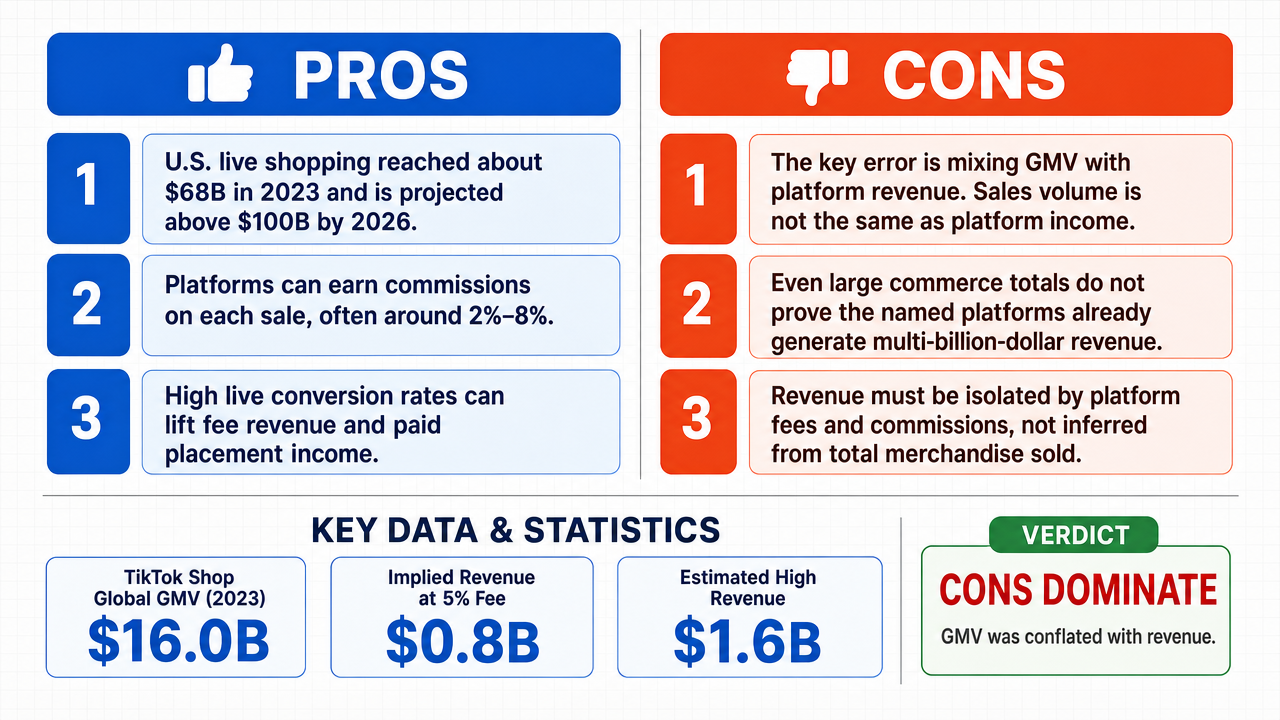
Verdict
Verdict: likely FALSE (64%)
Web Report: https://solsice.com/public/debates/live-shopping-particularly-on-platforms-like-tiktok-shop-wha-d4cfe1c6b273
This section provides a brief overview of the key arguments. You do not need to read the full detailed report below.
✅ Key PRO arguments:
- ■The broader US live shopping commerce market reached approximately $68 billion in 2023 and is projected to grow to over $100 billion by 2026, with TikTok Shop alone achieving over $16 billion in global GMV in its first full year, providing foundational momentum toward multi-billion dollar platform revenue .
- ■High conversion rates in live shopping translate proportionally into platform commissions (typically 2-8% per sale) and promoted placement fees without a proportional rise in platform operating costs, because heavy discounting and creator incentive costs are largely borne by sellers rather than the platforms themselves.
❌ Key ANTI arguments:
- ■The affirmative confuses Gross Merchandise Value (a transaction volume figure) with platform revenue (fees and commissions), which is a substitution of proxy; without isolated revenue figures for TikTok Shop, Whatnot, and eBay Live, GMV growth does not demonstrate multi-billion dollar platform revenue.
- ■The affirmative's argument is internally inconsistent: citing $68 billion in US live shopping commerce for 2023 would already yield approximately $2.04 billion in platform revenue at a 3% take-rate , making the 2027 growth trajectory claim logically redundant and undermining the projected milestone framing.
💭 Conclusion: False. The negative side's strongest argument, that the affirmative conflated Gross Merchandise Value with platform revenue , was decisive in this debate. The affirmative never isolated revenue specifically generated by the named platforms (TikTok Shop, Whatnot, eBay Live), instead relying on industry-wide commerce figures that do not directly substantiate the multi-billion dollar platform revenue claim. The negative also exposed an internal inconsistency in the affirmative's framing of growth trajectory relative to an already-cited large 2023 base. While the affirmative raised reasonable counterpoints about commission structures and cost efficiency, they did not provide platform-specific revenue data to overcome the proxy-substitution flaw. Confidence remains at 64% because some partial support for the affirmative's underlying market-growth narrative was left unrefuted, leaving residual uncertainty about whether specific platform revenue could reach the threshold.
🔬 DeepResearch Result: likely FALSE ❌ (64%)
Assertion: Live shopping , particularly on platforms like TikTok Shop, Whatnot, and eBay Live, will be a multi-billion dollar industry in 2027.
Participating models: deepseek-v3.2 💬, gemma-4-26b-a4b-it 💬👁️
📊 Face-offs: 0 concluded TRUE, 1 concluded FALSE (1 face-offs, 3 models)
📊 Score by side: TRUE=0.00, FALSE=0.64
🏅 Model score changes:
minimax-m3 💬👁️: +6
✅ PRO Arguments:
- ■The broader US live shopping commerce market reached approximately $68 billion in 2023 and is projected to grow to over $100 billion by 2026, with TikTok Shop alone achieving over $16 billion in global GMV in its first full year, providing foundational momentum toward multi-billion dollar platform revenue . deepseek-v3.2 💬
- ■High conversion rates in live shopping translate proportionally into platform commissions (typically 2-8% per sale) and promoted placement fees without a proportional rise in platform operating costs, because heavy discounting and creator incentive costs are largely borne by sellers rather than the platforms themselves. deepseek-v3.2 💬
❌ ANTI Arguments:
- ■The affirmative confuses Gross Merchandise Value (a transaction volume figure) with platform revenue (fees and commissions), which is a substitution of proxy; without isolated revenue figures for TikTok Shop, Whatnot, and eBay Live, GMV growth does not demonstrate multi-billion dollar platform revenue. gemma-4-26b-a4b-it 💬👁️
- ■The affirmative's argument is internally inconsistent: citing $68 billion in US live shopping commerce for 2023 would already yield approximately $2.04 billion in platform revenue at a 3% take-rate , making the 2027 growth trajectory claim logically redundant and undermining the projected milestone framing. gemma-4-26b-a4b-it 💬👁️
💭 Reasoning: False. The negative side's strongest argument, that the affirmative conflated Gross Merchandise Value with platform revenue, was decisive in this debate. The affirmative never isolated revenue specifically generated by the named platforms (TikTok Shop, Whatnot, eBay Live), instead relying on industry-wide commerce figures that do not directly substantiate the multi-billion dollar platform revenue claim. The negative also exposed an internal inconsistency in the affirmative's framing of growth trajectory relative to an already-cited large 2023 base. While the affirmative raised reasonable counterpoints about commission structures and cost efficiency, they did not provide platform-specific revenue data to overcome the proxy-substitution flaw. Confidence remains at 64% because some partial support for the affirmative's underlying market-growth narrative was left unrefuted, leaving residual uncertainty about whether specific platform revenue could reach the threshold.
📋 PRO Facts:
• US live shopping commerce sales reached approximately $68 billion in 2023.
• TikTok Shop achieved over $16 billion in GMV globally in 2023.
• TikTok Shop's typical platform commission ranges from 2-8% per sale.
• US live shopping commerce is projected to grow to over $100 billion by 2026.
📋 ANTI Facts:
• Platform revenue is distinct from GMV; revenue is derived from fees and commissions on transactions.
• Applying even a 3% take-rate to the cited $68 billion 2023 US live shopping commerce figure yields approximately $2.04 billion, creating a logical inconsistency in the affirmative's growth-trajectory argument.
• The affirmative did not present isolated revenue figures for TikTok Shop, Whatnot, or eBay Live.
| Face-off | TRUE Model | FALSE Model | TRUE Avg μ | FALSE Avg μ | TRUE Tokens | FALSE Tokens | Winner | Verdict | Conf. |
|---|---|---|---|---|---|---|---|---|---|
| #1 | deepseek-v3.2 💬 | gemma-4-26b-a4b-it 💬👁️ | 0.319 | 0.214 | 8 | 2 | TRUE | FALSE | 64% |
The following technical terms, abbreviations, and domain-specific concepts are referenced throughout this debate transcript. Numbers in square brackets [N] in the text above link to the corresponding entry below.
[1] average order value — AOV — An e-commerce metric representing the average dollar amount spent per customer order, used to gauge purchasing behavior and revenue per transaction.
[2] commission — In platform economics, a percentage fee that a marketplace charges sellers on each transaction conducted through the platform.
[3] conversion rate — The percentage of users or viewers who take a desired action (such as making a purchase) out of the total audience exposed to an offering; a key e-commerce performance metric.
[4] customer acquisition cost — CAC — The total cost a business incurs to acquire a new customer, including marketing and advertising spend divided by the number of new customers gained.
[5] GMV — Gross Merchandise Value — The total monetary value of goods sold through a platform over a given period, representing transaction volume rather than the platform's actual revenue.
[6] gross merchandise value — GMV — The total monetary value of goods sold through a platform over a given period, representing transaction volume rather than the platform's actual revenue.
[7] live shopping — A commerce format that combines live video streaming with real-time purchasing, where hosts showcase products and viewers can buy them during the broadcast.
[8] margin compression — A reduction in profit margins, typically caused by rising costs, competitive pricing pressure, or discounting, which can limit revenue growth even as sales volume increases.
[9] market trajectory — The projected path or trend of growth in a market over time, often used to forecast future size or revenue potential.
[10] multi-billion dollar — Referring to a financial scale measured in billions of dollars; in this debate, defined by the affirmative as generating at least $2 billion in revenue.
[11] organic traffic — Visitors or viewers who arrive at a platform or content through unpaid, natural discovery (such as algorithmic recommendations) rather than paid advertising.
[12] platform economics — The study of how digital marketplace platforms generate revenue (typically through commissions, fees, and advertising) while balancing costs such as infrastructure and incentives.
[13] platform profitability — The ability of a marketplace platform to generate net positive earnings after accounting for operational costs, incentives, and revenue from fees and commissions.
[14] platform revenue — Income earned by a platform from its services, distinct from GMV; typically derived from commissions, transaction fees, advertising, and promoted placements.
[15] promoted placements — Paid advertising slots within a platform where sellers can pay for increased visibility of their products or live streams, constituting a platform revenue stream.
[16] social proof — A marketing concept in which observed behavior, reviews, or endorsements from other users influence a viewer's likelihood of making a purchase.
[17] streaming infrastructure — The underlying technical systems (servers, encoding, content delivery networks) that enable live video broadcasting at scale, typically incurring largely fixed costs.
[18] take-rate — The percentage of total transaction value (GMV) that a platform retains as revenue; used to convert gross sales figures into estimated platform earnings.
The following financial data tables were referenced during the debate exchanges:
| Metric | TikTok Shop (2023) | Implied Platform Revenue (at 5% fee) |
|---|---|---|
| Global GMV | $16.0B | $0.8B |
| Platform Revenue (Est. Low) | N/A | $0.8B |
| Platform Revenue (Est. High) | N/A | $1.6B |
Legend: Comparison between reported GMV and theoretical platform revenue based on varying commission rates. Estimates are for illustrative purposes to demonstrate the gap between GMV and actual revenue.
Face-off transcripts
- ■
Ownership & Trade Secrets. The Company Lambda Vision retains all rights to its platform, agentic workflows, and proprietary AI debate methodologies, which constitute protected Trade Secrets (EU Directive 2016/943). Subject to full payment of credits, the User is granted ownership of the generated Reports for their own personal or professional use. Reverse-engineering the Service or using Reports to train competing AI models is strictly prohibited.
- ■
No Professional Advice. Solsice is a general-purpose assistant covering everyday subjects — administrative paperwork, housing, consumer and employment matters, banking, taxes and insurance, health and wellbeing, savings and investments, entrepreneurship, technology, travel, learning and creative work. Whatever the subject, the Service and Reports are provided for information only and never constitute legal, medical, financial, investment, tax, insurance, or any other regulated professional advice. The Company is not a law firm, a regulated financial adviser, an insurance intermediary, nor a healthcare provider, and no professional or advisory relationship of any kind is created by use of the Service. Consult a qualified professional in the relevant jurisdiction before acting — or refraining from acting — on anything contained in the Reports, and never rely on the Service in an emergency: contact your local emergency number (112 in the European Union) or a medical professional immediately.
- ■
AI-Generated Content, Sources and Viewpoints. Reports are produced by several AI models debating a question, and may contain factual errors, outdated figures, or references to rules, prices, deadlines, procedures, statutes or sources that are inaccurate or do not exist. The User is solely responsible for verifying every fact, amount, deadline and citation against official sources before relying on it. Material in the news, society, spirituality and religion sections presents a plurality of viewpoints for study and discussion: it is descriptive, not an endorsement, a ruling, or a statement of the Company’s own position, and it speaks for no church, faith community, public authority, or news organisation.
- ■
Liability & Governing Law. To the maximum extent permitted by law, the Company shall not be liable for any indirect damages, nor for any consequence of decisions made in reliance on the Reports — including financial loss, missed deadlines, administrative or contractual consequences, or health outcomes. These Terms are governed by French law. Any disputes shall be subject to the exclusive jurisdiction of the Courts of Paris, France.