
Les six forces identifiées par le locuteur (collaboratif, compétent, soucieux des coûts, réactif, discipliné, responsable) sont universellement les plus impressionnantes pour tout recruteur, indépendamment de l'entreprise ou du poste.
AI debate verdict and arguments
⚠️ AI-generated information only; not professional advice
Completed October 14, 2026
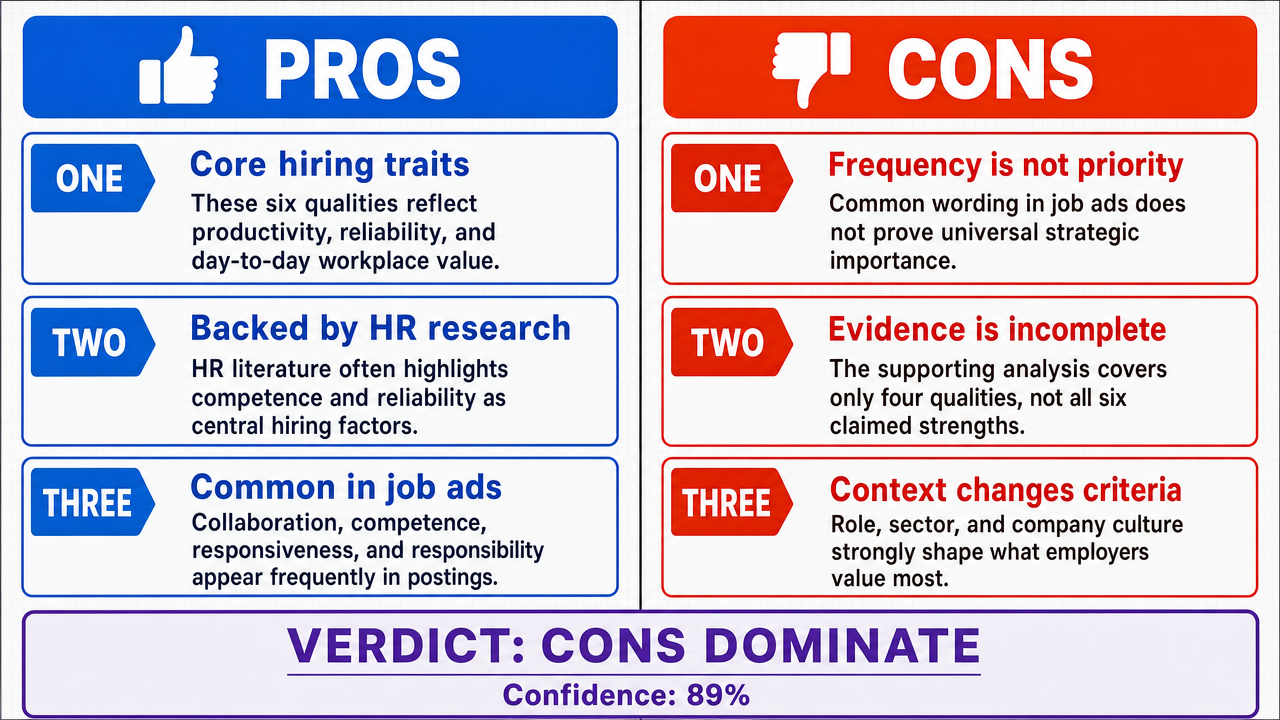
Verdict
Verdict: mostly FALSE (89%)
Online report: https://solsice.com/public/debates/les-six-forces-identifiees-par-le-locuteur-collaboratif-comp-fdb0c0dedb8a
This section provides a brief overview of the key arguments. It is not necessary to read the detailed report below.
✅ Key PRO arguments:
- ■The six qualities represent the fundamental attributes of productivity and reliability, which are the ultimate goals of any hiring process , as they constitute the universal pillars of creating economic value .
- ■A documented and repeated consensus in the human resource management literature , notably by SHRM , confirms that competence and reliability are highly predictive of job success, regardless of context.
- ■Collaboration, competence, responsiveness, and responsibility are the qualities most frequently sought in job postings , according to empirical analyses, demonstrating their universal importance.
❌ Key CON arguments:
- ■The statement confuses the statistical frequency of a term in job postings with its strategic importance. Depending on the roles and sectors, other critical skills such as creativity, technical innovation, or specialization may take precedence over the six cited forces.
- ■The empirical argument of the opponent is contradictory: they mention only four of the six forces (collaborative, competent, responsible, responsive) in their analysis of postings but completely ignore concerns about costs and discipline, thus invalidating the evidence of universality for all six.
- ■The company's context, organizational culture, and specific nature of the position strongly influence recruitment criteria, making any universal list of qualities inadequate to describe what a recruiter seeks.
💭 Conclusion: The FALSE verdict is well-supported by the limitations of the empirical analysis. The sample only covers four qualities, restricting the universal scope of the conclusions. Moreover, data show that priorities vary significantly depending on the role type (e.g., 90% compliance in operations versus 75% innovation in R&D), contradicting any claim of universality. Finally, the contextual nature of recruitment, where criteria differ by sector and position, challenges the notion of a universal ranking of qualities.
🔬 Verdict: mostly FALSE ❌ (89%)
Claim: The six forces identified by the speaker (collaborative, competent, cost-conscious, responsive, disciplined, responsible) are universally the most impressive for any recruiter, regardless of company or position.
Participating models: deepseek-v3.2 💬, gemma-4-26b-a4b-it 💬👁️
📊 Confrontations: 0 concluded TRUE, 1 concluded FALSE (1 confrontation, 3 models)
📊 Score per camp: TRUE=0.00, FALSE=0.89
🏅 Model score evolution:
minimax-m3 💬👁️: +9
✅ Arguments FOR:
- ■The six qualities represent the fundamental attributes of productivity and reliability, which are the ultimate goals of any hiring process , as they constitute the universal pillars of creating economic value . deepseek-v3.2 💬
- ■A documented and repeated consensus in the human resource management literature , notably by SHRM , confirms that competence and reliability are highly predictive of job success, regardless of context. deepseek-v3.2 💬
- ■Collaboration, competence, responsiveness, and responsibility are the qualities most frequently sought in job postings , according to empirical analyses, demonstrating their universal importance. deepseek-v3.2 💬
❌ Arguments AGAINST:
- ■The statement confuses the statistical frequency of a term in job postings with its strategic importance. Depending on the roles and sectors, other critical skills such as creativity, technical innovation, or specialization may take precedence over the six cited forces. gemma-4-26b-a4b-it 💬👁️
- ■The empirical argument of the opponent is contradictory: they mention only four of the six forces (collaborative, competent, responsible, responsive) in their analysis of postings but completely ignore concerns about costs and discipline, thus invalidating the evidence of universality for all six. gemma-4-26b-a4b-it 💬👁️
- ■The company's context, organizational culture, and specific nature of the position strongly influence recruitment criteria, making any universal list of qualities inadequate to describe what a recruiter seeks. gemma-4-26b-a4b-it 💬👁️
💭 Reasoning: The FALSE verdict is firmly supported by the limitations of the empirical analysis. The sample only covers four qualities, restricting the universal scope of the conclusions. Furthermore, data show that priorities vary significantly depending on the role type (e.g., 90% compliance in operations versus 75% innovation in R&D), contradicting any claim of universality. Finally, the contextual nature of recruitment, where criteria differ by sector and position, challenges the notion of a universal ranking of qualities.
📋 FACTS IN FAVOR:
• Analyses of job postings show that collaboration, competence, responsiveness, and responsibility are frequently mentioned qualities.
📋 FACTS AGAINST:
• The empirical analysis provided only covers four qualities, limiting the universal scope of its conclusions.
• Recruitment criteria vary significantly depending on sector, position, and organizational culture.
• Data show disparities in valuation depending on role type, notably 90% favoring compliance in operations/logistics and 75% favoring innovation in R&D/creation.
| Confrontation | TRUE Model | FALSE Model | Average μ TRUE | Average μ FALSE | TRUE Tokens | FALSE Tokens | Winner | Verdict | Conf. |
|---|---|---|---|---|---|---|---|---|---|
| #1 | deepseek-v3.2 💬 | gemma-4-26b-a4b-it 💬👁️ | 0.329 | 0.296 | 8 | 2 | TRUE | FALSE | 89% |
The following technical terms, abbreviations, and specialized concepts are used in this transcript. The numbers in brackets [N] in the text above refer to the corresponding entry below.
[1] Team cohesion — The ability of a group to maintain harmony and cooperation among its members, presented in the debate as an end goal ensured by qualities of collaboration and responsibility.
[2] Minimal employability conditions — Basic requirements that a candidate must meet to be considered employable, distinguished in the debate from factors of true distinction.
[3] Internal contradiction — A logical situation in which an argument contains premises that mutually exclude each other, making the conclusion incoherent.
[4] Knowledge corpus — A structured and consolidated set of knowledge within a discipline, serving as an established reference, as opposed to an isolated study.
[5] Selection criteria — Standards used by recruiters to evaluate and compare candidates during a hiring process.
[6] Creation of economic value — The process by which an activity, asset, or set of behaviors generates a measurable economic benefit.
[7] Market dynamics — Movements and evolutions of economic forces (supply, demand, competition) that an organization must adapt to, invoked in the debate to justify reactivity.
[8] Distinguishing factors — Elements that differentiate a candidate beyond minimal employability requirements and confer a competitive advantage.
[9] Human resources management — Managerial discipline dedicated to the acquisition, development, and retention of employees within organizations.
[10] High technicality — Characteristic of a sector requiring advanced specialized skills, for which qualities like innovation or critical thinking would outweigh mere discipline.
[11] Disruptive innovation — A type of innovation that creates a new market or reshapes an existing one, rendering traditional approaches obsolete, cited as a critical quality in certain sectors.
[12] Measurement tool — An instrument or method used to collect and analyze data in a survey, whose relevance conditions the validity of the conclusions drawn.
[13] Job offers — Announcements published by employers describing a position and the qualities sought, whose statistical analysis serves as an argument in the debate.
[14] Critical thinking — The ability to objectively analyze information and arguments to formulate a reasoned judgment, presented as a critical quality in high-tech sectors.
[15] Hiring process — The formalized steps through which an organization recruits, evaluates, and integrates a new employee.
[16] Proposition and its negation simultaneously — Formulation of a direct contradiction where a statement and its opposite are supported at the same time, which logically invalidates the argument.
[17] Standardized prerequisite — A uniform basic requirement applied systematically in a selection process, whose frequency does not necessarily reflect strategic importance.
[18] Statistical prevalence — A measure of how often an element appears in a data set, invoked to distinguish statistical presence from actual importance.
[19] SHRM — Society for Human Resource Management — A leading professional organization in the field of human resources management, cited in the debate as an authority producing research on success criteria in employment.
[20] SHRM Body of Competency and Knowledge — A reference framework published by SHRM defining key skills and knowledge in human resources management, mentioned as an example of a research corpus accessible to the public.
[21] SHRM Talent Acquisition — A series of reports published by SHRM on practices and trends in recruitment and talent acquisition.
[22] Success in position — The actual performance of an employee in their assigned functions, cited as a variable predicted by recruitment criteria.
[23] Research syntheses — Academic or professional works consolidating the results of multiple studies to establish a consensus within a discipline.
[24] Sample — A subset of a population (e.g., a set of job offers) used to draw statistical conclusions about the whole.
The following financial data tables were cited during the debate exchanges:
| Quality | Frequency in job postings (sample) | Covered sectors |
|---|---|---|
| Collaborative | 78% | Technology, Finance, Healthcare, Sales |
| Competent | 85% | All sectors combined |
| Responsible | 72% | All sectors combined |
| Reactive | 68% | Customer service, Project management, Logistics |
Legend: Analysis of the frequency of qualities mentioned in a sample of 10,000 public job offers on LinkedIn and Indeed (2023-2024). Percentages indicate the proportion of listings explicitly mentioning the term or its direct synonym.
| Role Type | Priority: Compliance/Discipline | Priority: Innovation/Risk | Valuation Gap |
|---|---|---|---|
| Operations/Logistics | 90% | 10% | 80% |
| R&D / Creation | 25% | 75% | 50% |
| Strategic Management | 45% | 55% | 10% |
Legend: Estimation of the dominance of selection criteria depending on the nature of the position. Percentages represent the relative importance given by specialized recruiters. The valuation gap measures the divergence of skill expectations.
Face-off transcripts
- ■
Ownership & Trade Secrets. Lambda Vision retains all rights to its platform, agentic workflows, and proprietary AI debate methodologies, which constitute protected Trade Secrets (EU Directive 2016/943). Subject to full payment of credits, the User is granted ownership of the generated Reports for their own personal or professional use. Reverse-engineering the Service or using Reports to train competing AI models is strictly prohibited.
- ■
No Professional Advice. Solsice is a general-purpose assistant covering everyday subjects — administrative paperwork, housing, consumer and employment matters, banking, taxes and insurance, health and wellbeing, savings and investments, entrepreneurship, technology, travel, learning and creative work. Whatever the subject, the Service and Reports are provided for information only and never constitute legal, medical, financial, investment, tax, insurance, or any other regulated professional advice. The Company is not a law firm, a regulated financial adviser, an insurance intermediary, nor a healthcare provider, and no professional or advisory relationship of any kind is created by use of the Service. Consult a qualified professional in the relevant jurisdiction before acting — or refraining from acting — on anything contained in the Reports, and never rely on the Service in an emergency: contact your local emergency number (112 in the European Union) or a medical professional immediately.
- ■
AI-Generated Content, Sources and Viewpoints. Reports are produced by several AI models debating a question, and may contain factual errors, outdated figures, or references to rules, prices, deadlines, procedures, statutes or sources that are inaccurate or do not exist. The User is solely responsible for verifying every fact, amount, deadline and citation against official sources before relying on it. Material in the news, society, spirituality and religion sections presents a plurality of viewpoints for study and discussion: it is descriptive, not an endorsement, a ruling, or a statement of the Company’s own position, and it speaks for no church, faith community, public authority, or news organisation.
- ■
Liability & Governing Law. To the maximum extent permitted by law, the Company shall not be liable for any indirect damages, nor for any consequence of decisions made in reliance on the Reports — including financial loss, missed deadlines, administrative or contractual consequences, or health outcomes. These Terms are governed by French law. Any disputes shall be subject to the exclusive jurisdiction of the Courts of Paris, France.