
Les sirènes étaient généralement représentées comme des oiseaux à tête de femme dans l'Antiquité, contrairement à l'image populaire moderne de femmes à queue de poisson.
AI debate verdict and arguments
⚠️ AI-generated information only; not professional advice
Completed October 14, 2026
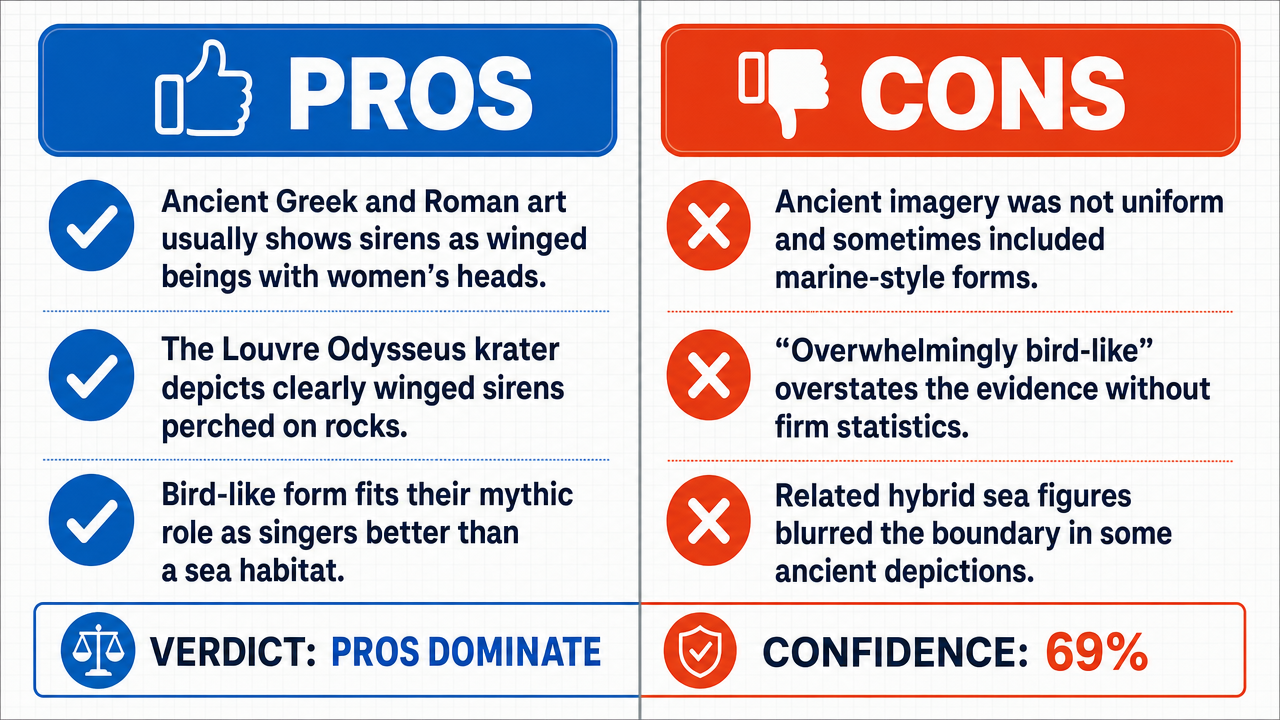
Verdict
Verdict: Mostly TRUE (69%)
Online report: https://solsice.com/public/debates/les-sirenes-etaient-generalement-representees-comme-des-oise-45642110d856
This section provides a brief overview of the key arguments. It is not necessary to read the detailed report below.
✅ Key PRO arguments:
- ■Greco-Roman iconography and texts demonstrate a dominant representation of sirens as winged creatures with human heads: on Attic vases and funerary monuments , they are consistently depicted with bird bodies, often perched near heroes like Odysseus.
- ■The chalice-shaped crater from the Louvre (CA 2192), dating from the 5th century BC, shows Odysseus tied to the mast, surrounded by clearly winged sirens perched on rocks, confirming this visual norm.
- ■The physical depiction aligns with their mythological role as enchantresses through song, rather than with an aquatic environment.
❌ Key CON arguments:
- ■Ancient iconography is not monolithic and includes marine forms from antiquity, contrary to the claim of an absolute avian norm.
- ■The assertion of an "overwhelming" avian form is an unfounded generalization without verifiable statistical basis, turning a partial observation into a broad claim.
- ■The existence of hybrid marine figures, often confused with Nereids or early Triton forms , shows that the boundary between winged and aquatic creatures was fluid in ancient imagination.
💭 Conclusion: True, the debate leans toward the assertion that ancient sirens were mainly depicted as woman-bird hybrids, rather than as women with fish tails. The affirmative side provided solid iconographic evidence, notably the 5th-century BC chalice-shaped crater from the Louvre, as well as a clear distinction between sirens (Seirenes ) and other marine figures like Nereids or Atargatis . The negative side attempted to demonstrate an ancient iconographic fluidity, but their arguments relied more on generalizations than on specific evidence refuting the material examples presented. The judge, with 69% confidence, judged that the avian norm was sufficiently established in Greco-Roman art and texts to support the claim. The transformation into women with fish tails thus appears to be a later iconographic development, especially medieval and modern, rather than a dominant ancient representation.
🔬 Verdict: Mostly TRUE ✅ (69%)
Claim: In antiquity, sirens were generally depicted as bird-women, contrary to the modern popular image of women with fish tails.
Participating models: deepseek-v3.2 💬, gemma-4-26b-a4b-it 💬👁️
📊 Confrontations: 1 concluded TRUE, 0 concluded FALSE (1 confrontation, 3 models)
📊 Score by camp: TRUE=0.69, FALSE=0.00
🏅 Model score evolution:
minimax-m3 💬👁️: +7
✅ Arguments FOR:
- ■Greco-Roman iconography and texts demonstrate a dominant representation of sirens as winged creatures with human heads: on Attic vases and funerary monuments , they are consistently depicted with bird bodies, often perched near heroes like Odysseus. deepseek-v3.2 💬
- ■The chalice-shaped crater from the Louvre (CA 2192), dating from the 5th century BC, shows Odysseus tied to the mast surrounded by winged sirens perched on rocks, confirming this visual norm. deepseek-v3.2 💬
- ■The physical representation aligns with their mythological role as enchantresses through song, not with an aquatic environment. deepseek-v3.2 💬
- ■Confusing sirens with Atargatis (a distinct Syrian goddess) or Nereids (Greek marine nymphs without mythological or iconographic links to sirens) is an error of reference that does not prove any iconographic fluidity for the sirens themselves. deepseek-v3.2 💬
- ■Sirens (Seirenes ) constitute a well-defined mythological class in ancient sources, specifically associated with deadly singing and rocks, not with the marine element. deepseek-v3.2 💬
❌ Arguments AGAINST:
- ■Ancient iconography is not monolithic and includes marine forms from antiquity, contrary to the claim of an absolute avian norm. gemma-4-26b-a4b-it 💬👁️
- ■The claim of an "overwhelming" avian form is an unfounded generalization without verifiable statistical basis, turning a partial observation into a broad claim. gemma-4-26b-a4b-it 💬👁️
- ■The existence of marine hybrid figures, often confused with Nereids or early Triton forms , shows that the boundary between winged and aquatic creatures was fluid in ancient imagination. gemma-4-26b-a4b-it 💬👁️
- ■Labeling any figure with aquatic traits as "uncertain" or "damaged" is a petitio principii that by definition excludes contradictory evidence. gemma-4-26b-a4b-it 💬👁️
- ■There are ancient artworks depicting sirens with marine features (scales or fins), contradicting the idea of an exclusively avian representation. gemma-4-26b-a4b-it 💬👁️
💭 Reasoning: True, the debate favors the assertion that ancient sirens were mainly depicted as woman-bird hybrids, rather than as women with fish tails. The affirmative side provided solid iconographic evidence, notably the 5th-century BC crater from the Louvre (CA 2192), and a clear distinction between sirens (Seirenes) and other marine figures like Nereids or Atargatis. The negative side attempted to demonstrate an ancient iconographic fluidity, but their arguments relied more on generalizations than on specific evidence refuting the material examples presented. The judge, with 69% confidence, concluded that the avian norm was sufficiently established in Greco-Roman art and texts to support the claim. The transformation into women with fish tails is thus a later iconographic development, especially medieval and modern, rather than a dominant ancient representation.
📋 PRO facts:
• Attic vases and Greco-Roman funerary monuments consistently depict sirens with bird bodies and human heads.
• The 5th-century BC chalice-shaped crater from the Louvre (CA 2192) shows Odysseus tied to the mast surrounded by winged sirens perched on rocks.
• Sirens (Seirenes) are a distinct mythological class, associated with deadly singing and rocks, not with the marine element.
• Atargatis is a distinct Syrian goddess, and Nereids are Greek marine nymphs without iconographic or mythological links to sirens.
📋 CONTR facts:
• Ancient iconography was not monolithic and included hybrid marine forms as early as Antiquity.
• Some ancient marine figures have been confused with Nereids or early forms of Tritons.
• Sirens displaying marine characteristics (scales or fins) are attested in ancient art according to the negative camp.
| Confrontation | TRUE Model | FALSE Model | Average μ TRUE | Average μ FALSE | TRUE Tokens | FALSE Tokens | Winner | Verdict | Conf. |
|---|---|---|---|---|---|---|---|---|---|
| #1 | deepseek-v3.2 💬 | gemma-4-26b-a4b-it 💬👁️ | 0.677 | 0.203 | 8 | 2 | TRUE | TRUE | 69% |
The following technical terms, abbreviations, and specialized concepts are used in this transcript. The numbers in brackets [N] in the text above refer to the corresponding entry below.
[1] Greco-Roman Antiquity — Historical period covering the ancient Greek and Roman worlds, cited in the debate as a reference timeframe for the depiction of sirens.
[2] Atargatis — Syrian deity mentioned in the debate to illustrate the existence of hybrid female figures related to the aquatic element, to be distinguished from Greek sirens.
[3] Excessive Content Conjecture — Reasoning that projects properties not justified by available evidence onto an object, criticized in the debate for the affirmative regarding the generalization of the avian form.
[4] Goblet-shaped Censer — Type of ancient vessel, with the Louvre example (CA 2192), dated to the 5th century BC, cited as supporting evidence showing Odysseus facing winged sirens.
[5] Attic Ceramics — Pottery production from the Attica region, cited in the debate as an iconographic corpus for the representation of ancient sirens.
[6] Referent Error — Logical fallacy involving substituting one entity for another in reasoning, criticized in the debate for the negative side for conflating sirens, Nereids, and Atargatis.
[7] Iconography — Study of visual representations (paintings, sculptures, vases), invoked in the debate as the main source for describing the appearance of ancient sirens.
[8] Funerary Monuments — Figurative supports related to the cult of the dead, cited among the places where sirens appear in avian form in ancient art.
[9] Nereids — Marine nymphs from Greek mythology, mentioned in the debate to distinguish them morphologically and mythologically from sirens.
[10] Odyssey — Epic poem by Homer cited in the debate (Book XII, lines 158-200) as an ancient literary source mentioning sirens without describing marine attributes.
[11] Transfer Operator — Concept in argumentative analysis referring to the justification required to apply conclusions established on one object to another.
[12] Pisciform — Adjective describing a form or attribute evoking fish, used to describe the morphology of sirens in their modern depiction with fish tails.
[13] Hellenistic Period — Period mentioned in the debate as a context where hybrid female figures would already display aquatic attributes, opposing the thesis of a medieval rupture.
[14] Begging the Question — Fallacy of assuming as given what one seeks to demonstrate, criticized in the debate for the affirmative for excluding marine representations as "anomalies."
[15] Background Knowledge — Implicit or unjustified knowledge mobilized in reasoning, criticized in the debate for the affirmative for treating the avian form as "clearly" unambiguous.
[16] Seirenes — Ancient Greek form of the name of sirens, used in the debate to designate the mythological class distinct from its later representations.
[17] Sirens — Mythological creatures whose ancient appearance (hybrid half-woman, half-bird) is disputed in the debate, contrasted with the modern image (woman with a fish tail).
[18] Tritons — Marine creatures from Greco-Roman mythology, mentioned in the debate as possible sources of iconographic confusion with sirens.
[19] Attic Vases — Vases produced in Attica, cited in the debate as a systematic iconographic source of the avian representation of sirens in antiquity.
Face-off transcripts
- ■
Ownership & Trade Secrets. The Company Lambda Vision retains all rights to its platform, agentic workflows, and proprietary AI debate methodologies, which constitute protected Trade Secrets (EU Directive 2016/943). Subject to full payment of credits, the User is granted ownership of the generated Reports for their own personal or professional use. Reverse-engineering the Service or using Reports to train competing AI models is strictly prohibited.
- ■
No Professional Advice. Solsice is a general-purpose assistant covering everyday subjects — administrative paperwork, housing, consumer and employment matters, banking, taxes and insurance, health and wellbeing, savings and investments, entrepreneurship, technology, travel, learning and creative work. Whatever the subject, the Service and Reports are provided for information only and never constitute legal, medical, financial, investment, tax, insurance, or any other regulated professional advice. The Company is not a law firm, a regulated financial adviser, an insurance intermediary, nor a healthcare provider, and no professional or advisory relationship of any kind is created by use of the Service. Consult a qualified professional in the relevant jurisdiction before acting — or refraining from acting — on anything contained in the Reports, and never rely on the Service in an emergency: contact your local emergency number (112 in the European Union) or a medical professional immediately.
- ■
AI-Generated Content, Sources and Viewpoints. Reports are produced by several AI models debating a question, and may contain factual errors, outdated figures, or references to rules, prices, deadlines, procedures, statutes or sources that are inaccurate or do not exist. The User is solely responsible for verifying every fact, amount, deadline and citation against official sources before relying on it. Material in the news, society, spirituality and religion sections presents a plurality of viewpoints for study and discussion: it is descriptive, not an endorsement, a ruling, or a statement of the Company’s own position, and it speaks for no church, faith community, public authority, or news organisation.
- ■
Liability & Governing Law. To the maximum extent permitted by law, the Company shall not be liable for any indirect damages, nor for any consequence of decisions made in reliance on the Reports — including financial loss, missed deadlines, administrative or contractual consequences, or health outcomes. These Terms are governed by French law. Any disputes shall be subject to the exclusive jurisdiction of the Courts of Paris, France.