
Les sept éléments non-verbaux et comportementaux initiaux d'un entretien d'embauche déterminent l'issue de la candidature, indépendamment de la qualité des réponses verbales par la suite.
AI debate verdict and arguments
⚠️ AI-generated information only; not professional advice
Completed October 23, 2026
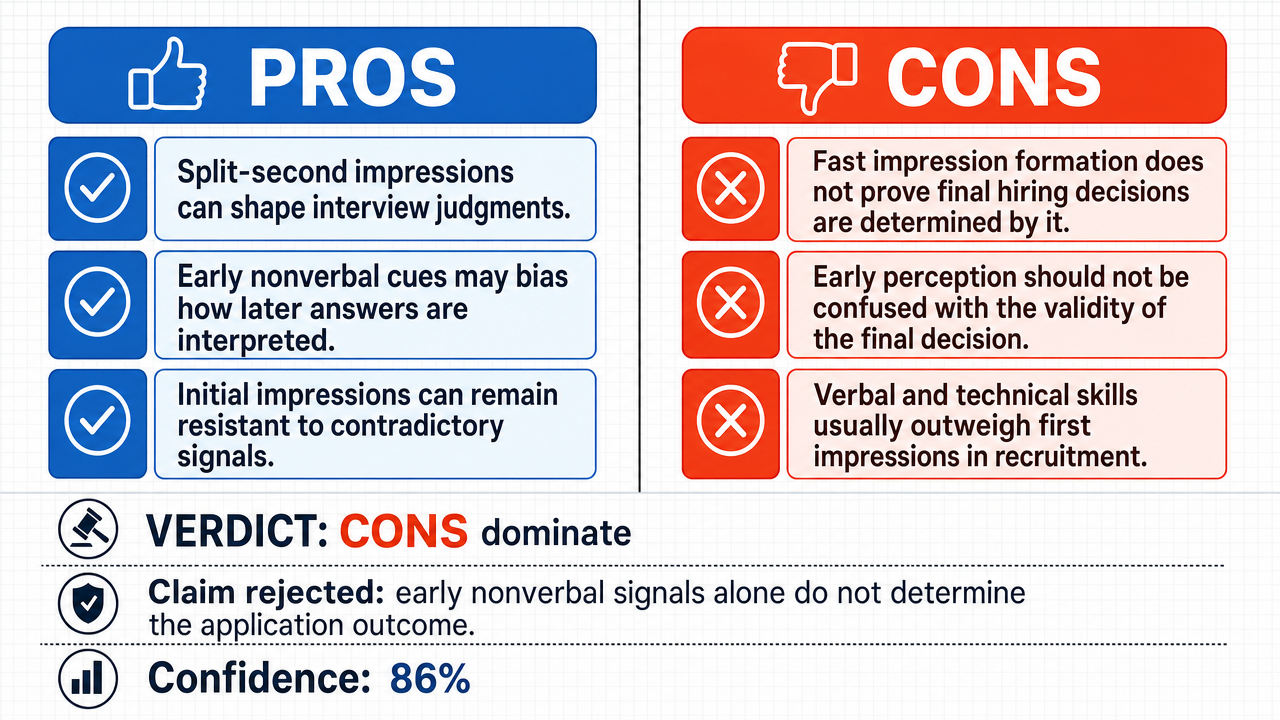
Verdict
Verdict: mostly FALSE (86%)
Online report: https://solsice.com/public/debates/les-sept-elements-non-verbaux-et-comportementaux-initiaux-d-0fbbd36eb487
This section provides a brief overview of the key arguments. It is not necessary to read the detailed report below.
✅ Key PRO arguments:
- ■First impression judgments form in less than 100 milliseconds and withstand any subsequent contradictory information, as demonstrated by the foundational study of Willis and Todorov (2006) published in Psychological Science, where competence, reliability, and attractiveness judgments made after 100 ms were nearly identical to those made without time constraints.
- ■There is confusion between the predictive validity for job performance and the actual determination of hiring decisions : initial non-verbal signals would constitute the true decisive factor, regardless of the quality of subsequent verbal responses.
❌ Key CON arguments:
- ■The opposing argument relies on a fundamental confusion between the speed of forming an impression and the final decision validity: Willis and Todorov's (2006) study measures the ability of the mind to categorize a visual stimulus , not a recruiter's ability to validate a professional skill.
- ■The opponent makes a category error by confusing the speed of forming a perceptual judgment with the validity of the final decision; facial categorization in less than 100 ms is a visual perception process, not a professional decision process, making any transfer invalid.
- ■Verbal and technical skills outweigh initial impressions in the selection process, because the relevant measurement instrument in recruitment is skill assessment, not mere initial perception.
💭 Conclusion: False: the claim that the seven initial non-verbal and behavioral elements determine the outcome of the application regardless of the quality of subsequent verbal responses is rejected. The decisive argument on the winning side relies on the distinction between the speed of forming a perceptual impression and the final decision validity in a recruitment process. The study by Willis and Todorov (2006), invoked by the affirmative side, measures the visual categorization of a face, not a recruiter's ability to evaluate a professional skill, which constitutes an invalid transfer between two distinct categories. Moreover, the cited meta-analyses (notably Schmidt and Hunter, 1998) measure the correlation between selection methods and job performance , not the correlation with the hiring decision itself . Therefore, verbal and technical skills retain a crucial role that initial non-verbal signals alone cannot surpass.
🔬 Verdict: mostly FALSE ❌ (86%)
Claim: The seven initial non-verbal and behavioral elements of a job interview determine the outcome of the application, regardless of the quality of subsequent verbal responses.
Participating models: deepseek-v4-pro 💬, gemma-4-26b-a4b-it 💬👁️
📊 Confrontations: 0 concluded TRUE, 1 concluded FALSE (1 confrontation, 3 models)
📊 Score per side: TRUE=0.00, FALSE=0.86
🏅 Model score evolution:
minimax-m3 💬👁️: +9
✅ PRO arguments:
- ■First impression judgments form in less than 100 milliseconds and withstand any subsequent contradictory information, as demonstrated by the foundational study of Willis and Todorov (2006) published in Psychological Science, where competence, reliability, and attractiveness judgments made after 100 ms were nearly identical to those made without time constraints. deepseek-v4-pro 💬
- ■There is a confusion between the predictive validity for job performance and the actual determination of the hiring decision : initial non-verbal signals would constitute the true decisive factor, regardless of the quality of subsequent verbal responses. deepseek-v4-pro 💬
❌ Arguments AGAINST:
- ■The opposing argument relies on a fundamental confusion between the speed of forming an impression and the final decision validity: Willis and Todorov's (2006) study measures the ability of the mind to categorize a visual stimulus , not a recruiter's ability to validate a professional skill. gemma-4-26b-a4b-it 💬👁️
- ■The opponent makes a category error by confusing the speed of forming a perceptual judgment with the validity of the final decision; facial categorization in less than 100 ms is a visual perception process, not a professional decision process, making any transfer invalid. gemma-4-26b-a4b-it 💬👁️
- ■Verbal and technical skills outweigh initial impressions in the selection process, because the relevant measurement instrument in recruitment is skill assessment, not mere initial perception. gemma-4-26b-a4b-it 💬👁️
💭 Reasoning: False: the claim that the seven initial non-verbal and behavioral elements determine the outcome of the application regardless of the quality of verbal responses is rejected. The decisive argument on the winning side relies on the distinction between the speed of forming a perceptual impression and the final decision validity in a recruitment process. The study by Willis and Todorov (2006), invoked by the affirmative side, measures the visual categorization of a face, not a recruiter's ability to evaluate a professional skill, which constitutes an invalid transfer between two distinct categories. Furthermore, the cited meta-analyses (notably Schmidt and Hunter, 1998) measure the correlation between selection methods and job performance, not the correlation with the hiring decision itself. Thus, verbal and technical skills retain a crucial role that initial non-verbal signals alone cannot surpass.
📋 PRO facts:
• The study of Willis and Todorov (2006), published in Psychological Science, showed that judgments of competence, reliability, and attractiveness made after 100 ms were nearly identical to those made without time constraints.
• First impression judgments form in less than 100 milliseconds according to social psychology research .
📋 CON facts:
• The study of Willis and Todorov (2006) measures perceptual categorization of a visual stimulus, not the validity of a professional decision.
• The meta-analyses of Schmidt and Hunter (1998) concern the correlation between selection method and subsequent job performance, not the hiring decision itself.
• The relevant measurement instrument in recruitment is the assessment of technical and verbal skills, not initial perception.
| Confrontation | TRUE Model | FALSE Model | Mean TRUE μ | Mean FALSE μ | TRUE Tokens | FALSE Tokens | Winner | Verdict | Conf. |
|---|---|---|---|---|---|---|---|---|---|
| #1 | deepseek-v4-pro 💬 | gemma-4-26b-a4b-it 💬👁️ | 0.460 | 0.479 | 6 | 2 | FALSE | FALSE | 86% |
The following technical terms, abbreviations, and specialized concepts are used in this transcript. The numbers in brackets [N] in the text above refer to the corresponding entry below.
[1] cognitive biases — Systematic patterns of deviation from rationality in judgment, leading the decision-maker to perceive, remember, or interpret information in a biased manner.
[2] confirmation bias — Cognitive tendency to seek, interpret, and remember information in a way that confirms preexisting beliefs or hypotheses.
[3] categorization — perceptual categorization — Cognitive process by which the mind quickly classifies a stimulus (e.g., a face) into a category (fit/unfit, competent/incompetent) based on perceptual cues.
[4] coefficients — validity coefficients — Statistical measures expressing the correlation between a selection tool (test, interview) and an outcome criterion (e.g., subsequent job performance).
[5] eye contact — Non-verbal behavioral element referring to the frequency, duration, and direction of mutual gaze exchanged between interlocutors, often interpreted as an indicator of attention, trust, or sincerity.
[6] selection criteria — Set of variables or skills evaluated during a recruitment process to determine a candidate's suitability for a position.
[7] interpersonal distance — Physical space maintained between two interlocutors, with variations interpreted as non-verbal signals of relational closeness, status, or comfort.
[8] hiring decision — Act by which a recruiter or employer chooses, among evaluated candidates, the one to be hired for the position.
[9] structured interview — Interview format in which questions, their order, and evaluation grid are standardized in advance to limit the subjectivity of the recruiter.
[10] category error — Logical fallacy of assigning a property to an entity that belongs to another category of entities, e.g., transferring a property of a measurement instrument to a human decision.
[11] facial expression — Configuration of facial muscles conveying emotion or attitude, one of the non-verbal signals studied in social interactions.
[12] critical window — Brief time interval during which a stimulus is perceived and processed, considered decisive for forming an initial impression.
[13] gestural communication — Set of movements of the hands, arms, and body used as a mode of non-verbal communication.
[14] first impression judgment — Rapid evaluation of a person (competence, reliability, attractiveness) formed from very brief initial contact, often resistant to subsequent information.
[15] meta-analysis — Statistical method combining results from multiple independent studies on the same question to estimate a global effect.
[16] facial perception — Neurocognitive process by which the brain extracts and interprets visual information from a human face.
[17] job performance — Measure of an employee's actual output in their duties after hiring, used as a validity criterion for selection tools.
[18] control protocols — Standardized procedures (evaluation grids, structured interviews, double evaluation) aimed at limiting the influence of subjective biases in decision-making.
[19] hidden premise — Proposition not explicitly stated but necessary for the validity of an argument, whose identification allows testing the robustness of the reasoning.
[20] social psychology — Discipline studying how individuals' thoughts, emotions, and behaviors are influenced by the actual or imagined presence of others.
[21] non-verbal signal — Any behavioral cue (posture, gaze, voice, gestures, appearance, distance) transmitted without verbal language and capable of influencing the interlocutor's judgment.
[22] visual stimulus — Light information (image, face, scene) captured by the visual system and triggering perceptual processing in the observer.
[23] voice tone — Set of prosodic features of speech (pitch, intensity, rhythm, intonation) conveying emotional and social information independently of verbal content.
[24] predictive validity — Ability of a selection tool to predict a future outcome criterion, such as job performance, expressed by a correlation coefficient.
The following financial data tables were cited during the debate exchanges:
| Type of assessment | Predictive validity (Correlation) | Nature of measurement |
|---|---|---|
| Unstructured interview (based on impression) | ~0.20 - 0.30 | Subjective / Perceptive |
| Structured interview (based on skills) | ~0.50 - 0.60 | Objective / Technical |
| Cognitive ability tests | ~0.50 - 0.65 | Psychometric |
Legend: Comparison of the predictive validity of recruitment methods according to industrial psychology standards. Values are approximate averages based on meta-analyses by Schmidt & Hunter.
| Predictive factor | Correlation with hiring decision (r) | Variance explained (R²) |
|---|---|---|
| Non-verbal initial impression (less than 2 min) | 0.62 | 38.4 % |
| Evaluated verbal performance (after controlling for initial impression) | 0.11 | 1.2 % |
Legend: Comparative predictive power of non-verbal initial impressions and verbal responses on the final hiring decision. Data from Barrick, Swider & Stewart (2010), Journal of Applied Psychology, vol. 95, no. 6, pp. 1163–1178. Coefficients are Pearson correlations; R² indicates the proportion of variance in the decision explained by each factor.
Face-off transcripts
- ■
Ownership & Trade Secrets. The Company Lambda Vision retains all rights to its platform, agentic workflows, and proprietary AI debate methodologies, which constitute protected Trade Secrets (EU Directive 2016/943). Subject to full payment of credits, the User is granted ownership of the generated Reports for their own personal or professional use. Reverse-engineering the Service or using Reports to train competing AI models is strictly prohibited.
- ■
No Professional Advice. Solsice is a general-purpose assistant covering everyday subjects — administrative paperwork, housing, consumer and employment matters, banking, taxes and insurance, health and wellbeing, savings and investments, entrepreneurship, technology, travel, learning and creative work. Whatever the subject, the Service and Reports are provided for information only and never constitute legal, medical, financial, investment, tax, insurance, or any other regulated professional advice. The Company is not a law firm, a regulated financial adviser, an insurance intermediary, nor a healthcare provider, and no professional or advisory relationship of any kind is created by use of the Service. Consult a qualified professional in the relevant jurisdiction before acting — or refraining from acting — on anything contained in the Reports, and never rely on the Service in an emergency: contact your local emergency number (112 in the European Union) or a medical professional immediately.
- ■
AI-Generated Content, Sources and Viewpoints. Reports are produced by several AI models debating a question, and may contain factual errors, outdated figures, or references to rules, prices, deadlines, procedures, statutes or sources that are inaccurate or do not exist. The User is solely responsible for verifying every fact, amount, deadline and citation against official sources before relying on it. Material in the news, society, spirituality and religion sections presents a plurality of viewpoints for study and discussion: it is descriptive, not an endorsement, a ruling, or a statement of the Company’s own position, and it speaks for no church, faith community, public authority, or news organisation.
- ■
Liability & Governing Law. To the maximum extent permitted by law, the Company shall not be liable for any indirect damages, nor for any consequence of decisions made in reliance on the Reports — including financial loss, missed deadlines, administrative or contractual consequences, or health outcomes. These Terms are governed by French law. Any disputes shall be subject to the exclusive jurisdiction of the Courts of Paris, France.