
Les propositions de David Lisnard, notamment la réforme du PEA, entraîneront une augmentation significative de l'investissement boursier des Français avant les élections de 2027.
AI debate verdict and arguments
⚠️ AI-generated information only; not professional advice
Completed October 8, 2026
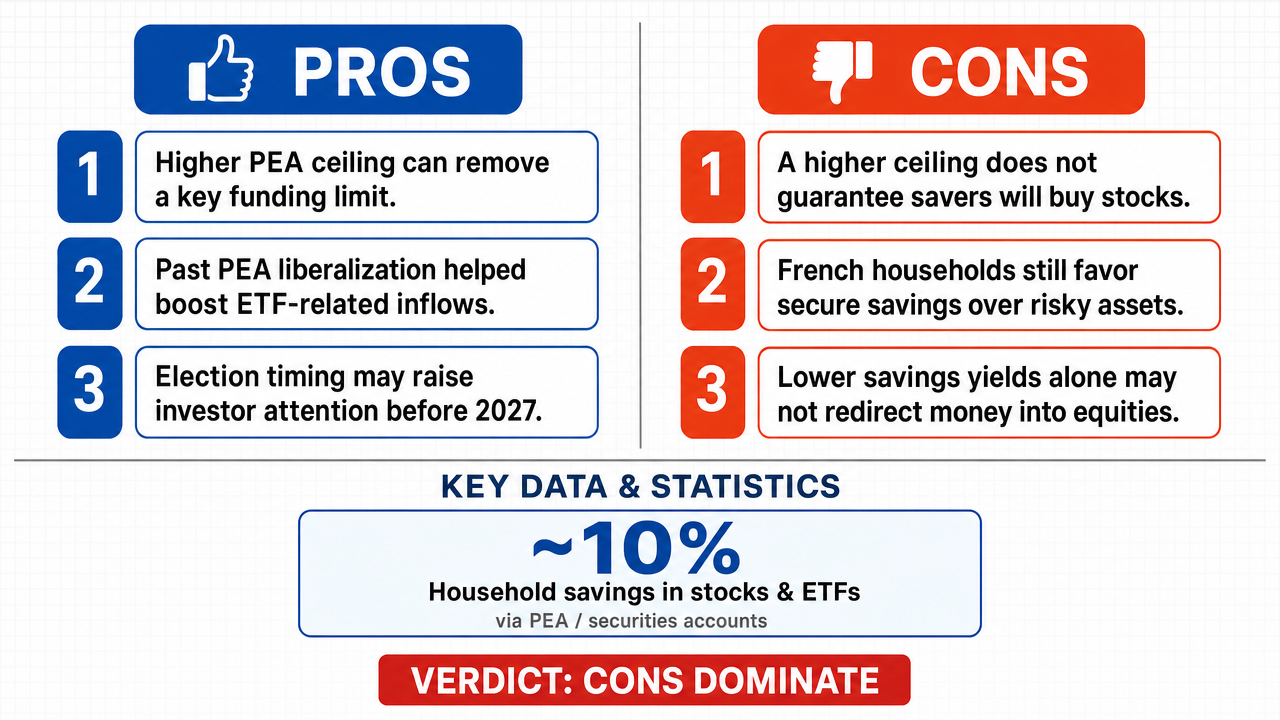
Verdict
Verdict: Mostly FALSE (83%)
This section provides a brief overview of the key arguments. It is not necessary to read the detailed report below.
✅ Key PRO arguments:
- ■The reform of the PEA aims to remove current barriers by increasing the deposit ceiling (currently set at 150,000 euros) and simplifying exit rules, which would make the vehicle more attractive and liquid for French savers .
- ■Historical observation shows that each liberalization of the PEA has indeed led to an acceleration of flows ; for example, opening to ETFs in 2019 caused a clear increase in deposits .
- ■The 2027 electoral calendar and the media coverage of the proposal create a concrete political momentum, with markets and investors regularly anticipating likely regulatory changes.
❌ Key CON arguments:
- ■The argument in favor of the reform relies on a confusion between the technical capacity of a product and the actual behavior of savers : increasing the PEA ceiling is a change in form that does not guarantee a substantive change (the intention to save in stocks).
- ■The structural problem of French savings is not the PEA ceiling but the very structure of household precautionary savings , which favors safety and liquidity .
- ■The idea that falling yields on savings accounts would mechanically push capital into the stock market is an ad hoc auxiliary hypothesis that provides no verifiable transmission mechanism between these two phenomena.
💭 Conclusion: False: the debate has not established that David Lisnard’s proposals will lead to a significant increase in French stock market investment . The opposing side convincingly demonstrated that the technical modification of the PEA (ceiling, exit rules) is merely a change of form and not of substance, with the real obstacle residing in the deep structure of household precautionary savings — savings accounts representing about 65% of their savings and only 10% for stocks and ETFs . The pro argument that past liberalizations have systematically accelerated flows is based on an abusive generalization not supported by the data presented. Moreover, the transmission mechanism between falling savings account yields and new capital entering the stock market has never been convincingly demonstrated with the available data.
🔬 Verdict: Mostly FALSE ❌ (83%)
Claim: David Lisnard’s proposals, notably the reform of the PEA , will lead to a significant increase in French stock market investment before the 2027 elections.
Participating models: deepseek-v3.2 💬, gemma-4-26b-a4b-it 💬👁️
📊 Confrontations: 0 concluded TRUE, 1 concluded FALSE (1 confrontation, 3 models)
📊 Score per camp: TRUE=0.00, FALSE=0.83
🏅 Model score evolution:
minimax-m3 💬👁️: +8
✅ PRO arguments:
- ■The reform of the PEA aims to remove current barriers by increasing the deposit ceiling (currently set at 150,000 euros) and simplifying exit rules, which would make the vehicle more attractive and liquid for French savers . deepseek-v3.2 💬
- ■Historical observation shows that each liberalization of the PEA has indeed led to an acceleration of flows ; for example, opening to ETFs in 2019 caused a clear increase in deposits . deepseek-v3.2 💬
- ■The 2027 electoral calendar and the media coverage of the proposal create a concrete political momentum, with markets and investors regularly anticipating likely regulatory changes. deepseek-v3.2 💬
- ■Current macroeconomic factors, such as inflation and the low yields of regulated savings accounts, act as 'push' factors making the stock alternative more attractive if the vehicle is improved. deepseek-v3.2 💬
❌ CON arguments:
- ■The argument in favor of the reform relies on a confusion between the technical capacity of a product and the actual behavior of savers: increasing the PEA ceiling is a change in form that does not guarantee a substantive change (the intention to save in stocks). gemma-4-26b-a4b-it 💬👁️
- ■The structural problem of French savings is not the PEA ceiling but the very structure of household precautionary savings , which favors safety and liquidity . gemma-4-26b-a4b-it 💬👁️
- ■The idea that falling yields on savings accounts would mechanically push capital into the stock market is an ad hoc auxiliary hypothesis that provides no verifiable transmission mechanism between these two phenomena. gemma-4-26b-a4b-it 💬👁️
- ■The generalization that any liberalization 'systematically' leads to increased flows is abusive and ignores the actual financial capacity constraints of French households. gemma-4-26b-a4b-it 💬👁️
💭 Reasoning: False: the debate has not established that David Lisnard’s proposals will lead to a significant increase in French stock market investment. The opposing side convincingly demonstrated that the technical modification of the PEA (ceiling, exit rules) is merely a change of form and not of substance, with the true obstacle residing in the deep structure of household precautionary savings — savings accounts representing about 65% of their savings and only 10% for stocks and ETFs. The pro argument that past liberalizations have systematically accelerated flows relies on an abusive generalization not supported by the data presented. Furthermore, the transmission mechanism between falling savings account yields and new capital entering the stock market has never been convincingly demonstrated with the available data.
📋 FACTS PRO:
• The assets under management of the PEA have exceeded 200 billion euros, indicating growing appetite among French investors for this product.
• The current market environment and investor trends already create a favorable context for a reform of the PEA.
📋 FACTS CON:
• The structural problem of French savings lies in the strong preference of households for precautionary savings, with savings accounts representing about 65% of their savings compared to only 10% for stocks and ETFs.
• No verifiable evidence has been provided of a transmission mechanism between the decline in interest rates of savings accounts and the increase in flows into the PEA.
• Changing the PEA ceiling does not alter the actual financial capacity of households to invest in stocks.
| Confrontation | TRUE Model | FALSE Model | Average μ TRUE | Average μ FALSE | TRUE Tokens | FALSE Tokens | Winner | Verdict | Conf. |
|---|---|---|---|---|---|---|---|---|---|
| #1 | deepseek-v3.2 💬 | gemma-4-26b-a4b-it 💬👁️ | 0.311 | 0.351 | 12 | 3 | FALSE | FALSE | 83% |
The following technical terms, abbreviations, and specialized concepts are used in this transcript. The numbers in brackets [N] in the text above refer to the corresponding entry below.
[1] Life insurance — Long-term savings contract taken out with an insurer, offering capital guarantee (for euro funds) and advantageous tax treatment after a certain holding period.
[2] Electoral calendar — Schedule of upcoming elections, likely to influence the adoption of reforms depending on the political context and campaign promises.
[3] Guaranteed capital — Commitment by the insurer or financial institution to return at least the initially invested amount, regardless of market developments.
[4] Catalyst — Triggering factor or event that accelerates or amplifies a movement, here used to designate an element likely to provoke a reallocation of savings into stocks.
[5] Securities account — Account allowing holding and trading securities (stocks, bonds, ETFs) outside of a tax-advantaged framework like the PEA or life insurance.
[6] Anticipation effect — Behavior of economic agents who adjust their current decisions based on expected regulatory or fiscal changes.
[7] In progress — Encours — Total amount of assets managed or held at a given moment, often used to measure the size of a market or savings product.
[8] Tax envelope — Enveloppe fiscale — Legal framework (PEA, life insurance, etc.) within which investments benefit from a specific tax regime, notably exemption or deferral.
[9] ETF — Exchange-Traded Fund — Bourse-traded investment fund aiming to replicate the performance of an index, traded continuously like a stock.
[10] Flow — Capital flows — Movements of incoming or outgoing money from a product or market, used to measure collection or discollection dynamics.
[11] Euro funds — Fonds en euros — Investment support of life insurance guaranteeing capital and offering a regular annual return, mainly backed by bonds.
[12] Entry friction — Obstacles (administrative complexity, regulatory constraints, costs) discouraging investors from accessing a financial product.
[13] Ad hoc hypothesis — Auxiliary hypothesis introduced specifically to save a theory from refutation, without being independently tested.
[14] Inflation — General and sustained rise in the price level, eroding purchasing power and real returns of investments.
[15] Stock market investment — Purchase of listed securities (stocks, ETFs, etc.) on a financial market with the hope of long-term returns or capital gains.
[16] LDD — Livret de Développement Durable — Regulated savings account whose funds are used to finance environmental and sustainable development projects, with favorable rates and tax treatment.
[17] LEP — Livret d'Épargne Populaire — Regulated savings account reserved for low-income individuals, offering a higher interest rate than the Livret A and tax-exempt earnings.
[18] Liberalization — Liberalization (of a savings product) — Relaxation of rules governing a financial product (ceilings, eligibility, exit) aimed at broadening its attractiveness and use.
[19] Liquidity — Characteristic of an investment allowing quick conversion into cash without significant loss of value.
[20] Savings accounts (A, LDD, LEP) — Regulated savings accounts — Accounts with regulated rates and tax exemption, considered as precautionary placements with immediate liquidity.
[21] Transmission mechanism — Process through which a shock or economic policy propagates to the real economy or agents' behaviors.
[22] Households — Group of individuals sharing a residence and pooling resources, the basic statistical unit of economic analysis.
[23] PEA — Plan d'Épargne en Actions — French tax-advantaged envelope allowing investment in European stocks with exemption from income tax on capital gains after 5 years, subject to a contribution ceiling.
[24] Contribution ceiling — Maximum amount that can be deposited into a given savings product (set at 150,000 euros for the PEA at the time of the debate).
[25] Push factors — Push factors — Macroeconomic factors (inflation, low interest rates, disappointing yields) that push savers toward alternative investments.
[26] Catch-up — Economic catch-up — Process by which a country or market closes its development or structuring gap relative to reference peers.
[27] Search for yield — Behavior of investors who, facing low interest rates, take more risks to obtain better returns on their investments.
[28] Yield — Return on an investment, expressed as a percentage of the invested capital, including interest, dividends, and capital gains.
[29] Capital loss risk — Risk that the value of an investment falls below the initial amount invested, characteristic of stocks and ETFs.
[30] Capital withdrawal — Sortie en capital — Mode of withdrawing funds from a savings product in the form of capital, as opposed to an annuity payout.
[31] Synergy — Combination of effects where the overall impact exceeds the sum of individual effects, invoked here between technical reform, political impetus, and macroeconomic context.
[32] Rate — Interest rate — Percentage applied to borrowed or lent capital, determining the cost of credit or the return on an investment.
[33] Installments — Amounts deposited by the saver into a savings product, separate from the capital gains or interest generated.
[34] Elasticity — Measure of the sensitivity of a variable (for example, stock demand) to a change in another factor (access conditions, yield, regulation).
[35] Savers — Individuals or households who set aside part of their income rather than consuming it immediately.
[36] Precautionary savings — Savings accumulated by households to face unforeseen expenses or a drop in income, generally placed in liquid and low-risk assets.
The following financial data tables were cited during the debate exchanges:
| Type of savings | Estimated share of household savings | Main characteristic |
|---|---|---|
| Savings accounts (A, LDD, LEP) | ~65% | Immediate liquidity / No risk |
| Life insurance (Euro funds) | ~25% | Capital guaranteed / Low return |
| Stocks and ETFs (via PEA/Stock account) | ~10% | Risk of capital loss |
Legend: Approximate distribution of household savings in France. The figures highlight the predominance of secure savings over risky assets.
Face-off transcripts
- ■
Ownership & Trade Secrets. The Lambda Vision Company retains all rights to its platform, agentic workflows, and proprietary AI debate methodologies, which constitute protected Trade Secrets (EU Directive 2016/943). Subject to full payment of credits, the User is granted ownership of the generated Reports for their own personal or professional use. Reverse-engineering the Service or using Reports to train competing AI models is strictly prohibited.
- ■
No Professional Advice. Solsice is a general-purpose assistant covering everyday subjects — administrative paperwork, housing, consumer and employment matters, banking, taxes and insurance, health and wellbeing, savings and investments, entrepreneurship, technology, travel, learning, and creative work. Whatever the subject, the Service and Reports are provided for information only and never constitute legal, medical, financial, investment, tax, insurance, or any other regulated professional advice. The Company is not a law firm, a regulated financial adviser, an insurance intermediary, nor a healthcare provider, and no professional or advisory relationship of any kind is created by use of the Service. Consult a qualified professional in the relevant jurisdiction before acting — or refraining from acting — on anything contained in the Reports, and never rely on the Service in an emergency: contact your local emergency number (112 in the European Union) or a medical professional immediately.
- ■
AI-Generated Content, Sources and Viewpoints. Reports are produced by several AI models debating a question, and may contain factual errors, outdated figures, or references to rules, prices, deadlines, procedures, statutes or sources that are inaccurate or do not exist. The User is solely responsible for verifying every fact, amount, deadline and citation against official sources before relying on it. Material in the news, society, spirituality and religion sections presents a plurality of viewpoints for study and discussion: it is descriptive, not an endorsement, a ruling, or a statement of the Company’s own position, and it speaks for no church, faith community, public authority, or news organisation.
- ■
Liability & Governing Law. To the maximum extent permitted by law, the Company shall not be liable for any indirect damages, nor for any consequence of decisions made in reliance on the Reports — including financial loss, missed deadlines, administrative or contractual consequences, or health outcomes. These Terms are governed by French law. Any disputes shall be subject to the exclusive jurisdiction of the Courts of Paris, France.