
Les moins-values sur les opérations de cryptomonnaies en France pourront être reportées sur 2036 pour compenser de futurs gains.
AI debate verdict and arguments
⚠️ AI-generated information only; not professional advice
Completed October 11, 2026
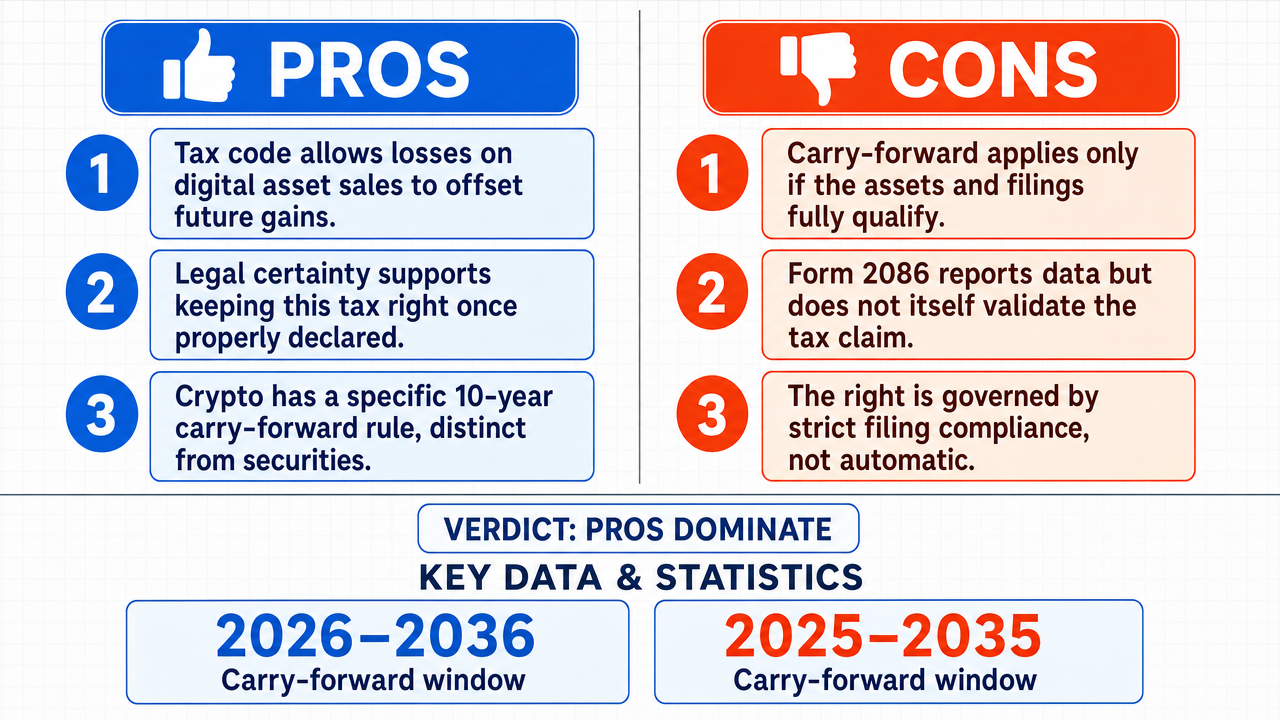
Verdict
Verdict: Mostly TRUE (65%)
This section provides a brief overview of the key arguments. It is not necessary to read the detailed report below.
✅ Key FOR arguments:
- ■Article 150 VH bis of the French General Tax Code indeed allows the deferral of losses incurred on the disposal of digital assets to be offset against gains of the same nature within ten years following the realization of the loss , meaning a loss realized in 2026 can be carried forward until 2036.
- ■The principle of legal certainty and the consistent jurisprudence of the Conseil d'État require that the tax administration cannot challenge a vested right , such as a loss carryforward , due to a mere procedural defect in the declaration, except in cases of proven fraud .
- ■This ten-year carryforward rule applies specifically to digital assets and is not subject to the same restrictive conditions as those applicable to traditional securities, making it a favorable mechanism for crypto investors.
❌ Key AGAINST arguments:
- ■The ten-year loss carryforward is strictly conditioned by the nature of the assets and the compliance of the declarations; if an operation does not strictly adhere to the declaration procedures provided by article 150 VH bis of the CGI , the right to carryforward may be challenged during a tax audit .
- ■The use of form 2086 is merely a collection instrument and does not prejudge the validity of the carryforward ; the tax authorities exercise control over the substance of the declared transactions and can challenge the carryforward in case of inconsistency.
- ■The right to carryforward is not an automatic or unconditional guarantee but a mechanism strictly governed by compliance obligations, stability of asset classification , and resilience to future legislative changes.
💭 Conclusion: True: the statement is legally grounded in French positive law . Article 150 VH bis of the General Tax Code clearly establishes a mechanism for deferring losses on digital asset disposals over a ten-year period, allowing a loss incurred in 2026 to be offset until 2036. The opposing party raised relevant objections regarding declaration compliance conditions and potential instability of the tax regime, but these arguments concern practical application rather than the existence of the right itself. The principle of legal certainty and the protection of vested rights through jurisprudence of the Conseil d'État reinforce the robustness of this carryforward rule. However, moderate confidence reflects legitimate reservations about the effective implementation conditions and risks of future legislative reforms.
🔬 Verdict: Mostly TRUE ✅ (65%)
Claim: Losses on cryptocurrency transactions in France can be carried forward until 2036 to offset future gains.
Participating models: deepseek-v3.2 💬, gemma-4-26b-a4b-it 💬👁️
📊 Confrontations: 1 concluded TRUE, 0 concluded FALSE (1 confrontation, 3 models)
📊 Score per camp: TRUE=0.65, FALSE=0.00
🏅 Model score evolution:
minimax-m3 💬👁️: +6
✅ FOR arguments:
- ■Article 150 VH bis of the French General Tax Code indeed allows the deferral of losses on digital assets to be offset against gains of the same nature within ten years following the loss realization , meaning a loss realized in 2026 can be carried forward until 2036. deepseek-v3.2 💬
- ■The principle of legal certainty and the consistent jurisprudence of the Conseil d'État require that the tax administration cannot challenge a vested right , such as a loss carryforward, due to a mere procedural defect in the declaration, except in cases of proven fraud . deepseek-v3.2 💬
- ■This ten-year carryforward rule is specific to digital assets and is not subject to the same restrictive conditions as those applicable to traditional securities, making it a mechanism favorable to crypto investors. deepseek-v3.2 💬
- ■The assertion should be read as a legal possibility open under current French tax law: in positive law , the offsetting of a net loss on the sale of digital assets against gains of the same nature realized within ten years is clearly authorized. deepseek-v3.2 💬
❌ Against arguments:
- ■The ten-year loss carryforward is strictly conditioned by the nature of the assets and declaration compliance; if an operation does not scrupulously follow the declaration procedures provided by article 150 VH bis of the CGI , the right to carryforward may be challenged during a tax audit . gemma-4-26b-a4b-it 💬👁️
- ■The use of form 2086 is merely a collection instrument and does not prejudge the validity of the carryforward ; the tax authorities exercise control over the substance of the declared transactions and can challenge the carryforward in case of inconsistency. gemma-4-26b-a4b-it 💬👁️
- ■The right to carryforward is not an automatic or unconditional guarantee but a mechanism strictly governed by declaration compliance obligations, stability of asset classification , and resilience to future legislative changes. gemma-4-26b-a4b-it 💬👁️
- ■The existence of a legal rule (article 150 VH bis of the CGI) does not mean its application is certain for each investor, as the legal qualification of digital assets can evolve and legislative reforms may modify the applicable tax regime. gemma-4-26b-a4b-it 💬👁️
💭 Reasoning: True: the statement is legally founded in French positive law. Article 150 VH bis of the General Tax Code clearly establishes a mechanism for deferring losses on digital asset disposals over a ten-year period, allowing a loss realized in 2026 to be offset until 2036. The opposing party raised relevant objections concerning declaration compliance conditions and potential instability of the tax regime, but these arguments relate to practical application rather than the existence of the right itself. The principle of legal certainty and the protection of vested rights through jurisprudence of the Conseil d'État strengthen the solidity of this carryforward rule. However, moderate confidence reflects legitimate reservations about the conditions for effective implementation and risks of future legislative reforms.
📋 Supporting facts:
• Article 150 VH bis of the French General Tax Code allows the carryforward of losses on digital assets against gains of the same nature realized within ten years.
• A loss realized in 2026 can legally be used until 2036 under current French tax law.
• The Conseil d'État protects vested rights regarding loss carryforwards against procedural defects, except in cases of bad faith.
📋 Opposing facts:
• The right to deferment is strictly conditioned by compliance with the declaration procedures provided for in Article 150 VH bis of the CGI.
• The tax administration may exercise control over the substance of the declared transactions and challenge the deferment in case of inconsistency.
• The tax regime for digital assets remains subject to potential evolution due to legislative reforms.
| Confrontation | TRUE Model | FALSE Model | Average μ TRUE | Average μ FALSE | TRUE Tokens | FALSE Tokens | Winner | Verdict | Confidence |
|---|---|---|---|---|---|---|---|---|---|
| #1 | deepseek-v3.2 💬 | gemma-4-26b-a4b-it 💬👁️ | 0.585 | 0.407 | 12 | 3 | TRUE | TRUE | 65% |
The following technical terms, abbreviations, and specialized concepts are used in this transcript. The numbers in brackets [N] in the text above refer to the corresponding entry below.
[1] Digital assets — Assets represented in digital form, notably cryptocurrencies and tokens, subject to a specific tax regime in France under article 150 VH bis of the CGI.
[2] Tax administration — Public body responsible for the application and collection of taxes, with authority to control and adjust taxpayers' declarations.
[3] Article 150 VH bis — Article 150 VH bis of the French General Tax Code — A French tax law article specifically governing the taxation of capital gains and losses on digital asset disposals, including a ten-year carry-forward mechanism.
[4] Disposal — Transfer of ownership of an asset, potentially generating a taxable capital gain or loss depending on the difference between the sale price and the acquisition cost.
[5] CGI — General Tax Code — Main collection of French tax law codifying rules related to taxation of individuals and entities.
[6] Council of State — The highest administrative court in France, whose jurisprudence is authoritative in tax and administrative law, especially regarding legal certainty and acquired rights.
[7] Tax audit — Verification by the tax authorities of the compliance of a taxpayer's declarations and tax calculations, which can lead to adjustments.
[8] Cryptocurrencies — Virtual currencies using cryptography and blockchain technology to secure transactions, classified as digital assets under French tax law.
[9] Acquired rights — Rights that are definitively established and cannot be challenged by the legislator without compensation, according to the Council of State's jurisprudence in tax matters.
[10] Carry-forward right — Ability for a taxpayer to offset a capital loss against future capital gains of the same nature, within the limits set by law.
[11] Positive law — Set of legal rules actually in force at a given time in a state, as opposed to natural law or prospective law.
[12] Form 2086 — Annual declaration of capital gains and losses on digital asset disposals, mandatory for allowing loss offset and carry-forward under article 150 VH bis of the CGI.
[13] Proven fraud — Confirmed intentional tax offense, distinct from mere procedural irregularities, which can justify the tax authorities' challenge to the carry-forward right.
[14] Imputation — Tax mechanism allowing a loss to be offset against a gain of the same nature to reduce the tax payable.
[15] Jurisprudence — Body of judicial decisions interpreting laws and constituting a source of law, especially in tax law.
[16] Consistent jurisprudence — Established and maintained judicial position through repeated and stable decisions, authoritative and serving as a reference for similar cases.
[17] Loss — Loss resulting from the disposal of an asset at a price lower than its acquisition or cost basis, tax-deductible against gains of the same nature.
[18] Net loss — Negative balance after offsetting gains and losses of the same category of assets during a fiscal year, which can be carried forward to subsequent years.
[19] Capital gain — Profit from the disposal of an asset at a price higher than its acquisition cost, taxable according to the applicable tax regime.
[20] Cost basis — Total acquisition cost of an asset, used as the basis for calculating gains and losses upon disposal, with the calculation method subject to control by the tax authorities.
[21] Asset classification — Legal categorization of an asset determining the applicable tax regime for its disposals, whose stability conditions the durability of the carry-forward right.
[22] Adjustment — Tax adjustment — Correction made by the tax authorities to a taxpayer's declaration, which can lead to additional tax assessments and challenge the carry-forward right.
[23] Carry-forward — Loss carry-forward — Ability to defer the offset of a loss against future gains, limited to ten years for digital assets under article 150 VH bis of the CGI.
[24] Legal certainty — General principle of law guaranteeing predictability and stability of legal situations, invoked to protect taxpayers' acquired rights.
[25] Tax claim document — Document evidencing a claim of the public treasury against a taxpayer, distinct from a simple declaration form which does not establish a right.
[26] Procedural irregularity — Irregularity affecting the procedure or modalities of an act, without altering its substance, with contested impact on the carry-forward right in the debate.
The following financial data tables were cited during the debate exchanges:
| Loss Year | First Year of Deduction | Last Year of Carryforward |
|---|---|---|
| 2026 | 2026 | 2036 |
| 2025 | 2025 | 2035 |
Legend: Application of Article 150 VH bis of the CGI: the net capital loss from digital asset disposal can be offset against gains of the same nature in the same year or within the following ten years. The years are expressed in the French civil calendar. Source: Legifrance, Article 150 VH bis of the CGI.
Face-off transcripts
- ■
Ownership & Trade Secrets. Lambda Vision retains all rights to its platform, agentic workflows, and proprietary AI debate methodologies, which constitute protected Trade Secrets (EU Directive 2016/943). Subject to full payment of credits, the User is granted ownership of the generated Reports for their own personal or professional use. Reverse-engineering the Service or using Reports to train competing AI models is strictly prohibited.
- ■
No Professional Advice. Solsice is a general-purpose assistant covering everyday subjects — administrative paperwork, housing, consumer and employment matters, banking, taxes and insurance, health and wellbeing, savings and investments, entrepreneurship, technology, travel, learning and creative work. Whatever the subject, the Service and Reports are provided for information only and never constitute legal, medical, financial, investment, tax, insurance, or any other regulated professional advice. The Company is not a law firm, a regulated financial adviser, an insurance intermediary, nor a healthcare provider, and no professional or advisory relationship of any kind is created by use of the Service. Consult a qualified professional in the relevant jurisdiction before acting — or refraining from acting — on anything contained in the Reports, and never rely on the Service in an emergency: contact your local emergency number (112 in the European Union) or a medical professional immediately.
- ■
AI-Generated Content, Sources and Viewpoints. Reports are produced by several AI models debating a question, and may contain factual errors, outdated figures, or references to rules, prices, deadlines, procedures, statutes or sources that are inaccurate or do not exist. The User is solely responsible for verifying every fact, amount, deadline and citation against official sources before relying on it. Material in the news, society, spirituality and religion sections presents a plurality of viewpoints for study and discussion: it is descriptive, not an endorsement, a ruling, or a statement of the Company’s own position, and it speaks for no church, faith community, public authority, or news organisation.
- ■
Liability & Governing Law. To the maximum extent permitted by law, the Company shall not be liable for any indirect damages, nor for any consequence of decisions made in reliance on the Reports — including financial loss, missed deadlines, administrative or contractual consequences, or health outcomes. These Terms are governed by French law. Any disputes shall be subject to the exclusive jurisdiction of the Courts of Paris, France.