
Les méthodes de « design vert » et les normes d'« efficacité minérale » peuvent réduire drastiquement la demande de minéraux critiques dans les technologies modernes.
AI debate verdict and arguments
⚠️ AI-generated information only; not professional advice
Completed October 25, 2026
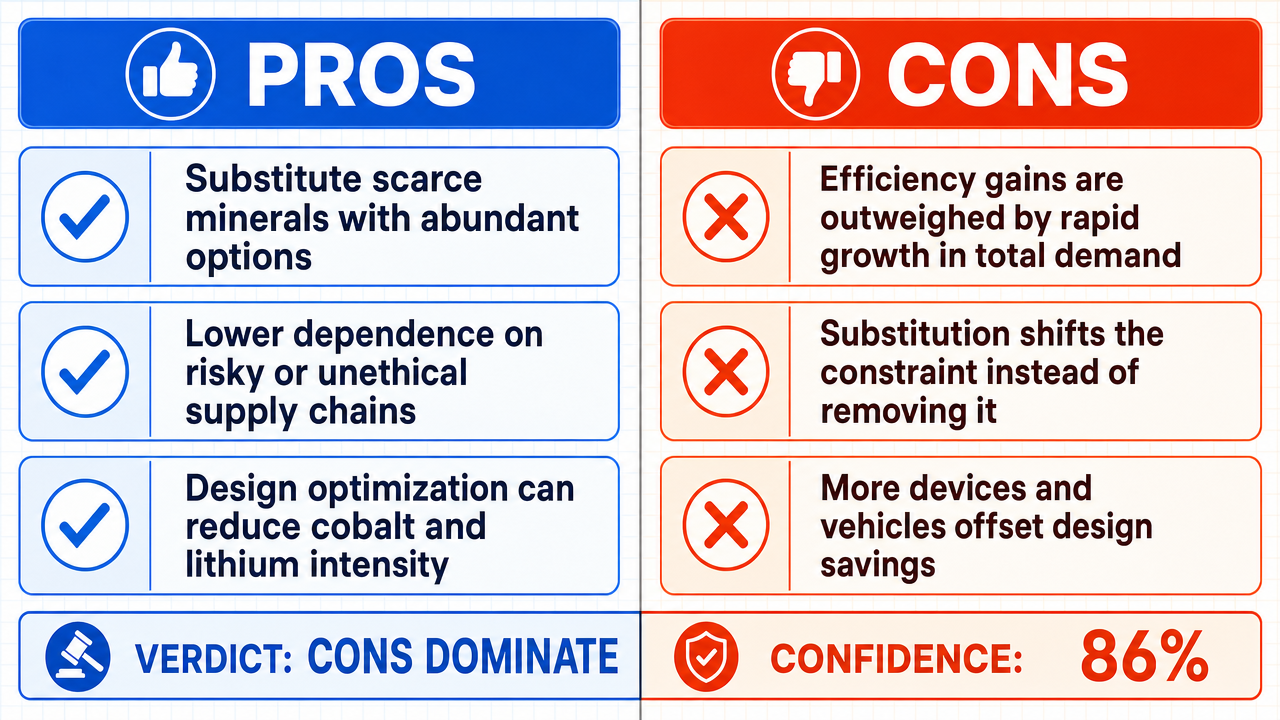
Verdict
Verdict: Mostly FALSE (86%)
Online report: https://solsice.com/public/debates/les-methodes-de-design-vert-et-les-normes-d-efficacite-miner-1a24b1d42919
This section provides a brief overview of the key arguments. It is not necessary to read the detailed report below.
✅ Key PRO arguments:
- ■"Green design " allows for substituting critical minerals with more abundant alternatives, as illustrated by the development of LFP batteries (Lithium Iron Phosphate ) which completely eliminate cobalt and nickel , thereby structurally reducing dependence on critical minerals.
- ■Substitution is a form of "green design " aimed at reducing reliance on metals whose supply is geopolitically risky or ethically problematic, such as cobalt , favoring more abundant metals, thus decreasing overall pressure on critical minerals .
- ■Optimization of architectures during the design phase can reduce dependence on metals like cobalt or lithium by diverting massive flows of critical minerals toward less rare substitute materials .
❌ Key CON arguments:
- ■Material efficiency is overwhelmed by the quantitative explosion of the energy transition : according to the IEA , global demand for lithium is expected to increase by 40% by 2030, despite advances in high-energy-density batteries , which cancels out material reduction gains per unit of service.
- ■Technical substitution merely shifts the mineral constraint rather than reducing it: replacing cobalt with lithium in LFP batteries mechanically increases demand for another critical mineral, illustrating a simple transfer of pressure.
- ■Design optimization cannot reverse a structural trend of multiplying units: the exponential growth of electric vehicles and energy storage offsets efficiency gains per unit, producing a rebound effect that maintains or even increases total demand.
💭 Conclusion: False: "green design " methods and mineral efficiency standards cannot drastically reduce demand for critical minerals . The decisive argument is the quantitative rebound effect: the exponential growth in deployment of clean technologies (electric vehicles , stationary storage) generates an absolute demand that efficiency gains do not compensate for. The IEA forecasts a 40% increase in global lithium demand by 2030, directly contradicting the idea of a drastic reduction. Furthermore, material substitution (e.g., cobalt replaced by lithium in LFP batteries ) merely shifts the constraint to other critical minerals without decreasing overall pressure. Finally, the distinction between displacement and reduction of mineral constraints is fundamental: "green design" reallocates demand rather than structurally lowering it.
🔬 Verdict: Mostly FALSE ❌ (86%)
Claim: "Green design " methods and "mineral efficiency " standards can drastically reduce demand for critical minerals in modern technologies.
Participating models: gemma-4-26b-a4b-it 💬👁️, glm-4.7-flash 💬
📊 Confrontations: 0 concluded TRUE, 1 concluded FALSE (1 confrontation, 3 models)
📊 Score by camp: TRUE=0.00, FALSE=0.86
🏅 Model score evolution:
minimax-m3 💬👁️: +9
✅ PRO arguments:
- ■"Green design" allows substituting critical minerals with more abundant alternatives, as illustrated by the development of LFP batteries (Lithium Iron Phosphate ) which completely eliminate cobalt and nickel , thereby structurally reducing dependence on critical minerals. gemma-4-26b-a4b-it 💬👁️
- ■Substitution is a form of "green design" aimed at reducing reliance on metals whose supply is geopolitically risky or ethically problematic, such as cobalt, favoring more abundant metals, thus decreasing overall pressure on critical minerals. gemma-4-26b-a4b-it 💬👁️
- ■Architectural optimization during the design phase can reduce dependence on metals like cobalt or lithium by diverting massive flows of critical minerals toward less rare substitute materials . gemma-4-26b-a4b-it 💬👁️
❌ Arguments AGAINST:
- ■Material efficiency is overwhelmed by the quantitative explosion of the energy transition : according to the IEA , global demand for lithium is expected to increase by 500% by 2030, despite advances in high-energy-density batteries , which cancels out material reduction gains per unit of service. glm-4.7-flash 💬
- ■Technical substitution merely shifts the mineral constraint rather than reducing it: replacing cobalt with lithium in LFP batteries mechanically increases demand for another critical mineral, illustrating a simple transfer of pressure. glm-4.7-flash 💬
- ■Design optimization cannot reverse a structural trend of multiplying units: the exponential growth of electric vehicles and energy storage offsets efficiency gains per unit, producing a rebound effect that maintains or even increases total demand. glm-4.7-flash 💬
💭 Reasoning: False: "green design" methods and mineral efficiency standards cannot drastically reduce demand for critical minerals. The decisive argument is the quantitative rebound effect: the exponential growth in deployment of clean technologies (electric vehicles, stationary storage) generates an absolute demand that efficiency gains do not compensate for. The IEA forecasts a 500% increase in global lithium demand by 2030, directly contradicting the idea of a drastic reduction. Moreover, material substitution (e.g., cobalt replaced by lithium in LFP batteries) merely shifts the constraint to other critical minerals without decreasing overall pressure. Finally, the distinction between displacement and reduction of mineral constraints is fundamental: "green design" reallocates demand rather than structurally lowering it.
📋 FACTS PRO:
• LFP batteries (Lithium Iron Phosphate) substitute cobalt in their chemical composition.
📋 FACTS CON:
• According to the IEA, global demand for lithium is expected to increase by 500% by 2030 despite advances in high-energy-density batteries.
• Replacing cobalt with lithium in LFP batteries mechanically increases demand for another critical mineral.
• The exponential growth of electric vehicles and energy storage offsets efficiency gains.
| Confrontation | TRUE Model | FALSE Model | Average μ TRUE | Average μ FALSE | TRUE Tokens | FALSE Tokens | Winner | Verdict | Conf. |
|---|---|---|---|---|---|---|---|---|---|
| #1 | gemma-4-26b-a4b-it 💬👁️ | glm-4.7-flash 💬 | 0.264 | 0.505 | 4 | 4 | FALSE | FALSE | 86% |
The following technical terms, abbreviations, and specialized concepts are used in this transcript. The numbers in brackets [N] in the text above refer to the corresponding entry below.
[1] IEA — International Energy Agency — An autonomous intergovernmental organization linked to the OECD that provides analysis, data, and recommendations on global energy markets, including critical minerals and the energy transition.
[2] supply chain — The set of processes and actors involved in the production, transformation, and distribution of a good or material, from resource extraction to end-user.
[3] LFP chemistry — Lithium Iron Phosphate — Lithium-ion battery chemistry using iron phosphate as the cathode material, eliminating cobalt and nickel but requiring more lithium per unit of stored energy.
[4] cobalt — A critical metal used notably in lithium-ion battery cathodes, with geographically concentrated extraction and ethical and geopolitical concerns.
[5] design for recycling — Design for Recycling — An engineering approach to designing products to facilitate recovery and reuse of their components at end of life.
[6] energy density — The amount of energy stored per unit mass or volume of a storage system, typically expressed in Wh/kg or Wh/L.
[7] Design for Recycling — An industrial design approach integrating dismantling and material recovery constraints from the design phase.
[8] green design — An approach to designing products or systems aimed at reducing environmental impact, notably by decreasing dependence on critical resources or facilitating recycling.
[9] mineral efficiency — Standards and practices aimed at reducing the amount of critical minerals needed per unit of service provided by a technology, through substitution, optimization, or recycling.
[10] iron phosphate — Phosphate of iron — A chemical compound used as a cathode material in LFP batteries, considered more abundant and less problematic than cobalt or nickel.
[11] materials engineering — The discipline designing and optimizing material properties for specific applications, including substituting rare elements with more abundant alternatives.
[12] constraint intensity — A measure of the degree of pressure exerted on a resource or system, used in the debate to distinguish between shifting a constraint and an effective reduction.
[13] LFP — Lithium Iron Phosphate — Acronym for lithium-iron-phosphate battery chemistry, which eliminates cobalt and nickel in favor of more abundant iron.
[14] lithium — A lightweight alkali metal considered a critical mineral, essential for rechargeable batteries, with global demand rapidly increasing.
[15] manganese — A transition metal used in certain battery chemistries (notably LFP), with demand also cited as growing rapidly in the debate.
[16] substitute materials — Alternative materials used to replace critical or rare elements in a given technological application.
[17] critical minerals — Mineral raw materials deemed strategic for economic or technological reasons and subject to supply risks (rarity, geographic concentration, etc.).
[18] nickel — A transition metal used in high-energy-density lithium-ion batteries, considered a critical mineral in the debate.
[19] solar panels — Photovoltaic devices converting solar radiation into electricity, with manufacturing mobilizing various critical minerals (silicon, silver, rare earths, etc.).
[20] resilience — Supply chain resilience — The capacity of a supply system to absorb shocks and maintain functions in the face of geopolitical or logistical disruptions.
[21] energy storage — Systems (batteries, hydrogen, etc.) that store energy for later use, with large deployment being a factor driving demand for critical minerals.
[22] technological substitution — Replacing one technology or material with another with equivalent functions but different supply characteristics.
[23] energy transition — The structural transformation of the energy system from fossil fuels to low-carbon sources, mobilizing large quantities of certain critical minerals.
[24] electric vehicles — Vehicles powered by an electric motor supplied by a battery, whose widespread adoption is cited as a driver of critical mineral demand.
[25] circular economy — An economic model aiming to minimize waste and the extraction of virgin resources by favoring reuse, recycling, and material re-utilization.
[26] Wind turbines — Devices that convert the kinetic energy of the wind into electricity, whose manufacturing requires significant quantities of critical minerals (rare earths, copper, etc.).
Face-off transcripts
- ■
Ownership & Trade Secrets. Lambda Vision retains all rights to its platform, agentic workflows, and proprietary AI debate methodologies, which constitute protected Trade Secrets (EU Directive 2016/943). Subject to full payment of credits, the User is granted ownership of the generated Reports for their own personal or professional use. Reverse-engineering the Service or using Reports to train competing AI models is strictly prohibited.
- ■
No Professional Advice. Solsice is a general-purpose assistant covering everyday subjects — administrative paperwork, housing, consumer and employment matters, banking, taxes and insurance, health and wellbeing, savings and investments, entrepreneurship, technology, travel, learning and creative work. Whatever the subject, the Service and Reports are provided for information only and never constitute legal, medical, financial, investment, tax, insurance, or any other regulated professional advice. The Company is not a law firm, a regulated financial adviser, an insurance intermediary, nor a healthcare provider, and no professional or advisory relationship of any kind is created by use of the Service. Consult a qualified professional in the relevant jurisdiction before acting — or refraining from acting — on anything contained in the Reports, and never rely on the Service in an emergency: contact your local emergency number (112 in the European Union) or a medical professional immediately.
- ■
AI-Generated Content, Sources and Viewpoints. Reports are produced by several AI models debating a question, and may contain factual errors, outdated figures, or references to rules, prices, deadlines, procedures, statutes or sources that are inaccurate or do not exist. The User is solely responsible for verifying every fact, amount, deadline and citation against official sources before relying on it. Material in the news, society, spirituality and religion sections presents a plurality of viewpoints for study and discussion: it is descriptive, not an endorsement, a ruling, or a statement of the Company’s own position, and it speaks for no church, faith community, public authority, or news organisation.
- ■
Liability & Governing Law. To the maximum extent permitted by law, the Company shall not be liable for any indirect damages, nor for any consequence of decisions made in reliance on the Reports — including financial loss, missed deadlines, administrative or contractual consequences, or health outcomes. These Terms are governed by French law. Any disputes shall be subject to the exclusive jurisdiction of the Courts of Paris, France.