
Les marchés de prédiction comme Polymarket sont des indicateurs plus fiables de l'issue d'une élection présidentielle que les sondages traditionnels.
AI debate verdict and arguments
⚠️ AI-generated information only; not professional advice
Completed October 8, 2026
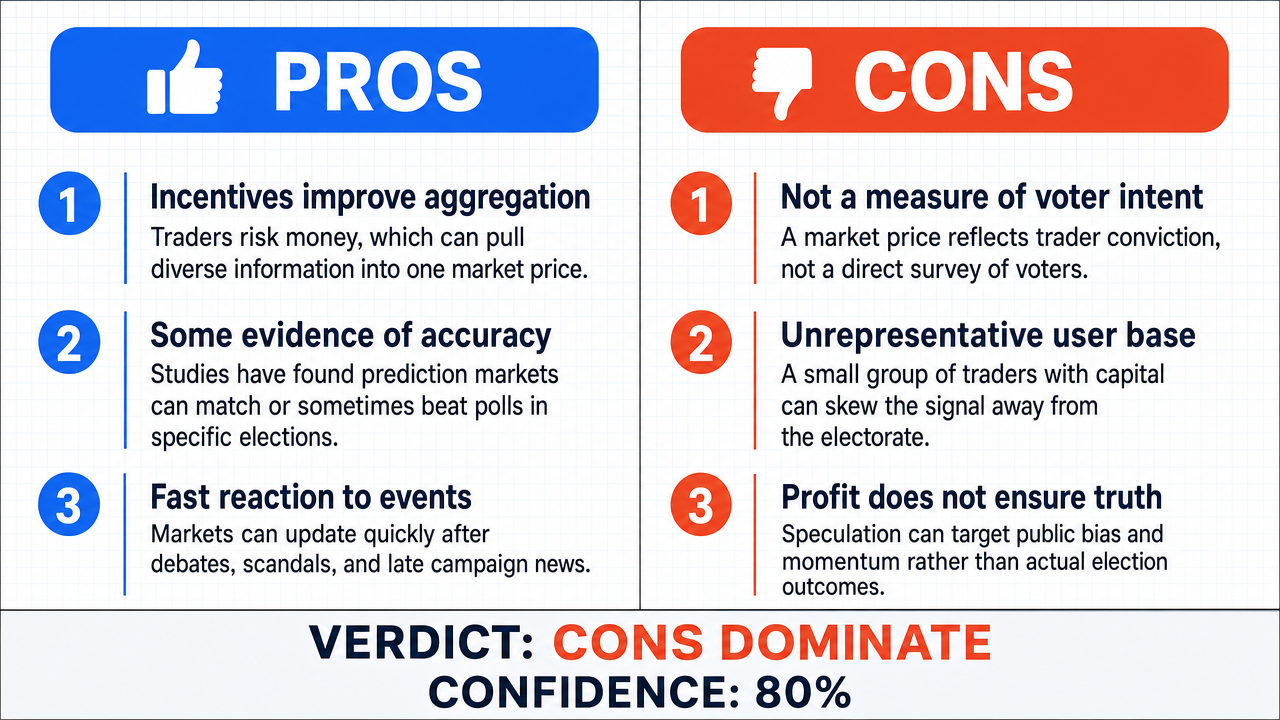
Verdict
Verdict: Mostly FALSE (80%)
This section provides a brief overview of the key arguments. It is not necessary to read the detailed report below.
✅ Key PRO arguments:
- ■Prediction markets aggregate dispersed information through financial incentives, in accordance with the Efficient Markets Theory : traders risk their own money, aligning their predictions with their true convictions, unlike survey respondents who may respond strategically.
- ■A 2020 study comparing PredictIt and polls for the U.S. presidential election showed that the market had a lower mean squared error over the last 100 days of the campaign.
- ■Markets offer superior responsiveness to campaign events and better correction of cognitive and social biases , producing a dynamic and accurate signal.
❌ Key CON arguments:
- ■A prediction market does not measure voting intention , but the conviction of a small group of financial actors, creating confusion between an asset’s price and popular will.
- ■Markets are structurally limited by the non-representative composition of their user base: a minority of traders with significant capital can manipulate odds to reflect their own interests or biases.
- ■Profit incentives do not necessarily lead to a search for electoral truth, but may encourage speculation on opinion biases or media reactivity; money invested turns an opinion into a financial signal , not an electoral one.
💭 Conclusion: False: prediction markets are not more reliable indicators than traditional polls for predicting the outcome of a presidential election. The decisive argument is the fundamental confusion between the measurement instrument and the object being measured: a prediction market captures the conviction of a small group of financial actors, not the voting intention of a diverse electorate. This substitution of reference is worsened by the non-representative composition of users, where a minority with substantial capital can manipulate odds according to their own interests. Moreover, profit incentives encourage speculation on media dynamics and opinion biases rather than an authentic search for electoral truth. Finally, market volatility and structural instability, sensitive to speculative capital movements, make them less stable than properly weighted polls in reflecting popular will.
🔬 Verdict: Mostly FALSE ❌ (80%)
Claim: Prediction markets , such as Polymarket , are more reliable indicators of the outcome of a presidential election than traditional polls .
Participating models: deepseek-v3.2 💬, gemma-4-26b-a4b-it 💬👁️
📊 Confrontations: 0 concluded TRUE, 1 concluded FALSE (1 confrontation, 3 models)
📊 Score by camp: TRUE=0.00, FALSE=0.80
🏅 Model score evolution:
minimax-m3 💬👁️: +8
✅ PRO arguments:
- ■Prediction markets aggregate dispersed information via financial incentives, in accordance with the Efficient Markets Theory : traders risk their own money, which aligns their predictions with their true convictions, unlike survey respondents who may respond strategically. deepseek-v3.2 💬
- ■A 2020 study comparing PredictIt and polls for the U.S. presidential election showed that the market had a lower mean squared error over the last 100 days of the campaign. deepseek-v3.2 💬
- ■Markets offer superior responsiveness to campaign events and better correction of cognitive and social biases , producing a dynamic and precise signal. deepseek-v3.2 💬
- ■The "wisdom of crowds" in prediction markets does not require demographic representativeness: it is an information aggregation mechanism where motivated participants bet on the actual outcome. deepseek-v3.2 💬
❌ Arguments AGAINST:
- ■A prediction market does not measure voting intention , but the conviction of a small group of financial actors, creating confusion between an asset’s price and popular will. gemma-4-26b-a4b-it 💬👁️
- ■Markets are structurally limited by the non-representative composition of their user base: a minority of traders with significant capital can manipulate odds to reflect their own interests or biases. gemma-4-26b-a4b-it 💬👁️
- ■Profit incentives do not necessarily lead to a search for electoral truth, but may encourage speculation on media biases or opinion reactivity; invested money turns an opinion into a financial signal, not an electoral one. gemma-4-26b-a4b-it 💬👁️
- ■There is a substitution of reference that invalidates the claim of market reliability: they measure a proxy (the conviction of a financial niche) rather than the actual subject (the will of the electorate). gemma-4-26b-a4b-it 💬👁️
💭 Reasoning: False: prediction markets are not more reliable indicators than traditional polls for predicting the outcome of a presidential election. The key argument is the fundamental confusion between the measurement instrument and the object being measured: a prediction market captures the conviction of a small group of financial actors, not the voting intention of a diverse electorate. This substitution of reference is worsened by the non-representative composition of users, where a minority with substantial capital can manipulate odds according to their own interests. Furthermore, profit incentives encourage speculation on media dynamics and opinion biases rather than an authentic search for electoral truth. Finally, market volatility and structural instability, sensitive to speculative capital movements, make them less stable than properly weighted polls in reflecting popular will.
📋 PRO facts:
• A 2020 study compared PredictIt and polls for the U.S. presidential election and showed that the market had a lower mean squared error over the last 100 days of the campaign.
• Efficient Markets Theory posits that financial incentives effectively aggregate dispersed information.
• Traders on prediction markets risk their own money, which, according to theory, aligns their predictions with their true convictions.
📋 CON facts:
• Prediction markets measure the conviction of a small group of financial actors, not the voting intention of a representative population.
• The user base of prediction markets is not demographically representative, allowing a wealthy minority to influence odds.
• Profit incentives may encourage speculation on media biases rather than an authentic search for electoral truth.
• Prediction markets exhibit structural volatility related to speculative capital movements, making them unstable as indicators.
| Confrontation | TRUE Model | FALSE Model | Mean μ TRUE | Mean μ FALSE | TRUE Tokens | FALSE Tokens | Winner | Verdict | Conf. |
|---|---|---|---|---|---|---|---|---|---|
| #1 | deepseek-v3.2 💬 | gemma-4-26b-a4b-it 💬👁️ | 0.357 | 0.252 | 12 | 3 | TRUE | FALSE | 80% |
The following technical terms, abbreviations, and specialized concepts are used in this transcript. The numbers in brackets [N] in the above text refer to the corresponding entry below.
[1] Financial asset — A negotiable title or instrument representing an economic value held by an actor on a financial market.
[2] Information aggregation — The process by which dispersed information held by many agents is combined to form a collective estimate, often via a market mechanism.
[3] Cognitive biases — Systematic errors in judgment or reasoning that influence individuals' decision-making, at the expense of rationality.
[4] Reporting bias — The tendency of survey respondents to give socially desirable or strategic answers rather than their true opinions, affecting the reliability of declarative data.
[5] Sociodemographic composition — The distribution of demographic characteristics (age, income, education, etc.) within a population or user group.
[6] Odds — Implicit probabilities derived from prediction market prices, reflecting the collective conviction of participants regarding the occurrence of an event.
[7] Herd effect — Behavior whereby agents imitate the decisions or positions of others rather than relying on their own analysis, potentially amplifying market movements.
[8] Mean squared error — Erreur quadratique moyenne (EQM) — A statistical measure of an estimator's accuracy, calculated as the average of the squares of the deviations between predicted and observed values.
[9] Sampling errors — Deviations between results obtained from a sample and the true values of the entire population, due to the sample being only a fraction of that population.
[10] Financial incentive — A mechanism by which participants are motivated by the prospect of monetary gains or losses to reveal their true convictions via bets or investments.
[11] Voting intention — A declaration by a voter of their intended choice in an election, distinct from the perceived probability by financial actors on a prediction market.
[12] Prediction markets — Trading platforms where participants buy and sell contracts whose payoff depends on the occurrence of future events, thus aggregating dispersed information into prices.
[13] Price mechanism — The process by which the interaction between buyers and sellers on a market determines prices, which are supposed to reflect the aggregated available information.
[14] Polymarket — A blockchain-based prediction market platform where users bet on the outcome of events, including political ones.
[15] Perceived probability — The subjective estimate of the likelihood of an event, as evaluated by an agent or group of agents, distinct from the objective probability.
[16] Wisdom of crowds — The theory that the aggregation of independent judgments from a diverse group can produce a collective estimate more accurate than that of individual experts.
[17] Sentiment — Market sentiment — An indicator reflecting the general attitude, optimism, or pessimism of market participants, distinct from an objective probability measure.
[18] Signal — Informational signal — Information extracted from a mechanism (price, vote, etc.) believed to reveal an underlying reality, whose reliability depends on the quality of the emission mechanism.
[19] Polls — Opinion polls — Statistical surveys aimed at measuring opinions, voting intentions, or preferences of a population by questioning a representative sample.
[20] Speculation — The act of taking a position on a financial market by betting on future price movements, often motivated by short-term profit rather than fundamental analysis.
[21] Proxy substitution — An error involving confusing an indirect measure (proxy) with the object it is supposed to represent, invalidating the conclusion drawn from that measure.
[22] Referent substitution — Confusion between what an instrument actually measures and the object it is supposed to measure, leading to erroneous conclusions about the instrument's reliability.
[23] Efficient market hypothesis — Efficient Market Hypothesis (EMH) — A financial hypothesis stating that asset prices on a market fully reflect all available information, making systematic prediction impossible.
[24] Volatility — A measure of the amplitude of price variations of an asset or market over a given period, an indicator of risk and uncertainty.
Face-off transcripts
- ■
Ownership & Trade Secrets. Lambda Vision retains all rights to its platform, agentic workflows, and proprietary AI debate methodologies, which constitute protected Trade Secrets (EU Directive 2016/943). Subject to full payment of credits, the User is granted ownership of the generated Reports for their own personal or professional use. Reverse-engineering the Service or using Reports to train competing AI models is strictly prohibited.
- ■
No Professional Advice. Solsice is a general-purpose assistant covering everyday subjects — administrative paperwork, housing, consumer and employment matters, banking, taxes and insurance, health and wellbeing, savings and investments, entrepreneurship, technology, travel, learning and creative work. Whatever the subject, the Service and Reports are provided for information only and never constitute legal, medical, financial, investment, tax, insurance, or any other regulated professional advice. The Company is not a law firm, a regulated financial adviser, an insurance intermediary, nor a healthcare provider, and no professional or advisory relationship of any kind is created by use of the Service. Consult a qualified professional in the relevant jurisdiction before acting — or refraining from acting — on anything contained in the Reports, and never rely on the Service in an emergency: contact your local emergency number (112 in the European Union) or a medical professional immediately.
- ■
AI-Generated Content, Sources and Viewpoints. Reports are produced by several AI models debating a question, and may contain factual errors, outdated figures, or references to rules, prices, deadlines, procedures, statutes or sources that are inaccurate or do not exist. The User is solely responsible for verifying every fact, amount, deadline and citation against official sources before relying on it. Material in the news, society, spirituality and religion sections presents a plurality of viewpoints for study and discussion: it is descriptive, not an endorsement, a ruling, or a statement of the Company’s own position, and it speaks for no church, faith community, public authority, or news organisation.
- ■
Liability & Governing Law. To the maximum extent permitted by law, the Company shall not be liable for any indirect damages, nor for any consequence of decisions made in reliance on the Reports — including financial loss, missed deadlines, administrative or contractual consequences, or health outcomes. These Terms are governed by French law. Any disputes shall be subject to the exclusive jurisdiction of the Courts of Paris, France.