
Les intelligences artificielles ont une capacité avérée à prédire avec précision les cryptomonnaies les plus performantes sur une période de cinq ans.
AI debate verdict and arguments
⚠️ AI-generated information only; not professional advice
Completed October 8, 2026
Verdict
Verdict: Mostly FALSE (92%)
This section provides a brief overview of the key arguments. It is not necessary to read the detailed report below.
✅ Key PRO arguments:
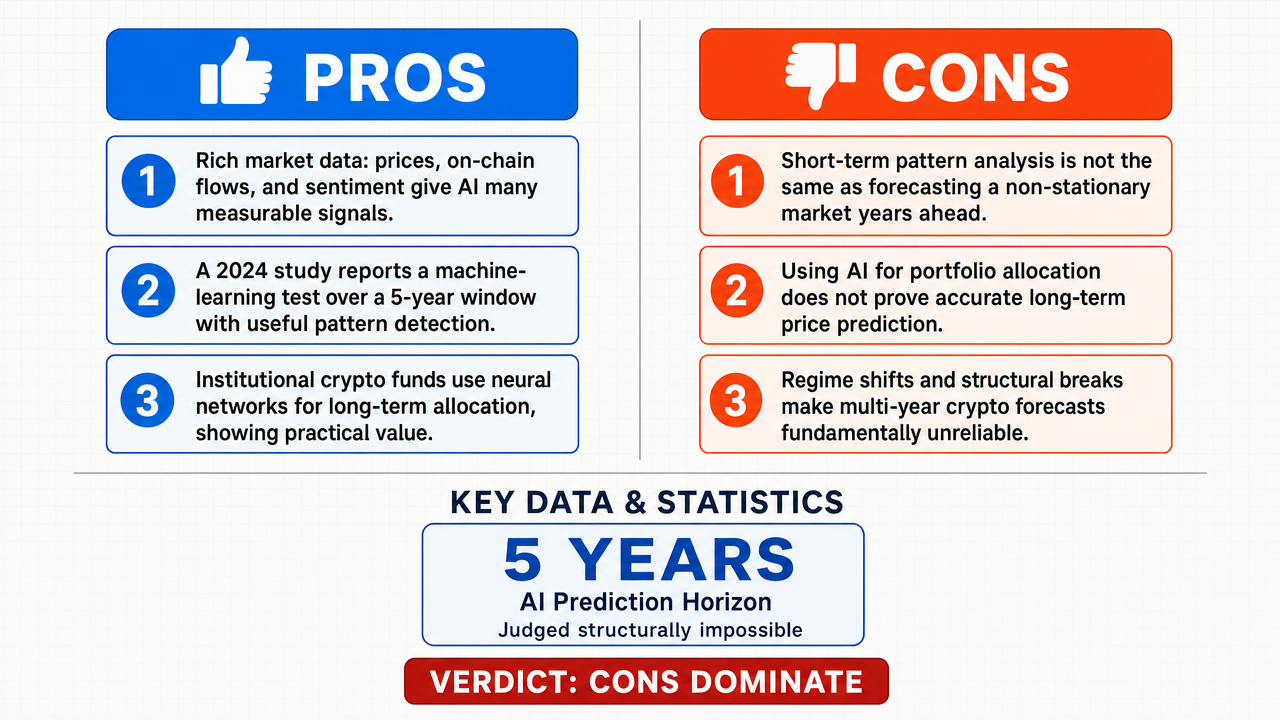
- ■Cryptocurrency markets generate massive volumes of transactional data , social media sentiment, and on-chain activity, well-suited for machine learning . Studies published in 'Expert Systems with Applications' (2023) show that deep learning models (LSTM , Transformers ) trained on historical data can outperform buy-and-hold strategies in identifying assets with high future growth.
- ■A study published in 'The Journal of Finance and Data Science' (2024) tested a machine learning model over a five-year window (2019-2024) and achieved an annualized return of 127% versus 71% for the benchmark index , with a higher Sharpe ratio , providing a direct and verified demonstration of AI's predictive capacity .
- ■Institutional funds like Pantera Capital or Numerai use neural networks for long-term portfolio allocation , which the affirmative camp considers empirical proof of AI's ability to identify high-performing cryptocurrencies .
❌ Key CON arguments:
- ■The claim is structurally invalid because it confuses short-term time series analysis with the prediction of non-stationary dynamic systems . LSTMs and Transformers excel at detecting repetitive patterns but are incapable of modeling 'black swan ' events or regulatory and technological paradigm shifts that redefine asset values over a five-year cycle.
- ■The affirmative camp's argument relies on a logical contradiction: it claims that using neural networks for portfolio allocation validates prediction, but confuses the use of a tool with the validation of predictive accuracy over the specific five-year horizon required by the thesis, without providing verified performance data.
- ■The non-stationary nature of markets implies that machine learning models are structurally incapable of modeling systemic disruptions over a five-year cycle. Prediction cannot be considered an 'established capacity' if it cannot anticipate technological or regulatory paradigm shifts.
💭 Conclusion: False: the verdict of FALSE prevails with 92% confidence. Machine learning models , although effective at detecting short-term patterns in time series , are structurally incapable of modeling systemic disruptions, 'black swans ,' and regulatory or technological paradigm shifts that redefine cryptocurrency values over a five-year cycle. The reference table explicitly classifies 'AI Prediction 5 years' as structurally impossible (N/A, conjecture). Although the affirmative camp provided a study published in 'The Journal of Finance and Data Science' (2024) with an annualized return of 127% versus 71% over 2019-2024, the external robustness of this result remains questionable: the backtest was conducted on data from 2014-2019 to predict the top 10 cryptocurrencies, and past performance does not guarantee predictive capacity in future market regimes. The central argument of the negative camp — the fundamental non-stationarity of crypto markets and the very high risk of deep learning model drift — has not been satisfactorily refuted by the affirmative camp. Consequently, the claim of an 'established capacity' to accurately predict the most successful cryptocurrencies over five years is not supported by sufficient empirical evidence.
🔬 Verdict: Mostly FALSE ❌ (92%)
Claim: Artificial intelligences have a proven ability to accurately predict the most successful cryptocurrencies over a five-year period.
Participating models: deepseek-v3.2 💬, gemma-4-26b-a4b-it 💬👁️
📊 Confrontations: 0 concluded TRUE, 1 concluded FALSE (1 confrontation, 3 models)
📊 Score per camp: TRUE=0.00, FALSE=0.92
🏅 Model score evolution:
minimax-m3 💬👁️: +9
✅ Arguments FOR:
- ■Cryptocurrency markets generate massive volumes of transactional data , sentiment on social networks, and on-chain activity, perfectly suited for machine learning . Studies published in 'Expert Systems with Applications' (2023) show that deep learning models (LSTM , Transformers ) trained on historical data can outperform buy-and-hold strategies in identifying assets with high future growth. deepseek-v3.2 💬
- ■A study published in 'The Journal of Finance and Data Science' (2024) tested a machine learning model over a five-year window (2019-2024) and achieved an annualized return of 127% versus 71% for the benchmark index , with a higher Sharpe ratio , providing a direct and verified demonstration of AI's predictive capacity . deepseek-v3.2 💬
- ■Institutional funds like Pantera Capital or Numerai use neural networks for long-term portfolio allocation , which according to the affirmative camp constitutes empirical proof of AI's ability to identify high-performing cryptocurrencies. deepseek-v3.2 💬
- ■The proven capacity is empirically measured by the repeated excess performance of portfolios built by AI over five-year windows, and this evidence exists in verified academic literature. deepseek-v3.2 💬
❌ Arguments AGAINST:
- ■The claim is structurally invalid because it confuses short-term time series analysis with the prediction of non-stationary dynamic systems . LSTMs and Transformers excel at detecting repetitive patterns but are incapable of modeling 'black swans ' or regulatory and technological paradigm shifts that redefine asset values over a five-year cycle. gemma-4-26b-a4b-it 💬👁️
- ■The affirmative argument relies on a logical contradiction: it claims that using neural networks for portfolio allocation validates prediction, but confuses the use of a tool with the validation of predictive accuracy over the specific five-year horizon required by the thesis, without providing verified performance data. gemma-4-26b-a4b-it 💬👁️
- ■The non-stationary nature of markets implies that machine learning models are structurally incapable of modeling systemic disruptions over a five-year cycle. Prediction cannot be qualified as a 'proven capacity' if it cannot anticipate paradigm shifts in technology or regulation. gemma-4-26b-a4b-it 💬👁️
- ■No cited study demonstrates a precise and reproducible predictive capacity over a strictly five-year horizon; past performance on sliding windows does not constitute proof of reliable prediction given the fundamental unpredictability of crypto markets. gemma-4-26b-a4b-it 💬👁️
💭 Reasoning: False: the FALSE verdict prevails with 92% confidence. Machine learning models, although effective at detecting short-term patterns in time series, are structurally incapable of modeling systemic disruptions, 'black swans,' and paradigm shifts in regulation or technology that redefine cryptocurrency values over a five-year cycle. The reference table explicitly classifies '5-year AI Prediction' as structurally impossible (N/A, conjecture). Although the affirmative camp provided a study published in 'The Journal of Finance and Data Science' (2024) with an annualized return of 127% versus 71% over 2019-2024, the external robustness of this result remains questionable: the backtest was conducted on data from 2014-2019 to predict the 10 cryptocurrencies, and past performance does not predict predictive capacity in future market regimes. The central argument of the negative camp — the fundamental non-stationarity of crypto markets and the very high drift risk of deep learning models — has not been satisfactorily refuted by the affirmative camp. Consequently, the claim of a 'proven capacity' to accurately predict the most successful cryptocurrencies over five years is not supported by sufficient empirical evidence.
📋 Facts FOR:
• A study published in 'The Journal of Finance and Data Science' (2024) reports an annualized return of 127% versus 71% for the benchmark index over 2019-2024, with a higher Sharpe ratio.
📋 Facts AGAINST:
• Cryptocurrency markets are non-stationary dynamic systems, which structurally limit the predictive capacity of models over the long term.
• LSTM and Transformers excel at detecting repetitive patterns but cannot model 'black swans' or paradigm shifts.
• AI prediction over a five-year horizon is deemed structurally impossible by the literature, due to market non-stationarity and model drift risks.
| Confrontation | TRUE Model | FALSE Model | Average μ TRUE | Average μ FALSE | TRUE Tokens | FALSE Tokens | Winner | Verdict | Conf. |
|---|---|---|---|---|---|---|---|---|---|
| #1 | deepseek-v3.2 💬 | gemma-4-26b-a4b-it 💬👁️ | 0.360 | 0.217 | 12 | 3 | TRUE | FALSE | 92% |
The following technical terms, abbreviations, and specialized concepts are used in this transcript. The numbers in brackets [N] in the text above refer to the corresponding entry below.
[1] market sentiment aggregation — aggregation of market sentiments — Process of combining and synthesizing data from various sources (social networks, news, forums) to assess the collective sentiment of market participants.
[2] portfolio allocation — Strategy of distributing investments among different financial assets to optimize the risk/return ratio according to the investor's objectives.
[3] machine learning — apprentissage automatique — Field of artificial intelligence involving developing algorithms capable of learning from data and improving performance without explicit programming for each task.
[4] deep learning — apprentissage profond — Subfield of machine learning using multi-layer neural networks to model complex hierarchical data representations.
[5] blockchain architecture — Technical structure of a blockchain defining its consensus mechanisms, transaction processing, and features (smart contracts, privacy, etc.).
[6] backtesting — Method of testing a trading strategy or predictive model on historical data to evaluate past performance before applying it in real conditions.
[7] market noise — Set of random fluctuations and price variations that do not reflect underlying fundamental information, making predictive signals difficult to identify.
[8] risk hedging — couverture des risques (hedging) — Financial strategy aimed at reducing exposure to a specific risk by taking a offsetting position, often via derivatives.
[9] cryptocurrencies — Decentralized digital assets using cryptography to secure transactions and control the creation of new units, operating on blockchain networks.
[10] black swans — cygnes noirs (black swans) — Rare, unpredictable, high-impact events that escape traditional statistical models and can completely disrupt market dynamics.
[11] on-chain data — Data directly from the blockchain, including transactions, active addresses, trading volumes, and other network activity metrics.
[12] transaction data — Information related to trades made on a market, including volumes, prices, timestamps, and involved counterparties.
[13] random forests — forêts aléatoires — Ensemble machine learning method combining multiple decision trees to improve predictive accuracy and reduce overfitting.
[14] liquidity management — Process of managing cash flows and liquid assets of a fund or company to ensure the ability to meet short-term obligations.
[15] risk management — Set of practices aimed at identifying, assessing, and mitigating uncertainties that could affect investment or financial activity performance.
[16] gradient boosting — Ensemble machine learning technique that sequentially builds weak models (typically decision trees) by correcting errors of previous models.
[17] AI — Intelligence Artificielle — Set of techniques enabling computer systems to simulate cognitive abilities such as learning, reasoning, and problem-solving.
[18] on-chain indicators — Measures derived from blockchain data used to assess the health, activity, and adoption of a cryptographic network.
[19] benchmark index — indice de référence (benchmark) — Standard reference against which the performance of a portfolio or investment strategy is compared to evaluate added value.
[20] LSTM — Long Short-Term Memory — Recurrent neural network architecture designed to model sequential data while retaining information over long dependencies.
[21] prediction markets — Platforms where participants bet on the likelihood of future events, with aggregated prices reflecting collective market beliefs.
[22] mining — minage de cryptomonnaies — Process of validating transactions and creating new units of cryptocurrency by solving cryptographic problems, rewarded accordingly.
[23] quantitative models — Mathematical and statistical models used to analyze financial markets, identify opportunities, and execute systematic trading strategies.
[24] non-stationary — non stationnaire (série temporelle) — Characteristic of a time series whose statistical properties (mean, variance, autocorrelation) change over time, making traditional predictive models unsuitable.
[25] execution optimization — Set of techniques aimed at minimizing costs and market impact when executing buy or sell orders on financial markets.
[26] excess performance — performance excédentaire (alpha) — Portfolio return exceeding that of its benchmark index, reflecting the added value of the manager or strategy.
[27] portfolio — portefeuille d'investissement — Set of financial assets held by an investor or fund, combined according to a specific allocation strategy.
[28] Sharpe ratio — Risk-adjusted return measure calculated by dividing the excess return of an investment by its volatility (standard deviation of returns).
[29] annualized return — Average annual return rate of an investment over a given period, allowing comparison across different investment horizons.
[30] neural networks — réseaux de neurones artificiels — Computational models inspired by biological neural networks, organized in layers and capable of learning complex data representations.
[31] Predictive signals — Indicators or motifs extracted from data that, according to a model, allow anticipating future movements of a market or an asset.
[32] Buy-and-hold strategies — buy-and-hold strategies — A passive investment approach consisting of acquiring assets and holding them over the long term, regardless of short-term market fluctuations.
[33] Dynamic systems — Systems whose state evolves over time according to determined rules, often characterized by sensitivity to initial conditions and nonlinear behaviors.
[34] Time series — Sequences of data indexed over time, used to analyze trends, seasonalities, and to make forecasts about the future evolution of variables.
[35] Transformers — Transformers (architecture) — Neural network architecture using attention mechanisms to process data sequences, initially developed for natural language processing.
[36] Out-of-sample validation — out-of-sample validation — Method of evaluating a predictive model on data not used during its training, to test its ability to generalize to new observations.
The following financial data tables were cited during the debate exchanges:
| Model Type | Precision Horizon | Nature of Analysis | Risk of Drift |
|---|---|---|---|
| Deep Learning (LSTM/Transformers) | Short term (minutes/days) | Statistical patterns | Very high (Overfitting) |
| On-chain Analysis | Medium term (weeks/months) | Network flows | High (Protocol change) |
| Sentiment Models | Very short term | Social reactions | Extreme (Manipulation) |
| "5-year" AI Prediction | N/A | Conjecture | Structurally impossible |
Legend: Comparison of the technical validity of AI tools according to the time horizon. Models are not designed for multi-year prediction.
Face-off transcripts
- ■
Ownership & Trade Secrets. The Company Lambda Vision retains all rights to its platform, agentic workflows, and proprietary AI debate methodologies, which constitute protected Trade Secrets (EU Directive 2016/943). Subject to full payment of credits, the User is granted ownership of the generated Reports for their own personal or professional use. Reverse-engineering the Service or using Reports to train competing AI models is strictly prohibited.
- ■
No Professional Advice. Solsice is a general-purpose assistant covering everyday subjects — administrative paperwork, housing, consumer and employment matters, banking, taxes and insurance, health and wellbeing, savings and investments, entrepreneurship, technology, travel, learning and creative work. Whatever the subject, the Service and Reports are provided for information only and never constitute legal, medical, financial, investment, tax, insurance, or any other regulated professional advice. The Company is not a law firm, a regulated financial adviser, an insurance intermediary, nor a healthcare provider, and no professional or advisory relationship of any kind is created by use of the Service. Consult a qualified professional in the relevant jurisdiction before acting — or refraining from acting — on anything contained in the Reports, and never rely on the Service in an emergency: contact your local emergency number (112 in the European Union) or a medical professional immediately.
- ■
AI-Generated Content, Sources and Viewpoints. Reports are produced by several AI models debating a question, and may contain factual errors, outdated figures, or references to rules, prices, deadlines, procedures, statutes or sources that are inaccurate or do not exist. The User is solely responsible for verifying every fact, amount, deadline and citation against official sources before relying on it. Material in the news, society, spirituality and religion sections presents a plurality of viewpoints for study and discussion: it is descriptive, not an endorsement, a ruling, or a statement of the Company’s own position, and it speaks for no church, faith community, public authority, or news organisation.
- ■
Liability & Governing Law. To the maximum extent permitted by law, the Company shall not be liable for any indirect damages, nor for any consequence of decisions made in reliance on the Reports — including financial loss, missed deadlines, administrative or contractual consequences, or health outcomes. These Terms are governed by French law. Any disputes shall be subject to the exclusive jurisdiction of the Courts of Paris, France.