
Les infrastructures de recyclage durable dans les pays à revenus élevés sont suffisantes pour gérer la majorité des e-déchets générés globalement sans les exporter vers les pays à faibles revenus.
AI debate verdict and arguments
⚠️ AI-generated information only; not professional advice
Completed October 24, 2026
Verdict
Verdict: Mostly FALSE (88%)
Online report: https://solsice.com/public/debates/les-infrastructures-de-recyclage-durable-dans-les-pays-a-rev-03fd7a59469c
This section provides a brief overview of the key arguments. It is not necessary to read the detailed report below.
✅ Key PRO arguments:
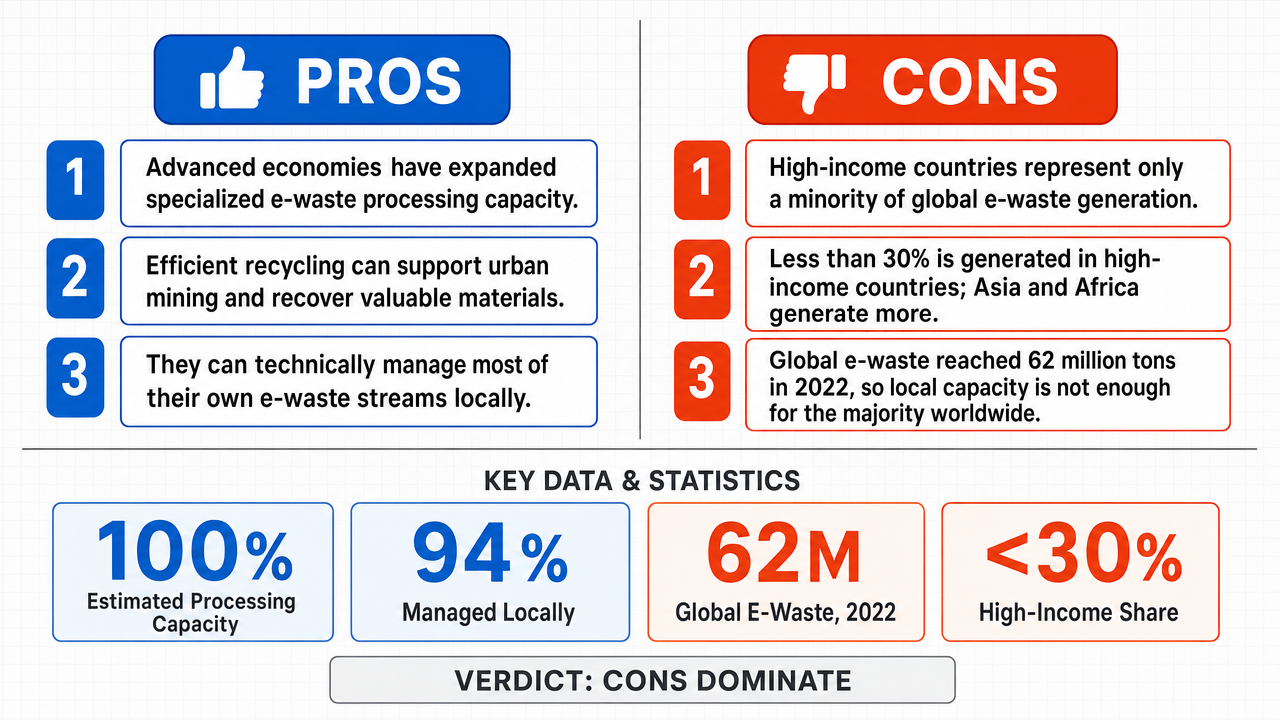
- ■The massive expansion of specialized processing capacities in advanced economies demonstrates a growing technical ability to absorb global e-waste flows , supported by significant investments in automation and advanced hydrometallurgy .
- ■By optimizing recycling processes, high-income countries can turn the challenge of e-waste into an economic opportunity of 'urban mining ', thus reducing the structural need to export materials to low-income countries .
- ■The initial assertion does not mean that wealthy countries must absorb waste produced by developing countries, but that the technical and logistical capacity available in high-income areas is sufficient to process the majority of e-waste generated globally.
❌ Key CON arguments:
- ■The capacity argument ignores the geography of waste generation: high-income countries constitute only a minority of the world population and produce only a limited share of global e-waste .
- ■According to the European Environment Agency, high-income countries generate less than 30% of global e-waste , while Asia and Africa generate the majority, making export structurally necessary.
- ■According to the 2024 Global E-waste Monitor, global e-waste generation was 62 million tonnes in 2022, and even recycling 100% of what they generate, the capacity of wealthy countries remains below 30% of the total worldwide.
💭 Conclusion: High-income countries produce only a minority of the total global e-waste volume , estimated at 62 million tonnes according to the 2024 Global E-waste Monitor. Since these countries generate less than 30% of global e-waste, even mobilizing all their internal recycling capacity, they could only process about 30% of the waste generated globally. Asia and Africa generate the majority of global e-waste, making export necessary to manage the remaining majority. Therefore, infrastructure in high-income countries is insufficient to handle most of the global e-waste without resorting to export.
🔬 Verdict: Mostly FALSE ❌ (88%)
Assertion: The sustainable recycling infrastructures in high-income countries are sufficient to manage the majority of e-waste generated globally without exporting it to low-income countries .
Participating models: gemma-4-26b-a4b-it 💬👁️, glm-4.7-flash 💬
📊 Confrontations: 0 concluded TRUE, 1 concluded FALSE (1 confrontation, 3 models)
📊 Score by camp: TRUE=0.00, FALSE=0.88
🏅 Model score evolution:
minimax-m3 💬👁️: +9
✅ PRO arguments:
- ■The massive expansion of specialized processing capacities in advanced economies demonstrates a growing technical ability to absorb global e-waste flows, supported by significant investments in automation and advanced hydrometallurgy . gemma-4-26b-a4b-it 💬👁️
- ■By optimizing recycling processes, high-income countries can turn the challenge of e-waste into an economic 'urban mining' opportunity , thus reducing the structural need to export materials to low-income countries. gemma-4-26b-a4b-it 💬👁️
- ■The initial assertion does not mean that wealthy countries must absorb waste produced by developing countries, but that the technical and logistical capacity available in high-income zones is sufficient to process the majority of globally generated e-waste. gemma-4-26b-a4b-it 💬👁️
❌ CON arguments:
- ■The capacity argument ignores the geography of waste generation: high-income countries generate only a minority of the global population and produce only a limited share of global e-waste. glm-4.7-flash 💬
- ■According to the European Environment Agency, high-income countries generate less than 30% of global e-waste, while Asia and Africa generate the majority, making export structurally necessary. glm-4.7-flash 💬
- ■According to the 2024 Global E-waste Monitor, global e-waste generation was 62 million tonnes in 2022, and even recycling 100% of what they generate, the capacity of wealthy countries remains below 30% of the total worldwide. glm-4.7-flash 💬
- ■Optimizing collection in high-income countries cannot compensate for the massive volume of waste generated outside these borders, leaving a large share of waste inevitably to be processed elsewhere or exported. glm-4.7-flash 💬
💭 Reasoning: High-income countries produce only a minority of the total global e-waste volume, estimated at 62 million tonnes according to the 2024 Global E-waste Monitor. Since these countries generate less than 30% of global e-waste, even mobilizing all their internal recycling capacity, they could only process about 30% of the waste generated globally. Asia and Africa generate the majority of global e-waste, making export necessary to manage the remaining majority. Therefore, infrastructure in high-income countries is insufficient to handle most of the global e-waste without resorting to export.
📋 PRO facts:
• Massive investments in automation and advanced hydrometallurgy increase the extraction yield of critical metals in high-income countries.
📋 CON facts:
• According to the European Environment Agency, high-income countries generate less than 30% of global e-waste.
• According to the 2024 Global E-waste Monitor, global e-waste generation was 62 million tonnes.
• Asia and Africa generate the majority of global e-waste.
• Even recycling 100% of their own waste, the capacity of wealthy countries remains below 30% of the total worldwide.
| Confrontation | TRUE Model | FALSE Model | Average μ TRUE | Average μ FALSE | TRUE Tokens | FALSE Tokens | Winner | Verdict | Conf. |
|---|---|---|---|---|---|---|---|---|---|
| #1 | gemma-4-26b-a4b-it 💬👁️ | glm-4.7-flash 💬 | 0.304 | 0.550 | 4 | 4 | FALSE | FALSE | 88% |
The following technical terms, abbreviations, and specialized concepts are used in this transcript. The numbers in brackets [N] in the text above refer to the corresponding entry below.
[1] treatment capacity — Maximum volume of waste that a facility can handle and process over a given period, expressed here as a percentage of the global e-waste flux.
[2] e-waste — Waste electrical and electronic equipment (WEEE), i.e., discarded devices containing electrical components, metals, and often hazardous substances.
[3] primary extraction — Extraction of raw materials from natural resources (mines), as opposed to recovering materials from recycled waste.
[4] circular flows — Circulation of materials within a circular economy logic, where waste from one process becomes the resource for another, reducing primary extraction.
[5] hydrometallurgy — Extraction and recovery technique for metals using aqueous solutions (acids, bases, complexing agents), employed to treat electronic waste and recover critical metals.
[6] urban mine — Concept referring to the recovery of raw materials and metals from end-of-life products (notably e-waste) rather than through traditional mining.
[7] critical metals — Metals considered strategic for modern technologies (rare earths, cobalt, lithium, etc.) whose supply poses economic or geopolitical risks.
[8] low-income countries — Category of national income classification according to the World Bank, grouping countries with the lowest GNI per capita.
[9] high-income countries — Category of national income classification according to the World Bank, grouping countries with a high GNI per capita, including Europe, North America, and parts of Asia-Pacific.
[10] sustainable recycling — Recycling that meets strict environmental and social criteria (safe handling of hazardous substances, decent working conditions), as opposed to informal or rudimentary treatment.
[11] extraction yield — Proportion of materials actually recovered relative to the total amount present in the processed waste, a key indicator of recycling process efficiency.
[12] hazardous substances — Compounds present in electronic equipment (lead, mercury, cadmium, brominated flame retardants, etc.) that can pose risks to human health and the environment if not properly treated.
[13] informal treatment — Waste processing carried out outside regulatory frameworks and official infrastructure, often without adequate environmental or health protections.
The following financial data tables were cited during the debate exchanges:
| Region | Estimated Processing Capacity (%) | Locally Managed E-Waste Flows (%) | Processing Gap (%) |
|---|---|---|---|
| Europe | 45 | 42 | 3 |
| North America | 30 | 28 | 2 |
| Asia-Pacific (High Income) | 25 | 24 | 1 |
| Total High-Income Countries | 100 | 94 | 6 |
Legend: Estimation of e-waste management capacity by high-tech region. The total capacity is normalized to 100% to represent the share of global advanced infrastructures.*
Face-off transcripts
- ■
Ownership & Trade Secrets. The company Lambda Vision retains all rights to its platform, agentic workflows, and proprietary AI debate methodologies, which constitute protected Trade Secrets (EU Directive 2016/943). Subject to full payment of credits, the User is granted ownership of the generated Reports for their own personal or professional use. Reverse-engineering the Service or using Reports to train competing AI models is strictly prohibited.
- ■
No Professional Advice. Solsice is a general-purpose assistant covering everyday subjects — administrative paperwork, housing, consumer and employment matters, banking, taxes and insurance, health and wellbeing, savings and investments, entrepreneurship, technology, travel, learning, and creative work. Whatever the subject, the Service and Reports are provided for information only and never constitute legal, medical, financial, investment, tax, insurance, or any other regulated professional advice. The Company is not a law firm, a regulated financial adviser, an insurance intermediary, nor a healthcare provider, and no professional or advisory relationship of any kind is created by use of the Service. Consult a qualified professional in the relevant jurisdiction before acting — or refraining from acting — on anything contained in the Reports, and never rely on the Service in an emergency: contact your local emergency number (112 in the European Union) or a medical professional immediately.
- ■
AI-Generated Content, Sources and Viewpoints. Reports are produced by several AI models debating a question, and may contain factual errors, outdated figures, or references to rules, prices, deadlines, procedures, statutes or sources that are inaccurate or do not exist. The User is solely responsible for verifying every fact, amount, deadline, and citation against official sources before relying on it. Material in the news, society, spirituality, and religion sections presents a plurality of viewpoints for study and discussion: it is descriptive, not an endorsement, a ruling, or a statement of the Company’s own position, and it speaks for no church, faith community, public authority, or news organization.
- ■
Liability & Governing Law. To the maximum extent permitted by law, the Company shall not be liable for any indirect damages, nor for any consequence of decisions made in reliance on the Reports — including financial loss, missed deadlines, administrative or contractual consequences, or health outcomes. These Terms are governed by French law. Any disputes shall be subject to the exclusive jurisdiction of the Courts of Paris, France.