
Les États-Unis ont un taux de participation électorale aux élections présidentielles inférieur à celui de la majorité des démocraties occidentales.
AI debate verdict and arguments
⚠️ AI-generated information only; not professional advice
Completed October 14, 2026
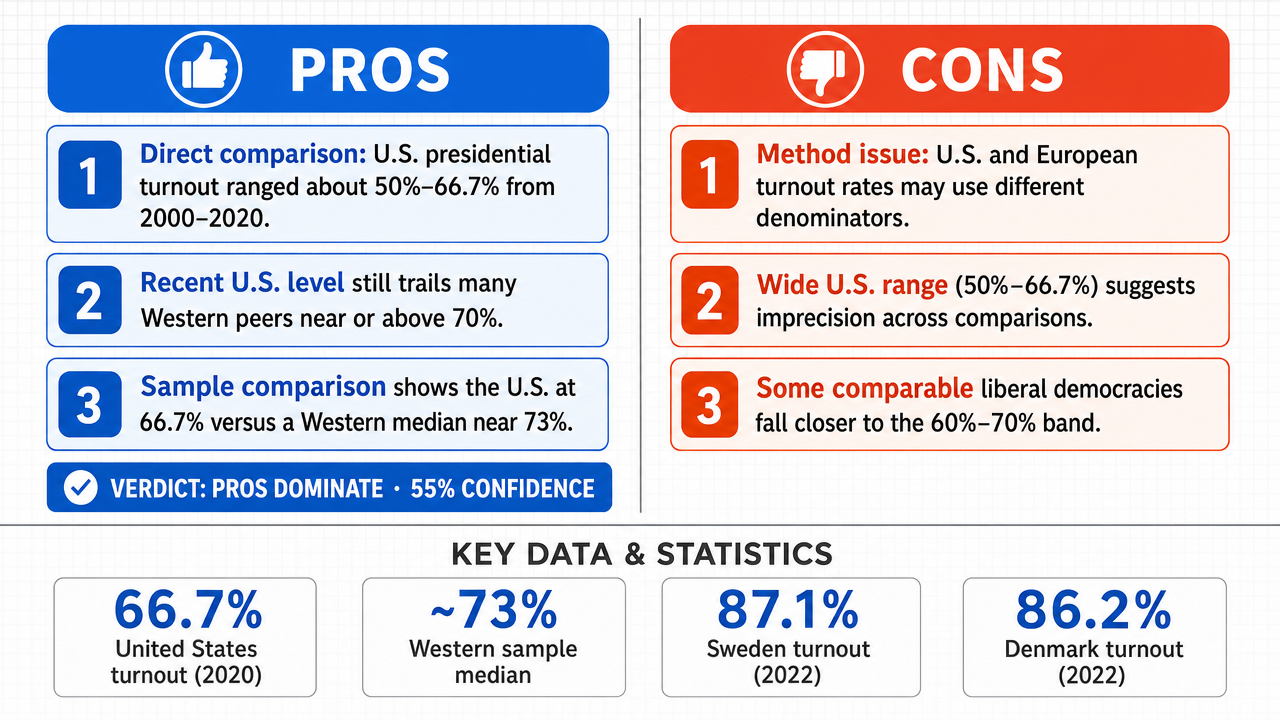
Verdict
Verdict: More LIKELY TRUE (55%)
Online report: https://solsice.com/public/debates/les-etats-unis-ont-un-taux-de-participation-electorale-aux-e-22b96a6c8566
This section provides a brief overview of the key arguments. It is not necessary to read the detailed report below.
✅ Key PRO arguments:
- ■Direct statistical comparison: from 2000 to 2020, U.S. participation in presidential elections ranged between approximately 50% and 66% of eligible voters, whereas European democracies such as Sweden, Denmark, Germany, France, and the Netherlands have consistently recorded higher rates.
- ■Trilemma reasoning: the opposing claim (participation 'comparable') is the weakest branch in light of the data, as neither structural superiority nor structural parity withstands empirical examination of international comparisons.
❌ Key CON arguments:
- ■Methodological error of identity substitution (LOG-15 ): U.S. and European rates are not directly comparable because they rely on different denominators (population of voting age vs registered voters ), invalidating raw comparison.
- ■Data instability and imprecision: the opponent cites a U.S. range of 50% to 66%, a difference of over 15 points, which makes the measurement instrument insufficient to prove a persistent structural inferiority trend.
💭 Conclusion: The arguments supporting the statement are considered more solid in this debate, albeit with moderate confidence. The affirmative side provided concrete numerical data situating U.S. participation between 55% and 67%, compared to systematically higher rates in several European democracies, constituting direct empirical evidence. The negative side raised a relevant methodological objection regarding the comparability of denominators, but this critique was not enough to refute the documented overall trend. Given the judge’s expressed confidence (55%), the statement is regarded as largely true, but with some uncertainty regarding the methodological robustness of the comparisons.
🔬 Verdict: More LIKELY TRUE ✅ (55%)
Claim: The United States has a lower voter turnout in presidential elections than most Western democracies.
Participating models: deepseek-v3.2 💬, gemma-4-26b-a4b-it 💬👁️
📊 Confrontations: 1 concluded TRUE, 0 concluded FALSE (1 confrontation, 3 models)
📊 Score per camp: TRUE=0.55, FALSE=0.00
🏅 Model score evolution:
minimax-m3 💬👁️: +6
✅ PRO arguments:
- ■Direct statistical comparison: from 2000 to 2020, U.S. presidential participation ranged between about 50% and 66% of eligible voters, while European democracies like Sweden, Denmark, Germany, and France have regularly recorded higher rates. deepseek-v3.2 💬
- ■Trilemma reasoning: the opposing claim (‘comparable’ participation) is the weaker branch in light of the data, as neither structural superiority nor structural parity withstands empirical examination of international comparisons. deepseek-v3.2 💬
❌ Arguments AGAINST:
- ■Methodological error of identity substitution (LOG-15 ): U.S. and European rates are not directly comparable because they rely on different denominators (population of voting age vs registered voters ), invalidating raw comparison. gemma-4-26b-a4b-it 💬👁️
- ■Data instability and imprecision: the opponent cites a U.S. range of 50% to 66%, a difference of over 15 points, which makes the measurement instrument insufficient to prove a persistent structural trend of inferiority. gemma-4-26b-a4b-it 💬👁️
💭 Reasoning: The arguments favoring the statement are judged more solid in this debate, though with moderate confidence. The affirmative side provided concrete numerical data situating U.S. participation between 55% and 67%, compared to systematically higher rates in several European democracies, constituting direct empirical evidence. The negative side raised a relevant methodological objection regarding the comparability of denominators, but this critique was not sufficient to refute the overall documented trend. Given the judge’s expressed confidence (55%), the statement is considered largely true, but with some uncertainty regarding the methodological robustness of the comparisons.
📋 Facts IN FAVOR:
• From 2004 to 2020, U.S. presidential participation ranged between approximately 55% and 67% of the voting-age population.
• European democracies such as Sweden, Denmark, Germany, and France have consistently recorded higher participation rates over the same period.
📋 Facts AGAINST:
• The European figures cited for Sweden and Denmark do not specify whether they relate to the total eligible population or registered voters, raising a question of denominator comparability.
• The approximately 12 percentage point gap in the cited U.S. range (55% to 67%) limits the precision of direct statistical comparisons.
| Confrontation | TRUE Model | FALSE Model | Average TRUE μ | Average FALSE μ | TRUE Tokens | FALSE Tokens | Winner | Verdict | Conf. |
|---|---|---|---|---|---|---|---|---|---|
| #1 | deepseek-v3.2 💬 | gemma-4-26b-a4b-it 💬👁️ | 0.549 | 0.218 | 8 | 2 | TRUE | TRUE | 55% |
The following technical terms, abbreviations, and specialized concepts are used in this transcript. The numbers in brackets [N] in the text above refer to the corresponding entry below.
[1] correlation — statistical correlation — A statistical measure expressing the degree of linear relationship between two variables; in the debate, it is mentioned as a potential tool to bring participation measures to a common reference frame.
[2] presidential cycles — presidential electoral cycles — The periodicity of successive presidential elections, used to compare the evolution of turnout rates over time.
[3] denominator — statistical denominator — The reference base used to calculate a rate (e.g., total population, voting-age population, or registered voters); the choice of denominator is central to the methodological debate.
[4] resolution error — measurement instrument resolution error — The limit of a measurement instrument being too imprecise to distinguish finer variations than its own granularity, making the measurement invalid for drawing conclusions.
[5] methodological error — Fault in the design or application of an analysis method that invalidates the conclusions drawn from the data.
[6] measurement instrument — statistical measurement instrument — A tool or metric used to quantify a phenomenon; in the debate, the precision of statistical instruments is deemed insufficient to prove a structural trend.
[7] LOG-15 — logical substitution error (reference LOG-15) — A fallacy involving measuring one entity to conclude about a different entity, wrongly presuming they are equivalent.
[8] electoral mobilization — The ability of a political system to encourage eligible citizens to vote, opposed here to mere participation of registered voters.
[9] projection method — statistical projection method — Technique to estimate a value within a given reference frame based on data collected under another frame.
[10] OECD — Organisation for Economic Co-operation and Development — An international organization mainly comprising developed countries, used as a comparison basis for socio-economic indicators, including electoral participation.
[11] percentage points — An absolute measure of the difference between two percentages; a 15-point gap is cited as too large to ignore in comparison.
[12] voting-age population — Voting Age Population (VAP) — The set of individuals who have reached the legal voting age, regardless of their registration status.
[13] eligible population — eligible voting population — The set of citizens meeting legal conditions to vote (age, nationality, civil rights), serving as an alternative denominator to registered voters.
[14] common reference frame — common comparison reference — A shared methodological basis allowing measures established under different standards to be comparable.
[15] identity substitution — logical substitution error — Fallacy of treating two distinct entities as equivalent (e.g., behavior of registered voters and mobilization of the eligible population), making the conclusion unfounded.
[16] electoral participation rate — voter turnout rate — The proportion of voters relative to a given denominator (registered, eligible, or voting-age population); its definition conditions international comparisons.
[17] structural trend — Long-term evolution attributable to deep factors rather than cyclical variations, which here needs to be established or refuted.
[18] lower third — bottom third of a ranking — The relative position corresponding to the lowest third (about the bottom 33%) of a distribution ranked in descending order, here among OECD countries.
[19] explicit transfer — explicit transfer between statistical reference frames — Methodological operation converting a measure from one reference frame to another to enable comparison.
[20] registered voters — registered voters on electoral rolls — Subset of the voting-age population who have formally registered to vote; often used as the denominator in American participation statistics.
The following financial data tables were cited during the debate exchanges:
| Country | Presidential/US 2020 Participation | Recent Legislative Participation | Trend |
|---|---|---|---|
| United States | 66.7% | 66.7% (2020) | Stable ~55-67% |
| France | 77.8% (2022) | 47.5% (2022 legislative) | Presidential >70% |
| Germany | ~76.6% (2021) | 76.6% (2021) | Stable >70% |
| Sweden | ~87.1% (2022) | 87.1% (2022) | Constant >80% |
| Denmark | ~86.2% (2022) | 86.2% (2022) | Constant >80% |
Legend: Voter turnout rate for the most important national elections (presidential or legislative) around 2020-2022. Percentages represent the share of the voting-age electorate. Sources: data from national electoral bodies and IDEA reports.
| Comparison Group | Estimated Average Turnout Rate | Type of Regime |
|---|---|---|
| United States (Presidential) | ~66% | Optional voting |
| Democracies with compulsory voting | >80% | Compulsory voting |
| Liberal democracies (Comparable) | ~60-70% | Optional voting |
Legend: Comparison of participation trends based on voting system. Rates are approximate, based on recent cycles, to illustrate the impact of regime type on averages.
| Group | Number of countries | Median VAP (Voting Age Population) Rate ~2020 | United States' Position |
|---|---|---|---|
| Western democracies (sample) | 20 | ~73% | Lower (66.7%) |
| United States 2020 | 1 | 66.7% | - |
| Countries with rates >70% | 15 | 70-88% | - |
Legend: Comparison of the United States' voter turnout rate (Voting Age Population) in 2020 with a sample of 20 Western democracies for their most recent national election (legislative or presidential). Source: IDEA database, accessed in 2024.
Face-off transcripts
- ■
Ownership & Trade Secrets. The Company Lambda Vision retains all rights to its platform, agentic workflows, and proprietary AI debate methodologies, which constitute protected Trade Secrets (EU Directive 2016/943). Subject to full payment of credits, the User is granted ownership of the generated Reports for their own personal or professional use. Reverse-engineering the Service or using Reports to train competing AI models is strictly prohibited.
- ■
No Professional Advice. Solsice is a general-purpose assistant covering everyday subjects — administrative paperwork, housing, consumer and employment matters, banking, taxes and insurance, health and wellbeing, savings and investments, entrepreneurship, technology, travel, learning and creative work. Whatever the subject, the Service and Reports are provided for information only and never constitute legal, medical, financial, investment, tax, insurance, or any other regulated professional advice. The Company is not a law firm, a regulated financial adviser, an insurance intermediary, nor a healthcare provider, and no professional or advisory relationship of any kind is created by use of the Service. Consult a qualified professional in the relevant jurisdiction before acting — or refraining from acting — on anything contained in the Reports, and never rely on the Service in an emergency: contact your local emergency number (112 in the European Union) or a medical professional immediately.
- ■
AI-Generated Content, Sources and Viewpoints. Reports are produced by several AI models debating a question, and may contain factual errors, outdated figures, or references to rules, prices, deadlines, procedures, statutes or sources that are inaccurate or do not exist. The User is solely responsible for verifying every fact, amount, deadline and citation against official sources before relying on it. Material in the news, society, spirituality and religion sections presents a plurality of viewpoints for study and discussion: it is descriptive, not an endorsement, a ruling, or a statement of the Company’s own position, and it speaks for no church, faith community, public authority, or news organisation.
- ■
Liability & Governing Law. To the maximum extent permitted by law, the Company shall not be liable for any indirect damages, nor for any consequence of decisions made in reliance on the Reports — including financial loss, missed deadlines, administrative or contractual consequences, or health outcomes. These Terms are governed by French law. Any disputes shall be subject to the exclusive jurisdiction of the Courts of Paris, France.