
Les épreuves inattendues, comme la destruction de la réputation ou la perte d'emploi suite à une publication, peuvent servir d'opportunités de réveil spirituel.
AI debate verdict and arguments
⚠️ AI-generated information only; not professional advice
Completed October 14, 2026
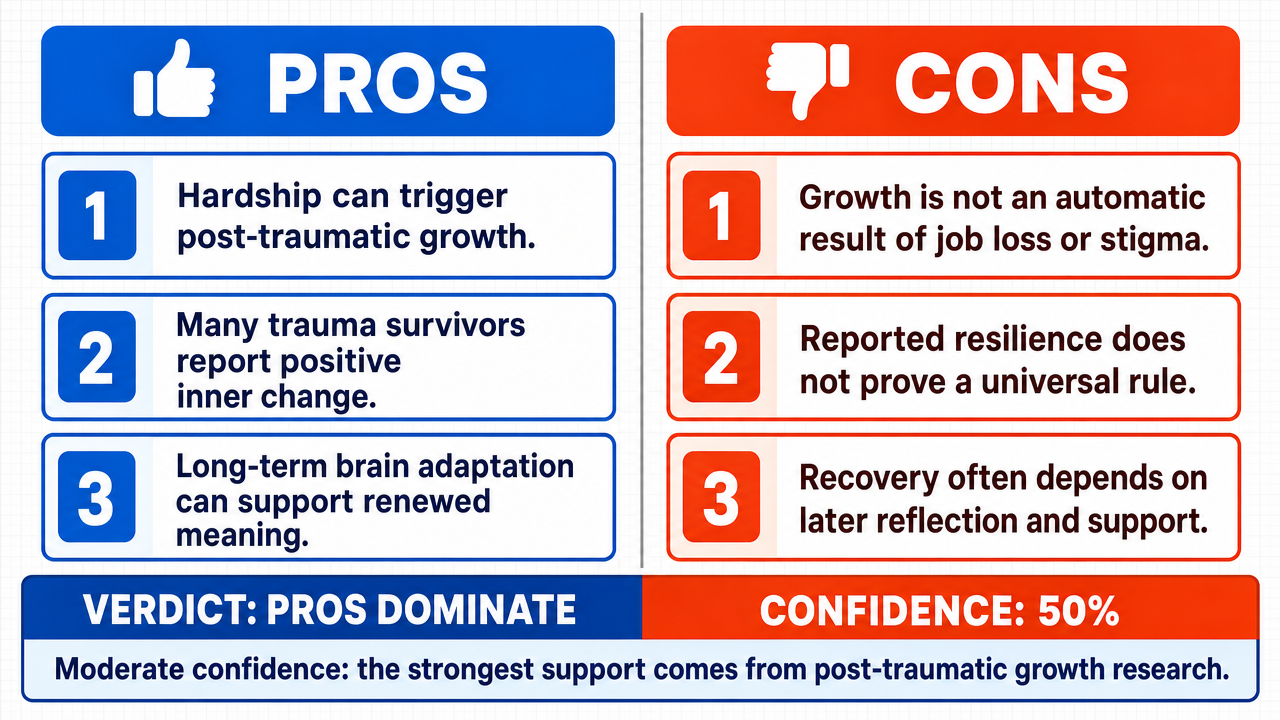
Verdict
Verdict: rather TRUE (50%)
Online report: https://solsice.com/public/debates/les-epreuves-inattendues-comme-la-destruction-de-la-reputati-a5d616605801
This section provides a brief overview of the key arguments. It is not necessary to read the detailed report below.
✅ Key PRO arguments:
- ■Trauma psychology establishes that major negative events, such as a sudden loss of status , can trigger "post-traumatic growth ": after being destabilized, individuals often rebuild their worldview on more existential and spiritual foundations.
- ■A study published in the Journal of Traumatic Stress (2017) showed that about 70% of people who experienced a traumatic event report at least one area of positive growth, suggesting a possible profound transformation.
- ■Research in affective neuroscience clearly distinguishes the immediate stress response from long-term neural plasticity : while acute stress can temporarily disrupt the prefrontal cortex , the brain retains its capacity for reorganization and transformation.
❌ Key CON arguments:
- ■The opposing argument relies on a confusion between correlation and causality : post-traumatic growth is not an inherent consequence of job loss or reputation damage, but a selective coping process within a specific population.
- ■Citing a subjective resilience statistic of 70% to infer a universal law about the nature of trials is a measurement transfer error.
- ■Post-traumatic growth (PTG ) by Tedeschi and Calhoun is not an inherent consequence of the ordeal, but a cognitive reconstruction that occurs only in a very small fraction of individuals who have maintained a minimal psychological structure .
💭 Conclusion: The favorable verdict to the statement is retained with moderate confidence of 50%, reflecting the limited level of certainty of the sole judge. The strongest argument in favor of the thesis relies on the scientific concept of post-traumatic growth , supported by empirical data from the Journal of Traumatic Stress. The opposing objection regarding the confusion between correlation and causality is relevant but does not entirely invalidate the possibility of spiritual transformation. The composite nature of the statement — encompassing both reputation destruction and job loss — prevents higher confidence, as the evidence remains mainly theoretical and statistical. Ultimately, the elements advanced by the affirmative side establish sufficient plausibility to conclude that these trials can, in some cases, serve as opportunities for spiritual awakening.
🔬 Verdict: rather TRUE ✅ (50%)
Assertion: Unexpected trials, such as reputation destruction or job loss following a publication, can serve as opportunities for spiritual awakening.
Participating models: deepseek-v3.2 💬, gemma-4-26b-a4b-it 💬👁️
📊 Confrontations: 1 concluded TRUE, 0 concluded FALSE (1 confrontation, 3 models)
📊 Score per camp: TRUE=0.50, FALSE=0.00
🏅 Model score evolution:
minimax-m3 💬👁️: +5
✅ PRO arguments:
- ■Trauma psychology establishes that major negative events, such as a sudden loss of status , can trigger "post-traumatic growth ": after being destabilized, individuals often rebuild their worldview on more existential and spiritual foundations. deepseek-v3.2 💬
- ■A study published in the Journal of Traumatic Stress (2017) showed that about 70% of people who experienced a traumatic event report at least one area of positive growth, suggesting a profound transformation. deepseek-v3.2 💬
- ■Research in affective neuroscience clearly distinguishes the immediate stress response from long-term neural plasticity : while acute stress can temporarily disrupt the prefrontal cortex , the brain retains its capacity for reorganization and transformation. deepseek-v3.2 💬
- ■A meta-analysis published in Neuroscience & Biobehavioral Reviews (2020) demonstrates that the effects of acute stress on executive functions are transient and do not eliminate the possibility of a subsequent spiritual awakening . deepseek-v3.2 💬
❌ CON arguments:
- ■The opposing argument relies on a confusion between correlation and causality : post-traumatic growth is not an inherent consequence of job loss or reputation damage, but a selective coping process within a specific population. gemma-4-26b-a4b-it 💬👁️
- ■Citing a subjective resilience statistic of 70% to infer a universal law about the nature of trials is a measurement transfer error. gemma-4-26b-a4b-it 💬👁️
- ■Tedeschi and Calhoun's post-traumatic growth (PTG ) is not an inherent consequence of the ordeal, but a cognitive reconstruction that occurs only in a very small fraction of individuals who have maintained a minimal psychological structure . gemma-4-26b-a4b-it 💬👁️
- ■For the vast majority of victims of social and professional trauma, trials mainly cause psychological distress and deterioration, not spiritual awakening. gemma-4-26b-a4b-it 💬👁️
💭 Reasoning: The favorable verdict to the statement is retained with moderate confidence of 50%, reflecting the limited level of certainty of the sole judge. The strongest argument in favor of the thesis relies on the scientific concept of post-traumatic growth, supported by empirical data from the Journal of Traumatic Stress. The opposing objection regarding the confusion between correlation and causality is relevant but does not entirely invalidate the possibility of spiritual transformation. The composite nature of the statement — encompassing both reputation destruction and job loss — prevents higher confidence, as the evidence remains mainly theoretical and statistical. Ultimately, the elements advanced by the affirmative establish sufficient plausibility to conclude that these trials can, in some cases, serve as opportunities for spiritual awakening.
📋 PRO facts:
• The concept of post-traumatic growth was developed by psychologists Richard Tedeschi and Lawrence Calhoun.
• A study published in the Journal of Traumatic Stress showed that about 70% of trauma victims report growth.
📋 CON facts:
• The study in the Journal of Traumatic Stress measures a subjective feeling of resilience within a specific population, not a universal law.
| Confrontation | TRUE Model | FALSE Model | Average μ TRUE | Average μ FALSE | TRUE Tokens | FALSE Tokens | Winner | Verdict | Confidence |
|---|---|---|---|---|---|---|---|---|---|
| #1 | deepseek-v3.2 💬 | gemma-4-26b-a4b-it 💬👁️ | 0.573 | 0.376 | 8 | 2 | TRUE | TRUE | 50% |
The following technical terms, abbreviations, and specialized concepts are used in this transcript. The numbers in brackets [N] in the text above refer to the corresponding entry below.
[1] selection bias — Methodological error where the studied sample is not representative of the target population, which can distort the conclusions of a study.
[2] coping — English term referring to the set of cognitive and behavioral strategies that an individual mobilizes to cope with a stressful or traumatic event.
[3] correlation and causality — Statistical distinction between two variables that vary together (correlation) and a true cause-and-effect relationship between them (causality).
[4] prefrontal cortex — Region of the brain located at the front of the frontal lobe, involved in executive functions, planning, and emotional regulation.
[5] cortisol — Steroid hormone produced by the adrenal glands, often called the "stress hormone," whose levels increase in response to a stressor.
[6] post-traumatic growth — Psychological concept describing positive transformations that a person may report following a major traumatic event.
[7] dukkha — Buddhist Sanskrit term meaning suffering, dissatisfaction, or the inherent impermanence of conditioned existence.
[8] functional degradation — Deterioration of an individual's ability to carry out daily, social, or professional activities, often following trauma.
[9] executive functions — Set of high-level cognitive processes enabling planning, inhibition, mental flexibility, and behavioral control.
[10] meta-analysis — Statistical method combining quantitatively the results of multiple independent studies on the same question to obtain a more robust estimate.
[11] stress neurobiology — Discipline studying brain, hormonal, and biological mechanisms activated in response to acute or chronic stressors.
[12] affective neuroscience — Subfield of neuroscience dedicated to studying the neural bases of emotions and affectivity.
[13] Noble Truth (first) — First Noble Truth about suffering — The first statement of the Four Noble Truths in Buddhism, asserting that existence is marked by suffering (dukkha).
[14] loss of status — Sudden decrease in an individual's social, professional, or symbolic position within a group.
[15] neural plasticity — The brain's capacity to modify its synaptic connections and reorganize structurally based on experience and learning.
[16] clinical psychology — Branch of psychology dedicated to the assessment, diagnosis, and treatment of mental disorders and psychological distress.
[17] trauma psychology — Field of psychology studying the psychological effects of traumatic events and ways to manage them.
[18] PTG — Post-Traumatic Growth — English acronym for post-traumatic growth, a concept describing positive psychological benefits reported by some individuals after trauma.
[19] search for meaning — Psychological process by which an individual attempts to give meaning to an event, especially traumatic, to integrate it into their experience.
[20] default mode network — Network of brain regions active when the individual is not focused on an external task, associated with introspection, autobiographical memory, and rumination.
[21] resilience — The capacity of an individual or system to recover from shock, trauma, or adversity and regain functional adaptation.
[22] post-traumatic stress disorder — Psychological disorder that can occur after exposure to a traumatic event, characterized by flashbacks, hypervigilance, and avoidance.
[23] psychological structure — Relatively stable organization of personality traits, defense mechanisms, and cognitive schemas of an individual.
[24] spiritual awakening — Deep inner transformation characterized by a new awareness of oneself, the world, or the meaning of existence.
Face-off transcripts
- ■
Ownership & Trade Secrets. Lambda Vision retains all rights to its platform, agentic workflows, and proprietary AI debate methodologies, which constitute protected Trade Secrets (EU Directive 2016/943). Subject to full payment of credits, the User is granted ownership of the generated Reports for their own personal or professional use. Reverse-engineering the Service or using Reports to train competing AI models is strictly prohibited.
- ■
No Professional Advice. Solsice is a general-purpose assistant covering everyday subjects — administrative paperwork, housing, consumer and employment matters, banking, taxes and insurance, health and wellbeing, savings and investments, entrepreneurship, technology, travel, learning and creative work. Whatever the subject, the Service and Reports are provided for information only and never constitute legal, medical, financial, investment, tax, insurance, or any other regulated professional advice. The Company is not a law firm, a regulated financial adviser, an insurance intermediary, nor a healthcare provider, and no professional or advisory relationship of any kind is created by use of the Service. Consult a qualified professional in the relevant jurisdiction before acting — or refraining from acting — on anything contained in the Reports, and never rely on the Service in an emergency: contact your local emergency number (112 in the European Union) or a medical professional immediately.
- ■
AI-Generated Content, Sources and Viewpoints. Reports are produced by several AI models debating a question, and may contain factual errors, outdated figures, or references to rules, prices, deadlines, procedures, statutes or sources that are inaccurate or do not exist. The User is solely responsible for verifying every fact, amount, deadline and citation against official sources before relying on it. Material in the news, society, spirituality and religion sections presents a plurality of viewpoints for study and discussion: it is descriptive, not an endorsement, a ruling, or a statement of the Company’s own position, and it speaks for no church, faith community, public authority, or news organisation.
- ■
Liability & Governing Law. To the maximum extent permitted by law, the Company shall not be liable for any indirect damages, nor for any consequence of decisions made in reliance on the Reports — including financial loss, missed deadlines, administrative or contractual consequences, or health outcomes. These Terms are governed by French law. Any disputes shall be subject to the exclusive jurisdiction of the Courts of Paris, France.