
Les blocages intérieurs, tels que la peur de manquer ou la culpabilité liée à l'argent, sont les causes principales de l'incapacité à manifester la prospérité financière désirée.
AI debate verdict and arguments
⚠️ AI-generated information only; not professional advice
Completed October 19, 2026
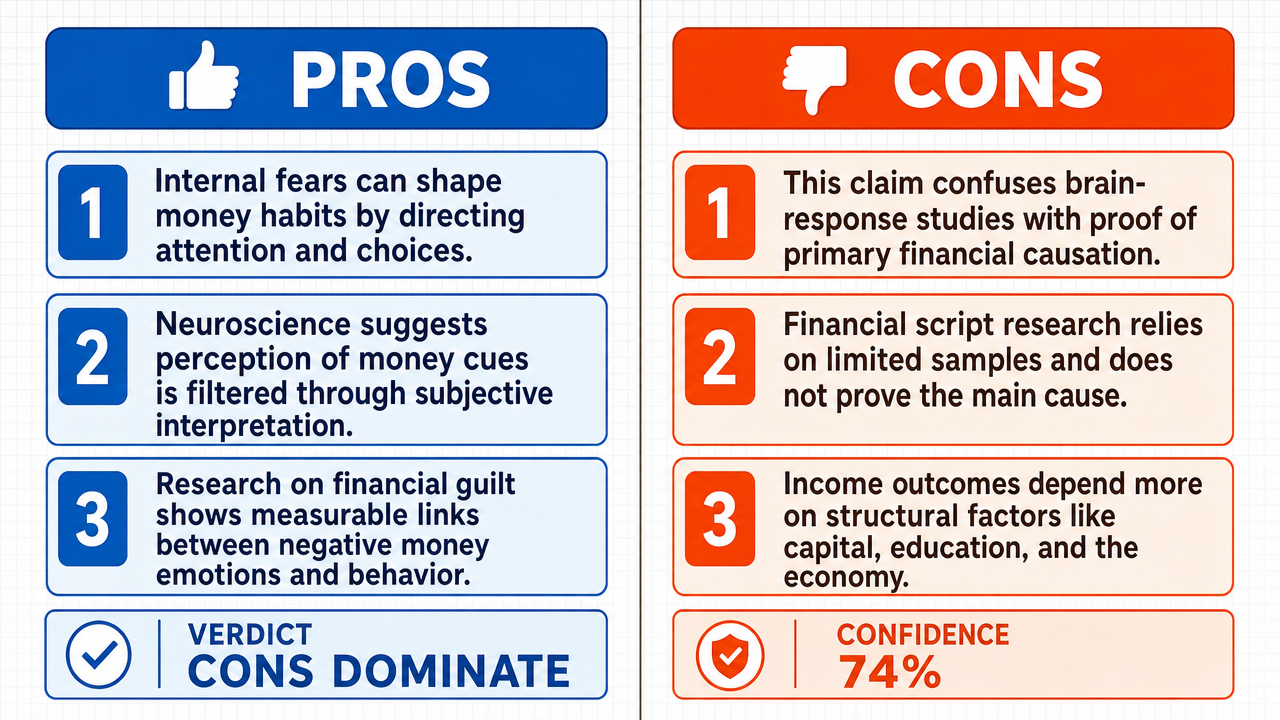
Verdict
Verdict: mostly FALSE (74%)
Online report: https://solsice.com/public/debates/les-blocages-interieurs-tels-que-la-peur-de-manquer-ou-la-cu-e97014c1f6fd
This section provides a brief overview of the key arguments. It is not necessary to read the detailed report below.
✅ Key PRO arguments:
- ■Unconscious mental patterns, such as the fear of scarcity , literally shape our financial reality by programming the reticular activating system (RAS ) to filter and amplify scarcity signals, rendering the individual blind to prosperity opportunities around them.
- ■Cognitive neuroscience , notably through studies on the visual cortex , demonstrates that subjective perceptions of monetary stimuli are deeply influenced by unconscious emotional biases acquired during childhood, which would block any manifestation capacity for financial success.
- ■The study by the Chicago Booth School of Business on financial guilt establishes an empirically measurable link between negative emotions related to money and dysfunctional financial behaviors, and demands a stricter causal proof standard for this correlation , while not applying it to opposing structural claims, which constitutes a logical contradiction .
❌ Key CONTRA arguments:
- ■The opposing argument makes an erroneous identity substitution: it uses measures of neural reactivity in the visual cortex and consumption behaviors to conclude on the 'manifestation ' capacity of wealth, without ever providing a correlation , correlation coefficient , or beta demonstrating that this reactivity translates into a real inability to seize financial opportunities.
- ■Brad Klontz's 'financial scripts ' do not demonstrate the primary causality because the study involves a biased sample of 422 participants already engaged in therapy for financial issues, preventing any generalization to the broader population and any conclusion about the 'primary' nature of these blockages.
- ■Financial prosperity mainly depends on structural and objective economic factors (initial capital, access to education, macroeconomic context, systemic discrimination) rather than internal psychological blockages, which cannot explain the massive wealth inequalities observed between social groups.
💭 Conclusion: The negative camp successfully demonstrated that internal psychological blockages are not the main cause of the inability to manifest financial prosperity , highlighting the lack of a valid causal transfer between psychological measures and actual financial outcomes. The pro argument was based on an identity substitution between perception measures and the concrete capacity to manifest , without compelling comparative data. Furthermore, Brad Klontz's study suffered from a major selection bias, preventing any conclusion about the 'primary' nature of the blockages. Structural and objective economic factors provide a more robust and empirically better-supported explanation. However, confidence is not absolute, as the pro camp still established a correlation between negative emotions and financial behaviors, even if it does not reach the claimed primary causality threshold .
🔬 Verdict: mostly FALSE ❌ (74%)
Claim: Internal blockages, such as the fear of scarcity or money-related guilt, are the main causes of the inability to manifest the desired financial prosperity .
Participating models: deepseek-v4-pro 💬, gemma-4-26b-a4b-it 💬👁️
📊 Confrontations: 0 concluded TRUE, 1 concluded FALSE (1 confrontation, 3 models)
📊 Score by camp: TRUE=0.00, FALSE=0.74
🏅 Model score evolution:
minimax-m3 💬👁️: +7
✅ PRO arguments:
- ■Unconscious mental schemas, such as the fear of scarcity, literally shape our financial reality by programming the reticular activating system (RAS ) to filter and amplify scarcity signals, making the individual blind to surrounding prosperity opportunities. deepseek-v4-pro 💬
- ■Cognitive neuroscience , notably through studies on the visual cortex , shows that subjective perceptions of monetary stimuli are deeply influenced by unconscious emotional biases acquired during childhood, which would block any manifestation of financial success. deepseek-v4-pro 💬
- ■The study by the Chicago Booth School of Business on financial guilt establishes a measurable empirical link between negative emotions related to money and dysfunctional financial behaviors, and demanding a stricter causal proof standard for this correlation , while not applying it to opposing structural claims, constitutes a logical contradiction . deepseek-v4-pro 💬
❌ CONTRA arguments:
- ■The opposing argument makes an erroneous identity substitution: it uses measures of neural reactivity in the visual cortex and consumption behaviors to conclude on the 'manifestation' capacity of wealth, without ever providing a correlation, correlation coefficient , or beta demonstrating that this reactivity translates into a real inability to seize financial opportunities. gemma-4-26b-a4b-it 💬👁️
- ■Brad Klontz's 'financial scripts ' do not demonstrate the primary causality because the study involves a biased sample of 422 participants already engaged in therapy for financial problems, preventing any generalization to the broader population and any conclusion about the 'primary' nature of these blockages. gemma-4-26b-a4b-it 💬👁️
- ■Financial prosperity mainly depends on structural and objective economic factors (initial capital, access to education, macroeconomic context, systemic discrimination) rather than internal psychological blockages, which cannot explain the massive wealth inequalities observed between social groups. gemma-4-26b-a4b-it 💬👁️
💭 Reasoning: The negative camp has successfully demonstrated that internal psychological blockages are not the main cause of the inability to manifest financial prosperity, highlighting the absence of a valid causal transfer between psychological measures and actual financial outcomes. The pro argument was based on an identity substitution between perception measures and the concrete capacity to manifest, without compelling comparative data. Moreover, Brad Klontz's study suffered from a major selection bias, preventing any conclusion about the 'primary' nature of the blockages. Structural and objective economic factors offer a more robust and empirically better-supported explanation. However, confidence is not absolute, as the pro camp still established a correlation between negative emotions and financial behaviors, even if it does not reach the claimed primary causality threshold.
📋 Supporting facts:
• A study by the Chicago Booth School of Business established a correlation between financial guilt and dysfunctional financial behaviors
• Brad Klontz identified unconscious 'financial scripts' formed during childhood through parental observation
📋 FACTS AGAINST:
• Brad Klontz's study focuses on a sample of participants already engaged in financial therapy , constituting a biased non-representative sample
• Structural factors (initial capital, education, macroeconomic context) explain a substantial part of the observed wealth inequalities
• Moving from measures of subjective perception to conclusions about the 'manifestation' capacity of wealth constitutes a fallacy of identity substitution
| Confrontation | TRUE Model | FALSE Model | Average μ TRUE | Average μ FALSE | TRUE Tokens | FALSE Tokens | Winner | Verdict | Conf. |
|---|---|---|---|---|---|---|---|---|---|
| #1 | deepseek-v4-pro 💬 | gemma-4-26b-a4b-it 💬👁️ | 0.458 | 0.342 | 6 | 2 | TRUE | FALSE | 74% |
The following technical terms, abbreviations, and specialized concepts are used in this transcript. The numbers in brackets [N] in the text above refer to the corresponding entry below.
[1] self-selection — Methodological bias whereby study participants volunteer or are included in a sample due to characteristics related to the studied phenomenon, skewing the representativeness of the sample. The debate mentions this concept regarding a sample of people already engaged in financial therapy.
[2] methodological biases — Systematic errors in the design, data collection, or analysis of a study that can distort results. In the debate, this term is contrasted with behavioral correlations cited by the affirmative.
[3] beta — Statistical coefficient (β) used in regression to measure the effect of one variable on another, accounting for other variables in the model. The debate mentions it as a standard measurement missing in the study cited by the affirmative.
[4] causality — Logical and empirical relationship whereby one phenomenon (the cause) produces or determines another phenomenon (the effect). The debate specifically addresses whether psychological blockages are the primary cause of financial stagnation.
[5] correlation coefficient — Standardized statistical measure (between -1 and +1) quantifying the strength and direction of the linear relationship between two variables. Mentioned in the debate as a missing indicator to establish a link between neural reactivity and economic capacity.
[6] excessive content conjecture — Reasoning that attributes to a correlation an explanatory power beyond what the data empirically justify, inferring a root cause from a mere association. Concept used by the negative to criticize the affirmative's argument.
[7] logical contradiction — Internal inconsistency of an argument in which two premises or conclusions mutually exclude each other. The debate mentions this concept regarding the argument based on financial scripts.
[8] correlation — Statistical measure of association between two variables, which does not necessarily imply a causal link. The debate repeatedly distinguishes correlation from causality.
[9] behavioral correlations — Statistical associations measured between observable behaviors (e.g., consumption or savings). The negative criticizes them for being presented as universal causes.
[10] visual cortex — Region of the brain located in the occipital lobe, specialized in processing visual information. Mentioned in the debate as being more reactive to threatening information than to rewarding information in individuals with a negative emotional predisposition.
[11] financial guilt — Negative emotion associated with money, mentioned in the debate as one of the internal blockages cited by the affirmative. A study from the Chicago Booth School of Business on this subject is cited by both parties.
[12] structural factors — Elements of macroeconomic, institutional, or social order (market, policies, economic environment) that influence individuals' financial outcomes. The negative side attributes the main cause of prosperity or stagnation to these factors.
[13] neural bundle — Group of nerve fibers grouped within the nervous system. The debate locates the reticular activating system within a neural bundle located in the brainstem.
[14] manifestation — In the context of the debate, a concept borrowed from personal development whereby an inner state (beliefs, emotions) would attract or produce corresponding external circumstances, notably financial prosperity.
[15] cognitive neuroscience — Discipline studying the neural bases of cognitive functions (attention, perception, memory). The debate relies on this discipline to explain the role of the reticular activating system in stimulus filtering.
[16] fear of missing out — Irrational fear of scarcity or insufficiency, considered in the debate as one of the internal blockages preventing the perception of prosperity opportunities.
[17] financial prosperity — State of abundance and financial wealth. Central concept of the debate, whose exact definition (subjective, psychological, or objective) is disputed between the two sides.
[18] emotional predisposition — Stable psychological tendency to react emotionally in a certain way. The debate cites it as a factor in biased processing of visual stimuli.
[19] neural reactivity — Measure of the response activity of neurons to a stimulus. The debate mentions the reactivity of the visual cortex to threatening stimuli, without the negative side accepting to infer an economic capacity from it.
[20] financial scripts — Concept from the work of Brad Klontz referring to unconscious beliefs about money formed during childhood through parental observation. Their causal role in financial stagnation is contested in the debate.
[21] SRA — reticular activating system — Bundle of neurons located in the brainstem that acts as an attentional filter, selecting stimuli to which the brain pays attention. The debate attributes a role to it in amplifying signals of scarcity.
[22] financial stagnation — State of lack of progress or improvement in an individual's financial situation. The origin (psychological or structural) of this phenomenon is the central issue of the debate.
[23] stimuli — Environmental elements (sensory or informational) that can trigger a response in the individual. The debate mentions threatening and rewarding stimuli processed differently by the visual cortex.
[24] savings rate — Proportion of income not spent and set aside. An economic variable cited in the debate to link negative emotions to observable financial outcomes.
[25] financial therapy — Approach combining psychological and financial support for people facing money-related difficulties. The sample of 422 participants cited in the debate consists of individuals already engaged in this type of process.
[26] brainstem — Structure located at the base of the brain, connecting the brain to the spinal cord. The debate locates the reticular activating system in this region.
[27] sample — Subset of a studied population used to draw general conclusions. The debate mentions a sample of 422 participants in financial therapy to criticize its representativeness.
The following financial data tables were cited during the debate exchanges:
| Disparity Factor | Impact on Income/Savings | Nature of the Factor |
|---|---|---|
| Access to Credit | Determining Variable | Structural |
| Inflation (purchasing power) | Macroeconomic Variable | Structural |
| Financial Education | Skill Variable | Individual |
| Social Capital | Network Variable | Structural |
Legend: Comparison of the types of factors influencing financial trajectories. Structural factors act on the individual's environment, while individual factors affect their capabilities.
Face-off transcripts
- ■
Ownership & Trade Secrets. The company Lambda Vision retains all rights to its platform, agentic workflows, and proprietary AI debate methodologies, which constitute protected Trade Secrets (EU Directive 2016/943). Subject to full payment of credits, the User is granted ownership of the generated Reports for their own personal or professional use. Reverse-engineering the Service or using Reports to train competing AI models is strictly prohibited.
- ■
No Professional Advice. Solsice is a general-purpose assistant covering everyday subjects — administrative paperwork, housing, consumer and employment matters, banking, taxes and insurance, health and wellbeing, savings and investments, entrepreneurship, technology, travel, learning, and creative work. Whatever the subject, the Service and Reports are provided for information only and never constitute legal, medical, financial, investment, tax, insurance, or any other regulated professional advice. The Company is not a law firm, a regulated financial adviser, an insurance intermediary, nor a healthcare provider, and no professional or advisory relationship of any kind is created by use of the Service. Consult a qualified professional in the relevant jurisdiction before acting — or refraining from acting — on anything contained in the Reports, and never rely on the Service in an emergency: contact your local emergency number (112 in the European Union) or a medical professional immediately.
- ■
AI-Generated Content, Sources and Viewpoints. Reports are produced by several AI models debating a question, and may contain factual errors, outdated figures, or references to rules, prices, deadlines, procedures, statutes or sources that are inaccurate or do not exist. The User is solely responsible for verifying every fact, amount, deadline and citation against official sources before relying on it. Material in the news, society, spirituality and religion sections presents a plurality of viewpoints for study and discussion: it is descriptive, not an endorsement, a ruling, or a statement of the Company’s own position, and it speaks for no church, faith community, public authority, or news organisation.
- ■
Liability & Governing Law. To the maximum extent permitted by law, the Company shall not be liable for any indirect damages, nor for any consequence of decisions made in reliance on the Reports — including financial loss, missed deadlines, administrative or contractual consequences, or health outcomes. These Terms are governed by French law. Any disputes shall be subject to the exclusive jurisdiction of the Courts of Paris, France.