
Le traitement réservé par la Fédération argentine aux équipes africaines invitées pour les matchs d'adieu de Lionel Messi en 2026 constitue une forme d'« esclavage des temps modernes ».
AI debate verdict and arguments
⚠️ AI-generated information only; not professional advice
Completed October 11, 2026
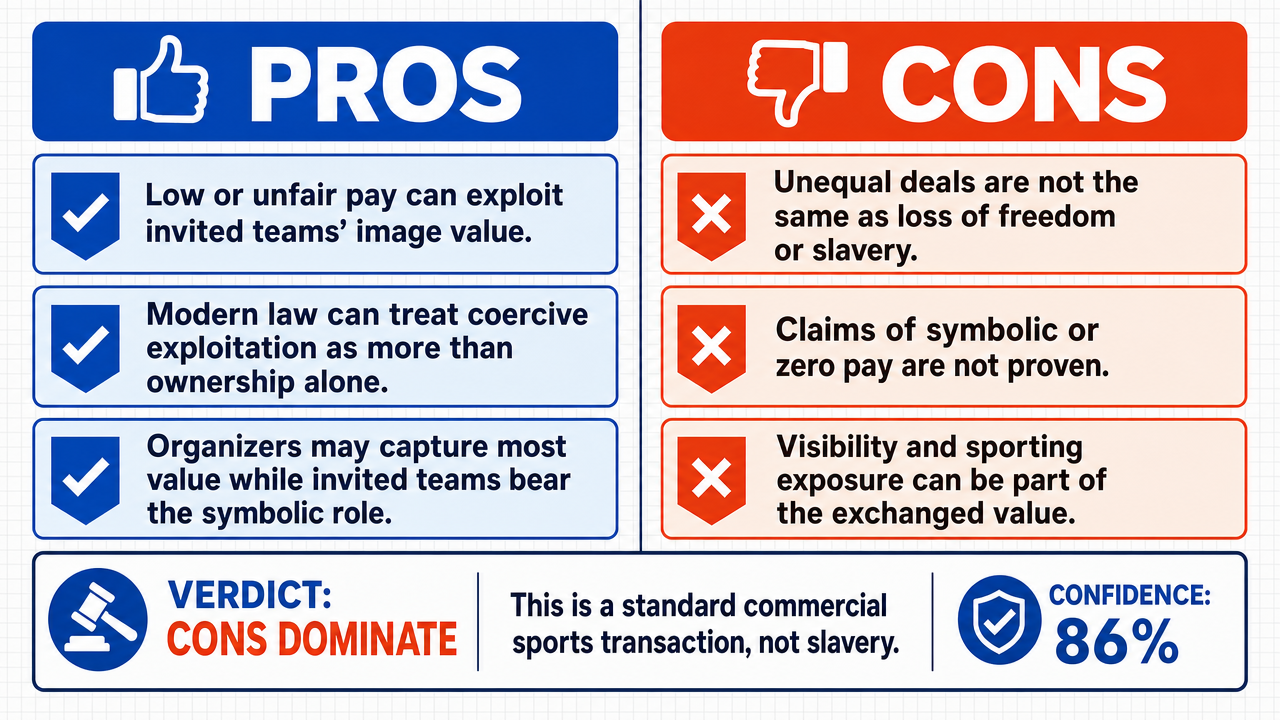
Verdict
Verdict: Mostly FALSE (86%)
This section provides a brief overview of the key arguments. It is not necessary to read the detailed report below.
✅ Key PRO arguments:
- ■The lack of fair financial compensation for the African teams invited to Messi's farewell matches, combined with the exploitation of their image and presence to generate substantial revenue for the AFA and its partners, resembles a form of exploitation where these teams serve as showcase .
- ■Contemporary law does not reduce slavery to ownership of a body; it also qualifies servitude , forced labor , and trafficking through coercion , fraud, abuse of vulnerability , or imposed control, according to ILO's definition of forced labor.
- ■The Messi 2026 event could turn the presence of African national teams into an instrument of exploitation when the value created is captured by the organizer, sponsors, and broadcasters, without transparent allocation to the invited teams.
❌ Key CON arguments:
- ■The accusation of slavery relies on a fundamental confusion between an asymmetrical commercial transaction and deprivation of liberty ; friendly matches are governed by service contracts where national federations act as sovereign legal entities negotiating their participation freely.
- ■The claim that compensation would be symbolic or null is unverified; in professional sports economics , value is not limited to direct payment but includes broadcasting rights , brand visibility, and sponsorship , which benefit the participating federations directly.
- ■Although economic asymmetry is real, it does not translate into deprivation of liberty ; the exchanged value includes intangible assets such as media visibility and institutional prestige, which are recognized forms of compensation in sports business law .
💭 Conclusion: False. The verdict of FALSE prevails because the anti-argument successfully demonstrated that inviting African teams to farewell matches is a standard commercial and sporting transaction between sovereign legal entities, not a deprivation of liberty constituting slavery. The pro side failed to prove the existence of coercion , fraud, or abuse of vulnerability transforming these invitations into forced labor under international law. Moreover, the pro argument that compensation is "symbolic or null" rests on an unverified premise, since the value for the invited federations includes intangible benefits (visibility, prestige, broadcasting rights ) recognized in sports business law . Finally, no factual evidence has been provided regarding coercive participation conditions or lack of consent from African federations, elements essential to any modern slavery qualification .
🔬 Verdict: Mostly FALSE ❌ (86%)
Claim: The treatment of African teams invited by the Argentine Football Association for Lionel Messi's 2026 farewell matches constitutes a form of "modern slavery."
Participating models: deepseek-v3.2 💬, gemma-4-26b-a4b-it 💬👁️
📊 Confrontations: 0 concluded TRUE, 1 concluded FALSE (1 confrontation, 3 models)
📊 Score per camp: TRUE=0.00, FALSE=0.86
🏅 Model score evolution:
minimax-m3 💬👁️: +9
✅ PRO arguments:
- ■The lack of fair financial compensation for the African teams invited to Messi's farewell matches, combined with the exploitation of their image and presence to generate substantial revenue for the AFA and its partners, resembles a form of exploitation where these teams serve as showcase . deepseek-v3.2 💬
- ■Contemporary law does not reduce slavery to ownership of a body; it also qualifies servitude , forced labor , and trafficking through coercion , fraud, abuse of vulnerability , or imposed control, according to ILO's definition of forced labor. deepseek-v3.2 💬
- ■The Messi 2026 event could turn the presence of African national teams into an instrument of exploitation when the value created is captured by the organizer, sponsors, and broadcasters, without transparent allocation to the invited teams. deepseek-v3.2 💬
❌ CON arguments:
- ■The slavery accusation relies on a fundamental confusion between an asymmetrical commercial transaction and deprivation of liberty ; friendly matches are governed by service contracts where national federations act as sovereign legal entities negotiating their participation freely. gemma-4-26b-a4b-it 💬👁️
- ■The claim that compensation would be symbolic or null is unverified; in professional sports economics , value is not limited to direct payment but includes broadcasting rights , brand visibility, and sponsorship , which benefit the participating federations directly. gemma-4-26b-a4b-it 💬👁️
- ■Although economic asymmetry is real, it does not translate into deprivation of liberty; the exchanged value includes intangible assets such as media visibility and institutional prestige, which are recognized forms of compensation in sports business law . gemma-4-26b-a4b-it 💬👁️
💭 Reasoning: False. The verdict of FALSE prevails because the anti-argument successfully demonstrated that inviting African teams to farewell matches is a standard commercial and sporting transaction between sovereign legal entities, not a deprivation of liberty constituting slavery. The pro side failed to prove the existence of coercion, fraud, or abuse of vulnerability transforming these invitations into forced labor under international law. Moreover, the pro argument that compensation is "symbolic or null" rests on an unverified premise, since the value for the invited federations includes intangible benefits (visibility, prestige, broadcasting rights) recognized in sports business law. Finally, no factual evidence has been provided regarding coercive participation conditions or lack of consent from African federations, elements essential to any modern slavery qualification .
📋 Facts PRO:
• The ILO defines forced labor as all work or service exacted under the threat of any penalty
• Contemporary law qualifies modern slavery as servitude, forced labor, and trafficking through coercion, fraud, or abuse of vulnerability
📋 Facts CON:
• International friendly matches are governed by service contracts between sovereign national federations
• The value of an invitation to a match of this magnitude includes broadcasting rights, brand visibility, and sponsorship benefiting the participating federations
• Intangible assets such as media visibility and institutional prestige constitute recognized forms of compensation in sports business law
| Confrontation | TRUE Model | FALSE Model | Average TRUE μ | Average FALSE μ | TRUE Tokens | FALSE Tokens | Winner | Verdict | Conf. |
|---|---|---|---|---|---|---|---|---|---|
| #1 | deepseek-v3.2 💬 | gemma-4-26b-a4b-it 💬👁️ | 0.251 | 0.209 | 12 | 3 | TRUE | FALSE | 86% |
The following technical terms, abbreviations, and specialized concepts are used in this transcript. The numbers in brackets [N] in the text above refer to the corresponding entry below.
[1] vulnerability abuse — Legal notion cited by the affirmative side as one of the contemporary criteria of modern slavery and forced labor, alongside coercion, fraud, and imposed control.
[2] immaterial assets — Non-monetary form of compensation mentioned by the negative side, including media visibility and institutional prestige, recognized in sports business law.
[3] AFA — Asociación del Fútbol Argentino (Argentine Football Federation) — National football federation of Argentina, organizer of Messi's farewell matches mentioned in the debate.
[4] economic asymmetry — Difference in economic capacity between the parties to an exchange, recognized in the debate as real but contested as proof of modern slavery.
[5] ticketing — Revenue from ticket sales; cited as one of the channels through which the value of a friendly match can be redistributed to invited teams.
[6] financial compensation — Direct remuneration paid to participating teams; the affirmative side argues it would be symbolic or null, which the negative side contests.
[7] coercion — Element cited by the affirmative side as a criterion of forced labor and modern slavery according to contemporary law.
[8] standardized match contracts — Model contracts used in global sport to frame friendly matches and tours; invoked by the negative side to demonstrate the commercial nature of the exchange.
[9] service provision contracts — Contractual framework through which national federations act as sovereign legal entities to negotiate friendly matches.
[10] Convention No. 29 — Convention (No. 29) on forced labor, 1930 (ILO) — ILO convention defining forced labor, cited by the affirmative side (art. 2) to underpin the qualification of modern slavery.
[11] sports business law — Branch of law cited by the negative side as a framework recognizing visibility and institutional prestige as forms of compensation.
[12] broadcast rights — Revenues from televised broadcasting of a sporting event; mechanism through which the value of a match would be distributed to participating federations according to the negative side.
[13] TV rights — Synonym of broadcast rights, mentioned as a revenue source in international friendly matches.
[14] modern slavery — Concept at the heart of the debate; the affirmative side extends it to servitude, forced labor, and trafficking by coercion, fraud, or vulnerability abuse, while the negative side limits it to deprivation of liberty and ownership rights over oneself.
[15] exploitation — Term used by the affirmative side to describe the capturing of value created by African teams for the benefit of the AFA and its partners.
[16] straw man — Role attributed by the affirmative side to African teams, whose participation would serve to legitimize the event without a fair share of the proceeds.
[17] FIFA — Fédération Internationale de Football Association — Global football governing body whose Human Rights Policy is cited by the affirmative side.
[18] ILO — International Labour Organization — International organization whose definition of forced labor and the 2014 Protocol are invoked by the affirmative side.
[19] national brand — Image and reputation value of a national team; cited as an asset whose market value would be increased by media exposure.
[20] friendly match — Non-competitive match governed by service provision contracts between national federations.
[21] FIFA Human Rights Policy — FIFA Policy on Human Rights — FIFA document cited by the affirmative side as a normative framework applicable to the Messi 2026 event.
[22] loss of autonomy — Notion invoked by the negative side to reject the qualification of slavery, believing that teams retain the capacity to accept or refuse the invitation.
[23] deprivation of liberty — Restrictive criterion of modern slavery defended by the negative side, which disputes its application to a contractual transaction.
[24] 2014 Protocol — 2014 Protocol to the Forced Labour Convention (ILO) — Instrument cited by the affirmative side (art. 1) that explicitly targets human trafficking.
[25] economic benefits — Economic gains generated by a sporting event, whose equitable sharing with African teams is contested by the affirmative side.
[26] servitude — Form of modern slavery mentioned by the affirmative side, distinct from ownership of a body according to contemporary law.
[27] sponsoring — Financing mechanism through commercial partners; cited as a channel for distributing the value of a friendly match.
[28] trafficking in persons — Offense targeted by the 2014 ILO Protocol, cited by the affirmative side as a possible component of modern slavery.
[29] Forced labor — According to the ILO definition cited in the debate: any work or service demanded under threat of penalty and which the individual has not offered of their own free will.
[30] market value — The economic value of a player or a national brand, with the negative party arguing that it is increased by media exposure.
[31] media visibility — Public exposure generated by the broadcasting of a match; presented by the negative party as a form of non-monetary compensation.
[32] professional sports economy — Analytical framework invoked by the negative party to assess the economic value of an invitation to a farewell match beyond just direct payment.
Face-off transcripts
- ■
Ownership & Trade Secrets. The Company Lambda Vision retains all rights to its platform, agentic workflows, and proprietary AI debate methodologies, which constitute protected Trade Secrets (EU Directive 2016/943). Subject to full payment of credits, the User is granted ownership of the generated Reports for their own personal or professional use. Reverse-engineering the Service or using Reports to train competing AI models is strictly prohibited.
- ■
No Professional Advice. Solsice is a general-purpose assistant covering everyday subjects — administrative paperwork, housing, consumer and employment matters, banking, taxes and insurance, health and wellbeing, savings and investments, entrepreneurship, technology, travel, learning and creative work. Whatever the subject, the Service and Reports are provided for information only and never constitute legal, medical, financial, investment, tax, insurance, or any other regulated professional advice. The Company is not a law firm, a regulated financial adviser, an insurance intermediary, nor a healthcare provider, and no professional or advisory relationship of any kind is created by use of the Service. Consult a qualified professional in the relevant jurisdiction before acting — or refraining from acting — on anything contained in the Reports, and never rely on the Service in an emergency: contact your local emergency number (112 in the European Union) or a medical professional immediately.
- ■
AI-Generated Content, Sources and Viewpoints. Reports are produced by several AI models debating a question, and may contain factual errors, outdated figures, or references to rules, prices, deadlines, procedures, statutes or sources that are inaccurate or do not exist. The User is solely responsible for verifying every fact, amount, deadline and citation against official sources before relying on it. Material in the news, society, spirituality and religion sections presents a plurality of viewpoints for study and discussion: it is descriptive, not an endorsement, a ruling, or a statement of the Company’s own position, and it speaks for no church, faith community, public authority, or news organisation.
- ■
Liability & Governing Law. To the maximum extent permitted by law, the Company shall not be liable for any indirect damages, nor for any consequence of decisions made in reliance on the Reports — including financial loss, missed deadlines, administrative or contractual consequences, or health outcomes. These Terms are governed by French law. Any disputes shall be subject to the exclusive jurisdiction of the Courts of Paris, France.