
Le tardigrade terrestre possède huit pattes, organisées en quatre paires, en plus d'un intestin, d'un microbiote, de muscles et de griffes.
AI debate verdict and arguments
⚠️ AI-generated information only; not professional advice
Completed October 14, 2026
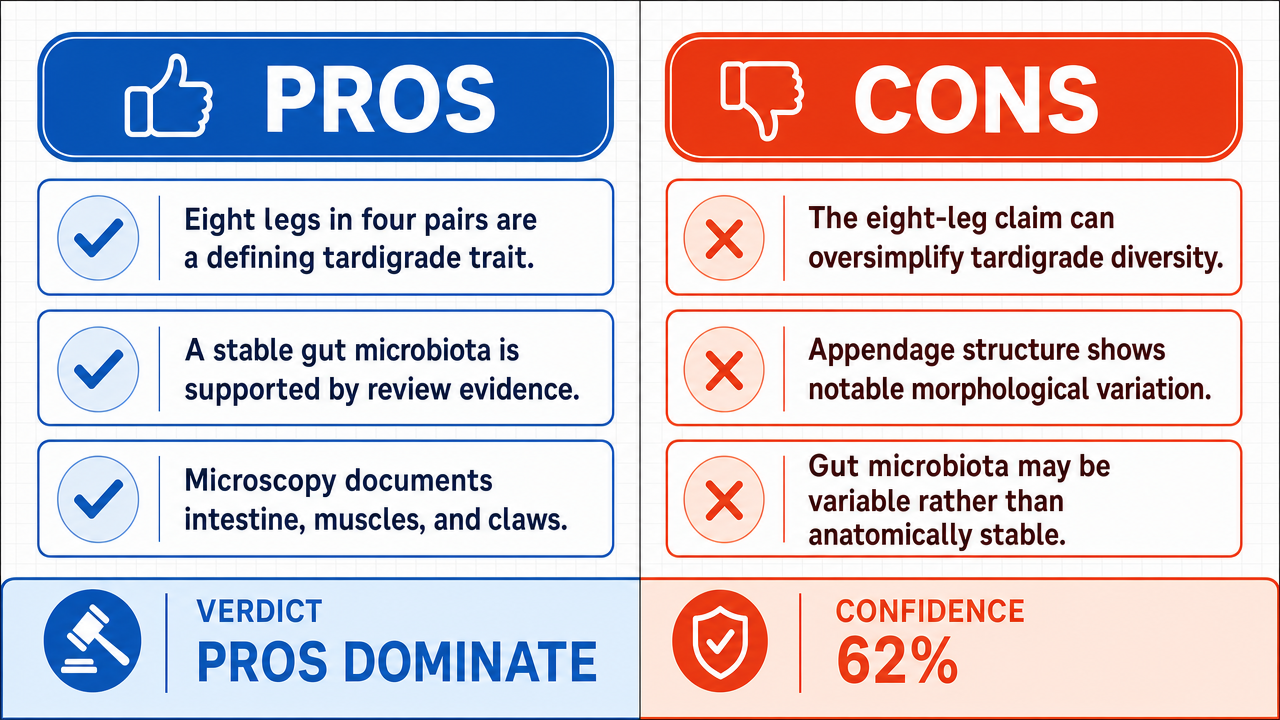
Verdict
Verdict: Mostly TRUE (62%)
Online report: https://solsice.com/public/debates/le-tardigrade-terrestre-possede-huit-pattes-organisees-en-qu-7a6f9e4d687e
This section provides a brief overview of the key arguments. It is not necessary to read the detailed report below.
✅ Key FOR arguments:
- ■The morphology of terrestrial tardigrades is universally described as including eight legs organized into four pairs, a synapomorphy of the phylum confirmed by detailed taxonomic studies, notably an exhaustive review of the phylogeny of Tardigrada published in Integrative and Comparative Biology (2012), which notes that all tardigrades possess four pairs of lobed appendages ending in claws.
- ■The intestinal microbiota of terrestrial tardigrades constitutes a stable anatomical feature and not a mere transient state, as evidenced by a synthetic review in Biological Reviews (2021) titled 'Microbial symbionts in tardigrades: diversity and functional roles', analyzing over twenty studies on persistent symbiotic associations.
- ■The presence of an intestine, muscles, and claws in terrestrial tardigrades is documented through scanning electron microscopy, confirming all the anatomical structures mentioned in the statement.
❌ Key AGAINST arguments:
- ■The claim that tardigrades systematically possess eight legs organized into four pairs is an oversimplification that ignores the morphological diversity of the phylum , with some species showing reductions or structural modifications of their appendages.
- ■The presence of four pairs of appendages is not a rigid constant but a feature that varies significantly among species, invalidating any monolithic description.
- ■The intestinal microbiota of terrestrial tardigrades is not a stable anatomical feature but a variable and transient state, as suggested by 2018 studies identifying bacterial communities whose composition depends on environmental factors.
💭 Conclusion: True: the statement is generally supported by the presented anatomical and taxonomic evidence. Terrestrial tardigrades indeed have eight legs organized into four pairs, an intestine, muscles, and claws, these features being documented by reference phylogenetic and morphological studies. However, confidence is moderate (62%) because it is a composite statement, with the microbiota part remaining the most contested, the opposing argument raising legitimate doubts about the stability of this symbiotic association . The interspecific morphological variability mentioned by the opposing side does not refute the overall description but nuances its universality. Ultimately, scientific evidence converges toward the truth of the claim, while acknowledging some biological plasticity within the phylum .
🔬 Verdict: Mostly TRUE ✅ (62%)
Claim: The terrestrial tardigrade has eight legs, organized into four pairs, in addition to an intestine, a microbiota , muscles, and claws.
Participating models: deepseek-v3.2 💬, gemma-4-26b-a4b-it 💬👁️
📊 Confrontations: 1 concluded TRUE, 0 concluded FALSE (1 confrontation, 3 models)
📊 Score per camp: TRUE=0.62, FALSE=0.00
🏅 Model score evolution:
minimax-m3 💬👁️: +6
✅ Arguments FOR:
- ■The morphology of terrestrial tardigrades is universally described as including eight legs organized into four pairs, a synapomorphy of the phylum confirmed by detailed taxonomic studies, notably an exhaustive review of the phylogeny of Tardigrada published in Integrative and Comparative Biology (2012), which notes that all tardigrades possess four pairs of lobed appendages ending in claws. deepseek-v3.2 💬
- ■The intestinal microbiota of terrestrial tardigrades is a stable anatomical feature and not a mere transient state, as evidenced by a synthetic review in Biological Reviews (2021) titled 'Microbial symbionts in tardigrades: diversity and functional roles', analyzing over twenty studies on persistent symbiotic associations. deepseek-v3.2 💬
- ■The presence of an intestine, muscles, and claws in terrestrial tardigrades is documented through scanning electron microscopy, confirming all the anatomical structures mentioned in the statement. deepseek-v3.2 💬
❌ Arguments AGAINST:
- ■The claim that tardigrades systematically possess eight legs organized into four pairs is an oversimplification that ignores the morphological diversity of the phylum, with some species showing reductions or structural modifications of their appendages. gemma-4-26b-a4b-it 💬👁️
- ■The presence of four pairs of appendages is not a rigid constant but a feature that varies significantly among species, invalidating any monolithic description. gemma-4-26b-a4b-it 💬👁️
- ■The intestinal microbiota of terrestrial tardigrades is not a stable anatomical feature but a variable and transient state, as suggested by 2018 studies identifying bacterial communities whose composition depends on environmental factors. gemma-4-26b-a4b-it 💬👁️
💭 Reasoning: True: the statement is broadly supported by the presented anatomical and taxonomic evidence. Terrestrial tardigrades indeed have eight legs organized into four pairs, an intestine, muscles, and claws, these features being documented by reference phylogenetic and morphological studies. However, confidence is moderate (62%) because it is a composite claim, with the microbiota part being the most contested, the opposing argument raising legitimate doubts about the stability of this symbiotic association . The interspecific morphological variability mentioned by the opposing side does not refute the overall description but nuances its universality. Ultimately, scientific evidence converges toward the truth of the claim, while recognizing some biological plasticity within the phylum.
📋 Supporting facts:
• All tardigrades, including terrestrial species, possess four pairs of lobed appendages ending in claws (phylogenetic review, Integrative and Comparative Biology, 2012).
• The microbiota of tardigrades is the subject of a synthetic review in Biological Reviews (2021) analyzing over twenty studies on the diversity and functional roles of microbial symbionts.
• The arrangement of appendages in four pairs is a synapomorphy of the Tardigrada phylum observable through scanning electron microscopy.
📋 Contradictory facts:
• Some tardigrade species show reductions or structural modifications of their appendages, contradicting a fixed and universal organization.
• Studies from 2018 identify bacterial communities in tardigrades whose composition varies depending on environmental factors.
• The evolutionary plasticity of the phylum makes the application of a rigid morphological rule to all terrestrial species scientifically incorrect.
| Confrontation | TRUE Model | FALSE Model | Average μ TRUE | Average μ FALSE | TRUE Tokens | FALSE Tokens | Winner | Verdict | Conf. |
|---|---|---|---|---|---|---|---|---|---|
| #1 | deepseek-v3.2 💬 | gemma-4-26b-a4b-it 💬👁️ | 0.536 | 0.243 | 8 | 2 | TRUE | TRUE | 62% |
The following technical terms, abbreviations, and specialized concepts are used in this transcript. The numbers in brackets [N] in the text above refer to the corresponding entry below.
[1] lobed appendages — In the context of the debate, refers to tardigrade limbs described as lobed structures ending in claws, whose number and arrangement are contested between the parties.
[2] confirmation bias — A cognitive error involving favoring information that confirms a preexisting hypothesis while dismissing contradictory evidence; the negative argument accuses the opponent of selecting "typical models" invoking this bias.
[3] synapomorphic character — In phylogenetics, a shared derived trait inherited from a common ancestor, used to define a clade; the affirmative argument thus qualifies the arrangement of tardigrade appendages.
[4] bacterial communities — The set of bacterial populations associated with a host or environment; the debate mentions their identification in certain tardigrade specimens.
[5] digestion and absorption — Steps of the digestive process: mechanical and chemical transformation of food, then passage of nutrients through the intestinal wall; the debate mentions these functions as carried out by the tardigrade's intestine.
[6] biological diversity — The variety of living organisms and their characteristics; invoked by the negative argument to highlight morphological variability within the phylum.
[7] interspesific — interspesific variability — Relating to differences observed between distinct species; the debate uses it to contest the application of a single morphological rule to all terrestrial species.
[8] microbiota — The set of microorganisms (bacteria, archaea, fungi, etc.) living in association with a host; the debate concerns its stable or transient nature in terrestrial tardigrades.
[9] scanning electron microscopy — Imaging technique using an electron beam scanning a sample surface to produce high-resolution images; cited as a method for observing tardigrade appendages.
[10] transmission electron microscopy — Imaging technique passing an electron beam through an ultrathin sample to reveal internal structure; cited for studying the tardigrade intestine.
[11] morphology — The study of the external form and structure of organisms; the debate uses it to discuss the organization of tardigrade legs and appendages.
[12] ecological niches — The set of environmental conditions and resources used by a species to survive and reproduce; mentioned in the context of the evolutionary plasticity of terrestrial tardigrades.
[13] muscular pharynx — The anterior part of the digestive tube, equipped with powerful muscles for ingestion; located upstream of the intestine in the tardigrade's digestive system.
[14] phylogeny — The study of evolutionary relationships and diversification history among organisms; cited regarding the phylum Tardigrada.
[15] phylum — Major taxonomic rank grouping organisms sharing a common body plan; the Tardigrada phylum is central to the debate.
[16] evolutionary plasticity — The capacity of a group of organisms to produce morphological or functional variation over evolution; invoked by the negative argument to justify appendage diversity.
[17] rectum — The terminal part of the digestive tract, preceding the anus; located downstream of the intestine in the tardigrade's digestive system.
[18] symbiotic — symbiotic association — A close and long-lasting relationship between two organisms of different species; used in the debate to describe the association between tardigrades and their microbiota.
[19] Tardigrada — phylum Tardigrada — A phylum of microscopic segmented animals, commonly called tardigrades or "water bears," characterized notably by their appendages ending in claws.
[20] taxa — Biological classification units (species, genera, families, etc.); referenced in the debate to emphasize morphological variability among groups.
[21] stress tolerance — The ability of an organism to withstand adverse environmental conditions (desiccation, radiation, extreme temperature, etc.); mentioned as a potential function of the microbiota.
[22] vertical transmission — transmitted vertically — Mode of transmitting a symbiont or trait from one generation to the next via reproduction; invoked to support the stability of tardigrade microbiota.
Face-off transcripts
- ■
Ownership & Trade Secrets. Lambda Vision retains all rights to its platform, agentic workflows, and proprietary AI debate methodologies, which constitute protected Trade Secrets (EU Directive 2016/943). Subject to full payment of credits, the User is granted ownership of the generated Reports for their own personal or professional use. Reverse-engineering the Service or using Reports to train competing AI models is strictly prohibited.
- ■
No Professional Advice. Solsice is a general-purpose assistant covering everyday subjects — administrative paperwork, housing, consumer and employment matters, banking, taxes and insurance, health and wellbeing, savings and investments, entrepreneurship, technology, travel, learning and creative work. Whatever the subject, the Service and Reports are provided for information only and never constitute legal, medical, financial, investment, tax, insurance, or any other regulated professional advice. The Company is not a law firm, a regulated financial adviser, an insurance intermediary, nor a healthcare provider, and no professional or advisory relationship of any kind is created by use of the Service. Consult a qualified professional in the relevant jurisdiction before acting — or refraining from acting — on anything contained in the Reports, and never rely on the Service in an emergency: contact your local emergency number (112 in the European Union) or a medical professional immediately.
- ■
AI-Generated Content, Sources and Viewpoints. Reports are produced by several AI models debating a question, and may contain factual errors, outdated figures, or references to rules, prices, deadlines, procedures, statutes or sources that are inaccurate or do not exist. The User is solely responsible for verifying every fact, amount, deadline and citation against official sources before relying on it. Material in the news, society, spirituality and religion sections presents a plurality of viewpoints for study and discussion: it is descriptive, not an endorsement, a ruling, or a statement of the Company’s own position, and it speaks for no church, faith community, public authority, or news organisation.
- ■
Liability & Governing Law. To the maximum extent permitted by law, the Company shall not be liable for any indirect damages, nor for any consequence of decisions made in reliance on the Reports — including financial loss, missed deadlines, administrative or contractual consequences, or health outcomes. These Terms are governed by French law. Any disputes shall be subject to the exclusive jurisdiction of the Courts of Paris, France.