
Le système bipartite américain est la cause principale de la faible participation électorale aux élections présidentielles.
AI debate verdict and arguments
⚠️ AI-generated information only; not professional advice
Completed October 14, 2026
Verdict
Verdict: Mostly FALSE (77%)
Online report: https://solsice.com/public/debates/le-systeme-bipartite-americain-est-la-cause-principale-de-la-38ec500d1f14
This section provides a brief overview of the key arguments. It is not necessary to read the detailed report below.
✅ Key PRO arguments:
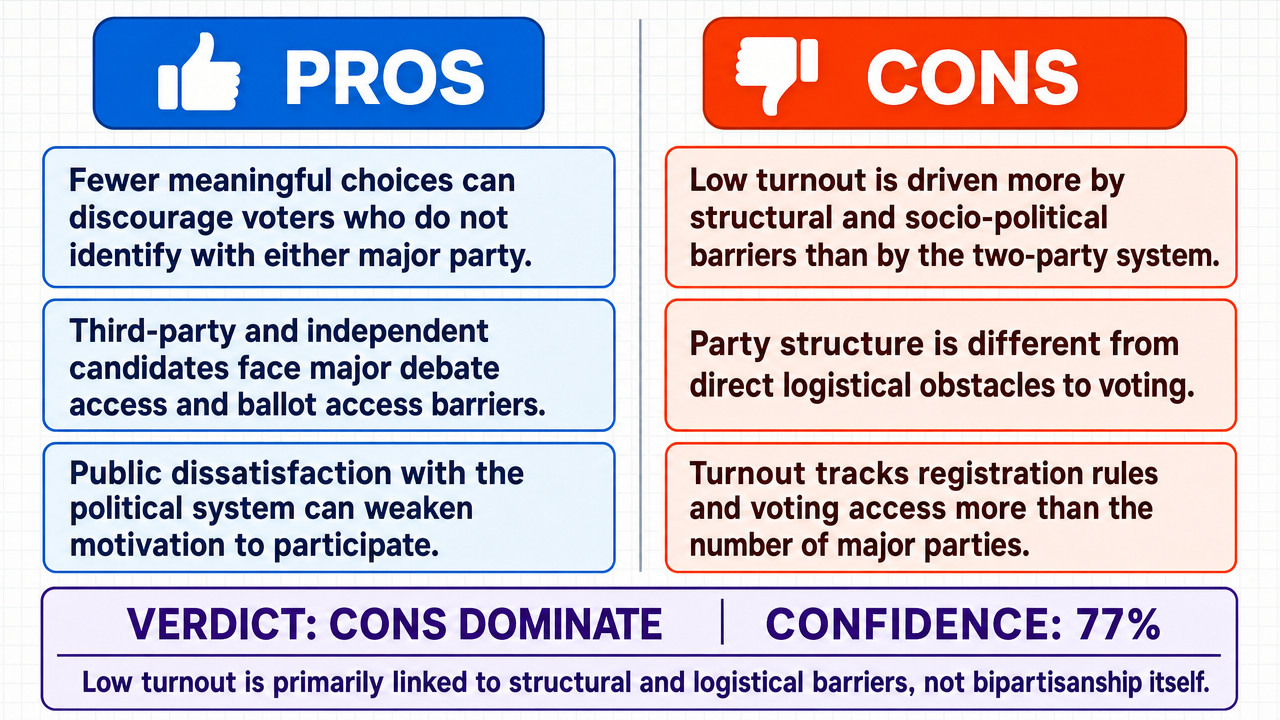
- ■The bipartite system substantially reduces choices perceived as meaningful, discouraging voters who do not identify with the two major platforms, which generates a sense of political alienation .
- ■Third-party or independent candidates are systematically excluded from major televised debates and face insurmountable legal hurdles in many states to access ballots .
- ■According to a Pew Research Center study, 58% of American voters in 2020 stated that the political system needed reform, indicating systemic discontent.
❌ Key CON arguments:
- ■Low voter turnout results from structural and socio-political factors other than bipartisanship , notably administrative barriers to voting.
- ■The affirmative argument confuses party structure with logistical voting obstacles, which are separate and more direct explanatory variables.
- ■Participation is more strongly correlated with ease of registration and voting method than with the nature of the parties: states with strict registration rules show structurally lower turnout , regardless of the bipartite system.
💭 Conclusion: False: The FALSE verdict is upheld because the NEGATIVE side successfully demonstrated that low American voter turnout mainly results from structural and logistical factors distinct from bipartisanship . The NEGATIVE arguments established a stronger correlation between administrative barriers to registration and voting and abstention than with the mere bipartite nature of the political system. Furthermore, the AFFIRMATIVE side failed to refute the core argument of the opposition, namely that legal and administrative obstacles (strict registration rules, restrictions on mail-in voting ) are more direct explanatory variables for participation. Additionally, the AFFIRMATIVE argument regarding the concentration of partisan resources in competitive states was refuted as logically inconsistent, as it overlooks non-partisan mobilization efforts that can offset this dynamic. Finally, the judge concluded that the causality between bipartisanship and abstention, as presented by the affirmative, lacked rigorous empirical demonstration compared to the administrative factors cited by the negative.
🔬 Verdict: Mostly FALSE ❌ (77%)
Claim: The American bipartite system is the main cause of low voter turnout in presidential elections.
Participating models: deepseek-v3.2 💬, gemma-4-26b-a4b-it 💬👁️
📊 Confrontations: 0 concluded TRUE, 1 concluded FALSE (1 confrontation, 3 models)
📊 Score by side: TRUE=0.00, FALSE=0.77
🏅 Model score evolution:
minimax-m3 💬👁️: +8
✅ Arguments FOR:
- ■The bipartite system significantly reduces choices perceived as meaningful, discouraging voters who do not identify with the two major platforms, which generates a sense of political alienation . deepseek-v3.2 💬
- ■Third-party or independent candidates are systematically excluded from major televised debates and face insurmountable legal hurdles in many states to access ballots . deepseek-v3.2 💬
- ■According to a Pew Research Center study, 58% of American voters in 2020 stated that the political system needed reform, indicating systemic discontent. deepseek-v3.2 💬
- ■Empirical research by Pew Research Center from 2018, titled “The Public, the Political System and American Democracy,” establishes a strong link between the perception of limited political choice and electoral abstention . deepseek-v3.2 💬
- ■Both parties concentrate their resources in competitive states , mechanically neglecting voters in “safe” states, which reduces mobilization in these areas. deepseek-v3.2 💬
❌ Arguments AGAINST:
- ■Low voter turnout results from structural and socio-political factors other than bipartisanship , notably administrative barriers to voting. gemma-4-26b-a4b-it 💬👁️
- ■The affirmative argument confuses party structure with logistical voting obstacles, which are separate and more direct explanatory variables. gemma-4-26b-a4b-it 💬👁️
- ■Participation is more strongly correlated with ease of registration and voting mode than with the nature of the parties: states with strict registration rules show structurally lower turnout , regardless of the bipartite configuration. gemma-4-26b-a4b-it 💬👁️
- ■The argument about the concentration of partisan resources in competitive states is logically inconsistent, as it does not demonstrate that partisan neglect is not offset by civil mobilizations or non-partisan organizations . gemma-4-26b-a4b-it 💬👁️
💭 Reasoning: False: The verdict of FALSE is upheld because the NEGATIVE side successfully demonstrated that American low voter turnout mainly results from structural and logistical factors separate from bipartisanship itself. The NEGATIVE arguments established a stronger correlation between administrative barriers to registration and voting and abstention than with the mere bipartite nature of the political system. Moreover, the AFFIRMATIVE side failed to refute the core argument of the opposition, namely that legal and administrative obstacles (strict registration rules, restrictions on mail-in voting ) are more direct explanatory variables for participation. Additionally, the AFFIRMATIVE argument regarding the concentration of partisan resources in competitive states was refuted as logically inconsistent, as it overlooks non-partisan mobilization efforts that can offset this dynamic. Finally, the judge concluded that the causality between bipartisanship and abstention, as presented by the affirmative, lacked rigorous empirical demonstration compared to the administrative factors invoked by the negative.
📋 Facts FOR:
• According to Pew Research Center in 2020, 58% of American voters stated that the political system needed reform.
• Third-party or independent candidates are systematically excluded from major debates.
• Many states impose legal obstacles on third-party candidates to access ballots.
📋 Facts AGAINST:
• States imposing strict registration rules or restrictions on mail-in voting display systematically lower turnout rates.
• Electoral participation is more closely correlated with ease of registration and voting method than with the nature of political parties.
• "Safe" states can maintain high participation through civil mobilizations and non-partisan organizations.
| Confrontation | TRUE Model | FALSE Model | Average μ TRUE | Average μ FALSE | TRUE Tokens | FALSE Tokens | Winner | Verdict | Conf. |
|---|---|---|---|---|---|---|---|---|---|
| #1 | deepseek-v3.2 💬 | gemma-4-26b-a4b-it 💬👁️ | 0.601 | 0.306 | 8 | 2 | TRUE | FALSE | 77% |
The following technical terms, abbreviations, and specialized concepts are used in this transcript. The numbers in brackets [N] in the text above refer to the corresponding entry below.
[1] abstention — The act, for a registered voter, of not participating in the election. The affirmative considers that bipartisanship is a cause; the negative mainly attributes it to logistical and administrative obstacles.
[2] political alienation — Feeling of detachment or distancing of citizens from the political system, invoked by the affirmative as a consequence of the lack of partisan choice.
[3] institutional architecture — Set of formal rules and mechanisms governing the organization of elections and the exercise of voting rights, which the negative opposes to bipartisanship as an explanatory factor for participation.
[4] electoral base — Core of voters mobilized around which a party bases its strategy, as opposed to the median electorate according to the affirmative's strategic polarization argument.
[5] bipartisanship — Political system dominated by two major parties. The affirmative sees it as the main cause of low participation; the negative disputes this causality. Central and contested point of the debate.
[6] ballots — vote ballots — Documents on which voters express their vote, access to which is, according to the affirmative, made difficult for third-party candidates by state legal obstacles.
[7] third-party candidates — third-party or independent candidates — Candidates not affiliated with the two major parties, whose systematic exclusion from major televised debates and ballots the affirmative highlights.
[8] counterfactual comparison — Causal analysis method involving comparing an observed situation to a hypothetical alternative scenario. The negative requires its use to establish the "main cause" of bipartisanship.
[9] party competition — Rivalry between political parties for votes and power, which the negative distinguishes from logistical barriers as a determinant of participation.
[10] electoral defection — Abstention by voters who, not identifying with any partisan offer, choose not to vote. Empirical link with the lack of choice claimed by the affirmative.
[11] civil mobilization — civil mobilizations — Collective actions by citizens or civil society organizations aimed at encouraging voting, invoked by the negative as a possible counterweight to partisan neglect in safe states.
[12] non-partisan organizations — Citizen or associative structures independent of political parties, which the negative suggests could support participation outside the partisan framework.
[13] electoral participation — Proportion of registered voters who actually exercise their right to vote in an election. The main cause of this phenomenon is the subject of debate.
[14] strategic polarization — Partisan strategy involving polarizing the debate and mobilizing a base rather than targeting the median electorate, identified by the affirmative as an effect of bipartisanship.
[15] causal primacy — Concept in causal analysis referring to the main factor among several possible causes and requiring, according to the negative, a counterfactual demonstration that the affirmative has not provided.
[16] empirical research — Research based on observation and data, which the affirmative cites to establish a link between limited political choice and abstention.
[17] invalid proxy substitution — Methodological critique made by the negative: reproach to the affirmative for using an indicator (trust in government) as an inadequate substitute for a variable (diversity of political offer) to demonstrate causality.
[18] participation rate — Quantitative indicator expressing the share of voters among registered voters, which the negative highlights as correlated with registration rules and voting mode.
[19] mail-in voting — Voting method allowing voters to transmit their ballot by postal mail, whose restrictions are mentioned by the negative as a factor in decreasing participation.
[20] median voter — Voter located at the ideological center of the electorate, whom parties, according to the affirmative, would neglect in favor of their mobilized base.
[21] competitive states — States where neither of the two major parties has a clearly established electoral advantage, in which the affirmative notes a concentration of partisan resources.
[22] safe states — "safe" states — States where one of the two major parties is assured of victory, where the negative argues that participation can remain high due to non-partisan dynamics.
The following financial data tables were cited during the debate exchanges:
| Participation Factor | Correlation with Voting | Observed Impact |
|---|---|---|
| Education Level | Very high | Crucial |
| Median Income | High | Significant |
| Voting Accessibility | Moderate to High | Variable by State |
| Election Competitiveness | Moderate | Variable |
Legend: Analysis of the determinants of voter participation in the United States. Factors are ranked by the strength of their statistical correlation with the turnout rate.
Face-off transcripts
- ■
Ownership & Trade Secrets. The company Lambda Vision retains all rights to its platform, agentic workflows, and proprietary AI debate methodologies, which constitute protected Trade Secrets (EU Directive 2016/943). Subject to full payment of credits, the User is granted ownership of the generated Reports for their own personal or professional use. Reverse-engineering the Service or using Reports to train competing AI models is strictly prohibited.
- ■
No Professional Advice. Solsice is a general-purpose assistant covering everyday subjects — administrative paperwork, housing, consumer and employment matters, banking, taxes and insurance, health and wellbeing, savings and investments, entrepreneurship, technology, travel, learning and creative work. Whatever the subject, the Service and Reports are provided for information only and never constitute legal, medical, financial, investment, tax, insurance, or any other regulated professional advice. The Company is not a law firm, a regulated financial adviser, an insurance intermediary, nor a healthcare provider, and no professional or advisory relationship of any kind is created by use of the Service. Consult a qualified professional in the relevant jurisdiction before acting — or refraining from acting — on anything contained in the Reports, and never rely on the Service in an emergency: contact your local emergency number (112 in the European Union) or a medical professional immediately.
- ■
AI-Generated Content, Sources and Viewpoints. Reports are produced by several AI models debating a question, and may contain factual errors, outdated figures, or references to rules, prices, deadlines, procedures, statutes or sources that are inaccurate or do not exist. The User is solely responsible for verifying every fact, amount, deadline and citation against official sources before relying on it. Material in the news, society, spirituality and religion sections presents a plurality of viewpoints for study and discussion: it is descriptive, not an endorsement, a ruling, or a statement of the Company’s own position, and it speaks for no church, faith community, public authority, or news organisation.
- ■
Liability & Governing Law. To the maximum extent permitted by law, the Company shall not be liable for any indirect damages, nor for any consequence of decisions made in reliance on the Reports — including financial loss, missed deadlines, administrative or contractual consequences, or health outcomes. These Terms are governed by French law. Any disputes shall be subject to the exclusive jurisdiction of the Courts of Paris, France.