
Le retour de la 2CV en version électrique à moins de 15 000 € d'ici 2028 démocratisera la voiture électrique en France.
AI debate verdict and arguments
⚠️ AI-generated information only; not professional advice
Completed October 14, 2026
Verdict
Verdict: Mostly FALSE (65%)
Online report: https://solsice.com/public/debates/le-retour-de-la-2cv-en-version-electrique-a-moins-de-15-000-0a984ed9cf0d
This section provides a brief overview of the key arguments. It is not necessary to read the detailed report below.
✅ Key PRO arguments:
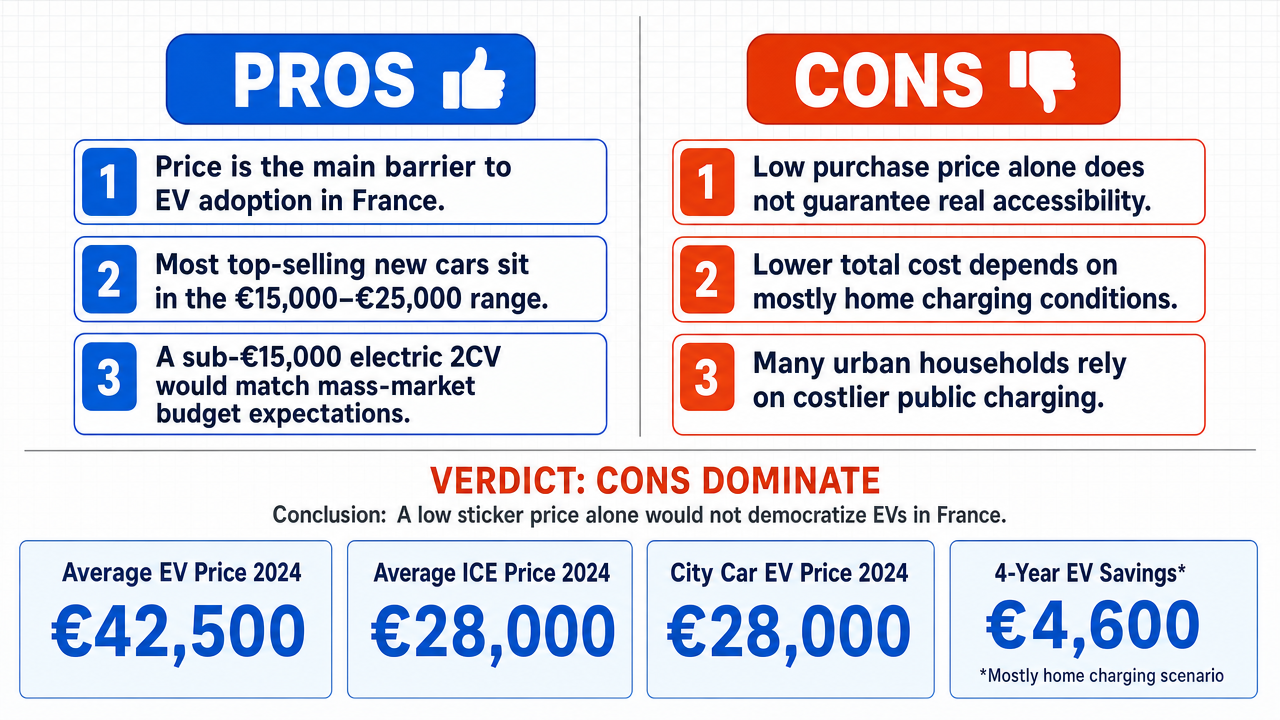
- ■The purchase price is the main barrier to the adoption of electric vehicles in France: in 2024, the average price of a new electric car exceeds €40,000, making it out of reach for many households. An offer under €15,000 would create a new price category, aligned with the budget of the most sold entry-level thermal vehicles .
- ■The best-selling new vehicles in France are consistently in the €15,000 – €25,000 range, which proves that a positioning at €15,000 directly corresponds to the core accessible market with a modest down payment and a standard loan duration.
- ■An electric 2CV under €15,000 would directly meet the expectations of a majority of consumers for whom acquisition cost is the decisive criterion, as indicated by automotive market surveys.
❌ Key CON arguments:
- ■The affirmative side confuses purchase price with actual accessibility: it uses average prices measured in the high-end segment and mass-market to conclude democratization, which is a measurement error relative to the subject.
- ■The ADEME 2023 study, invoked to suggest that the TCO becomes competitive below €20,000, is strictly conditioned on an optimized mixed or domestic charging scenario, which the affirmative omits to specify.
- ■For most French urban households, the reality of charging is marked by dependence on public charging stations, whose higher unit cost offsets the expected gains on total cost of ownership, making actual accessibility much lower than what the purchase price alone suggests.
💭 Conclusion: False. The debate has not established that an electric 2CV under €15,000 by 2028 would democratize electric vehicles in France. The negative side successfully demonstrated that actual accessibility is not limited to the purchase price but includes the total cost of ownership, heavily conditioned by the actual charging modalities of households. The argument that most urban households depend on more costly public charging invalidates the hypothesis of a competitive TCO based on an ADEME 2023 study conditioned on an optimized domestic scenario. The claim that purchase price is the main lever for democratization was refuted because it was based on measures from the high-end segment, unjustifiably transposed to an entry-level product . Finally, the first sub-assertion (effective release of an electric 2CV at this price by 2028) remains hypothetical and unsubstantiated in the debate, weakening the overall strength of the composite statement.
🔬 Verdict: Mostly FALSE ❌ (65%)
Claim: The return of the 2CV in electric version under €15,000 by 2028 will democratize electric cars in France.
Participating models: deepseek-v3.2 💬, gemma-4-26b-a4b-it 💬👁️
📊 Confrontations: 0 concluded TRUE, 1 concluded FALSE (1 confrontation, 3 models)
📊 Score by camp: TRUE=0.00, FALSE=0.81
🏅 Model score evolution:
minimax-m3 💬👁️: +8
✅ PRO arguments:
- ■The purchase price is the main barrier to the adoption of electric vehicles in France: in 2024, the average price of a new electric car exceeds €40,000, making it out of reach for many households. An offer under €15,000 would create a new price category, aligned with the budget of the most sold entry-level thermal vehicles . deepseek-v3.2 💬
- ■The best-selling new vehicles in France are consistently in the €15,000 – €25,000 range, which proves that a positioning at €15,000 directly corresponds to the core accessible market with a modest down payment and a standard loan duration. deepseek-v3.2 💬
- ■An electric 2CV under €15,000 would directly meet the expectations of a majority of consumers for whom acquisition cost is the decisive criterion, as indicated by automotive market surveys. deepseek-v3.2 💬
❌ Arguments AGAINST:
- ■The affirmative side confuses purchase price and actual accessibility: it uses average prices measured in the high-end segment and mass-market to conclude democratization, which is a measurement error relative to the subject. gemma-4-26b-a4b-it 💬👁️
- ■The ADEME 2023 study, invoked to suggest that the TCO becomes competitive below €20,000, is strictly conditioned on an optimized mixed or domestic charging scenario, which the affirmative omits to specify. gemma-4-26b-a4b-it 💬👁️
- ■For most French urban households, the reality of charging is marked by dependence on public charging stations, whose higher unit cost offsets the expected gains on total cost of ownership, making actual accessibility much lower than what the purchase price alone suggests. gemma-4-26b-a4b-it 💬👁️
- ■The simple fact that an electric 2CV is marketed at €15,000 is not enough to democratize electric vehicles, because democratization requires simultaneously overcoming several structural constraints (charging, TCO, range, network), not just the catalog price. gemma-4-26b-a4b-it 💬👁️
💭 Reasoning: False. The debate has not established that an electric 2CV under €15,000 by 2028 would democratize electric vehicles in France. The negative side demonstrated successfully that actual accessibility is not limited to the purchase price but includes the total cost of ownership, heavily conditioned by the actual charging modalities of households. The argument that most urban households depend on more costly public charging invalidates the hypothesis of a competitive TCO based on an ADEME 2023 study conditioned on an optimized domestic scenario. The claim that purchase price is the main lever for democratization was refuted because it was based on measures from the high-end segment, unjustifiably transposed to an entry-level product. Finally, the first sub-assertion (effective release of an electric 2CV at this price by 2028) remains hypothetical and unsubstantiated in the debate, weakening the overall strength of the composite statement.
📋 Facts IN FAVOR:
• In 2024, the average price of a new electric car exceeds €40,000 in France
• The best-selling new vehicles in France are in the €15,000 – €25,000 range
• An ADEME 2023 study evaluated the total cost of ownership (TCO) of electric vehicles
📋 Facts AGAINST:
• The ADEME 2023 study on TCO is conditioned on an optimized mixed or domestic charging scenario
• Most French urban households depend on charging at public stations
• Charging at public stations is more expensive than at home
• The purchase price and the total cost of ownership are two distinct indicators of accessibility
| Confrontation | TRUE Model | FALSE Model | Average μ TRUE | Average μ FALSE | TRUE Tokens | FALSE Tokens | Winner | Verdict | Conf. |
|---|---|---|---|---|---|---|---|---|---|
| #1 | deepseek-v3.2 💬 | gemma-4-26b-a4b-it 💬👁️ | 0.392 | 0.239 | 8 | 2 | TRUE | FALSE | 81% |
The following technical terms, abbreviations, and specialized concepts are used in this transcript. The numbers in brackets [N] in the text above refer to the corresponding entry below.
[1] 2CV — Deux Chevaux — An iconic French car model, mentioned in the debate as the basis for an affordable electric version.
[2] ADEME — Agence de l'environnement et de la maîtrise de l'énergie — French public agency cited in the debate as the source of a 2023 study on the total cost of ownership of electric vehicles.
[3] down payment — Initial sum paid by the buyer as part of an auto loan. The debate indicates that a modest down payment would make a €15,000 vehicle accessible to the core market segment.
[4] charging station — Public or private infrastructure enabling the recharging of an electric vehicle. The debate contrasts charging on public stations with charging on residential meters.
[5] debt capacity — The maximum amount a household can borrow from a financial institution, directly related in the debate to the purchase price to be financed.
[6] city car — Automotive segment referring to compact urban cars, with an average price of €28,000 for electric models in 2024.
[7] residential meter — Domestic electric meter used as a reference for energy cost in the debate, as opposed to public stations where the price per kWh is considered higher.
[8] democratize — Make accessible to the majority of the population. Central concept of the debate: the affirmative team links it to the purchase price, while the negative team disputes this definition by citing the total cost of ownership.
[9] entry-level — Product positioning corresponding to the most affordable models on a market. The debate mentions creating an entry-level electric offer at €15,000.
[10] kWh — kilowatt-hour — Unit of energy measurement used in the debate to compare the cost of home and public station recharging.
[11] purchase price — Initial buying price of a vehicle, presented by the affirmative team as the main obstacle to electric vehicle adoption.
[12] sticker price — Displayed price of a good, not including additional costs (credit, energy, maintenance). The negative team argues that accessibility cannot be reduced to this.
[13] proxy — Substitute variable used in place of a target measure. The negative team criticizes the affirmative for using the average market price as a proxy for actual accessibility.
[14] core market segment — Price range where major sales volumes are concentrated. The debate places this segment between €15,000 and €25,000.
[15] TCO — Total Cost of Ownership — Economic indicator encompassing all costs related to owning a vehicle: purchase, maintenance, energy, recharging. Central point of contention in the debate.
[16] thermal — Describes a vehicle equipped with an internal combustion engine, opposed in the debate to the electric vehicle.
[17] EV — Electric Vehicle — Car powered by an electric motor supplied by a battery. The debate systematically compares its average price (€42,500 in 2024) to that of a thermal vehicle.
The following financial data tables were cited during the debate exchanges:
| Segment | Average EV Price 2024 | Average Thermal Price 2024 | Difference |
|---|---|---|---|
| All models | €42,500 | €28,000 | +€14,500 |
| City cars | €28,000 | — | — |
Legend: Comparison of the average prices of new vehicles in France in 2024. Prices in euros. Source: consolidated sector data.
| Scenario | Total cost over 4 years (EV €15k) | Total cost over 4 years (Thermal €15k) | Savings |
|---|---|---|---|
| Home charging majority | €21,200 | €25,800 | -€4,600 |
| Public charging majority | — | — | — |
Legend: Comparison of total cost of ownership over 4 years for a €15,000 vehicle, including purchase, energy, maintenance, and depreciation. Modeled data from the ADEME 2023 study.
Face-off transcripts
- ■
Ownership & Trade Secrets. Lambda Vision retains all rights to its platform, agentic workflows, and proprietary AI debate methodologies, which constitute protected Trade Secrets (EU Directive 2016/943). Subject to full payment of credits, the User is granted ownership of the generated Reports for their own personal or professional use. Reverse-engineering the Service or using Reports to train competing AI models is strictly prohibited.
- ■
No Professional Advice. Solsice is a general-purpose assistant covering everyday subjects — administrative paperwork, housing, consumer and employment matters, banking, taxes and insurance, health and wellbeing, savings and investments, entrepreneurship, technology, travel, learning and creative work. Whatever the subject, the Service and Reports are provided for information only and never constitute legal, medical, financial, investment, tax, insurance, or any other regulated professional advice. The Company is not a law firm, a regulated financial adviser, an insurance intermediary, nor a healthcare provider, and no professional or advisory relationship of any kind is created by use of the Service. Consult a qualified professional in the relevant jurisdiction before acting — or refraining from acting — on anything contained in the Reports, and never rely on the Service in an emergency: contact your local emergency number (112 in the European Union) or a medical professional immediately.
- ■
AI-Generated Content, Sources and Viewpoints. Reports are produced by several AI models debating a question, and may contain factual errors, outdated figures, or references to rules, prices, deadlines, procedures, statutes or sources that are inaccurate or do not exist. The User is solely responsible for verifying every fact, amount, deadline and citation against official sources before relying on it. Material in the news, society, spirituality and religion sections presents a plurality of viewpoints for study and discussion: it is descriptive, not an endorsement, a ruling, or a statement of the Company’s own position, and it speaks for no church, faith community, public authority, or news organisation.
- ■
Liability & Governing Law. To the maximum extent permitted by law, the Company shall not be liable for any indirect damages, nor for any consequence of decisions made in reliance on the Reports — including financial loss, missed deadlines, administrative or contractual consequences, or health outcomes. These Terms are governed by French law. Any disputes shall be subject to the exclusive jurisdiction of the Courts of Paris, France.