
Le recyclage des déchets électroniques (e-déchets) peut satisfaire une part significative de la demande mondiale en éléments de terres rares.
AI debate verdict and arguments
⚠️ AI-generated information only; not professional advice
Completed October 24, 2026
Verdict
Verdict: Mostly FALSE (76%)
Online report: https://solsice.com/public/debates/le-recyclage-des-dechets-electroniques-e-dechets-peut-satisf-5174d2675d72
This section provides a brief overview of the key arguments. It is not necessary to read the detailed report below.
✅ Key PRO arguments:
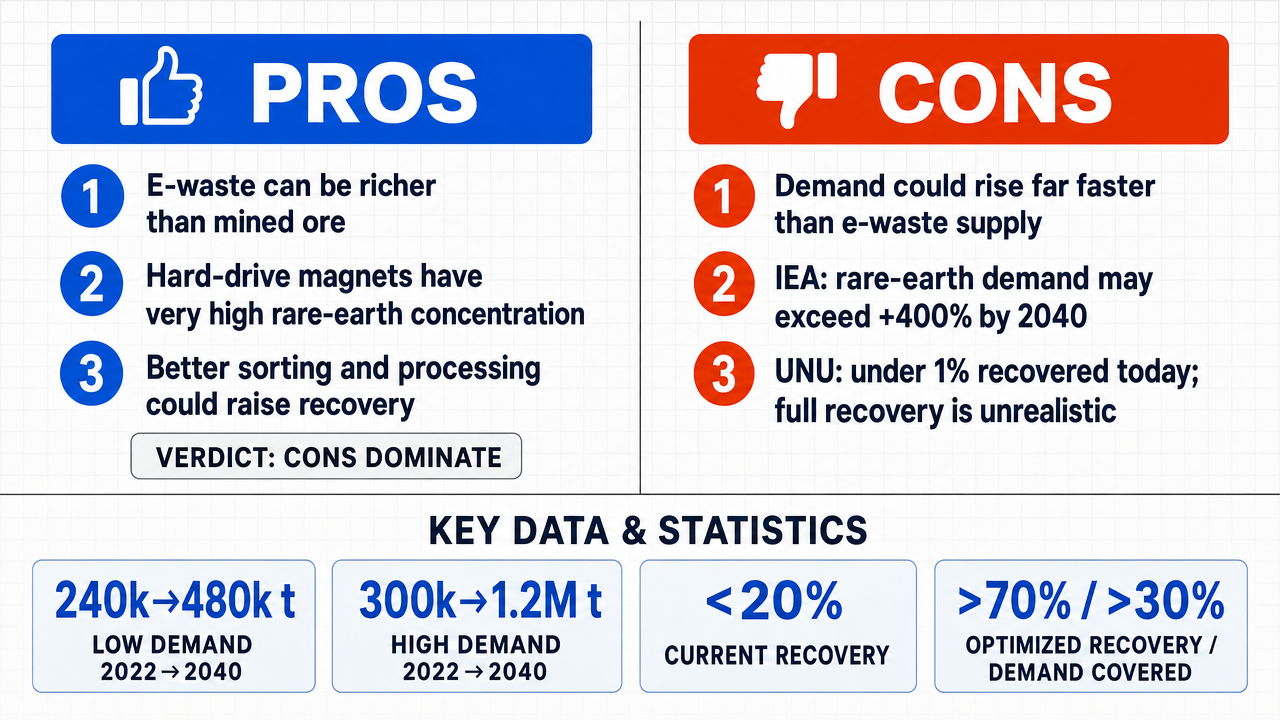
- ■E-waste constitutes urban deposits that are much richer than natural mineral deposits: electronic components , such as permanent magnets in hard drives or electric motors, concentrate rare earth elements (neodymium , dysprosium) at densities several orders of magnitude higher than natural mineral deposits, making recycling potentially very productive.
- ■Current recovery rates , below 20%, reflect a lack of specialized sorting infrastructure rather than an insurmountable structural limit; with investments and technological advances, these rates could increase significantly, enabling recycling to meet a substantial part of the demand.
❌ Key CON arguments:
- ■The quantitative gap is enormous: according to the International Energy Agency (IEA ), global demand for rare earth elements could increase by over 400% by 2040 (mainly for electric vehicles and wind turbines ), while the total volume of rare earths contained in annually collected e-waste is well below this projection, with actual recovery rates often below 20% for critical elements.
- ■Future technologies will not allow more than 70% recovery of rare earths : according to UNU , less than 1% of rare earths in e-waste are currently recovered, as the chemical separation of rare earths from base metals remains technically inefficient for secondary flows with low concentrations, such as capacitors or screens.
💭 Conclusion: False. The FALSE verdict is retained because the quantitative arguments presented by the negative side demonstrate a major structural gap between the global demand for rare earths , expected to grow by over 400% by 2040 according to the IEA , and the actual recovery capacity from e-waste , which remains below 20% for critical elements and at 1% according to UNU . The affirmative side mainly relies on the theoretical potential of urban deposits and an optimistic view of technological evolution, without providing verifiable numerical data contradicting the projections of the IEA and UNU. The negative side has shown that technical limitations of chemical separation and insufficient collection volumes make recycling incapable, in the short and medium term, of satisfying a significant part of the demand. Finally, e-waste recycling can contribute marginally to supply but does not constitute a credible substitute for primary mining in the face of exploding demand.
🔬 Verdict: mostly FALSE ❌ (76%)
Claim: Recycling of electronic waste (e-waste ) can satisfy a significant part of the global demand for rare earth elements .
Participating models: gemma-4-26b-a4b-it 💬👁️, glm-4.7-flash 💬
📊 Confrontations: 0 concluded TRUE, 1 concluded FALSE (1 confrontation, 3 models)
📊 Score by side: TRUE=0.00, FALSE=0.76
🏅 Model score evolution:
minimax-m3 💬👁️: +8
✅ PRO arguments:
- ■E-waste constitutes urban deposits that are much richer than natural mineral deposits: electronic components , such as permanent magnets in hard drives or electric motors, concentrate rare earth elements (neodymium , dysprosium) at densities several orders of magnitude higher than natural mineral deposits, making recycling potentially very productive. gemma-4-26b-a4b-it 💬👁️
- ■Current recovery rates , below 20%, reflect a lack of specialized sorting infrastructure rather than an insurmountable structural limit; with investments and technological advances, these rates could increase significantly, enabling recycling to meet a substantial part of the demand. gemma-4-26b-a4b-it 💬👁️
❌ Arguments AGAINST:
- ■The quantitative gap is enormous: according to the International Energy Agency (IEA ), global demand for rare earth elements could increase by more than 400% by 2040 (mainly for electric vehicles and wind turbines ), while the total volume of rare earths in collected e-waste annually is significantly below this projection, with actual recovery rates often below 20% for critical elements. glm-4.7-flash 💬
- ■Future technologies will not allow more than 70% recovery of rare earths: according to UNU , less than 1% of rare earths in e-waste are currently recovered, as the chemical separation of rare earths from base metals remains technically inefficient for secondary flows with low concentrations, such as capacitors or screens. glm-4.7-flash 💬
💭 Reasoning: False. The FALSE verdict is retained because the quantitative arguments presented by the negative side demonstrate a major structural gap between the global demand for rare earths, expected to grow by over 400% by 2040 according to the IEA, and the actual recovery capacity from e-waste, which remains below 20% for critical elements and at 1% according to UNU. The affirmative side mainly relies on the theoretical potential of urban deposits and an optimistic view of technological evolution, without providing verifiable numerical data contradicting the projections of the IEA and UNU. The negative side has shown that technical limitations of chemical separation and insufficient collection volumes make recycling incapable, in the short and medium term, of satisfying a significant part of the demand. Finally, e-waste recycling can contribute marginally to supply but does not constitute a credible substitute for primary mining in the face of exploding demand.
📋 PRO facts:
• Permanent magnets in hard drives concentrate rare earths at densities significantly higher than natural mineral deposits.
• Current recovery rates below 20% reflect a lack of specialized sorting infrastructure rather than a structural limit.
📋 CON facts:
• According to the International Energy Agency (IEA), global demand for rare earths could increase by over 400% by 2040, mainly for electric vehicles and wind turbines.
• Actual recovery rates of rare earths from e-waste are often below 20% for critical elements.
• According to UNU, less than 1% of rare earths contained in e-waste are currently recovered due to the technical inefficiency of chemical separation for secondary flows.
| Confrontation | TRUE Model | FALSE Model | Average μ TRUE | Average μ FALSE | TRUE Tokens | FALSE Tokens | Winner | Verdict | Confidence |
|---|---|---|---|---|---|---|---|---|---|
| #1 | gemma-4-26b-a4b-it 💬👁️ | glm-4.7-flash 💬 | 0.303 | 0.654 | 4 | 4 | FALSE | FALSE | 76% |
The following technical terms, abbreviations, and specialized concepts are used in this transcript. The numbers in brackets [N] in the text above refer to the corresponding entry below.
[1] permanent magnets — Magnetic components that retain their magnetism without an external energy source, used in electric motors, hard drives, and wind turbines, and which concentrate large quantities of rare earth elements such as neodymium and dysprosium.
[2] value chains — Set of sequential activities (extraction, processing, distribution) enabling the production and marketing of a good, whose security is a major geopolitical issue for rare earths.
[3] electronic components — Constitutive elements of electronic devices (capacitors, integrated circuits, screens, magnets) containing various metals, including rare earths at varying concentrations.
[4] mass concentration — Concept referring to the density of a useful resource in a deposit or a material flux, used to compare the richness of primary ores to electronic waste.
[5] ecological design — Ecodesign / eco-conception — Approach to product design aimed at reducing their environmental impact throughout their lifecycle, notably by facilitating disassembly and recycling at end of life.
[6] capacitors — Electronic components storing an electric charge, mentioned in the debate as containing rare earths at low concentrations, difficult to recover through recycling.
[7] exponential growth — Increase of a quantity at a constant rate applied to the current value, characterizing in the debate the projection of global demand for rare earths.
[8] thermodynamic density — Measure of the energy or mass concentration of a resource in a material, invoked to qualify the richness of e-waste in rare earths compared to natural ores.
[9] e-waste — electronic waste — Waste from electrical and electronic equipment at end of life (computers, phones, motors), considered as secondary deposits of strategic metals.
[10] secondary flows — Materials derived from end-of-life products or production residues, as opposed to primary flows (extracted ores), whose recycling constitutes a source of supply.
[11] urban deposits — Accumulations of resources in waste and urban infrastructure, a concept describing e-waste as an exploitable reserve of strategic metals.
[12] high purity — Quality of a recycled material whose concentration of target elements reaches the thresholds required for industrial applications, notably high-performance magnets.
[13] IEA — International Energy Agency — Intergovernmental organization providing analyses and projections on global energy, cited in the debate as a source of estimates for the growth of demand for rare earths.
[14] sorting infrastructures — Facilities and equipment dedicated to separating and classifying waste according to their composition, whose lack is identified as a barrier to recovery rates.
[15] base metals — Common metals (copper, aluminum, zinc, etc.) present in electronic components, whose separation from rare earths poses a technical challenge for recycling.
[16] neodymium — neodymium (Nd) — Chemical element of the rare earth family, used in high-performance permanent magnets due to its exceptional magnetic properties.
[17] orders of magnitude — Relative measurement scales (factors of 10), used in the debate to compare the concentration of rare earths in magnets to that in natural ores.
[18] EPR — Extended Producer Responsibility — Regulatory principle requiring producers to organize or finance the end-of-life management of their products, mentioned as a lever to improve equipment recyclability.
[19] supply security — Guarantee of sustainable access to strategic raw materials, a major geopolitical issue for rare earths dominated by a few producing countries.
[20] chemical separation — Extraction process using chemical reactions (hydrometallurgy, pyrometallurgy) to isolate specific elements from a mixture, whose effectiveness on rare earths is debated.
[21] recovery rate — Proportion of a given element effectively extracted from a waste stream during recycling, with current values for rare earths being contested between parties (less than 1% according to UNU, less than 20% according to the affirmative).
[22] rare earths — rare earth elements (REE) — Family of 17 chemical elements with specific properties (magnetic, optical, catalytic), essential for green and digital technologies but whose extraction and recycling pose technical and environmental challenges.
[23] UNU — United Nations University — UN research and training institution, cited in the debate as a source indicating that less than 1% of rare earths contained in e-waste are currently recovered.
[24] EVs — electric vehicles — Vehicles powered by an electric motor, whose batteries and motors contain significant quantities of rare earths, identified as the main driver of future demand.
[25] circular economy — Economic model aimed at keeping resources in circulation as long as possible through reuse, repair, and recycling, opposed to the linear model of extract-produce-dispose.
[26] wind turbines — Devices converting wind energy into electricity, whose generators use permanent magnets based on rare earths, identified as a driver of future demand.
The following financial data tables were cited during the debate exchanges:
| Resource Type | Typical Concentration (g/t) | Recovery Potential | Impact on Demand |
|---|---|---|---|
| Rock Ore (Average) | 0.1 - 1.0 | Low to Moderate | Limited by extraction |
| Hard Drive Magnets | 250,000 - 300,000 | Very High | Significant |
| Smartphone Components | 10 - 50 | Moderate | Growing |
Legend: Comparison of rare earth concentrations between traditional mineral sources and recycling sources (e-waste). Concentration values are expressed in grams per tonne (g/t).
| Scenario | Rare Earth Demand (2022) | Rare Earth Demand (2040) | Predicted Growth Rate | Current Recycling Share |
|---|---|---|---|---|
| Low | 240,000 tonnes | 480,000 tonnes | +100% | < 5% |
| High | 300,000 tonnes | 1,200,000 tonnes | +300% | < 10% |
Legend: Projection of global rare earth demand (neodymium, dysprosium, etc.) according to the International Energy Agency (IEA) and an estimate of the potential contribution of current recycling. Growth rates are based on energy transition scenarios. Source: IEA World Energy Outlook 2023.
| Processing Method | Processing Cost (USD/kg) | Profitability vs Mining Extraction |
|---|---|---|
| Hydrometallurgy (E-waste) | 80 - 120 | Unprofitable |
| Pyrometallurgy (E-waste) | 60 - 90 | Unprofitable |
| Mining Extraction (Virgin) | 30 - 50 | Profitable |
Legend: Comparison of estimated processing costs for recovering rare earths via recycling versus traditional mining extraction. Costs are expressed in US dollars per kilogram of metal recovered. Source: European Commission, Critical Raw Materials Report (2020).
| Factor | Impact on Recycling Market Share |
|---|---|
| Device Renewal Rate | Slow (3-5 years) |
| EV Growth Rate | Rapid (20%+ annually) |
| Geographical Dispersibility | High (logistical costs) |
Legend: Analysis of structural constraints limiting the contribution of e-waste recycling to global rare earth demand. Source: Analysis based on reports from the IEA and UNU.
| Development Phase | Estimated Recovery Rate | R&D Innovation Cost | Share of Demand Covered |
|---|---|---|---|
| Current (Linear) | < 20% | Low | < 5% |
| Transition (Regulated) | 30% - 50% | Medium | 10% - 15% |
| Optimized (Circular) | > 70% | High | > 30% |
Legend: Projection of the evolution of recovery rate and the share of global demand covered by recycling based on technological and regulatory maturity. Data are extrapolations based on circular economy trends.
| Scenario | Rare Earth Volume (tonnes) | Recycling Market Share |
|---|---|---|
| Global Demand (2023) | 300,000 | 0% |
| Recycling Potential (Optimistic) | 5,000 | 1.6% |
| Electric Vehicle Demand | 100,000 | 2.0% |
Legend: Comparison of global rare earth demand (neodymium, dysprosium) and recycling contribution potential according to the International Energy Agency (IEA) and the United Nations Environment Programme (UNU). Source: IEA World Energy Outlook 2023, UNU Global E-waste Monitor 2024.
Face-off transcripts
- ■
Ownership & Trade Secrets. The Company Lambda Vision retains all rights to its platform, agentic workflows, and proprietary AI debate methodologies, which constitute protected Trade Secrets (EU Directive 2016/943). Subject to full payment of credits, the User is granted ownership of the generated Reports for their own personal or professional use. Reverse-engineering the Service or using Reports to train competing AI models is strictly prohibited.
- ■
No Professional Advice. Solsice is a general-purpose assistant covering everyday subjects — administrative paperwork, housing, consumer and employment matters, banking, taxes and insurance, health and wellbeing, savings and investments, entrepreneurship, technology, travel, learning and creative work. Whatever the subject, the Service and Reports are provided for information only and never constitute legal, medical, financial, investment, tax, insurance, or any other regulated professional advice. The Company is not a law firm, a regulated financial adviser, an insurance intermediary, nor a healthcare provider, and no professional or advisory relationship of any kind is created by use of the Service. Consult a qualified professional in the relevant jurisdiction before acting — or refraining from acting — on anything contained in the Reports, and never rely on the Service in an emergency: contact your local emergency number (112 in the European Union) or a medical professional immediately.
- ■
AI-Generated Content, Sources and Viewpoints. Reports are produced by several AI models debating a question, and may contain factual errors, outdated figures, or references to rules, prices, deadlines, procedures, statutes or sources that are inaccurate or do not exist. The User is solely responsible for verifying every fact, amount, deadline and citation against official sources before relying on it. Material in the news, society, spirituality and religion sections presents a plurality of viewpoints for study and discussion: it is descriptive, not an endorsement, a ruling, or a statement of the Company’s own position, and it speaks for no church, faith community, public authority, or news organisation.
- ■
Liability & Governing Law. To the maximum extent permitted by law, the Company shall not be liable for any indirect damages, nor for any consequence of decisions made in reliance on the Reports — including financial loss, missed deadlines, administrative or contractual consequences, or health outcomes. These Terms are governed by French law. Any disputes shall be subject to the exclusive jurisdiction of the Courts of Paris, France.