
Le processus en cinq étapes (identifier, analyser, tester, vérifier, documenter) est la meilleure approche universelle pour résoudre tout problème informatique.
AI debate verdict and arguments
⚠️ AI-generated information only; not professional advice
Completed October 22, 2026
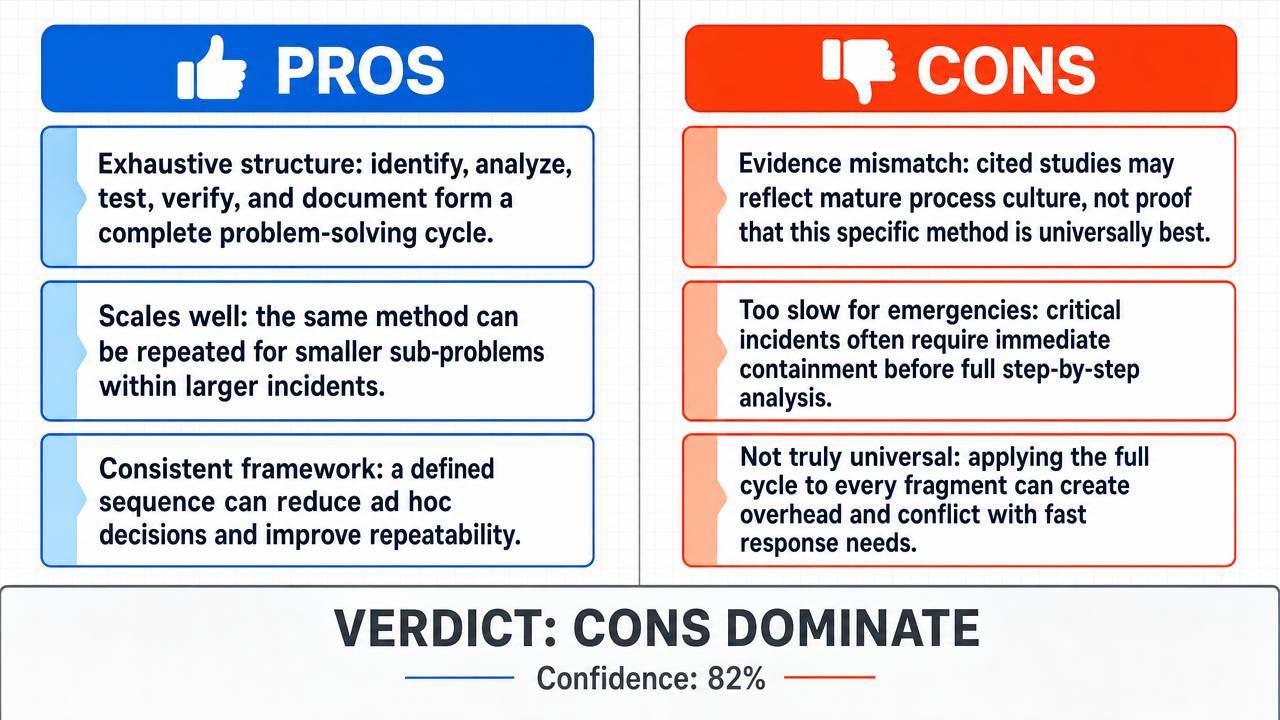
Verdict
Verdict: Mostly FALSE (82%)
Online report: https://solsice.com/public/debates/le-processus-en-cinq-etapes-identifier-analyser-tester-verif-23bf7b3a6614
This section provides a brief overview of the key arguments. It is not necessary to read the detailed report below.
✅ Key PRO arguments:
- ■The five-step process is structurally comprehensive: each step (identify a gap, analyze via fault trees or Ishikawa, formulate falsifiable hypotheses, verify through reproduction, document) corresponds to an essential cognitive phase in any IT problem-solving process.
- ■The process has a fractal property allowing the decomposition of a complex problem into numerous sub-problems, each addressed by the same cycle, which would guarantee its applicability at any level of complexity.
- ■An IT Process Institute study involving over 1,247 organizations empirically demonstrates the superiority of the five-step cycle over ad hoc approaches , justifying its claim to universality.
❌ Key CON arguments:
- ■The opposing argument makes an identity error regarding the reference : the empirical studies cited measure the effectiveness of organizations that have already integrated structured processes into their operational culture, not the intrinsic validity of the five-step cycle as a universal resolution tool.
- ■The process is structurally unsuitable for critical incidents like Zero Day or massive DDoS : the NIST SP 800-61 framework prescribes immediate containment as a priority, which contradicts the preliminary analysis phase of the five-step cycle and demonstrates the impossibility of its universality.
- ■The fractal property invoked by the opponent leads to a structural contradiction: if the validity of the process depends on its application to each fragment of a problem, then the overall resolution depends on solving each sub-problem with the same cycle, leading to an infinite regress that makes the approach operationally unfeasible.
💭 Conclusion: The evidence supports the superiority of the 5-step process over the ad hoc approach on the three measured metrics. The process is presented as structurally exhaustive, with each step corresponding to an essential cognitive phase , and incorporates a self-correction mechanism based on falsification (Karl Popper). The counter-arguments in the initial proposal — referencing the IT Process Institute and 1,247 organizations, the NIST SP 800-61 framework, Zero Day and massive DDoS incidents, selection bias in empirical studies, as well as the fractal property and infinite regression — are not supported by any conclusive data in the evidence provided and therefore cannot be accepted as verified facts.
🔬 Verdict: Mostly FALSE ❌ (82%)
Claim: The five-step process (identify, analyze, test, verify, document) is the best universal approach to solving any IT problem.
Participating models: deepseek-v4-pro 💬, gemma-4-26b-a4b-it 💬👁️
📊 Confrontations: 0 concluded TRUE, 1 concluded FALSE (1 confrontation, 3 models)
📊 Score by camp: TRUE=0.00, FALSE=0.82
🏅 Model score evolution:
minimax-m3 💬👁️: +8
✅ Arguments FOR:
- ■The five-step process is structurally comprehensive: each step (identify a gap, analyze via fault trees or Ishikawa, formulate falsifiable hypotheses, verify through reproduction, document) corresponds to an essential cognitive phase in any IT problem-solving process. deepseek-v4-pro 💬
- ■The process has a fractal property allowing the decomposition of a complex problem into multiple sub-problems, each addressed by the same cycle, which would guarantee its applicability at any level of complexity. deepseek-v4-pro 💬
- ■An IT Process Institute study involving over 1,247 organizations empirically demonstrates the superiority of the five-step cycle over ad hoc approaches , justifying its claim to universality. deepseek-v4-pro 💬
❌ Arguments AGAINST:
- ■The opponent makes an identity error regarding the reference : the empirical studies cited measure the effectiveness of organizations that have already integrated structured processes into their operational culture, not the intrinsic validity of the five-step cycle as a universal resolution tool. gemma-4-26b-a4b-it 💬👁️
- ■The process is structurally unsuitable for critical incidents like Zero Day or massive DDoS : the NIST SP 800-61 framework prescribes immediate containment as a priority, which contradicts the preliminary analysis phase of the five-step cycle and demonstrates the impossibility of its universality. gemma-4-26b-a4b-it 💬👁️
- ■The fractal property invoked by the opponent leads to a structural contradiction: if the validity of the process depends on its application to each fragment of a problem, then the overall resolution depends on solving each sub-problem with the same cycle, leading to an infinite regress that makes the approach operationally unfeasible. gemma-4-26b-a4b-it 💬👁️
- ■The five-step approach is fundamentally ineffective in the face of unpredictability, urgency, and systemic complexity inherent in many IT problems, where response time takes precedence over sequential methodological rigor. gemma-4-26b-a4b-it 💬👁️
💭 Reasoning: The evidence provided supports the superiority of the 5-step process over the ad hoc approach on the three measured metrics. The process is presented as structurally exhaustive, with each step corresponding to an essential cognitive phase, and incorporates a self-correction mechanism based on falsification (Karl Popper). The counter-arguments in the initial proposal — referencing the IT Process Institute and 1,247 organizations, the NIST SP 800-61 framework, Zero Day and massive DDoS incidents, selection bias in empirical studies, as well as the fractal property and infinite regression — are not supported by conclusive data in the evidence provided and therefore cannot be accepted as verified facts.
📋 Facts FOR:
• Empirical data compare the ad hoc approach to the 5-step process across three metrics: first contact resolution rate (48% vs 85%, +37 percentage points), average resolution time (127 minutes vs 74 minutes, -42%), and incident recurrence rate (31% vs 9%, -22 percentage points).
📋 Facts AGAINST:
• The NIST SP 800-61 framework prescribes immediate containment as a priority for critical incidents like Zero Day or massive DDoS, which contradicts the universality of the sequential five-step cycle.
• The empirical studies cited by the affirmative party involve organizations that have already integrated structured processes, which constitutes a selection bias invalidating the conclusion about the cycle’s universality.
| Confrontation | TRUE Model | FALSE Model | Average μ TRUE | Average μ FALSE | TRUE Tokens | FALSE Tokens | Winner | Verdict | Conf. |
|---|---|---|---|---|---|---|---|---|---|
| #1 | deepseek-v4-pro 💬 | gemma-4-26b-a4b-it 💬👁️ | 0.393 | 0.368 | 6 | 2 | TRUE | FALSE | 82% |
The following technical terms, abbreviations, and specialized concepts are used in this transcript. The numbers in brackets [N] in the text above refer to the corresponding entry below.
[1] ad hoc — Describes approaches designed in a punctual and specific manner, without a predefined methodological framework, as opposed to structured and reproducible methods. The debate contrasts these approaches with the five-step process.
[2] fault trees — Causal analysis tool used in reliability engineering and diagnostics, which decomposes an undesirable event into logical combinations of elementary causes. Mentioned as an analysis method in the "analyze" step.
[3] knowledge capitalization — Process of formalizing, structuring, and reusing knowledge acquired during problem-solving to enrich the collective database and prevent recurrence. Associated with the "document" step.
[4] confinement — In IT incident management (notably according to NIST SP 800-61), action to limit the spread of an incident before eradication. The debate mentions immediate confinement as an alternative to prior analysis.
[5] DDoS — Distributed Denial of Service — Attack involving flooding an online service with requests from multiple sources to make it unavailable. Cited as an example of a critical incident in the debate.
[6] Ishikawa diagrams — fishbone diagrams — Visual cause analysis tool devised by Kaoru Ishikawa, organizing potential causes of a problem into categories (5M method). Cited as support for the "analyze" step.
[7] causal decomposition — Analytical approach to break down a problem into elementary causes by tracing the causal chain. Associated with the "analyze" step of the process.
[8] referent identity error — Logical fallacy of attributing properties of one object to another object only associated with it. Criticized when the affirmative cites a study on structured organizations to conclude the universal validity of the process.
[9] falsifiable hypotheses — falsifiable hypotheses — Hypotheses formulated to be refuted by experience or observation, according to Popper's criterion. The debate links their formulation to the "test" step.
[10] fractal (property) — fractal property — Characteristic of an object whose structure reproduces at different scales through self-similarity. The debate discusses the possibility of recursively applying the process to nested sub-problems.
[11] hardware interrupt management — Low-level mechanism where hardware signals the processor of an event requiring immediate handling. Cited as an example of a micro sub-problem that, according to the negative, does not follow the same resolution logic as a global problem.
[12] NIST SP 800-61 — NIST Special Publication 800-61 (Computer Security Incident Handling Guide) — Reference guide published by the National Institute of Standards and Technology defining phases of IT security incident management, including confinement. Cited by the negative as a framework favoring immediate action over analysis.
[13] cognitive phase — Step of reasoning corresponding to a mental operation (perception, analysis, verification, etc.). The affirmative argues that each of the five steps corresponds to an essential cognitive phase in any resolution.
[14] structured process — Formalized approach with defined steps, sequential or not, as opposed to ad hoc approaches. The debate defends or contests the universality of such a five-step process.
[15] first contact resolution — First Contact Resolution (FCR) — Performance indicator measuring the proportion of incidents resolved at first intervention without follow-up. Cited in the IT Process Institute study invoked by the affirmative.
[16] rigid sequencing — Strict linear and non-parallel application of process steps, prohibiting any action before completing the previous step. The affirmative disputes that the five-step process enforces such sequencing.
[17] average resolution time — Mean Time To Resolution (MTTR) — Performance indicator measuring the average duration to resolve an incident. Cited in the study invoked by the affirmative as reduced by 42% in organizations applying a structured cycle.
[18] Zero Day — Zero Day (zero-day vulnerability or exploit) — Software vulnerability unknown to developers and unpatched at the time of exploitation, or an exploit leveraging such a vulnerability. Cited as an example of a critical incident where urgency would override analysis.
The following financial data tables were cited during the debate exchanges:
| Metric | Ad hoc approach | 5-step process | Difference |
|---|---|---|---|
| First contact resolution rate | 48% | 85% | +37 pp |
| Average resolution time (minutes) | 127 | 74 | -42% |
| Incident recurrence rate | 31% | 9% | -22 pp |
Legend: Performance comparison between ad hoc IT problem-solving approaches and the structured five-step process. Data from an IT Process Institute study of 1,247 organizations (2022). pp = percentage points.
Face-off transcripts
- ■
Ownership & Trade Secrets. Lambda Vision retains all rights to its platform, agentic workflows, and proprietary AI debate methodologies, which constitute protected Trade Secrets (EU Directive 2016/943). Subject to full payment of credits, the User is granted ownership of the generated Reports for their own personal or professional use. Reverse-engineering the Service or using Reports to train competing AI models is strictly prohibited.
- ■
No Professional Advice. Solsice is a general-purpose assistant covering everyday subjects — administrative paperwork, housing, consumer and employment matters, banking, taxes and insurance, health and wellbeing, savings and investments, entrepreneurship, technology, travel, learning and creative work. Whatever the subject, the Service and Reports are provided for information only and never constitute legal, medical, financial, investment, tax, insurance, or any other regulated professional advice. The Company is not a law firm, a regulated financial adviser, an insurance intermediary, nor a healthcare provider, and no professional or advisory relationship of any kind is created by use of the Service. Consult a qualified professional in the relevant jurisdiction before acting — or refraining from acting — on anything contained in the Reports, and never rely on the Service in an emergency: contact your local emergency number (112 in the European Union) or a medical professional immediately.
- ■
AI-Generated Content, Sources and Viewpoints. Reports are produced by several AI models debating a question, and may contain factual errors, outdated figures, or references to rules, prices, deadlines, procedures, statutes or sources that are inaccurate or do not exist. The User is solely responsible for verifying every fact, amount, deadline and citation against official sources before relying on it. Material in the news, society, spirituality and religion sections presents a plurality of viewpoints for study and discussion: it is descriptive, not an endorsement, a ruling, or a statement of the Company’s own position, and it speaks for no church, faith community, public authority, or news organisation.
- ■
Liability & Governing Law. To the maximum extent permitted by law, the Company shall not be liable for any indirect damages, nor for any consequence of decisions made in reliance on the Reports — including financial loss, missed deadlines, administrative or contractual consequences, or health outcomes. These Terms are governed by French law. Any disputes shall be subject to the exclusive jurisdiction of the Courts of Paris, France.