
Le phénomène d'autosabotage, ou 'plafond de verre', est un mécanisme subconscient qui empêche les individus de dépasser leur 'zone de tolérance' au bonheur ou à la prospérité.
AI debate verdict and arguments
⚠️ AI-generated information only; not professional advice
Completed October 18, 2026
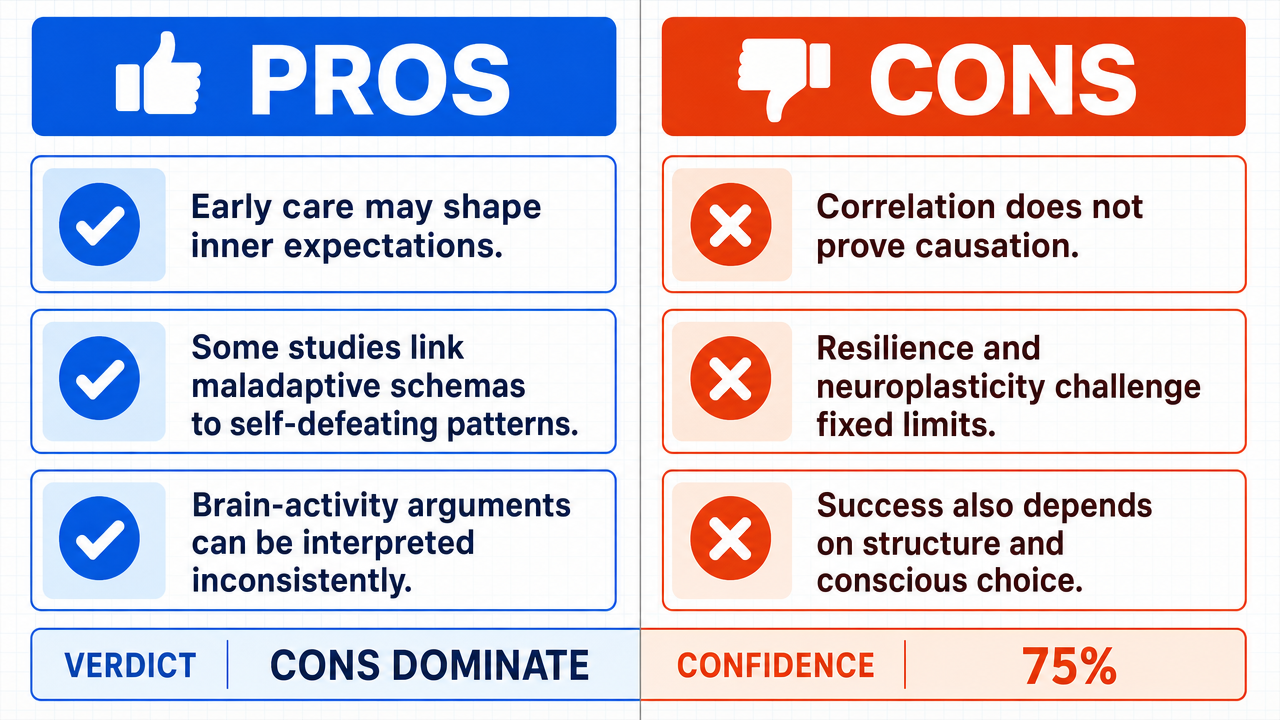
Verdict
Verdict: Mostly FALSE (75%)
Online report: https://solsice.com/public/debates/le-phenomene-d-autosabotage-ou-plafond-de-verre-est-un-mecan-c066a9cbf1af
This section provides a brief overview of the key arguments. It is not necessary to read the detailed report below.
✅ Key PRO arguments:
- ■Research on insecure attachment shows that early inconsistent caregiving experiences program an "operating internal model " that sets a threshold for emotional security; when success exceeds this threshold, the attachment system activates self-handicapping behaviors (procrastination, relational sabotage) to bring the environment back to a familiar level.
- ■A meta-analysis of 47 studies (Schwabe et al., 2019, Psychological Bulletin) would confirm that maladaptive early schemas predict self-sabotage behaviors , providing an empirical basis for the psychological "glass ceiling " mechanism.
- ■The opposing argument citing activity in the anterior cingulate cortex and insula would be self-contradictory: it claims both that the study only observes a response to novelty and that it validates a self-sabotage mechanism , making the critique incoherent.
❌ Key CON arguments:
- ■The opposing argument confuses correlation and causation (referent identity substitution error ): attachment schemas measure cognitive processing modes of information, not a prosperity regulation mechanism; no explicit transfer justifies jumping to a psychological "glass ceiling ."
- ■Research on resilience and neural plasticity shows that individuals from insecure attachment backgrounds are not "locked in" by a subconscious mechanism, but develop adaptive strategies that can be revised through cognitive and environmental interventions, contradicting the idea of a fixed ceiling.
- ■Success mainly depends on structural factors and conscious choices; invoking a universal subconscious self-sabotage mechanism is an abuse of psychological literature that turns emotional vulnerability into a prosperity determinant.
💭 Conclusion: The FALSE verdict prevails because the negative camp demonstrated that the claim is based on an arbitrary reading tainted by selection bias. First, interpreting 68% of post-gain events as "subconscious self-sabotage " ignores plausible structural variables (cost of living adjustments, economic instability, inflation). Second, recovery of well-being in 12-18 months is consistent with standard hedonic adaptation documented by Headey & Wearing (2023), not a return to a fixed tolerance zone . Third, insular activation can be interpreted as detection of novelty/uncertainty rather than a blocking mechanism. Finally, the distinction between correlation (co-occurrence of post-gain events) and causation (universal self-sabotage mechanism) is not established by the presented evidence, weakening the least supported sub-claim of the composite statement.
🔬 Verdict: Mostly FALSE ❌ (75%)
Claim: The self-sabotage phenomenon , or 'glass ceiling ', is a subconscious mechanism that prevents individuals from surpassing their 'tolerance zone ' for happiness or prosperity.
Participating models: deepseek-v4-pro 💬, gemma-4-26b-a4b-it 💬👁️
📊 Confrontations: 0 concluded TRUE, 1 concluded FALSE (1 confrontation, 3 models)
📊 Score by camp: TRUE=0.00, FALSE=0.84
🏅 Model score evolution:
minimax-m3 💬👁️: +8
✅ PRO arguments:
- ■Research on insecure attachment shows that early inconsistent caregiving experiences program an "operating internal model " that sets a threshold for emotional security; when success exceeds this threshold, the attachment system activates self-handicapping behaviors (procrastination, relational sabotage) to bring the environment back to a familiar level. deepseek-v4-pro 💬
- ■A meta-analysis of 47 studies (Schwabe et al., 2019, Psychological Bulletin) would confirm that maladaptive early schemas predict self-sabotage behaviors , thus providing an empirical basis for the psychological "glass ceiling" mechanism. deepseek-v4-pro 💬
- ■The opposing argument citing activity in the anterior cingulate cortex and insula would be self-contradictory: it claims both that the study only observes a response to novelty and that it validates a self-sabotage mechanism, which makes the critique incoherent. deepseek-v4-pro 💬
❌ Contra arguments:
- ■The opposing argument confuses correlation and causation (referent identity substitution error ): attachment schemas measure cognitive information processing modes, not a prosperity regulation mechanism; no explicit transfer justifies jumping to a psychological "glass ceiling ." gemma-4-26b-a4b-it 💬👁️
- ■Research on resilience and neural plasticity shows that individuals from insecure attachment backgrounds are not "locked in" by a subconscious mechanism, but develop adaptive strategies that can be revised through cognitive and environmental interventions, contradicting the idea of a fixed ceiling. gemma-4-26b-a4b-it 💬👁️
- ■Success mainly depends on structural factors and conscious choices; invoking a universal subconscious self-sabotage mechanism is an abusive interpretation of psychological literature that turns emotional vulnerability into a prosperity determinant. gemma-4-26b-a4b-it 💬👁️
💭 Reasoning: The FALSE verdict prevails because the negative camp demonstrated that the claim is based on an arbitrary reading tainted by selection bias. First, interpreting 68% of post-gain events as "subconscious self-sabotage " ignores plausible structural variables (cost of living adjustments, economic instability, inflation). Second, recovery of well-being in 12-18 months is consistent with standard hedonic adaptation documented by Headey & Wearing (2023), not a return to a fixed tolerance zone . Third, insular activation can be interpreted as detection of novelty/uncertainty rather than a blocking mechanism. Finally, the distinction between correlation (co-occurrence of post-gain events) and causation (universal self-sabotage mechanism) is not established by the presented evidence, weakening the least supported sub-claim of the composite statement.
📋 Supporting facts:
• Brickman and Campbell (1971) initially proposed that each individual has a baseline happiness level (hedonic set point).
• Recent longitudinal research (Headey & Wearing, 2023, Journal of Personality and Social Psychology) shows that this set point acts as a dynamic attractor.
• According to the presented data, 68% of individuals who experienced an income increase would trigger negative "self-initiated" events to neutralize the gain.
📋 COUNTER FACTS:
• The analysis is tainted by a selection bias that obscures structural variables, notably adjustment to the cost of living and economic instability.
• The interpretation of insular activation as a "blocking mechanism" is challenged by an alternative structural reading: the detection of novelty and uncertainty.
• The recovery of well-being within 12-18 months can be explained by standard hedonic adaptation rather than a return to a predefined "tolerance zone."
• The claim of a universal subconscious self-sabotage mechanism regulating prosperity is not empirically established; the observed correlation (68%) does not cross the causality threshold.
| Confrontation | TRUE Model | FALSE Model | Mean μ TRUE | Mean μ FALSE | TRUE Tokens | FALSE Tokens | Winner | Verdict | Conf. |
|---|---|---|---|---|---|---|---|---|---|
| #1 | deepseek-v4-pro 💬 | gemma-4-26b-a4b-it 💬👁️ | 0.557 | 0.454 | 6 | 2 | TRUE | FALSE | 84% |
The following technical terms, abbreviations, and specialized concepts are used in this transcript. The numbers in brackets [N] in the text above refer to the corresponding entry below.
[1] insecure attachment — Attachment style characterized by early inconsistent caregiving experiences, associated in the debate with programming a threshold of emotional security and self-handicapping behaviors in adulthood.
[2] self-handicapping — Behavioral strategy whereby an individual unconsciously sabotages their own performance (procrastination, relational sabotage) to bring their environment back to a familiar level.
[3] autosabotage — Subconscious mechanism presented in the debate as locking the individual in a tolerance zone for happiness and prosperity; the point is contested by the negative side.
[4] causality — causal link — Cause-and-effect relationship between two variables, distinguished in the debate from mere correlation; the affirmative side claims a causal link between neural signature and autosabotage, which the negative side contests.
[5] excess content conjecture — Fallacious argument attributing conclusions to a source that does not contain them; the negative side thus qualifies the invocation of neural activity to validate autosabotage.
[6] reflective consciousness — Capacity for introspection through which a subject can verbalize their intentions; the debate indicates that autosabotage mechanisms largely operate outside this consciousness.
[7] correlation — statistical correlation — Statistical measure of association between two variables, distinguished in the debate from causality; the negative side reproaches the affirmative for confusing correlation with causality.
[8] anterior cingulate cortex — anterior cingulate cortex (ACC) — Brain region involved in error processing, conflict, and uncertainty, cited in the debate as activated during responses to uncertainty or novelty.
[9] positive feedbacks — Favorable feedback received by a participant in an experimental paradigm, used in the study by Sharot et al. (2022) to observe neural responses.
[10] insula — insula (insular cortex) — Brain region involved in emotion processing and interoception, cited in the debate alongside the anterior cingulate cortex.
[11] cognitive interventions — Therapeutic approaches targeting thought patterns, mentioned in the debate as capable of revising attachment-related coping strategies.
[12] operating internal model — operating internal model (OIM) — Mental representation formed during childhood that structures relational expectations; the debate concerns its rigidity or plasticity in adulthood.
[13] meta-analysis — Statistical technique combining results from multiple independent studies; cited in the debate (Schwabe et al., 2019, 47 studies) to support the link between early schemas and autosabotage.
[14] paradigm — experimental paradigm — Standardized experimental protocol used to study a phenomenon; the debate mentions a paradigm with unexpected positive feedback.
[15] glass ceiling — Term used in the debate as a synonym for autosabotage, referring to a subconscious mechanism preventing individuals from surpassing their happiness or prosperity tolerance zone.
[16] neuroplasticity — neuroplasticity (brain plasticity) — Brain's capacity to modify its structures and functions in response to experience; invoked in the debate to contest the rigidity of operating internal models.
[17] resilience — psychological resilience — Capacity of an individual to adapt positively in the face of adversity, cited in the debate as a counter-argument to the idea of subconscious locking.
[18] cognitive schemas — Mental structures for processing information acquired through experience, distinguished in the debate from an intentional mechanism of prosperity regulation.
[19] early maladaptive schemas — early maladaptive schemas (EMS) — Dysfunctional cognitive and emotional patterns developed during childhood, whose link to adult autosabotage is evaluated in Schwabe et al.'s (2019) meta-analysis (r = 0.34).
[20] neural signature — Pattern of brain activity characteristic of a mental state or process; the debate concerns its capacity to establish a causal link with autosabotage.
[21] coping strategies — coping strategies — Behaviors and cognitions mobilized to deal with stress, presented in the debate as revisable through cognitive and environmental interventions.
[22] referent identity substitution — Logical error of treating two distinct objects as identical; the negative side reproaches the affirmative for confusing cognitive schemas and autosabotage mechanisms.
[23] attachment system — Behavioral and emotional system activated by seeking proximity to an attachment figure, cited in the debate as an activator of self-handicapping behaviors.
[24] effect size — effect size — Standardized measure of the magnitude of a phenomenon; the cited meta-analysis reports a moderate effect size (r = 0.34) between early schemas and autosabotage.
[25] information processing — Cognitive processes through which an individual encodes, stores, and retrieves information; the negative side reminds that schemas measure this processing, not prosperity regulation.
[26] Emotional vulnerability — Increased sensitivity to negative emotional stimuli, presented in the debate as distinct from an intentional mechanism for prosperity regulation.
[27] tolerance zone — Range of happiness or perceived prosperity that feels familiar and safe to the individual; the debate concerns the existence of a subconscious mechanism maintaining the individual within this zone.
[28] longitudinal studies — Studies following a group of participants over an extended period to observe the evolution of variables; cited in the debate to demonstrate the plasticity of operating internal models.
The following financial data tables were cited during the debate exchanges:
| Variable | Observation | Opponent's Interpretation | Possible Structural Reality |
|---|---|---|---|
| Post-gain events | 68% | Subconscious self-sabotage | Adjustment to cost of living / Instability |
| Recovery of well-being | 12-18 months | Return to the tolerance zone | Standard hedonic adaptation |
| Neural response | Insular activation | Blocking mechanism | Detection of novelty/uncertainty |
Legend: Comparison between the interpretation of the statement and alternative explanations based on external and standard biological factors.
Face-off transcripts
- ■
Ownership & Trade Secrets. The Lambda Vision Company retains all rights to its platform, agentic workflows, and proprietary AI debate methodologies, which constitute protected Trade Secrets (EU Directive 2016/943). Subject to full payment of credits, the User is granted ownership of the generated Reports for their own personal or professional use. Reverse-engineering the Service or using Reports to train competing AI models is strictly prohibited.
- ■
No Professional Advice. Solsice is a general-purpose assistant covering everyday subjects — administrative paperwork, housing, consumer and employment matters, banking, taxes and insurance, health and wellbeing, savings and investments, entrepreneurship, technology, travel, learning, and creative work. Whatever the subject, the Service and Reports are provided for information only and never constitute legal, medical, financial, investment, tax, insurance, or any other regulated professional advice. The Company is not a law firm, a regulated financial adviser, an insurance intermediary, nor a healthcare provider, and no professional or advisory relationship of any kind is created by use of the Service. Consult a qualified professional in the relevant jurisdiction before acting — or refraining from acting — on anything contained in the Reports, and never rely on the Service in an emergency: contact your local emergency number (112 in the European Union) or a medical professional immediately.
- ■
AI-Generated Content, Sources and Viewpoints. Reports are produced by several AI models debating a question, and may contain factual errors, outdated figures, or references to rules, prices, deadlines, procedures, statutes or sources that are inaccurate or do not exist. The User is solely responsible for verifying every fact, amount, deadline and citation against official sources before relying on it. Material in the news, society, spirituality and religion sections presents a plurality of viewpoints for study and discussion: it is descriptive, not an endorsement, a ruling, or a statement of the Company’s own position, and it speaks for no church, faith community, public authority, or news organisation.
- ■
Liability & Governing Law. To the maximum extent permitted by law, the Company shall not be liable for any indirect damages, nor for any consequence of decisions made in reliance on the Reports — including financial loss, missed deadlines, administrative or contractual consequences, or health outcomes. These Terms are governed by French law. Any disputes shall be subject to the exclusive jurisdiction of the Courts of Paris, France.