
Le nombre de bises pratiqué en France varie uniquement en fonction des régions et non des familles ou des individus.
AI debate verdict and arguments
⚠️ AI-generated information only; not professional advice
Completed October 26, 2026
Verdict
Verdict: Mostly FALSE (92%)
Online report: https://solsice.com/public/debates/le-nombre-de-bises-pratique-en-france-varie-uniquement-en-fo-fa19730e0262
This section provides a brief overview of the key arguments. It is not necessary to read the detailed report below.
✅ Key FOR arguments:
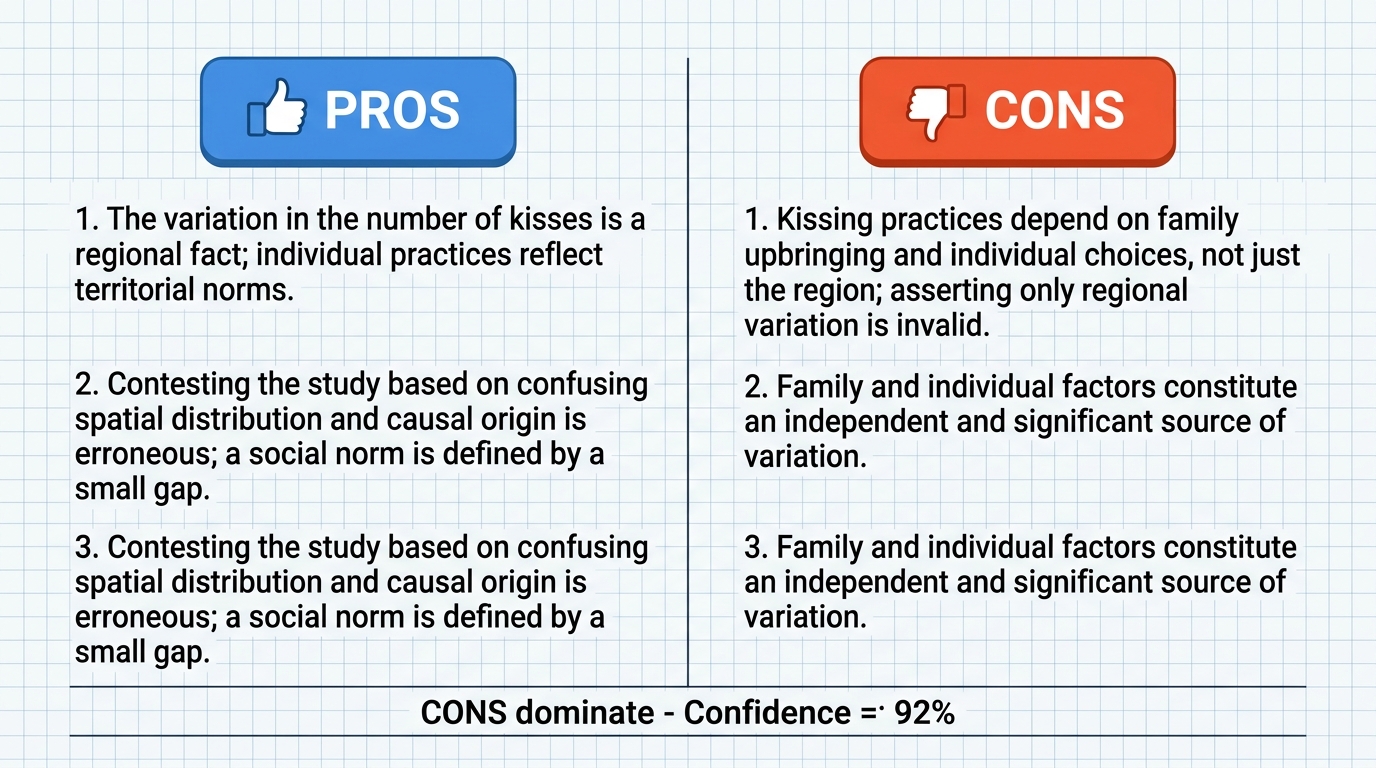
- ■The variation in the number of kisses in France is a regional fact: family and individual practices are merely reflections of territorial norms. Dominique Picard's study (PUF, 2007), based on a national survey , reveals a clear partition : two kisses in the West and North, three in the Center and South-West, four across a broad zone.
- ■Challenging Picard's study by invoking confusion between spatial distribution and causal origin is mistaken: a social norm is defined by a low variation in individual behaviors around it. The study measures the strength of the norm by the degree of consensus within the population, establishing its regional character.
❌ Key AGAINST arguments:
- ■Bise practices depend on family upbringing and individual choices, not solely on the region. Claiming an 'only' regional variation confuses statistical trend and exclusive causality : family structures transmit norms that can diverge from territorial averages , such as a family preferring a greeting or a handshake in a region where kisses dominate.
- ■Family and individual factors constitute an independent and significant source of variation. For the exclusive regional thesis to be valid, this second branch should be null or fully absorbed by the regional norm, which the examination of practices refutes.
💭 Conclusion: False, the claim that the number of kisses varies solely according to regions is contradicted by the opposing arguments. They demonstrate that family and individual practices are an independent source of variation, not merely a reflection of territorial norms. The pro argument only proves the existence of regional trends, not the exclusive causal role of the region. The distinction between statistical trend and exclusive causality is central: a family can deviate from the regional norm without losing its identity. The judge therefore concluded in favor of the negative with 92% confidence, invalidating the thesis of purely regional variation.
🔬 Verdict: Mostly FALSE ❌ (92%)
Claim: The number of kisses practiced in France varies only according to regions and not families or individuals.
Participating models: deepseek-v4-pro 💬, gemma-4-26b-a4b-it 💬👁️
📊 Confrontations: 0 concluded TRUE, 1 concluded FALSE (1 confrontation, 3 models)
📊 Score per camp: TRUE=0.00, FALSE=0.92
🏅 Model score evolution:
deepseek-v4-flash-0731 💬: +9
✅ FOR arguments:
- ■The variation in the number of kisses in France is a regional fact: family and individual practices are merely reflections of territorial norms. Dominique Picard's study (PUF, 2007), based on a national survey , reveals a clear partition : two kisses in the West and North, three in the Center and South-West, four across a broad zone. deepseek-v4-pro 💬
- ■Challenging Picard's study by invoking confusion between spatial distribution and causal origin is mistaken: a social norm is defined by a low variation in individual behaviors around it. The study measures the strength of the norm by the degree of consensus within the population, establishing its regional character. deepseek-v4-pro 💬
❌ Arguments AGAINST:
- ■Bise practices depend on family upbringing and individual choices, not only on the region. Claiming an 'only' regional variation confuses statistical trend and exclusive causality : family structures transmit norms that can diverge from territorial averages , such as a family preferring a greeting or a handshake in a region where kisses dominate. gemma-4-26b-a4b-it 💬👁️
- ■Family and individual factors are an independent and significant source of variation. For the exclusive regional thesis to be valid, this second branch should be null or fully absorbed by the regional norm, which the examination of practices refutes. gemma-4-26b-a4b-it 💬👁️
💭 Reasoning: False, the claim that the number of kisses varies only according to regions is contradicted by the opposing arguments. They demonstrate that family and individual practices are an independent source of variation, not merely a reflection of territorial norms. The pro argument only proves the existence of regional trends, not the exclusive causal role of the region. The distinction between statistical trend and exclusive causality is central: a family can deviate from the regional norm without losing its identity. The judge therefore concluded in favor of the negative with 92% confidence, invalidating the thesis of purely regional variation.
📋 Facts FOR:
• Dominique Picard's study (PUF, 2007) is based on a national survey of several thousand respondents .
• The mapping of kisses distinguishes two kisses in the West and North (Brittany, Pays de la Loire, Normandy), three in the Center and South-West, and four across a broad zone.
📋 Facts AGAINST:
• Family structures act as transmission units of norms that can diverge from territorial averages.
• A family may practice a more formal politeness (greeting or handshake) within a region where kisses are the norm.
• Family and individual factors are independent and significant sources of variation.
| Confrontation | TRUE Model | FALSE Model | Average μ TRUE | Average μ FALSE | TRUE Tokens | FALSE Tokens | Winner | Verdict | Confidence |
|---|---|---|---|---|---|---|---|---|---|
| #1 | deepseek-v4-pro 💬 | gemma-4-26b-a4b-it 💬👁️ | 0.307 | 0.354 | 6 | 2 | FALSE | FALSE | 92% |
The following technical terms, abbreviations, and specialized concepts are used in this transcript. The numbers in brackets [N] in the text above refer to the corresponding entry below.
[1] Statistical anomaly — Observation that significantly deviates from what a model or distribution predicts, presented here as a simple exception rather than a structural source of variation.
[2] Social attractor — Concept that a regional norm exerts an attractive force on individual and family behaviors, bringing them back to the dominant practice.
[3] Normative autonomy — Ability of an individual or family to maintain their own rules of conduct, independently of dominant territorial norms.
[4] Methodological substitution bias — Reasoning error involving replacing one question (causal origin) with another (spatial distribution) to wrongly conclude an exclusive causality.
[5] Kisses — Greeting practice involving placing one or more kisses on the cheek; the number of kisses is debated regarding its regional, familial, or individual determinism.
[6] Mapping — Spatial representation of a phenomenon, here the geographic distribution of the number of kisses in France.
[7] Exclusive causality — Single cause-and-effect relationship, here the assertion that only the region determines the number of kisses, without influence from families or individuals.
[8] Transmission cells — Social groups, notably families, that transmit norms and practices from one generation to the next.
[9] Restricted social circles — Small groups, such as family or close friends, within which specific greeting rites may be maintained.
[10] Identity choice — Deliberate decision to adopt a practice, such as a number of kisses, to assert belonging or difference.
[11] Spatial coherence — Geographical regularity of a phenomenon, suggesting that variation is not random but organized by regional boundaries.
[12] Individual behaviors — Actions and practices specific to each person, with variance around a norm measured to assess its strength.
[13] Autonomous causal component — Family or individual factor that produces its own effects on variation, without being determined by the regional norm.
[14] Consensus — Population agreement on a practice; the degree of consensus measures the strength of a social norm.
[15] Degree of consensus — Level of agreement within a population on a norm, used to evaluate its strength.
[16] Spatial distribution — How a phenomenon is spread across the geographic space.
[17] Large-scale survey — Statistical study conducted on a very large sample of the population.
[18] Stable regional boundaries — Persistent geographic limits that delineate zones where the same norm applies.
[19] Lineage heritage — Transmission of practices and norms within a family over multiple generations.
[20] Intra-regional heterogeneity — Variety of behaviors within the same region; its absence is used to support the existence of a strong regional norm.
[21] Lineage — Family descent line, considered as a vector for transmitting greeting rites.
[22] Micro-sociology — Branch of sociology studying interactions and norms at the small group level, such as families and individuals.
[23] Territorial averages — Average statistical values calculated for each region, which family practices can be compared to.
[24] Social norm — Shared rule of conduct within a group, whose strength is measured by the degree of consensus and low variance of individual behaviors.
[25] Partition — Division of a territory into distinct zones, here according to the practiced number of kisses.
[26] Variation pockets — Localized zones where family or individual practices diverge from the dominant regional norm.
[27] Handshake — Alternative greeting gesture to kisses, mentioned as a possible family practice.
[28] Greeting rites — Codified greeting practices (kisses, handshake, salute) transmitted within groups.
[29] Respondents — People who answered a survey or questionnaire.
[30] Salute — Non-physical greeting form, mentioned as an alternative to kisses.
[31] Primary socialization — Process of learning norms and values within the family during childhood, cited as a source of variation in greeting practices.
[32] National survey — Questionnaire-based study conducted on a representative sample of a country's population.
[33] Compliance rate — Percentage of people following the regional norm; the transcript mentions a rate above 85% among respondents.
[34] Statistical trend — Observable regularity in data, not necessarily implying an exclusive causal relationship.
[35] Cultural transmission — Process by which practices, norms, and values are passed between generations or groups.
[36] Unit of cultural transmission — Group, such as the family, considered as a vector for transmitting cultural practices.
[37] Individual/family variables — Characteristics specific to persons or families that may influence the practice of the number of kisses.
[38] Variance — Statistical measure of dispersion of values around a mean; low variance is used to establish the strength of a social norm.
[39] Marginal differences — Slight differences between individual behaviors and the norm, considered non-significant.
[40] National scale — Level of analysis covering the entire country, here France.
The following financial data tables were cited during the debate exchanges:
| Region | Number of standard kisses |
|---|---|
| Brittany, Pays de la Loire | 2 |
| Île-de-France, Normandy, Grand Est | 2 or 4 |
| Nouvelle-Aquitaine, Occitanie, Auvergne-Rhône-Alpes | 3 |
| Provence-Alpes-Côte d'Azur, Hauts-de-France | 3 or 4 |
Legend: Number of standard kisses per major regional zone according to Dominique Picard's survey (2007). Local variations exist but remain within these regional ranges.
Face-off transcripts
- ■
Ownership & Trade Secrets. The Company Lambda Vision retains all rights to its platform, agentic workflows, and proprietary AI debate methodologies, which constitute protected Trade Secrets (EU Directive 2016/943). Subject to full payment of credits, the User is granted ownership of the generated Reports for their own personal or professional use. Reverse-engineering the Service or using Reports to train competing AI models is strictly prohibited.
- ■
No Professional Advice. Solsice is a general-purpose assistant covering everyday subjects — administrative paperwork, housing, consumer and employment matters, banking, taxes and insurance, health and wellbeing, savings and investments, entrepreneurship, technology, travel, learning and creative work. Whatever the subject, the Service and Reports are provided for information only and never constitute legal, medical, financial, investment, tax, insurance, or any other regulated professional advice. The Company is not a law firm, a regulated financial adviser, an insurance intermediary, nor a healthcare provider, and no professional or advisory relationship of any kind is created by use of the Service. Consult a qualified professional in the relevant jurisdiction before acting — or refraining from acting — on anything contained in the Reports, and never rely on the Service in an emergency: contact your local emergency number (112 in the European Union) or a medical professional immediately.
- ■
AI-Generated Content, Sources and Viewpoints. Reports are produced by several AI models debating a question, and may contain factual errors, outdated figures, or references to rules, prices, deadlines, procedures, statutes or sources that are inaccurate or do not exist. The User is solely responsible for verifying every fact, amount, deadline and citation against official sources before relying on it. Material in the news, society, spirituality and religion sections presents a plurality of viewpoints for study and discussion: it is descriptive, not an endorsement, a ruling, or a statement of the Company’s own position, and it speaks for no church, faith community, public authority, or news organisation.
- ■
Liability & Governing Law. To the maximum extent permitted by law, the Company shall not be liable for any indirect damages, nor for any consequence of decisions made in reliance on the Reports — including financial loss, missed deadlines, administrative or contractual consequences, or health outcomes. These Terms are governed by French law. Any disputes shall be subject to the exclusive jurisdiction of the Courts of Paris, France.