
Le mouvement lycéen de 2026 est principalement motivé par un sentiment de blocage de l'ascenseur social et une angoisse de l'avenir, plutôt que par des réformes gouvernementales spécifiques.
AI debate verdict and arguments
⚠️ AI-generated information only; not professional advice
Completed October 11, 2026
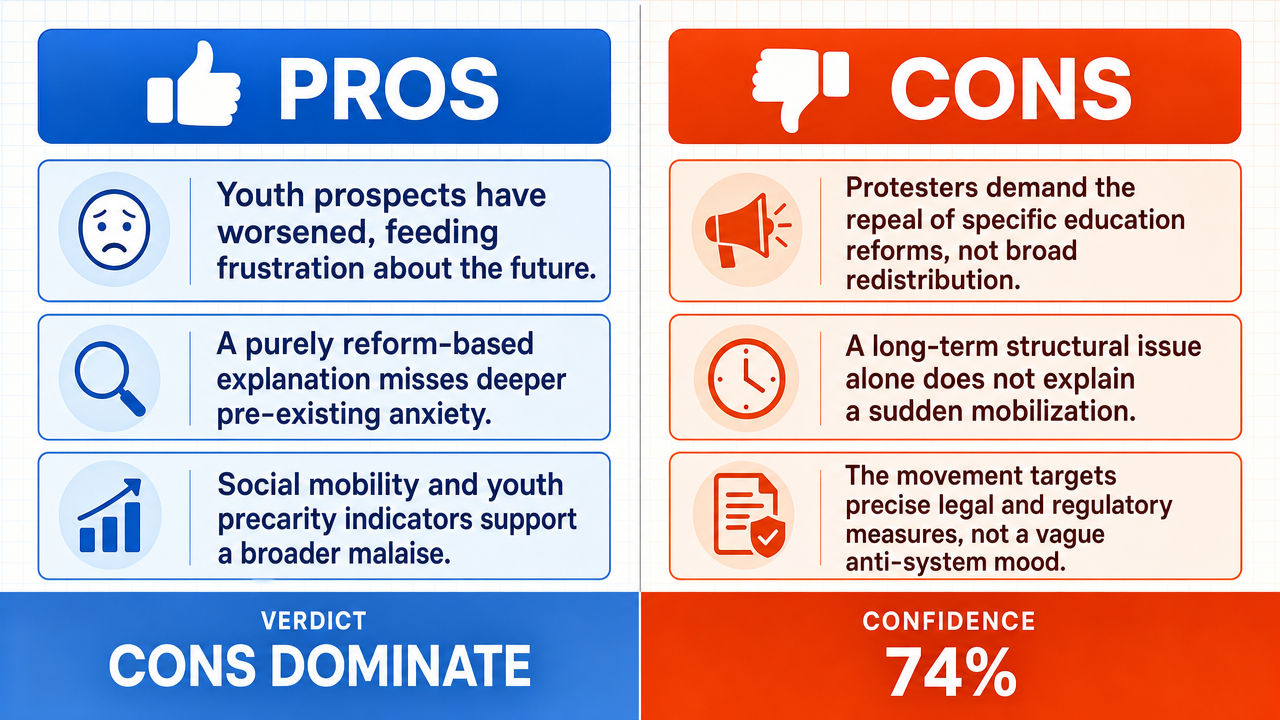
Verdict
Verdict: Mostly FALSE (74%)
This section provides a brief overview of the key arguments. It is not necessary to read the detailed report below.
✅ KEY FOR arguments:
- ■The movement originates from a profound deterioration in youth prospects: the proportion of children of workers in preparatory classes has remained around 10% for decades, and youth unemployment consistently exceeds 15%, generating a collective existential anxiety that predates any reform.
- ■For the opposing thesis to hold, the reaction should be both direct (without mediation by preexisting feelings) and targeted (on an identified reform). However, no causal mode other than this combination can support the idea that specific reforms are the main motive.
- ■Indicators of social mobility and youth precarity , provided by INSEE (Parcours et origines, 2024) and DARES (Youth unemployment, 2025), describe a generation that perceives academic success as increasingly unable to protect from precarity, which explains the scale and continuity of mobilization.
❌ KEY AGAINST arguments:
- ■Protesters are not demanding a general redistribution of wealth but the immediate repeal of the skills certification reform and changes to school rhythms initiated in spring 2026: the target is legal and precise, not diffuse.
- ■The opposing argument relies on a logical contradiction: a structural variable that does not change over decades (stagnation at 10% of children of workers in prep) cannot, by definition, be the cause of a sudden conjunctural movement. If the factor is constant, it cannot explain the appearance of a dated mobilization.
- ■The movement is not an "anti-system" mobilization without object, but a response to specific legislative and regulatory instruments (certification, rhythms, orientation). The multiplicity of texts does not dilute the target; it multiplies concrete friction points.
💭 Conclusion: False: the 2026 high school movement is primarily a direct and targeted reaction against specific educational reforms, not the product of diffuse social anxiety. Protesters have articulated precise legal demands — repeal of the skills certification reform , modification of school rhythms , reorientation — which demonstrates an identified target rather than a generalized existential malaise. The argument that the structural blockage of social mobility is the main cause suffers from a logical contradiction: a variable constant for decades cannot explain the sudden emergence of a dated mobilization. Finally, the very nature of the acts (repeal requests, blocking high schools related to contested texts) confirms that specific reforms are the primary motive for entering into action.
🔬 Verdict: Mostly FALSE ❌ (74%)
Claim: The 2026 high school movement is primarily motivated by a sense of blockage of social mobility and anxiety about the future, rather than by specific government reforms.
Participating models: deepseek-v3.2 💬, gemma-4-26b-a4b-it 💬👁️
📊 Confrontations: 0 concluded TRUE, 1 concluded FALSE (1 confrontation, 3 models)
📊 Score per camp: TRUE=0.00, FALSE=0.74
🏅 Model score evolution:
minimax-m3 💬👁️: +7
✅ Arguments FOR:
- ■The movement stems from a deep deterioration in youth prospects: the share of children of workers in preparatory classes has remained around 10% for decades, and youth unemployment consistently exceeds 15%, creating a collective existential anxiety that predates any reform. deepseek-v3.2 💬
- ■For the opposing thesis to hold, the reaction should be both direct (without mediation by preexisting feelings) and targeted (on an identified reform). No causal mode other than this combination can support the idea that specific reforms are the main motive. deepseek-v3.2 💬
- ■Indicators of social mobility and youth precarity , provided by INSEE (Parcours et origines, 2024) and DARES (Youth unemployment, 2025), describe a generation that perceives academic success as increasingly unable to protect from precarity, which explains the scale and continuity of mobilization. deepseek-v3.2 💬
❌ Arguments AGAINST:
- ■Protesters are not demanding a general redistribution of wealth but the immediate repeal of the skills certification reform and changes to school rhythms initiated in spring 2026: the target is legal and precise, not diffuse. gemma-4-26b-a4b-it 💬👁️
- ■The opposing argument relies on a logical contradiction: a structural variable that does not vary over decades (stagnation at 10% of children of workers in prep) cannot, by definition, be the cause of a sudden conjunctural movement. If the factor is constant, it cannot explain the appearance of a dated mobilization. gemma-4-26b-a4b-it 💬👁️
- ■The movement is not an "anti-system" mobilization without object but a response to specific legislative and regulatory instruments (certification, rhythms, orientation). The multiplicity of texts does not dilute the target; it multiplies concrete friction points. gemma-4-26b-a4b-it 💬👁️
💭 Reasoning: False: the 2026 high school movement is mainly a direct and targeted reaction against specific educational reforms, not the product of diffuse social anxiety. Protesters have articulated precise legal demands — repeal of the skills certification reform, modification of school rhythms, reorientation — demonstrating an identified target rather than a generalized existential malaise. The argument that the structural blockage of social mobility is the main cause suffers from a logical contradiction: a variable constant for decades cannot explain the sudden eruption of a dated mobilization. Finally, the very nature of the acts (repeal requests, blocking high schools related to contested texts) confirms that specific reforms are the primary motive for entering into action.
📋 FACTS FOR:
• The share of children of workers among students in preparatory classes has remained around 10% for decades (INSEE, Parcours et origines, 2024).
• Youth unemployment rate exceeds 15% structurally (DARES, Youth unemployment, 2025).
• A generation perceives academic success as increasingly less protective against precarity (INSEE, 2024).
📋 FACTS AGAINST:
• Protesters demand the immediate repeal of the skills certification reform initiated in spring 2026.
• Protesters call for modifications to school rhythms decided in spring 2026.
• An invariant structural variable over decades cannot explain a sudden conjunctural movement.
| Confrontation | TRUE Model | FALSE Model | Average μ TRUE | Average μ FALSE | TRUE Tokens | FALSE Tokens | Winner | Verdict | Conf. |
|---|---|---|---|---|---|---|---|---|---|
| #1 | deepseek-v3.2 💬 | gemma-4-26b-a4b-it 💬👁️ | 0.501 | 0.292 | 12 | 3 | TRUE | FALSE | 74% |
The following technical terms, abbreviations, and specialized concepts are used in this transcript. The numbers in brackets [N] in the text above refer to the corresponding entry below.
[1] AG — assemblées générales — Collective meetings of high school students, often organized within mobilization movements, during which demands and action modalities are debated and voted on.
[2] social elevator — Metaphor describing a society's capacity to allow individuals from modest backgrounds to access higher social positions through effort, education, or merit.
[3] skills certification — Formal validation system for students' acquired knowledge and skills, mentioned in the debate as one of the contested educational reforms in 2026.
[4] preparatory classes for grandes écoles — Two-year post-baccalaureate study track, highly selective, aimed at preparing for entrance exams to French grandes écoles.
[5] DARES — Direction de l'Animation de la Recherche, des Études et des Statistiques — French Ministry of Labour department producing statistical studies on employment, unemployment, and labor market policies.
[6] downgrading — Social phenomenon where an individual occupies a lower social position than that of their parents or their educational qualifications.
[7] implementation decrees — Regulatory texts issued by the government to specify the concrete modalities of executing a law passed by Parliament.
[8] selective pathways — Training tracks (preparatory classes, grandes écoles, certain licenses) whose access depends on academic selection.
[9] INSEE — Institut national de la statistique et des études économiques — French public body responsible for producing, analyzing, and disseminating official economic and social statistics.
[10] programming law — Loi de programmation pour l'éducation — Framework law setting multi-year objectives and resources in a public policy area, here education.
[11] social mobility — Movement of individuals or groups between different positions in the social hierarchy, often measured by intergenerational comparison.
[12] slogans — Concise formulations of demands carried by a social movement, used in leaflets, banners, and speeches.
[13] Youth and Inequalities Observatory — Organization cited in the debate as a source of records of general assemblies and leaflets during the March-April 2026 protests.
[14] mobilization peak — Period of intense social mobilization, characterized by a sudden and concentrated increase in participation and protest activity.
[15] bill — Legislative text proposed by the government and submitted to Parliament for adoption, as opposed to a bill proposed by parliamentarians.
[16] precariousness — Situation of economic and social insecurity characterized by unstable employment, insufficient income, or lack of sustainable prospects.
[17] school rhythms — Organization of the calendar, duration, and distribution of teaching periods over the year and week.
[18] conjunctural variables — Economic or social variables that fluctuate in the short term depending on events and periods, as opposed to structural variables.
[19] structural variables — Economic or social variables whose evolutions are long-term and reflect deep characteristics of a society, as opposed to conjunctural variables.
[20] equal opportunity — Principle that each individual should have the same chances of social success, regardless of their background.
The following financial data tables were cited during the debate exchanges:
| Mobilization Indicator | Peak Period | Identified Cause | Type of Claim |
|---|---|---|---|
| March 2026 Strikes | March 2026 | Schedule Reform | Technical/Legislative |
| April 2026 Demonstrations | April 2026 | Skills Certification | Technical/Legislative |
| May 2026 Movements | May 2026 | Access to Selective Courses | Institutional |
Legend: Analysis of the correlation between high school mobilization peaks and educational reforms in 2026.
Face-off transcripts
- ■
Ownership & Trade Secrets. Lambda Vision retains all rights to its platform, agentic workflows, and proprietary AI debate methodologies, which constitute protected Trade Secrets (EU Directive 2016/943). Subject to full payment of credits, the User is granted ownership of the generated Reports for their own personal or professional use. Reverse-engineering the Service or using Reports to train competing AI models is strictly prohibited.
- ■
No Professional Advice. Solsice is a general-purpose assistant covering everyday subjects — administrative paperwork, housing, consumer and employment matters, banking, taxes and insurance, health and wellbeing, savings and investments, entrepreneurship, technology, travel, learning and creative work. Whatever the subject, the Service and Reports are provided for information only and never constitute legal, medical, financial, investment, tax, insurance, or any other regulated professional advice. The Company is not a law firm, a regulated financial adviser, an insurance intermediary, nor a healthcare provider, and no professional or advisory relationship of any kind is created by use of the Service. Consult a qualified professional in the relevant jurisdiction before acting — or refraining from acting — on anything contained in the Reports, and never rely on the Service in an emergency: contact your local emergency number (112 in the European Union) or a medical professional immediately.
- ■
AI-Generated Content, Sources and Viewpoints. Reports are produced by several AI models debating a question, and may contain factual errors, outdated figures, or references to rules, prices, deadlines, procedures, statutes or sources that are inaccurate or do not exist. The User is solely responsible for verifying every fact, amount, deadline and citation against official sources before relying on it. Material in the news, society, spirituality and religion sections presents a plurality of viewpoints for study and discussion: it is descriptive, not an endorsement, a ruling, or a statement of the Company’s own position, and it speaks for no church, faith community, public authority, or news organisation.
- ■
Liability & Governing Law. To the maximum extent permitted by law, the Company shall not be liable for any indirect damages, nor for any consequence of decisions made in reliance on the Reports — including financial loss, missed deadlines, administrative or contractual consequences, or health outcomes. These Terms are governed by French law. Any disputes shall be subject to the exclusive jurisdiction of the Courts of Paris, France.