
Le monopole des agents de change au sein du 'temple' financier français pendant deux siècles a principalement servi à protéger les intérêts d'un petit nombre plutôt qu'à assurer la stabilité ou l'équité du marché.
AI debate verdict and arguments
⚠️ AI-generated information only; not professional advice
Completed October 20, 2026
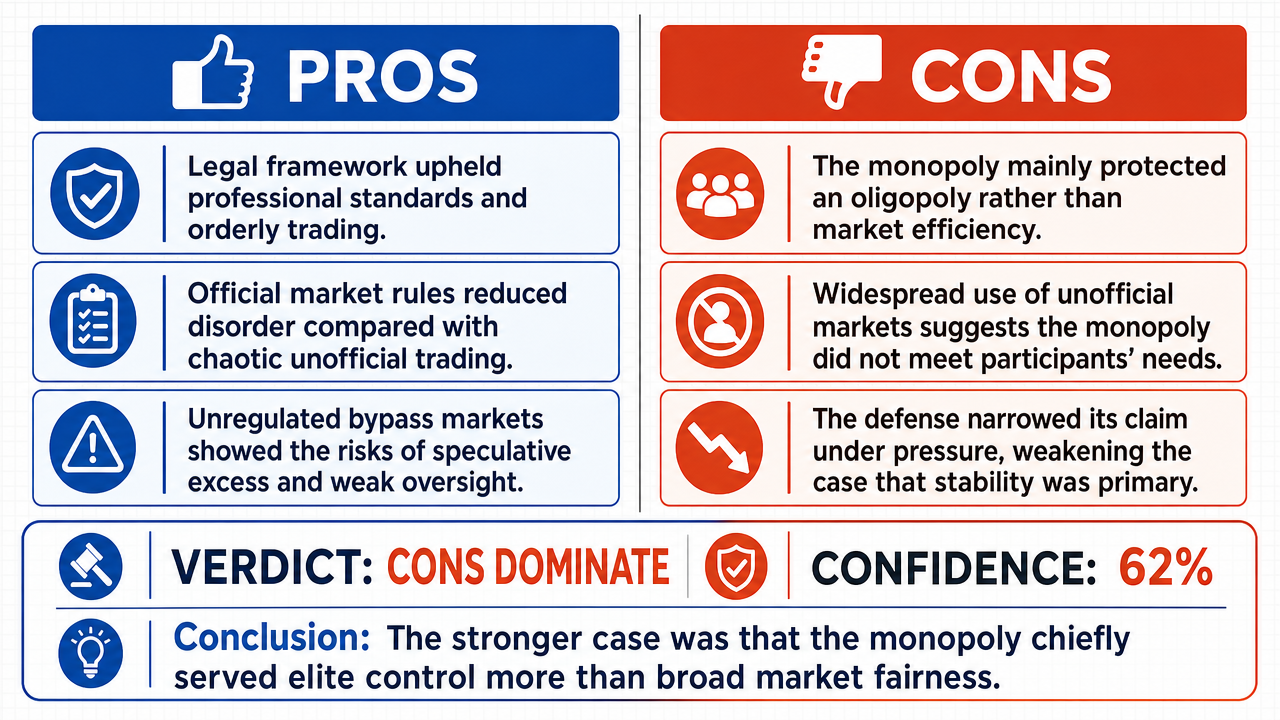
Verdict
Verdict: likely FALSE (62%)
Web Report: https://solsice.com/public/debates/le-monopole-des-agents-de-change-au-sein-du-temple-financier-84b8b7303a1d
This section provides a brief overview of the key arguments. You do not need to read the full detailed report below.
✅ Key PRO arguments:
- ■The agents de change monopoly operated as a legally enforced framework that maintained high professional standards and ensured orderly trading , with fixed commissions and restricted entry protecting investors from unqualified intermediaries .
- ■The parallel unofficial Coulisse market was itself a source of systemic instability —a chaotic venue plagued by speculative excess , fraud, and repeated crises that the official monopoly was specifically designed to contain.
- ■The emergence of the Coulisse demonstrates the risks of unregulated trading ; the official monopoly offered a safe haven, and its bypassing often led to speculative excesses that justified the regulated framework.
❌ Key ANTI arguments:
- ■The monopoly functioned as a rent-seeking mechanism that prioritized oligopolistic control over market efficiency , with the affirmative's own summary contradicting the claim they were assigned to defend.
- ■If the monopoly truly provided a stable, functional, and safe haven, it would not have been bypassed by the overwhelming majority of market participants who migrated to the Coulisse , which handled the vast majority of French securities transactions by the late nineteenth century.
- ■The affirmative's position suffered from a 'glissement de quantificateur ,' narrowing the thesis under pressure to argue that the monopoly 'primarily protected market stability ,' which is a softened version of the original claim and represents a concession rather than a defense.
💭 Conclusion: False. The debate verdict indicates that the assertion is incorrect—the agents de change monopoly did not primarily serve to protect a small group's interests at the expense of stability and fairness. The winning side successfully argued that the monopoly functioned as a rent-seeking mechanism prioritizing oligopolistic control, and that the coexistence of a 'stable' official monopoly with a dominant Coulisse handling the vast majority of French securities transactions by the late nineteenth century undermines any claim that the official market was the primary functional venue. The affirmative's defense of stability and fairness was weakened by logical inconsistencies and the observation that market participants overwhelmingly bypassed the official structure. The judge's confidence of 62% reflects moderate certainty, as the single debate with 100% tournament confidence indicates unanimous agreement among judges on the outcome despite the relatively narrow margin.
🔬 DeepResearch Result: likely FALSE ❌ (62%)
Assertion: Le monopole des agents de change au sein du 'temple' financier français pendant deux siècles a principalement servi à protéger les intérêts d'un petit nombre plutôt qu'à assurer la stabilité ou l'équité du marché.
Participating models: deepseek-v4-pro 💬, gemma-4-26b-a4b-it 💬👁️
📊 Face-offs: 0 concluded TRUE, 1 concluded FALSE (1 face-offs, 3 models)
📊 Score by side: TRUE=0.00, FALSE=0.62
🏅 Model score changes:
minimax-m3 💬👁️: +6
✅ PRO Arguments:
- ■The agents de change monopoly operated as a legally enforced framework that maintained high professional standards and ensured orderly trading , with fixed commissions and restricted entry protecting investors from unqualified intermediaries . deepseek-v4-pro 💬
- ■The parallel unofficial Coulisse market was itself a source of systemic instability —a chaotic venue plagued by speculative excess , fraud, and repeated crises that the official monopoly was specifically designed to contain. deepseek-v4-pro 💬
- ■The emergence of the Coulisse demonstrates the risks of unregulated trading ; the official monopoly offered a safe haven, and its bypassing often led to speculative excesses that justified the regulated framework. deepseek-v4-pro 💬
❌ ANTI Arguments:
- ■The monopoly functioned as a rent-seeking mechanism that prioritized oligopolistic control over market efficiency , with the affirmative's own summary contradicting the claim they were assigned to defend. gemma-4-26b-a4b-it 💬👁️
- ■If the monopoly truly provided a stable, functional, and safe haven, it would not have been bypassed by the overwhelming majority of market participants who migrated to the Coulisse, which handled the vast majority of French securities transactions by the late nineteenth century. gemma-4-26b-a4b-it 💬👁️
- ■The affirmative's position suffered from a 'glissement de quantificateur ,' narrowing the thesis under pressure to argue that the monopoly 'primarily protected market stability ,' which is a softened version of the original claim and represents a concession rather than a defense. gemma-4-26b-a4b-it 💬👁️
💭 Reasoning: False. The debate verdict indicates that the assertion is incorrect—the agents de change monopoly did not primarily serve to protect a small group's interests at the expense of stability and fairness. The winning side successfully argued that the monopoly functioned as a rent-seeking mechanism prioritizing oligopolistic control, and that the coexistence of a 'stable' official monopoly with a dominant Coulisse handling the vast majority of French securities transactions by the late nineteenth century undermines any claim that the official market was the primary functional venue. The affirmative's defense of stability and fairness was weakened by logical inconsistencies and the observation that market participants overwhelmingly bypassed the official structure. The judge's confidence of 62% reflects moderate certainty, as the single debate with 100% tournament confidence indicates unanimous agreement among judges on the outcome despite the relatively narrow margin.
📋 PRO Facts:
• The Coulisse was a parallel unofficial market that operated alongside the official agents de change monopoly.
• The monopoly featured fixed commissions and restricted entry for agents de change.
• By the late nineteenth century, the Coulisse often handled the majority of transactions in French securities.
📋 ANTI Facts:
• The Coulisse handled the vast majority of French securities transactions by the late nineteenth century.
• The agents de change monopoly was legally enforced and operated for approximately two centuries within the French financial system.
• The official monopoly and the Coulisse coexisted as parallel market structures during the late nineteenth century.
| Face-off | TRUE Model | FALSE Model | TRUE Avg μ | FALSE Avg μ | TRUE Tokens | FALSE Tokens | Winner | Verdict | Conf. |
|---|---|---|---|---|---|---|---|---|---|
| #1 | deepseek-v4-pro 💬 | gemma-4-26b-a4b-it 💬👁️ | 0.384 | 0.311 | 6 | 2 | TRUE | FALSE | 62% |
The following technical terms, abbreviations, and domain-specific concepts are referenced throughout this debate transcript. Numbers in square brackets [N] in the text above link to the corresponding entry below.
[1] agents de change — Official stockbrokers of the Paris Bourse who, under a legally enforced monopoly, were the only authorized intermediaries for trading French securities for roughly two centuries.
[2] Bourse de Paris — Paris Stock Exchange — The official Paris stock exchange, referred to in the debate as the French financial 'temple,' where the agents de change held their monopoly.
[3] circular tautology — A logical error in which the conclusion is assumed in the premises; in the debate, the negative argues the affirmative's defense of the monopoly's stability is circular.
[4] commissions — Fixed brokerage fees charged by the agents de change, whose rigidity is cited in the debate as a structural inefficiency of the monopoly.
[5] competitive pricing — Pricing determined by open market competition; in the debate, the Coulisse is described as offering more competitive pricing than the official monopoly.
[6] concession — In debate terminology, an admission that weakens one's assigned position; the negative argues the affirmative's reframing of the thesis amounts to a concession.
[7] conformity — In debate terminology, adherence to the assigned thesis; the negative accuses the affirmative of failing in conformity by contradicting their assigned claim.
[8] Coulisse — The unofficial parallel securities market in Paris that emerged alongside the official monopoly and, by the late nineteenth century, handled the majority of French securities transactions.
[9] glissement de quantificateur — quantifier shift — A logical fallacy in which the scope of a quantifier (e.g., 'all' to 'some') is shifted, typically to weaken a claim; cited by the negative as a flaw in the affirmative's argument.
[10] investor losses — Financial harm suffered by investors; in the debate, the affirmative cites catastrophic investor losses in the Coulisse as evidence against unregulated trading.
[11] liquidity — The ease with which assets can be bought or sold without affecting their price; cited as a reason participants migrated to the Coulisse.
[12] logical contradiction — The coexistence of two propositions that cannot both be true; the negative argues the affirmative's defense contains a logical contradiction.
[13] market efficiency — The degree to which a market reflects available information and allocates resources optimally; the negative argues the monopoly prioritized oligopolistic control over market efficiency.
[14] market fairness — Equitable treatment of market participants; both sides dispute whether the monopoly ensured or undermined market fairness.
[15] market participants — Entities (investors, traders, intermediaries) active in a market; the negative notes that the majority of market participants bypassed the official monopoly.
[16] market stability — The absence of excessive volatility or disorderly trading conditions; the affirmative argues the monopoly ensured stability, while the negative disputes this.
[17] monopoly — Exclusive control over a market or service; the debate concerns the legally enforced monopoly of the agents de change over French securities trading.
[18] mutually exclusive propositions — Statements that cannot both be true at the same time; the negative argues the affirmative asserts two such propositions as a single defense.
[19] oligopolistic — Pertaining to a market structure dominated by a small number of participants; the negative characterizes the monopoly as preserving oligopolistic control.
[20] orderly trading — Trading conducted in a regulated, disciplined manner; the affirmative argues the monopoly maintained orderly trading.
[21] Panama Canal scandal — Panama Canal scandal of 1892 — A major French financial scandal involving the collapse of the Panama Canal company; cited in the debate as evidence of speculative manipulation and fraud in the Coulisse.
[22] privileged corporate group — A small, favored set of insiders; the debate's central dispute is whether the monopoly served this group or the broader market.
[23] pétition de principe — begging the question / circular reasoning — A logical fallacy in which an argument assumes its own conclusion as a premise; the negative accuses the affirmative of this fallacy.
[24] regulated alternative — A market venue operating under official rules and oversight; the affirmative frames the monopoly as a regulated alternative to the chaotic Coulisse.
[25] rent-seeking — An economic behavior in which participants manipulate public policy or market conditions to extract economic rents without creating new wealth; the negative argues the monopoly was a rent-seeking mechanism.
[26] securities transactions — Trades in financial instruments such as stocks and bonds; the Coulisse is said to have handled the majority of French securities transactions by the late nineteenth century.
[27] speculative excess — Trading behavior driven by speculation that goes beyond rational investment; the Coulisse is described as plagued by speculative excess.
[28] structural inefficiencies — Built-in flaws in a market's organization that hinder efficiency; the negative attributes migration to the Coulisse to the monopoly's structural inefficiencies.
[29] systemic instability — Disorder affecting an entire financial system rather than isolated participants; the affirmative argues the Coulisse was a source of systemic instability.
[30] thesis — In debate terminology, the proposition a side is assigned to defend; the negative argues the affirmative departed from their assigned thesis.
[31] unqualified intermediaries — Brokers or agents lacking the professional standards required to trade safely; the affirmative argues the monopoly protected investors from such intermediaries.
[32] unregulated trading — Trading conducted without official oversight or rules; the Coulisse is characterized as a venue of unregulated trading.
Face-off transcripts
- ■
Ownership & Trade Secrets. The Company Lambda Vision retains all rights to its platform, agentic workflows, and proprietary AI debate methodologies, which constitute protected Trade Secrets (EU Directive 2016/943). Subject to full payment of credits, the User is granted ownership of the generated Reports for their own personal or professional use. Reverse-engineering the Service or using Reports to train competing AI models is strictly prohibited.
- ■
No Professional Advice. Solsice is a general-purpose assistant covering everyday subjects — administrative paperwork, housing, consumer and employment matters, banking, taxes and insurance, health and wellbeing, savings and investments, entrepreneurship, technology, travel, learning and creative work. Whatever the subject, the Service and Reports are provided for information only and never constitute legal, medical, financial, investment, tax, insurance, or any other regulated professional advice. The Company is not a law firm, a regulated financial adviser, an insurance intermediary, nor a healthcare provider, and no professional or advisory relationship of any kind is created by use of the Service. Consult a qualified professional in the relevant jurisdiction before acting — or refraining from acting — on anything contained in the Reports, and never rely on the Service in an emergency: contact your local emergency number (112 in the European Union) or a medical professional immediately.
- ■
AI-Generated Content, Sources and Viewpoints. Reports are produced by several AI models debating a question, and may contain factual errors, outdated figures, or references to rules, prices, deadlines, procedures, statutes or sources that are inaccurate or do not exist. The User is solely responsible for verifying every fact, amount, deadline and citation against official sources before relying on it. Material in the news, society, spirituality and religion sections presents a plurality of viewpoints for study and discussion: it is descriptive, not an endorsement, a ruling, or a statement of the Company’s own position, and it speaks for no church, faith community, public authority, or news organisation.
- ■
Liability & Governing Law. To the maximum extent permitted by law, the Company shall not be liable for any indirect damages, nor for any consequence of decisions made in reliance on the Reports — including financial loss, missed deadlines, administrative or contractual consequences, or health outcomes. These Terms are governed by French law. Any disputes shall be subject to the exclusive jurisdiction of the Courts of Paris, France.