
Le guide téléchargeable de 21 questions d'entretien pour le support client Amazon, rédigé par un expert avec 30 ans d'expérience, garantit la réussite du candidat lors de l'entretien.
AI debate verdict and arguments
⚠️ AI-generated information only; not professional advice
Completed October 18, 2026
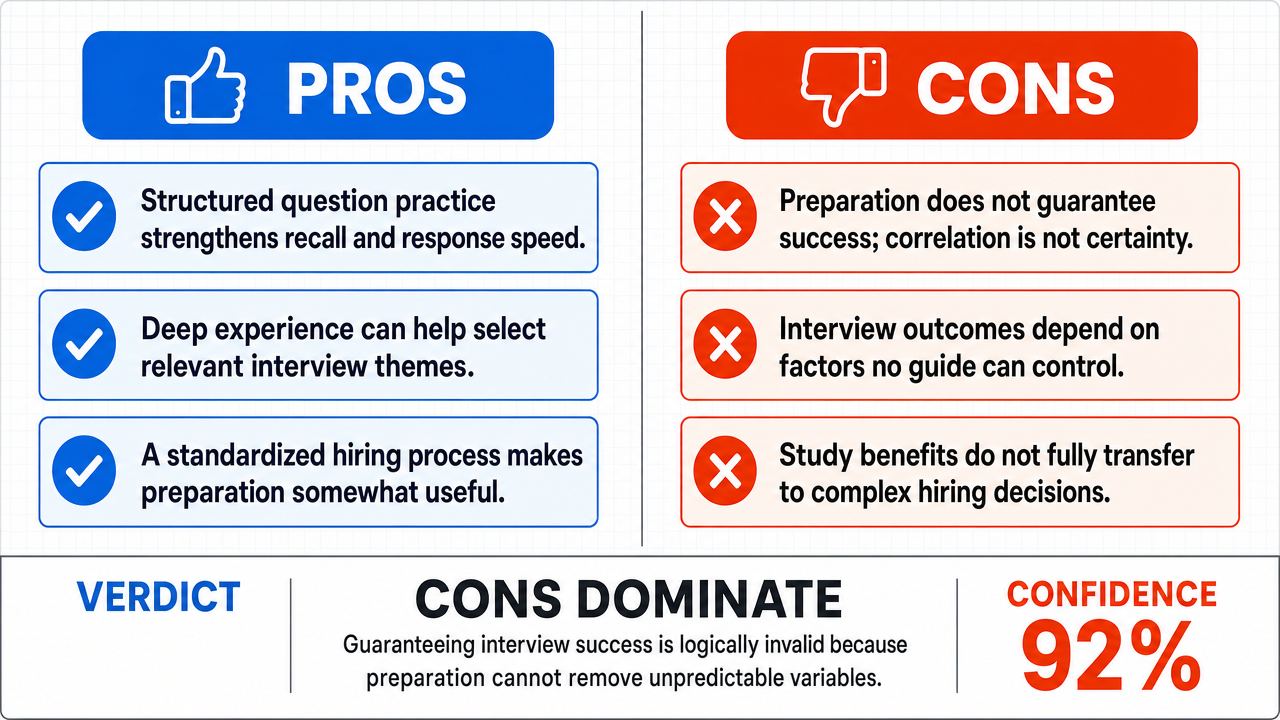
Verdict
Verdict: Mostly FALSE (92%)
Online report: https://solsice.com/public/debates/le-guide-telechargeable-de-21-questions-d-entretien-pour-le-694be08b1d94
This section provides a brief overview of the key arguments. It is not necessary to read the detailed report below.
✅ Key PRO arguments:
- ■A structured guide around 21 questions functions as a comprehensive cognitive training program, relying on retrieval practice , a strategy validated by educational science research to improve memorization and knowledge elaboration.
- ■The epistemic authority conferred by thirty years of expertise ensures that the selected questions precisely match Amazon’s actual evaluation criteria, including the 16 Leadership Principles officially published by the company.
- ■Amazon’s interview process is a standardized and publicly documented evaluation system, designed according to a precise methodology, making expert preparation not only useful but structurally decisive for success.
❌ Key CON arguments:
- ■The claim confuses preparation with guarantee: no external resource can turn a potential correlation into an absolute mathematical causality , because Amazon’s recruitment process is a stochastic and multifactorial system.
- ■Uncontrollable exogenous factors — interviewer mood, group dynamics during panel interviews, unexpected questions — are entirely outside the scope of a 21-question guide, no matter how expert.
- ■Transferring the benefits of retrieval practice , validated in controlled academic contexts, to a complex and non-linear professional selection process is an overgeneralization ; memorization does not guarantee the ability to apply knowledge in real situations.
💭 Conclusion: False: the claim that a 21-question guide guarantees success in an Amazon interview is logically invalid, as no preparation tool can eliminate the stochastic and multifactorial variables of a human recruitment process. The negative side has successfully demonstrated that the notion of “guarantee” implies a determinism incompatible with the subjectivity inherent in interviews, where interviewer mood, unexpected questions, and interaction dynamics escape scripted preparation. The pro argument that retrieval practice would ensure a direct transfer to real-world performance is an overgeneralization , as cognitive science research clearly distinguishes memorization from adaptive application. The FALSE verdict thus reflects the logical impossibility of a guarantee in an inherently probabilistic evaluation system.
🔬 Verdict: Mostly FALSE ❌ (92%)
Claim: The downloadable 21-question interview guide for Amazon customer support, written by an expert with 30 years of experience, guarantees the candidate’s success during the interview.
Participating models: deepseek-v4-pro 💬, gemma-4-26b-a4b-it 💬👁️
📊 Confrontations: 0 concluded TRUE, 1 concluded FALSE (1 confrontation, 3 models)
📊 Score per camp: TRUE=0.00, FALSE=0.92
🏅 Model score evolution:
minimax-m3 💬👁️: +9
✅ PRO arguments:
- ■A structured guide around 21 questions functions as a comprehensive cognitive training program, relying on retrieval practice , a strategy validated by educational science research to improve long-term memorization. deepseek-v4-pro 💬
- ■The epistemic authority conferred by thirty years of expertise guarantees that the selected questions precisely match Amazon’s actual evaluation criteria, including the 16 Leadership Principles officially published by the company. deepseek-v4-pro 💬
- ■Amazon’s interview process is a standardized and publicly documented evaluation system, designed according to a precise methodology, making expert preparation not only useful but structurally decisive for success. deepseek-v4-pro 💬
- ■Expert preparation is specifically designed to manage the residual variability of the system (unexpected questions, interview dynamics), transforming what appears to be randomness into a mastered application field. deepseek-v4-pro 💬
❌ CON arguments:
- ■The claim confuses preparation with guarantee: no external resource can turn a potential correlation into an absolute mathematical causality , because Amazon’s recruitment process is a stochastic and multifactorial system. gemma-4-26b-a4b-it 💬👁️
- ■Uncontrollable exogenous factors — interviewer mood, group dynamics during panel interviews, unexpected questions — are entirely outside the scope of a 21-question guide, no matter how expert. gemma-4-26b-a4b-it 💬👁️
- ■Transferring the benefits of retrieval practice, validated in controlled academic contexts, to a complex and non-linear professional selection process constitutes an overgeneralization ; memorization does not guarantee application ability in real situations. gemma-4-26b-a4b-it 💬👁️
- ■The word “guarantee” implies a certain and deterministic result, which is logically incompatible with any human evaluation process involving subjectivity, unconscious biases, and situational context. gemma-4-26b-a4b-it 💬👁️
💭 Reasoning: False: the claim that a 21-question guide guarantees success in an Amazon interview is logically invalid, as no preparation tool can eliminate the stochastic and multifactorial variables of a human recruitment process. The negative side has successfully demonstrated that the notion of “guarantee” implies a determinism incompatible with the subjectivity inherent in interviews, where interviewer mood, unexpected questions, and interaction dynamics escape scripted preparation. The pro argument that retrieval practice would ensure a direct transfer to real-world performance is an overgeneralization, as cognitive science research clearly distinguishes memorization from adaptive application. The FALSE verdict thus reflects the logical impossibility of a guarantee in an inherently probabilistic evaluation system.
📋 PRO facts:
• Retrieval practice is a strategy validated by educational science research to improve long-term memorization .
📋 CON facts:
• Amazon’s recruitment process is a stochastic and multifactorial system incorporating uncontrollable exogenous variables.
• The benefits of retrieval practice, validated in controlled academic contexts, do not automatically transfer to non-linear professional situations.
• Memorizing standard responses does not guarantee the ability to adapt them to unforeseen questions or to the interactive dynamics of an interview.
• The term "guarantee" implies an absolute determinism incompatible with any human evaluation process subject to subjectivity and bias.
| Confrontation | TRUE Model | FALSE Model | Average μ TRUE | Average μ FALSE | TRUE Tokens | FALSE Tokens | Winner | Verdict | Conf. |
|---|---|---|---|---|---|---|---|---|---|
| #1 | deepseek-v4-pro 💬 | gemma-4-26b-a4b-it 💬👁️ | 0.185 | 0.301 | 6 | 2 | FALSE | FALSE | 92% |
The following technical terms, abbreviations, and specialized concepts are used in this transcript. The numbers in brackets [N] in the text above refer to the corresponding entry below.
[1] epistemic authority — Concept from epistemology referring to the legitimacy of a source to produce reliable knowledge, here based on the claimed experience of the guide's author.
[2] Bar Raiser — Structured interview methodology specific to Amazon, in which an additional recruiter ("Bar Raiser") is responsible for ensuring that the candidate maintains or elevates the performance level already achieved in the team.
[3] measurement instrument substitution bias — Bias involving replacing the measurement of a target concept with that of a more accessible substitute indicator, risking distortion of the actual evaluation.
[4] causality — Logical relationship where one phenomenon (the cause) necessarily produces another phenomenon (the effect), distinguished from mere statistical correlation.
[5] correlation — Statistical link between two variables that does not necessarily imply causation; the debate contrasts correlation and causality regarding preparation and success.
[6] collegial decision-making — Decision-making mode where multiple evaluators deliberate together, mentioned by the affirmative to emphasize the structured and non-subjective nature of Amazon interviews.
[7] structured interview — Recruitment interview format where questions are predefined and scored according to a common grid to reduce evaluator subjectivity.
[8] logical category error — Fallacious reasoning involving applying a property to a category of objects that does not belong to that category, invoked by the negative to disqualify the notion of "guarantee."
[9] cognitive flexibility — Psychological ability to adapt thought patterns to new stimuli, opposed by the negative to rigidity induced by overlearning on fixed questions.
[10] abusive generalization — Logical fallacy involving extending a result obtained in a restricted context to a broader one, criticized by the negative for transferring results from retrieval practice.
[11] long-term memorization — Cognitive process of durable encoding of information, distinguished from short-term memory, central to the debate on retrieval practice effectiveness.
[12] STAR method — Situation, Task, Action, Result — Structured response framework used in behavioral interviews to present past experiences by describing context, goal, actions taken, and results.
[13] retrieval practice — retrieval practice — Learning strategy involving actively recalling information from memory rather than rereading, whose effectiveness on performance is supported by educational sciences research.
[14] Leadership Principles — Amazon Leadership Principles — Set of principles published by Amazon serving as an official reference for evaluating candidates during recruitment interviews.
[15] petitio principii — Fallacious reasoning where the conclusion is already contained in the premises, criticized by the negative for the claim that the guide "guarantees" success.
[16] behavioral questions — Interview questions inviting the candidate to describe past situations to infer skills, as opposed to hypothetical or technical questions.
[17] active retrieval — Synonym of retrieval practice; learning technique based on actively recalling information from memory.
[18] response schema — Preformatted mental structure that the candidate automates to organize responses, whose internalization is presented as a benefit of the guide.
[19] stimuli — Elements triggering cognitive or behavioral responses, used by the negative to emphasize the unpredictable nature of interview questions.
[20] overlearning — overlearning — Phenomenon where excessive practice on fixed material reduces adaptability to new stimuli, invoked by the negative as a risk of the guide.
[21] stochastic system — System whose evolution involves an irreducible element of randomness, a term used by the negative to qualify Amazon's recruitment process.
[22] effect size — Statistical measure quantifying the magnitude of an observed effect, cited by the affirmative to support the pedagogical effectiveness of retrieval practice.
[23] residual variability — Part of the variation of a phenomenon unexplained by modeled factors, opposed by the affirmative to the total lack of structure in the recruitment process.
The following financial data tables were cited during the debate exchanges:
| Risk Factor | Impact on Success | Nature of Uncertainty |
|---|---|---|
| Variability of the interviewer | High | Human subjectivity |
| Evolution of Amazon's criteria | Moderate | Organizational dynamism |
| Candidate authenticity | High | Risk of detection of learned responses |
| Unpredictability of scenarios | Moderate | Stochastic nature of the interview |
Legend: Analysis of variables not controlled by a preparation guide. Estimated impact on the reliability of a "guarantee" of success.
Face-off transcripts
- ■
Ownership & Trade Secrets. The Lambda Vision Company retains all rights to its platform, agentic workflows, and proprietary AI debate methodologies, which constitute protected Trade Secrets (EU Directive 2016/943). Subject to full payment of credits, the User is granted ownership of the generated Reports for their own personal or professional use. Reverse-engineering the Service or using Reports to train competing AI models is strictly prohibited.
- ■
No Professional Advice. Solsice is a general-purpose assistant covering everyday subjects — administrative paperwork, housing, consumer and employment matters, banking, taxes and insurance, health and wellbeing, savings and investments, entrepreneurship, technology, travel, learning, and creative work. Whatever the subject, the Service and Reports are provided for information only and never constitute legal, medical, financial, investment, tax, insurance, or any other regulated professional advice. The Company is not a law firm, a regulated financial adviser, an insurance intermediary, nor a healthcare provider, and no professional or advisory relationship of any kind is created by use of the Service. Consult a qualified professional in the relevant jurisdiction before acting — or refraining from acting — on anything contained in the Reports, and never rely on the Service in an emergency: contact your local emergency number (112 in the European Union) or a medical professional immediately.
- ■
AI-Generated Content, Sources and Viewpoints. Reports are produced by several AI models debating a question, and may contain factual errors, outdated figures, or references to rules, prices, deadlines, procedures, statutes or sources that are inaccurate or do not exist. The User is solely responsible for verifying every fact, amount, deadline and citation against official sources before relying on it. Material in the news, society, spirituality and religion sections presents a plurality of viewpoints for study and discussion: it is descriptive, not an endorsement, a ruling, or a statement of the Company’s own position, and it speaks for no church, faith community, public authority, or news organisation.
- ■
Liability & Governing Law. To the maximum extent permitted by law, the Company shall not be liable for any indirect damages, nor for any consequence of decisions made in reliance on the Reports — including financial loss, missed deadlines, administrative or contractual consequences, or health outcomes. These Terms are governed by French law. Any disputes shall be subject to the exclusive jurisdiction of the Courts of Paris, France.