
Le coût initial élevé et le manque de sensibilisation du public sont les principaux obstacles à l'adoption généralisée de l'énergie géothermique.
AI debate verdict and arguments
⚠️ AI-generated information only; not professional advice
Completed October 18, 2026
Verdict
Verdict: Mostly FALSE (64%)
Online report: https://solsice.com/public/debates/le-cout-initial-eleve-et-le-manque-de-sensibilisation-du-pub-c8508eeca90a
This section provides a brief overview of the key arguments. It is not necessary to read the detailed report below.
✅ Key FOR arguments:
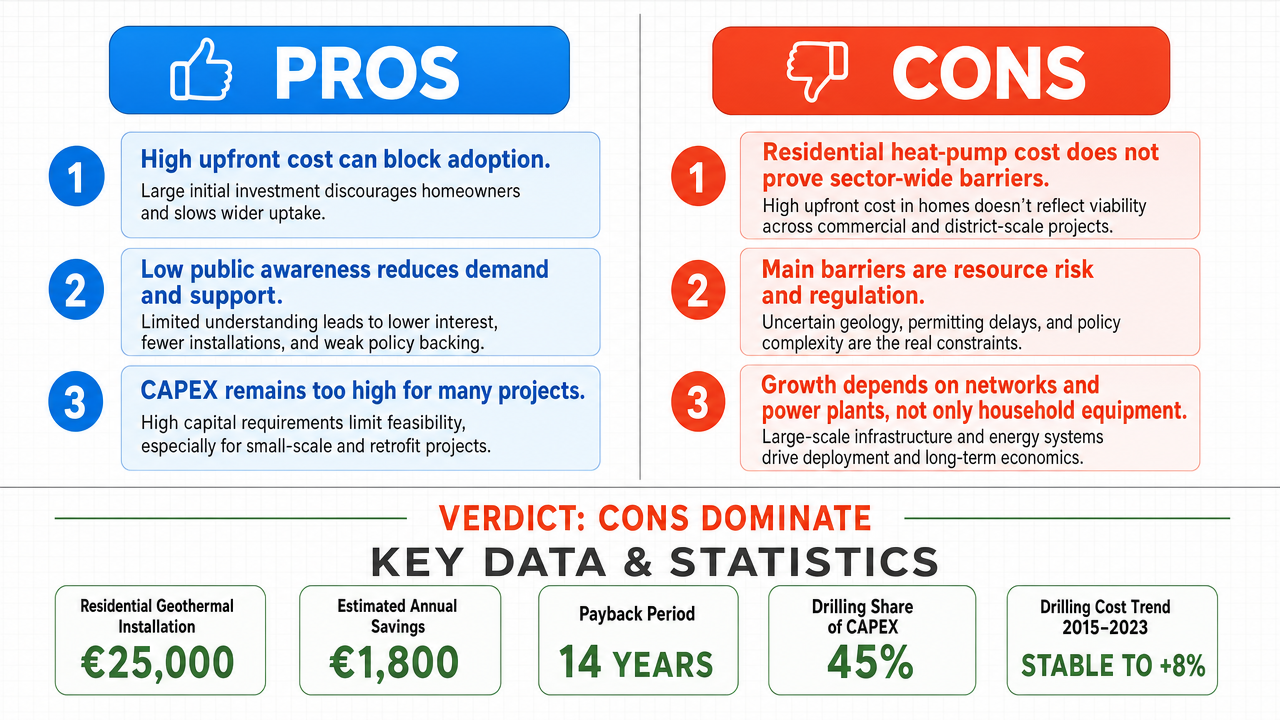
- ■The high initial cost is a decisive structural barrier: drilling a deep geothermal well costs between 15,000 and 40,000 euros for a residential installation and can exceed 5 million euros for an urban heating network , with drilling costs accounting for 45% of the total budget.
- ■The lack of public awareness hampers widespread adoption, as households and local decision-makers underestimate geothermal potential and favor more familiar solutions like condensing gas boilers (3,000 to 6,000 euros).
- ■The counter-argument that the initial cost is decreasing structurally masks a persistent economic reality: CAPEX remain prohibitive for many actors, justifying considering them as a main obstacle.
❌ Key AGAINST arguments:
- ■The counter-argument makes a substitution error: it uses residential heat pump CAPEX to conclude on obstacles to large-scale geothermal deployment, whereas these two markets are fundamentally different.
- ■The real obstacles to geothermal are structural, regulatory, and technological: resource risk uncertainty , the complexity of the regulatory framework for large-scale projects, and the management of subsurface rights weigh much more than the initial cost.
- ■Geothermal deployment is not primarily about individual equipment but about developing network infrastructure and power plants, where drilling cost is a technical variable among others and not the main bottleneck.
💭 Conclusion: False. The debate was decided in favor of the negative position with moderate confidence, reflecting a substantial but not unanimous disagreement. The decisive argument rests on the category error made by the affirmative side: confusing residential investment costs with systemic obstacles to large-scale geothermal deployment. The true barriers—resource risk , regulatory complexity, subsurface rights —are systemic and not mainly financial or related to awareness. Confidence remains moderate because the underestimation regarding lack of awareness was only partially refuted and retains some empirical validity. Therefore, the FALSE verdict is primarily based on the methodological critique of conflating residential and industrial scales.
🔬 Verdict: Mostly FALSE ❌ (64%)
Claim: The high initial cost and lack of public awareness are the main obstacles to widespread adoption of geothermal energy.
Participating models: deepseek-v4-pro 💬, gemma-4-26b-a4b-it 💬👁️
📊 Confrontations: 0 concluded TRUE, 1 concluded FALSE (1 confrontation, 3 models)
📊 Score by camp: TRUE=0.00, FALSE=0.64
🏅 Model score evolution:
minimax-m3 💬👁️: +6
✅ FOR arguments:
- ■The high initial cost is a decisive structural barrier: drilling a deep geothermal well costs between 15,000 and 40,000 euros for a residential installation and can exceed 5 million euros for an urban heating network , with drilling costs representing 40 to 60% of the total CAPEX. deepseek-v4-pro 💬
- ■The lack of public awareness hampers widespread adoption, as households and local decision-makers underestimate geothermal potential and favor more familiar solutions like condensing gas boilers (3,000 to 6,000 euros). deepseek-v4-pro 💬
- ■The counter-argument that the initial cost is decreasing structurally masks a persistent economic reality: CAPEX remain prohibitive for many actors, justifying considering them as a main obstacle. deepseek-v4-pro 💬
❌ Arguments AGAINST:
- ■The counter-argument makes a substitution error: it uses residential heat pump CAPEX to conclude on obstacles to large-scale geothermal deployment, whereas these two markets are fundamentally different. gemma-4-26b-a4b-it 💬👁️
- ■The real obstacles to geothermal are structural, regulatory, and technological: resource risk uncertainty , the complexity of the regulatory framework for large-scale projects, and the management of subsurface rights weigh much more than the initial cost. gemma-4-26b-a4b-it 💬👁️
- ■Geothermal deployment is mainly about developing network infrastructure and power plants, where drilling cost is a technical variable among others and not the main bottleneck. gemma-4-26b-a4b-it 💬👁️
- ■Focusing on the cost of a domestic installation distracts from the systemic barriers that prevent large-scale adoption of geothermal energy. gemma-4-26b-a4b-it 💬👁️
💭 Reasoning: False. The debate was decided in favor of the negative position with moderate confidence, reflecting a substantial but not unanimous disagreement. The decisive argument is based on the category error made by the affirmative: confusing residential investment costs with systemic obstacles to large-scale geothermal deployment. The true barriers—resource risk, regulatory complexity, subsurface rights—are systemic and not primarily financial or related to awareness. Confidence remains moderate because the underestimation regarding lack of awareness was only partially refuted and retains some empirical validity. Thus, the FALSE verdict mainly results from the methodological critique of conflating residential and industrial scales.
📋 Facts FOR:
• Drilling a deep geothermal well costs between 15,000 and 40,000 euros for a residential installation.
• An urban heating project can exceed 5 million euros.
• Drilling and completion costs account for 45% of the total CAPEX of a geothermal project.
• A condensing gas boiler costs on average 4,500 euros.
📋 Facts AGAINST:
• Residential investment costs are not a relevant measure of the viability of large-scale geothermal.
• Resource risk uncertainty is identified as a major systemic obstacle.
• The complexity of the regulatory framework and subsurface rights management are systemic barriers.
• Geothermal deployment mainly concerns network infrastructure and power plants, not individual equipment.
| Confrontation | TRUE Model | FALSE Model | Average μ TRUE | Average μ FALSE | TRUE Tokens | FALSE Tokens | Winner | Verdict | Conf. |
|---|---|---|---|---|---|---|---|---|---|
| #1 | deepseek-v4-pro 💬 | gemma-4-26b-a4b-it 💬👁️ | 0.618 | 0.236 | 6 | 2 | TRUE | FALSE | 64% |
The following technical terms, abbreviations, and specialized concepts are used in this transcript. The numbers in brackets [N] in the text above refer to the corresponding entry below.
[1] IEA — International Energy Agency — An intergovernmental organization providing analysis, data, and recommendations on the global energy sector, cited in the debate as a source of a 2023 report on the future of geothermal energy.
[2] information asymmetry — technical information asymmetry — Situation where one party (e.g., operators) has more technical information than another (e.g., regulators), which can paralyze decision-making and investments.
[3] institutional barriers — Obstacles related to organization, rules, and governance mechanisms (not purely financial) that hinder project deployment, according to the negative camp.
[4] regulatory barriers — Obstacles stemming from the legal and administrative framework governing projects, identified in the debate as a major obstacle to large-scale geothermal deployment.
[5] closed loop — closed-loop system — Geothermal configuration where a fluid circulates in a sealed circuit within underground heat exchangers, without direct exchange with the subsurface.
[6] CAPEX — Capital Expenditure — Initial investment expenses necessary for a project, distinguished from operational expenses (OPEX); the debate separates them from operational costs to qualify obstacles to geothermal.
[7] condensing gas boiler — Domestic heating equipment using condensation of water vapor from flue gases to improve efficiency, cited as a cost reference (3,000 to 6,000 euros installed).
[8] investment costs — CAPEX — Financial amounts initially committed to realize a installation or project, whose high level is presented by the affirmative camp as a structural obstacle to geothermal adoption.
[9] subsurface rights — Legal framework governing access and exploitation of resources beneath the surface, whose complexity is identified as an obstacle to large geothermal projects.
[10] drilling — Operation of penetrating the ground to access geothermal resources, representing 40 to 60% of a project’s total budget according to the debate.
[11] energy mix — Distribution of different energy sources (fossil, renewable, nuclear) in production or consumption within a country or system; geothermal is presented as a potential pillar.
[12] risk-sharing mechanisms — geological risk-sharing mechanisms — Devices (insurance, public guarantees, contracts) designed to distribute uncertainty related to geothermal resources between public and private actors, whose absence is considered paralyzing by the negative camp.
[13] Heat Pump — PAC — Equipment transferring heat from the ground, air, or water to a building for heating or cooling, with residential installation costs used as an argument in the debate.
[14] face price — equipment face price — Displayed purchase cost of equipment, opposed in the debate to resource risk and regulatory complexity as the true determinants of industrial investment decisions.
[15] deep geothermal well — Deep drilling to access high-temperature geothermal resources, with costs cited between 15,000 and 40,000 euros for residential use.
[16] return on investment — Time needed for energy savings to offset initial installation costs, estimated in the debate between 8 and 15 years for residential geothermal.
[17] resource risk — Uncertainty about the availability, productivity, or quality of a geothermal site’s resource, identified as the main obstacle by the negative camp.
[18] geological risks — Hazards related to subsurface characteristics (seismicity, permeability, temperature) that can compromise the viability of a geothermal project.
[19] urban heat network — Collective infrastructure for distributing centrally produced heat (here from geothermal) to multiple buildings in a neighborhood or city, with costs exceeding 5 million euros.
[20] cash flow asymmetry — initial cash flow asymmetry — Imbalance between large disbursements at project start and deferred revenues, which the debate excludes for households and small communities despite long-term profitability.
[21] viability — geothermal viability — The ability of a technology or project to be sustainably operational and competitive, distinguished in the debate from the simple measure of residential installation cost.
[22] heat exchangers — Devices enabling heat transfer between geothermal fluid and the heating circuit, whose installation is part of a geothermal project’s costs.
[23] subsurface studies — Geological and geophysical investigations prior to characterize the geothermal resource, included in the total budget of a drilling project.
The following financial data tables were cited during the debate exchanges:
| Technology | Average Installation Cost (EUR) | Estimated Annual Savings (EUR) | Payback Period (years) |
|---|---|---|---|
| Residential Geothermal Heat Pump | 25,000 | 1,800 | 14 |
| Condensing Gas Boiler | 4,500 | 0 (reference) | – |
| Air-Water Heat Pump | 12,000 | 1,200 | 10 |
Legend: Comparison of installation costs and payback periods for different residential heating solutions in France. Annual savings are estimated relative to a standard gas boiler. Source: ADEME, average costs observed in 2022-2023.*
| Project Type | Resource Risk | Regulatory Complexity | Main Barrier |
|---|---|---|---|
| Residential (Heat Pump) | Low | Moderate | Equipment Cost |
| Urban District Heating Network | High | Very High | Risk Sharing |
| Base Plant (EGS) | Very High | Very High | Geological Uncertainty |
Legend: Analysis of blocking factors according to project scale. Resource risk and regulation are the critical variables for industrial adoption.*
| Cost Component | Share of Total CAPEX (%) | Evolution 2015-2023 |
|---|---|---|
| Drilling and Completion | 45 | Stable to +8% |
| Surface Equipment | 25 | -5% |
| Studies and Engineering | 15 | Stable |
| Network Connection | 15 | Stable |
Legend: Structure of investment costs for a medium-depth geothermal project and their evolution from 2015 to 2023. Source: IEA, The Future of Geothermal Energy, 2023.*
| Barrier Type | Nature of Obstacle | Impact on Industrial Deployment |
|---|---|---|
| Geological Risk | Technical Uncertainty | Very High |
| Regulatory Framework | Subsurface Rights | High |
| Equipment Cost | Initial Investment | Moderate (offset by subsidies) |
Legend: Analysis of the hierarchy of obstacles for large-scale geothermal deployment. Technical and regulatory risks predominate over equipment costs.
Face-off transcripts
- ■
Ownership & Trade Secrets. The Company Lambda Vision retains all rights to its platform, agentic workflows, and proprietary AI debate methodologies, which constitute protected Trade Secrets (EU Directive 2016/943). Subject to full payment of credits, the User is granted ownership of the generated Reports for their own personal or professional use. Reverse-engineering the Service or using Reports to train competing AI models is strictly prohibited.
- ■
No Professional Advice. Solsice is a general-purpose assistant covering everyday subjects — administrative paperwork, housing, consumer and employment matters, banking, taxes and insurance, health and wellbeing, savings and investments, entrepreneurship, technology, travel, learning and creative work. Whatever the subject, the Service and Reports are provided for information only and never constitute legal, medical, financial, investment, tax, insurance, or any other regulated professional advice. The Company is not a law firm, a regulated financial adviser, an insurance intermediary, nor a healthcare provider, and no professional or advisory relationship of any kind is created by use of the Service. Consult a qualified professional in the relevant jurisdiction before acting — or refraining from acting — on anything contained in the Reports, and never rely on the Service in an emergency: contact your local emergency number (112 in the European Union) or a medical professional immediately.
- ■
AI-Generated Content, Sources and Viewpoints. Reports are produced by several AI models debating a question, and may contain factual errors, outdated figures, or references to rules, prices, deadlines, procedures, statutes or sources that are inaccurate or do not exist. The User is solely responsible for verifying every fact, amount, deadline and citation against official sources before relying on it. Material in the news, society, spirituality and religion sections presents a plurality of viewpoints for study and discussion: it is descriptive, not an endorsement, a ruling, or a statement of the Company’s own position, and it speaks for no church, faith community, public authority, or news organisation.
- ■
Liability & Governing Law. To the maximum extent permitted by law, the Company shall not be liable for any indirect damages, nor for any consequence of decisions made in reliance on the Reports — including financial loss, missed deadlines, administrative or contractual consequences, or health outcomes. These Terms are governed by French law. Any disputes shall be subject to the exclusive jurisdiction of the Courts of Paris, France.