
Le « corps de souffrance » est une accumulation de douleur émotionnelle héritée de l'enfance et de vies antérieures, cherchant périodiquement à se nourrir de nouvelles expériences douloureuses.
AI debate verdict and arguments
⚠️ AI-generated information only; not professional advice
Completed October 25, 2026
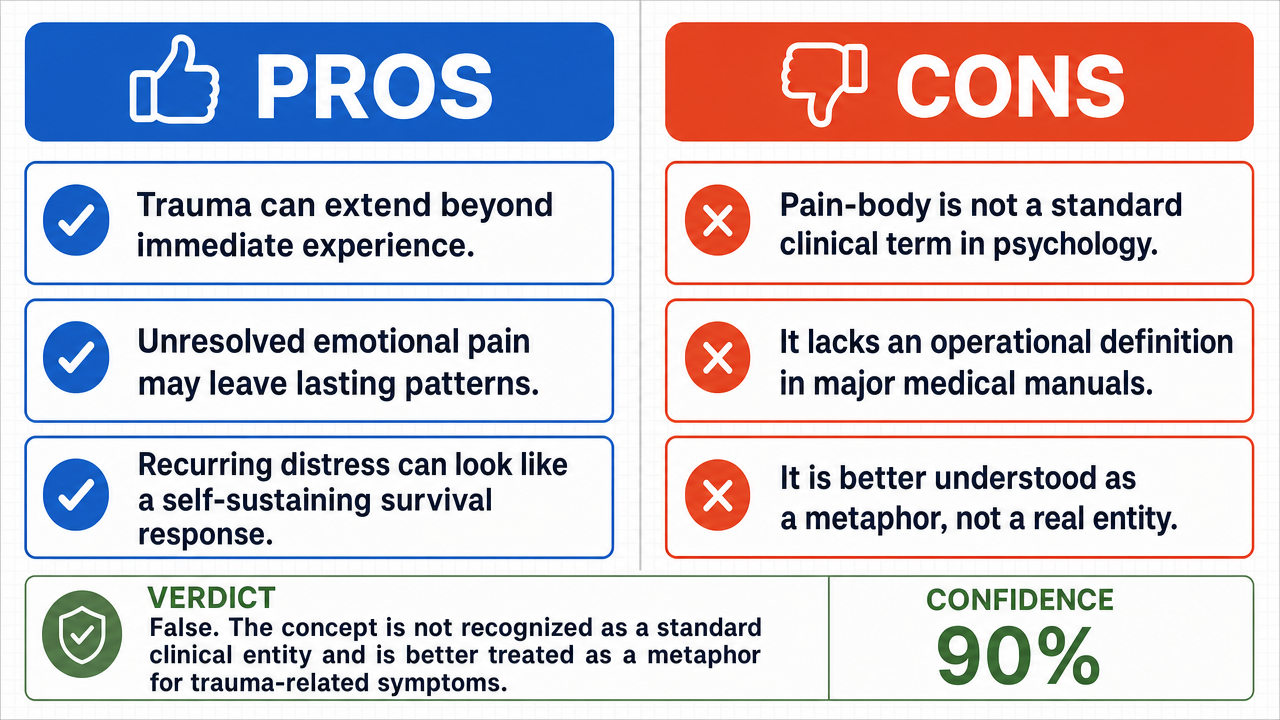
Verdict
Verdict: Mostly FALSE (90%)
Online report: https://solsice.com/public/debates/le-corps-de-souffrance-est-une-accumulation-de-douleur-emoti-400269afb377
This section provides a brief overview of the key arguments. It is not necessary to read the detailed report below.
✅ Key PRO arguments:
- ■The axis of transgenerational traumatic memory demonstrates that pain is not limited to immediate individual experience but constitutes a structure that can be inherited. Epigenetic research suggests that traumas experienced by ancestors can leave biological and psychological marks transmissible across generations, creating a form of “body” of painful memory preexisting the individual.
- ■This accumulation of unresolved emotional burdens acts as a fingerprint that defines the structure of suffering, validating the idea of inheritance from childhood and beyond, including from past lives.
- ■Traumatic reactivation can be interpreted as a survival dynamic maintained by an entity — the body of suffering — which sustains a constant reactivation of emotional load , rather than as a purely resolutive mechanism.
❌ Key CON arguments:
- ■The term “body of suffering ” is not recognized as a standard clinical entity in modern psychology. It is often confused with “somatic markers ” or “somatic symptoms ,” which refer to observable physiological responses to stress, not an accumulation of inherited pains.
- ■The lack of an operational definition in major medical and psychological manuals invalidates its use as a universal scientific principle, especially regarding inheritance from past lives.
- ■In clinical psychology, this term is a metaphor for somatic symptoms resulting from unresolved trauma, not a biological or psychic entity with its own will seeking to feed on new painful experiences.
💭 Conclusion: False. The verdict of FALSE is supported by the fact that the “body of suffering ” is not recognized as a standard clinical entity in modern psychology but rather as a psychoanalytic metaphor referring to somatic symptoms linked to unresolved trauma. The statement contains several distinct sub-claims — the accumulation of emotional pain, inheritance from childhood AND past lives, and active seeking of new painful experiences — of which the weakest (inheritance from past lives) is not supported by any operational definition in major medical or psychological manuals. The repetition compulsion , invoked by the affirmative camp, is interpreted clinically as a resolution mechanism , not as the manifestation of an autonomous entity seeking to feed on pain. Finally, research on somatic disorders confirms that physical pain is a physiological response to stress, not an expression of an entity’s will.
🔬 Verdict: Mostly FALSE ❌ (90%)
Claim: The “body of suffering ” is an accumulation of inherited emotional pain from childhood and past lives, periodically seeking to feed on new painful experiences.
Participating models: gemma-4-26b-a4b-it 💬👁️, glm-4.7-flash 💬
📊 Confrontations: 0 concluded TRUE, 1 concluded FALSE (1 confrontation, 3 models)
📊 Score by camp: TRUE=0.00, FALSE=0.90
🏅 Model score evolution:
minimax-m3 💬👁️: +9
✅ PRO arguments:
- ■The axis of transgenerational traumatic memory demonstrates that pain is not limited to immediate individual experience but constitutes a structure that can be inherited. Epigenetic research suggests that traumas experienced by ancestors can leave biological and psychological marks transmissible across generations, creating a form of “body” of painful memory preexisting the individual. gemma-4-26b-a4b-it 💬👁️
- ■This accumulation of unresolved emotional burdens acts as a fingerprint that defines the structure of suffering, validating the idea of inheritance from childhood and beyond, including from past lives. gemma-4-26b-a4b-it 💬👁️
- ■Traumatic reactivation can be interpreted as a survival dynamic maintained by an entity — the body of suffering — which sustains a constant reactivation of emotional load , rather than as a purely resolutive mechanism. gemma-4-26b-a4b-it 💬👁️
❌ Arguments AGAINST:
- ■The term “body of suffering” is not recognized as a standard clinical entity in modern psychology. It is often confused with “somatic markers ” or “somatic symptoms ,” which refer to observable physiological responses to stress, not an accumulation of inherited pains. glm-4.7-flash 💬
- ■The absence of an operational definition in major medical and psychological manuals invalidates its use as a universal scientific principle, especially regarding inheritance from past lives. glm-4.7-flash 💬
- ■In clinical psychology, this term is a metaphor for somatic symptoms resulting from unresolved trauma, not a biological or psychic entity with its own will seeking to feed on new painful experiences. glm-4.7-flash 💬
- ■Research on somatic disorders shows that physical pain is a physiological reaction to stress or trauma, not the result of a conscious entity seeking to feed on painful experiences. glm-4.7-flash 💬
💭 Reasoning: False. The verdict of FALSE is supported by the fact that the “body of suffering” is not recognized as a standard clinical entity in modern psychology but rather as a psychoanalytic metaphor referring to somatic symptoms related to unresolved trauma. The statement contains several distinct sub-claims — the accumulation of emotional pain, inheritance from childhood AND past lives, and active seeking of new painful experiences — of which the weakest (inheritance from past lives) is not supported by any operational definition in major medical or psychological manuals. The repetition compulsion , invoked by the affirmative camp, is interpreted clinically as a resolution mechanism , not as the manifestation of an autonomous entity seeking to feed on pain. Finally, research on somatic disorders confirms that physical pain is a physiological response to stress, not an expression of an entity’s will.
📋 Facts IN FAVOR:
• Epigenetic research suggests that ancestral traumas can leave transmissible biological and psychological marks.
• Repetition compulsion is a clinically observed phenomenon in trauma survivors.
📋 Facts AGAINST:
• The term “body of suffering” has no operational definition in major medical and psychological manuals (DSM, ICD).
• Somatic markers and somatic symptoms are observable physiological responses to stress, not psychic entities.
• Physical pain related to somatic disorders is a physiological reaction to stress or trauma, documented in clinical manuals.
• The concept is a psychoanalytic metaphor, not a tangible biological or psychic entity.
| Confrontation | TRUE Model | FALSE Model | Average μ TRUE | Average μ FALSE | TRUE Tokens | FALSE Tokens | Winner | Verdict | Confidence |
|---|---|---|---|---|---|---|---|---|---|
| #1 | gemma-4-26b-a4b-it 💬👁️ | glm-4.7-flash 💬 | 0.317 | 0.470 | 4 | 4 | FALSE | FALSE | 90% |
The following technical terms, abbreviations, and specialized concepts are used in this transcript. The numbers in brackets [N] in the above text refer to the corresponding entry below.
[1] Emotional charge — In psychology, accumulation of unresolved emotions weighing on the subject and potentially structuring their experience, mentioned in the debate as a component of the body of suffering.
[2] Repetition compulsion — Mechanism by which an individual unconsciously tends to relive traumatic situations. The debate opposes a reading that sees this mechanism as aimed at resolving trauma to one that interprets it as an active search for pain by an entity (the body of suffering).
[3] Body of suffering — Central concept of the debate. The affirmative presents it as an entity accumulating emotional pain inherited from childhood and past lives, seeking to feed on new painful experiences. The negative describes it as a non-scientific metaphor, sometimes confused with somatic markers or symptoms.
[4] Phenomenological dimension — Approach that prioritizes the study of lived and subjective experience of a phenomenon, as opposed to a purely functional or objective analysis, invoked by the affirmative to describe traumatic reactivation.
[5] EMDR — Eye Movement Desensitization and Reprocessing — Therapy cited in the debate as demonstrating that the repetition of traumatic memories is part of a treatment and resolution process, not an active consumption of pain.
[6] Imprint — Lasting mark left by an experience, notably traumatic, which structures how the subject experiences and perceives subsequent situations.
[7] Teleological reading — Interpretation of a phenomenon based on its purpose or goal, criticized by the affirmative when applied to the repetition compulsion.
[8] Somatic markers — Observable physiological responses associated with emotional states, mentioned in the debate as sometimes being confused with the concept of the body of suffering.
[9] Defense mechanism — Unconscious psychic process by which the subject protects themselves from anxiety; the repetition compulsion is described in the debate as such a mechanism.
[10] Transgenerational traumatic memory — Hypothesis that traumas experienced by ancestors can leave transmissible marks to descendants, creating a form of inherited painful memory.
[11] Predisposition — Increased tendency or vulnerability to develop a disorder or particular reaction, mentioned in the context of epigenetics.
[12] Psychoanalytic — Relating to psychoanalysis, a theoretical approach exploring the unconscious, drives, and defense mechanisms, qualified in the debate as a framework where the body of suffering is a metaphor.
[13] Traumatic reactivation — Process by which a memory or emotion related to trauma is reactivated in the present, reviving the associated emotional charge.
[14] Resolution — In the therapeutic context, process by which a trauma is integrated and overcome, as opposed to perpetuated. The debate contests whether the repetition compulsion leads to resolution or perpetuation.
[15] Painful schemas — Repetitive cognitive or emotional structures leading the subject to relive or recreate situations of suffering.
[16] Somatic Symptom Disorder — Psychiatric disorder cited in the debate to distinguish physiological reactions to stress or trauma from the concept of the body of suffering.
[17] Somatic symptoms — Physical manifestations that may be related to a psychological state or stress, without a clearly identified organic cause, mentioned in the debate as distinct from the body of suffering.
[18] Cognitive-behavioral therapies — CBT — Therapeutic approaches focused on the links between thoughts, emotions, and behaviors, mentioned in the debate as demonstrating that the repetition of traumatic memories is part of a resolution process.
[19] Somatic disorders — Category of psychiatric disorders characterized by the presence of physical symptoms without complete medical explanation, invoked in the debate to distinguish these disorders from the concept of the body of suffering.
[20] Somatoform disorders — Diagnostic category grouping disorders characterized by persistent somatic symptoms not medically explained, mentioned in the debate.
[21] Epigenetics — Field studying modifications in gene expression that do not result from changes in DNA sequence, invoked in the debate to suggest a biological transmission of ancestral traumas.
Face-off transcripts
- ■
Ownership & Trade Secrets. Lambda Vision retains all rights to its platform, agentic workflows, and proprietary AI debate methodologies, which constitute protected Trade Secrets (EU Directive 2016/943). Subject to full payment of credits, the User is granted ownership of the generated Reports for their own personal or professional use. Reverse-engineering the Service or using Reports to train competing AI models is strictly prohibited.
- ■
No Professional Advice. Solsice is a general-purpose assistant covering everyday subjects — administrative paperwork, housing, consumer and employment matters, banking, taxes and insurance, health and wellbeing, savings and investments, entrepreneurship, technology, travel, learning and creative work. Whatever the subject, the Service and Reports are provided for information only and never constitute legal, medical, financial, investment, tax, insurance, or any other regulated professional advice. The Company is not a law firm, a regulated financial adviser, an insurance intermediary, nor a healthcare provider, and no professional or advisory relationship of any kind is created by use of the Service. Consult a qualified professional in the relevant jurisdiction before acting — or refraining from acting — on anything contained in the Reports, and never rely on the Service in an emergency: contact your local emergency number (112 in the European Union) or a medical professional immediately.
- ■
AI-Generated Content, Sources and Viewpoints. Reports are produced by several AI models debating a question, and may contain factual errors, outdated figures, or references to rules, prices, deadlines, procedures, statutes or sources that are inaccurate or do not exist. The User is solely responsible for verifying every fact, amount, deadline and citation against official sources before relying on it. Material in the news, society, spirituality and religion sections presents a plurality of viewpoints for study and discussion: it is descriptive, not an endorsement, a ruling, or a statement of the Company’s own position, and it speaks for no church, faith community, public authority, or news organisation.
- ■
Liability & Governing Law. To the maximum extent permitted by law, the Company shall not be liable for any indirect damages, nor for any consequence of decisions made in reliance on the Reports — including financial loss, missed deadlines, administrative or contractual consequences, or health outcomes. These Terms are governed by French law. Any disputes shall be subject to the exclusive jurisdiction of the Courts of Paris, France.