
Le contrôle des infrastructures numériques par les géants de la technologie constitue une menace plus directe pour la souveraineté des États que la puissance financière des acteurs privés.
AI debate verdict and arguments
⚠️ AI-generated information only; not professional advice
Completed November 13, 2026
Answer
Bracket
Round 1/1 · 1/1 duels
Ranking
- 1.Menace numérique(google/gemma-4-26b-a4b-it)87%
- 2.Menace financière(z-ai/glm-4.7-flash)13%
🏆 Winner: Digital Threat (74%)
Online report: https://solsice.com/public/debates/le-controle-des-infrastructures-numeriques-par-les-geants-de-6ca676c3f35a
Probability that "Digital Threat" is the better of the 2 options: 74% (chance: 50%)
This section provides a brief overview of the key arguments. It is not necessary to read the detailed report below.
✅ Key PRO Arguments:
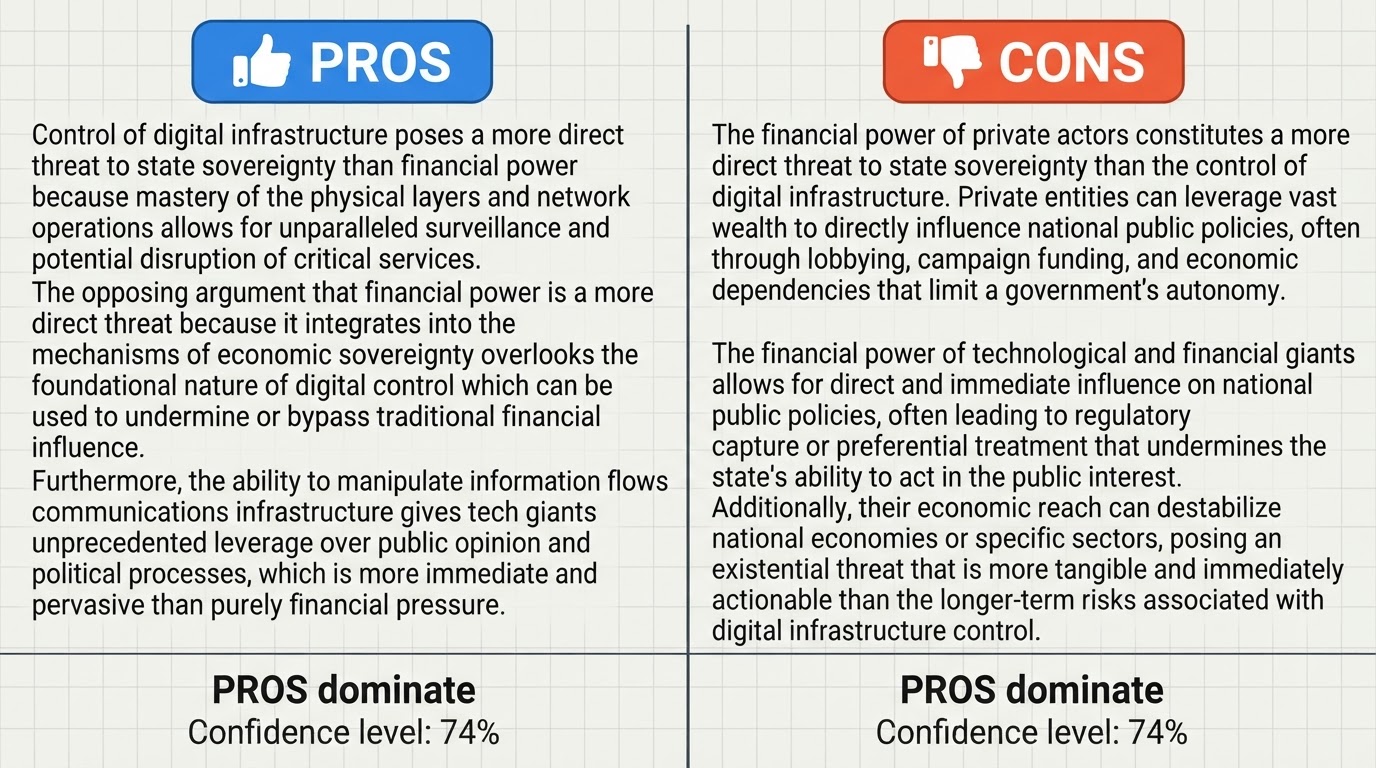
- ■Control of digital infrastructures more directly threatens sovereignty than financial power because mastery of the physical and logical layers of digital technology (cloud , undersea cables , servers ) creates an existential vulnerability that money cannot compensate for. Unlike financial power, which can be regulated through taxation or monetary policies , control of infrastructure allows for information interception and the real-time paralysis of essential State services . Sovereignty lies not only in the ability to spend, but in the ability to function autonomously.
- ■The opposing argument that financial power is a more direct threat because it embeds itself within the mechanisms of economic and fiscal sovereignty is a begging the question : it uses the conclusion to demonstrate the reason for this superiority, without establishing a concrete fact that would distinguish the nature of this threat from that of the digital threat.
❌ Key CONTRA Arguments:
- ■The financial power of private actors constitutes a more direct threat to the sovereignty of States than the control of digital infrastructures . Systemic economic interdependence places States in a position of structural financial vulnerability, and technological and financial giants hold market positions that allow them to directly influence public policies and national economic decisions, at a scale and speed that digital infrastructures cannot match in terms of immediate impact.
- ■The financial power of technological and financial giants allows for direct and immediate influence on national public policies , often without requiring technical manipulation of infrastructure. Unlike digital infrastructures , which require specific technical actions, financial power embeds itself into the very mechanisms of the economic and fiscal sovereignty of States.
💭 Conclusion: Digital Threat prevails over the financial threat defended by z-ai/glm-4.7-flash in this duel, with 74% confidence. The decisive argument is that control of digital infrastructures creates an existential vulnerability by enabling information interception and the real-time paralysis of essential services , which financial power , regulable through taxation , cannot match. Sovereignty relies on the ability to function autonomously, and not solely on the ability to spend, which places mastery of the physical and logical layers of digital technology at the heart of the threat. The opposing argument was correctly identified as begging the question , as it asserts the superiority of the financial threat without providing a concrete fact distinguishing it from the digital threat. The judge therefore ruled in favor of the digital threat, confirming that structural dependence on infrastructure affects sovereignty more directly than financial power alone.
🔬 Verdict: 🏆 Digital threat (74 %)
Assertion: The control of digital infrastructures by tech giants constitutes a more direct threat to the sovereignty of States than the financial power of private actors .
Participating Models: gemma-4-26b-a4b-it 💬👁️, glm-4.7-flash 💬
✅ Arguments FOR:
- ■Control of digital infrastructures poses a more direct threat to sovereignty than financial power because mastery of the physical and logical layers of digital technology (cloud , undersea cables , servers ) creates an existential vulnerability that money cannot compensate for. Unlike financial power, which can be regulated through taxation or monetary policies , control of infrastructure allows for the interception of information and the real-time paralysis of essential State services . Sovereignty lies not only in the ability to spend, but in the ability to function autonomously. gemma-4-26b-a4b-it 💬👁️
- ■The opposing argument that financial power is a more direct threat because it embeds itself into the mechanisms of economic and fiscal sovereignty is a begging the question : it uses the conclusion to demonstrate the reason for this superiority, without establishing any concrete fact that would distinguish the nature of this threat from that of the digital threat. gemma-4-26b-a4b-it 💬👁️
❌ Arguments AGAINST:
- ■The financial power of private actors constitutes a more direct threat to the sovereignty of States than the control of digital infrastructures. Systemic economic interdependence places States in a position of structural financial vulnerability, and tech and financial giants hold market positions that allow them to directly influence public policies and national economic decisions, at a scale and speed that digital infrastructures cannot match in terms of immediate impact. glm-4.7-flash 💬
- ■The financial power of tech and financial giants allows for direct and immediate influence on national public policies, often without requiring technical manipulation of infrastructures. Unlike digital infrastructures, which require specific technical actions, financial power embeds itself into the very mechanisms of the economic and fiscal sovereignty of States. glm-4.7-flash 💬
💭 Reasoning: Digital threat prevails over the financial threat defended by z-ai/glm-4.7-flash in this duel, with a confidence of 74%. The decisive argument is that control of digital infrastructures creates an existential vulnerability by enabling information interception and the real-time paralysis of essential services, which financial power, regulable through taxation, cannot match. Sovereignty rests on the ability to function autonomously, not just the ability to spend, which places the mastery of the physical and logical layers of digital technology at the heart of the threat. The opposing argument was correctly identified as begging the question, as it asserts the superiority of the financial threat without providing a concrete fact distinguishing it from the digital threat. The judge therefore ruled in favor of the digital threat, confirming that structural dependence on infrastructure more directly affects sovereignty than financial power alone.
📋 Facts FOR:
• Control of digital infrastructures includes cloud, undersea cables, and servers.
• Mastery of infrastructure allows for the interception of information and the real-time paralysis of essential State services.
• Sovereignty is defined as the ability to function autonomously, not just the ability to spend.
• The opposing argument regarding financial power was characterized as begging the question by the defender of the digital threat.
• The judge assigned a 74% confidence to the victory of the digital threat.
📋 Facts AGAINST:
• Financial power creates systemic economic interdependence, placing States in structural vulnerability.
• Tech and financial giants can directly influence public policies and national economic decisions.
• Financial power embeds itself into the economic and fiscal sovereignty mechanisms of States.
• The impact of financial power is presented as immediate and large-scale, without requiring technical manipulation of infrastructure.
• No quantified financial data was provided in the debate to support the financial threat.
| Confrontation | TRUE Model | FALSE Model | TRUE avg μ | FALSE avg μ | TRUE Tokens | FALSE Tokens | Winner | Verdict | Conf. |
|---|---|---|---|---|---|---|---|---|---|
| #1 | gemma-4-26b-a4b-it 💬👁️ | glm-4.7-flash 💬 | 0.252 | 0.154 | 2 | 4 | TRUE | TRUE | 74% |
The following technical terms, abbreviations, and specialized concepts are used in this transcript. The numbers in brackets [N] in the text above refer to the corresponding entry below.
[1] private actors — private sector companies — Non-state economic entities, notably technological and financial giants, whose power is compared to that of States in the debate.
[2] algorithms — computer algorithms — Sets of calculation rules used by platforms to organize information distribution and steer user behavior.
[3] informational asymmetry — information asymmetry — A situation in which one party possesses more information than the other, allowing digital giants to exert influence over States and citizens.
[4] operational autonomy — autonomous capacity for action — A State's ability to function and make decisions without depending on foreign private entities for its essential infrastructures.
[5] cloud — cloud computing — Remote data storage and processing infrastructure, owned by private companies, the control of which is presented as a threat to sovereignty.
[6] coercion — capacity for constraint — An actor's ability to impose their will on a State through economic or financial means, without recourse to physical force.
[7] physical and logical layers — hardware and software levels of digital infrastructure — Distinction between hardware components (servers, cables) and software (algorithms, platforms) whose mastery conditions the control of the digital realm.
[8] access cutoff — interruption of access to digital services — Voluntary or accidental interruption of the availability of digital infrastructures, presented as an existential risk to the State.
[9] submarine cables — undersea telecommunication cables — Physical data transmission infrastructures laid on the ocean floor, cited as a critical layer of digital control.
[10] circular demonstration — circular reasoning — An argument that uses its conclusion as a premise without providing independent proof, as charged against the opposing thesis here.
[11] taxation — tax system — The set of taxation rules allowing the State to collect resources, presented as a tool for regulating financial power.
[12] tech giants — large companies in the technology sector — Large digital companies whose control of infrastructures and platforms is compared to the financial power of private actors.
[13] digital infrastructures — digital infrastructures — The set of physical and logical equipment (cloud, cables, servers, algorithms) necessary for the functioning of digital services.
[14] information interception — capture of data and communications — The action of seizing data and communications in transit, made possible by the control of infrastructures, and presented as a direct threat.
[15] systemic economic interdependence — generalized economic dependence — A situation where the economies of States are linked to those of powerful private actors, creating structural financial vulnerability.
[16] cognitive manipulation — manipulation of perceptions and behaviors — Influence exerted on minds via the control of algorithms and information distribution platforms.
[17] transfer mechanism — process of transmitting influence — The process by which financial influence translates concretely into an effect on public policy, the absence of which is charged against the opponent.
[18] paralysis of essential services — shutdown of indispensable State services — Interruption of the functioning of vital public services, presented as a possible consequence of the control of digital infrastructures.
[19] distribution platforms — information dissemination platforms — Online services that control the dissemination and visibility of content, cited as levers of influence over opinions.
[20] monetary policies — policies for regulating money and credit — Actions taken by central banks regarding money and interest rates, presented as a means of regulating financial power.
[21] public policies — actions of public authorities — Decisions and measures taken by the State, which private actors seek to influence through their financial power.
[22] market positions — dominant market shares — Preponderant position held by certain actors in an economic sector, giving them power of influence over States.
[23] financial power — economic and monetary power — Capacity for influence based on financial resources and market positions, opposed in the debate to the control of digital infrastructures.
[24] begging the question — circular argument — Reasoning error consisting of taking for granted the conclusion one wishes to demonstrate, here the superiority of the financial threat.
[25] service disruption — interruption of service provision — Cessation of the functioning of a digital service, which can affect the State's capacity to act.
[26] financial regulation — framework for markets and financial actors — Set of rules aimed at regulating financial activities, presented as insufficient in the face of infrastructure control.
[27] servers — computers dedicated to data storage and processing — IT equipment that stores and processes data, the hardware component of digital infrastructures.
[28] sovereignty — supreme authority of a State over its territory — Capacity of a State to exercise its authority and make decisions autonomously, the loss of which is discussed in the debate.
[29] economic and fiscal sovereignty — State control over its economic and fiscal policies — Dimension of sovereignty relating to the control of economic and fiscal levers, which financial power can directly penetrate.
[30] data storage — retention of digital data — Retention of data on servers, the location and control of which are sovereignty issues.
[31] communication vectors — information transmission channels — Technical means through which data flows, the ownership of which by foreign private entities is presented as a loss of autonomy for the State.
Face-off transcripts
- ■
Ownership & Trade Secrets. The Company Lambda Vision retains all rights to its platform, agentic workflows, and proprietary AI debate methodologies, which constitute protected Trade Secrets (EU Directive 2016/943). Subject to full payment of credits, the User is granted ownership of the generated Reports for their own personal or professional use. Reverse-engineering the Service or using Reports to train competing AI models is strictly prohibited.
- ■
No Professional Advice. Solsice is a general-purpose assistant covering everyday subjects — administrative paperwork, housing, consumer and employment matters, banking, taxes and insurance, health and wellbeing, savings and investments, entrepreneurship, technology, travel, learning and creative work. Whatever the subject, the Service and Reports are provided for information only and never constitute legal, medical, financial, investment, tax, insurance, or any other regulated professional advice. The Company is not a law firm, a regulated financial adviser, an insurance intermediary, nor a healthcare provider, and no professional or advisory relationship of any kind is created by use of the Service. Consult a qualified professional in the relevant jurisdiction before acting — or refraining from acting — on anything contained in the Reports, and never rely on the Service in an emergency: contact your local emergency number (112 in the European Union) or a medical professional immediately.
- ■
AI-Generated Content, Sources and Viewpoints. Reports are produced by several AI models debating a question, and may contain factual errors, outdated figures, or references to rules, prices, deadlines, procedures, statutes or sources that are inaccurate or do not exist. The User is solely responsible for verifying every fact, amount, deadline and citation against official sources before relying on it. Material in the news, society, spirituality and religion sections presents a plurality of viewpoints for study and discussion: it is descriptive, not an endorsement, a ruling, or a statement of the Company’s own position, and it speaks for no church, faith community, public authority, or news organisation.
- ■
Liability & Governing Law. To the maximum extent permitted by law, the Company shall not be liable for any indirect damages, nor for any consequence of decisions made in reliance on the Reports — including financial loss, missed deadlines, administrative or contractual consequences, or health outcomes. These Terms are governed by French law. Any disputes shall be subject to the exclusive jurisdiction of the Courts of Paris, France.