
Le château de Chambord, par sa démesure et sa fonction, était principalement une démonstration de puissance de François Ier adressée à l'Europe plutôt qu'une résidence royale fonctionnelle.
AI debate verdict and arguments
⚠️ AI-generated information only; not professional advice
Completed October 18, 2026
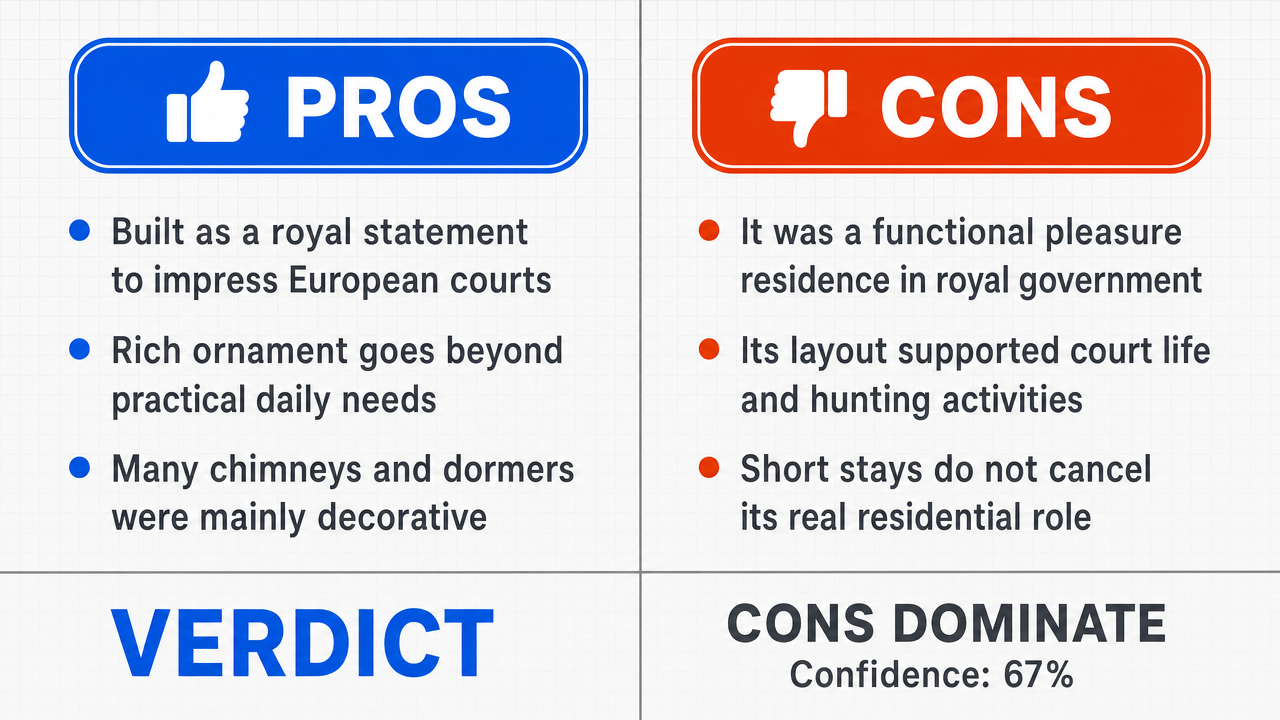
Verdict
Verdict: Mostly FALSE (67%)
Online report: https://solsice.com/public/debates/le-chateau-de-chambord-par-sa-demesure-et-sa-fonction-etait-2b7e5c2a49f5
This section provides a brief overview of the key arguments. It is not necessary to read the detailed report below.
✅ Key PRO arguments:
- ■Chambord castle was primarily designed as an architectural manifesto of French royal power intended to impress European courts , with its 440 rooms, 365 chimneys, and 84 staircases, including the famous double-helix staircase attributed to Leonardo da Vinci, whose scale and ornamentation surpass any functional residential logic.
- ■The abundance of sculptures, ornate dormer windows , and rooftops topped with monumental chimneys do not serve any practical need but aim to demonstrate the technical mastery and wealth of the king, with this gigantism directly inspired by Italian palaces.
- ■Most of Chambord's chimneys never had an effective heating function; the forest of chimneys and dormers mainly constitutes a sculpted decor, a manifesto of royal power, as confirmed by the official site of the Chambord National Estate, which speaks of a spectacular crowning, a true stone decor.
❌ Key CON arguments:
- ■Chambord is a functional leisure residence integrated into the royal power system ; confusing the rarity of occupancy with a lack of residential function is a misinterpretation of Renaissance court practices , where royal residence is defined by its capacity to host the power structure during strategic trips.
- ■By its very structure, Chambord was designed for managing court activities, notably hunting, which constituted an essential residential function at the time, rather than a simple symbolic monument.
- ■The brief stays of François I at Chambord (72 days over 32 years) do not invalidate the castle's residential function; for the itinerant French monarchy of the Renaissance , a residence was not a place of permanent, static living but a strategic and pleasurable anchoring point, making the residential function fully compatible with episodic occupation.
💭 Conclusion: False: the debate did not establish that Chambord was mainly a demonstration of power rather than a functional residence. The negative side successfully demonstrated that the nature of Renaissance royal residences was itinerant and strategic, making François I's short stays compatible with a genuine residential function. The argument that Chambord was practically used for court activities, notably hunting, and served as a royal power anchor , weakens the thesis of it being merely an architectural manifesto . However, the moderate confidence level (67%) reflects that the ostentatious and symbolic dimension of the castle, defended by the affirmative camp, remains partially valid and recognized even by the winning side. The FALSE verdict thus rests on the idea that residential function and power demonstration were not mutually exclusive, but the former cannot be denied in favor of the latter alone.
🔬 Verdict: Mostly FALSE ❌ (67%)
Claim: Chambord castle, by its grandeur and function, was primarily a demonstration of power by François I aimed at Europe rather than a functional royal residence .
Participating models: deepseek-v4-pro 💬, gemma-4-26b-a4b-it 💬👁️
📊 Confrontations: 0 concluded TRUE, 1 concluded FALSE (1 confrontation, 3 models)
📊 Score by camp: TRUE=0.00, FALSE=0.67
🏅 Model score evolution:
minimax-m3 💬👁️: +7
✅ Arguments FOR:
- ■Chambord castle was primarily designed as an architectural manifesto of French royal power intended to impress European courts , with its 440 rooms, 365 chimneys, and 84 staircases, including the famous double-helix staircase attributed to Leonardo da Vinci, whose scale and ornamentation surpass any functional residential logic. deepseek-v4-pro 💬
- ■The profusion of sculptures, ornate dormer windows , and rooftops topped with monumental chimneys do not serve any practical need but aim to demonstrate the technical mastery and wealth of the king, with this gigantism directly inspired by Italian palaces. deepseek-v4-pro 💬
- ■Most of Chambord's chimneys never had an effective heating function; the forest of chimneys and dormers mainly constitutes a sculpted decor, a manifesto of royal power, as confirmed by the official site of the Chambord National Estate, which speaks of a spectacular crowning, a true stone decor. deepseek-v4-pro 💬
❌ Arguments AGAINST:
- ■Chambord is a functional leisure residence integrated into the royal power system ; confusing the rarity of occupancy with a lack of residential function is a misinterpretation of Renaissance court practices , where royal residence is defined by its capacity to host the power structure during strategic trips. gemma-4-26b-a4b-it 💬👁️
- ■Chambord, by its very structure, was designed for managing court activities, notably hunting, which constituted an essential residential function at the time, rather than a simple symbolic monument. gemma-4-26b-a4b-it 💬👁️
- ■The brief stays of François I at Chambord (72 days over 32 years) do not invalidate the castle's residential function; for the itinerant French monarchy of the Renaissance, a residence was not a place of permanent, static living but a strategic and pleasurable anchoring point, making the residential function fully compatible with episodic occupation. gemma-4-26b-a4b-it 💬👁️
💭 Reasoning: False: the debate did not establish that Chambord was mainly a demonstration of power rather than a functional residence. The negative side successfully demonstrated that the nature of Renaissance royal residences was itinerant and strategic, making François I's short stays compatible with a genuine residential function. The argument that Chambord was practically used for court activities, notably hunting, and served as a royal power anchor , weakens the thesis of it being merely an architectural manifesto. However, the moderate confidence (67%) reflects that the ostentatious and symbolic dimension of the castle, defended by the affirmative camp, remains partially valid and recognized even by the winning side. The FALSE verdict thus rests on the idea that residential function and power demonstration were not mutually exclusive, but the former cannot be denied in favor of the latter alone.
📋 Facts in favor:
• Chambord castle has 440 rooms, 365 chimneys, and 84 staircases.
• The double-helix staircase is attributed to Leonardo da Vinci.
• The official site of the National Domain of Chambord describes the roofs as a spectacular crown, a true stone setting.
• The architecture of Chambord is directly inspired by Italian palaces.
📋 FACTS AGAINST:
• Francis I only stayed at Chambord for 72 days over 32 years of reign.
• The French Renaissance royal court was itinerant and defined its residences as strategic anchoring points.
• Chambord was designed to host court activities, including hunting.
• The residential function of a palace in the Renaissance was not measured by continuous occupation duration.
| Confrontation | TRUE Model | FALSE Model | Average μ TRUE | Average μ FALSE | TRUE Dice | FALSE Dice | Winner | Verdict | Conf. |
|---|---|---|---|---|---|---|---|---|---|
| #1 | deepseek-v4-pro 💬 | gemma-4-26b-a4b-it 💬👁️ | 0.633 | 0.269 | 6 | 2 | TRUE | FALSE | 67% |
The following technical terms, abbreviations, and specialized concepts are used in this transcript. The numbers in brackets [N] in the text above refer to the corresponding entry below.
[1] Charles V — European ruler of the 16th century mentioned in the debate as one of the most lavish princes whose splendor François I sought to rival architecturally.
[2] itinerant court — Mode of monarchical government in which the court moves from residence to residence rather than being fixed in one place, presented in the debate as characteristic of the French monarchy during the Renaissance.
[3] European courts — Royal and princely courts of Europe in the 16th century, whose splendor served as a reference in the political and symbolic rivalry between sovereigns.
[4] excessive expenditure — Excessive accumulation of resources and material means beyond any functional necessity, used in the debate to qualify the ornamentation and scale of Chambord.
[5] magnitude — Architectural concept referring to dimensions and ornamentation exceeding typical needs, explicitly defined as such in the debate statement.
[6] demonstration of power — Symbolic assertion of royal authority through architecture, a function attributed to Chambord by the affirmative camp.
[7] double-helix staircase — Type of architectural staircase with two intertwined spiral flights, attributed to Leonardo da Vinci in the context of Chambord.
[8] François I — King of France in the 16th century, commissioning of Chambord according to the debate, whose rivalry with European princes motivated the castle's construction.
[9] territorial management — Administration and political control of a domain or territory by the sovereign, a function the negative camp attributes to Chambord as a power infrastructure.
[10] architectural gigantism — Architectural trend characterized by exceptional dimensions and grandeur, applied to Chambord in the debate to qualify its scale.
[11] high nobility — Upper stratum of the French nobility in the 16th century, whose standards of comfort and architecture are mentioned in the debate to relativize the notion of magnitude.
[12] ornamental dormer windows — Decorative openings on roofs, mentioned in the debate as characteristic ornamental elements of Chambord.
[13] architectural manifesto — Architectural work designed as a symbolic demonstration of ideas or power, a function attributed to Chambord by the affirmative camp.
[14] French monarchy — Political regime of France under François I, characterized in the debate by an itinerant court and pleasure residences.
[15] ornamentation — All decorative elements of a building, whose excess or functional necessity is at the heart of the debate on Chambord.
[16] pleasure palace — Royal residence used for leisure and seasonal stays rather than permanent residence, category to which the negative camp links Chambord.
[17] Pope — Sovereign pontiff mentioned in the debate as one of the European princes whose splendor François I sought to rival.
[18] royal power — Political authority of the king, whose architectural and symbolic expression is discussed in the debate regarding Chambord.
[19] Renaissance — European historical and cultural period (15th-16th centuries) during which Chambord was built and which serves as a stylistic reference framework in the debate.
[20] pleasure residence — Residence intended for leisure and temporary court stays, function attributed to Chambord by the negative camp.
[21] functional royal residence — Residence designed for daily and practical use by the court, as opposed to a purely symbolic or ostentatious function.
[22] power structure — Political and social organization of monarchical power, of which Chambord would be an infrastructure according to the negative camp.
[23] vaults — Architectural covering elements, mentioned in the debate as demonstrating technical virtuosity at Chambord.
Face-off transcripts
- ■
Ownership & Trade Secrets. Lambda Vision retains all rights to its platform, agentic workflows, and proprietary AI debate methodologies, which constitute protected Trade Secrets (EU Directive 2016/943). Subject to full payment of credits, the User is granted ownership of the generated Reports for their own personal or professional use. Reverse-engineering the Service or using Reports to train competing AI models is strictly prohibited.
- ■
No Professional Advice. Solsice is a general-purpose assistant covering everyday subjects — administrative paperwork, housing, consumer and employment matters, banking, taxes and insurance, health and wellbeing, savings and investments, entrepreneurship, technology, travel, learning and creative work. Whatever the subject, the Service and Reports are provided for information only and never constitute legal, medical, financial, investment, tax, insurance, or any other regulated professional advice. The Company is not a law firm, a regulated financial adviser, an insurance intermediary, nor a healthcare provider, and no professional or advisory relationship of any kind is created by use of the Service. Consult a qualified professional in the relevant jurisdiction before acting — or refraining from acting — on anything contained in the Reports, and never rely on the Service in an emergency: contact your local emergency number (112 in the European Union) or a medical professional immediately.
- ■
AI-Generated Content, Sources and Viewpoints. Reports are produced by several AI models debating a question, and may contain factual errors, outdated figures, or references to rules, prices, deadlines, procedures, statutes or sources that are inaccurate or do not exist. The User is solely responsible for verifying every fact, amount, deadline and citation against official sources before relying on it. Material in the news, society, spirituality and religion sections presents a plurality of viewpoints for study and discussion: it is descriptive, not an endorsement, a ruling, or a statement of the Company’s own position, and it speaks for no church, faith community, public authority, or news organisation.
- ■
Liability & Governing Law. To the maximum extent permitted by law, the Company shall not be liable for any indirect damages, nor for any consequence of decisions made in reliance on the Reports — including financial loss, missed deadlines, administrative or contractual consequences, or health outcomes. These Terms are governed by French law. Any disputes shall be subject to the exclusive jurisdiction of the Courts of Paris, France.