
Le Centre-Val de Loire est la première région céréalière d'Europe en termes de production de blé, maïs et orge.
AI debate verdict and arguments
⚠️ AI-generated information only; not professional advice
Completed October 19, 2026
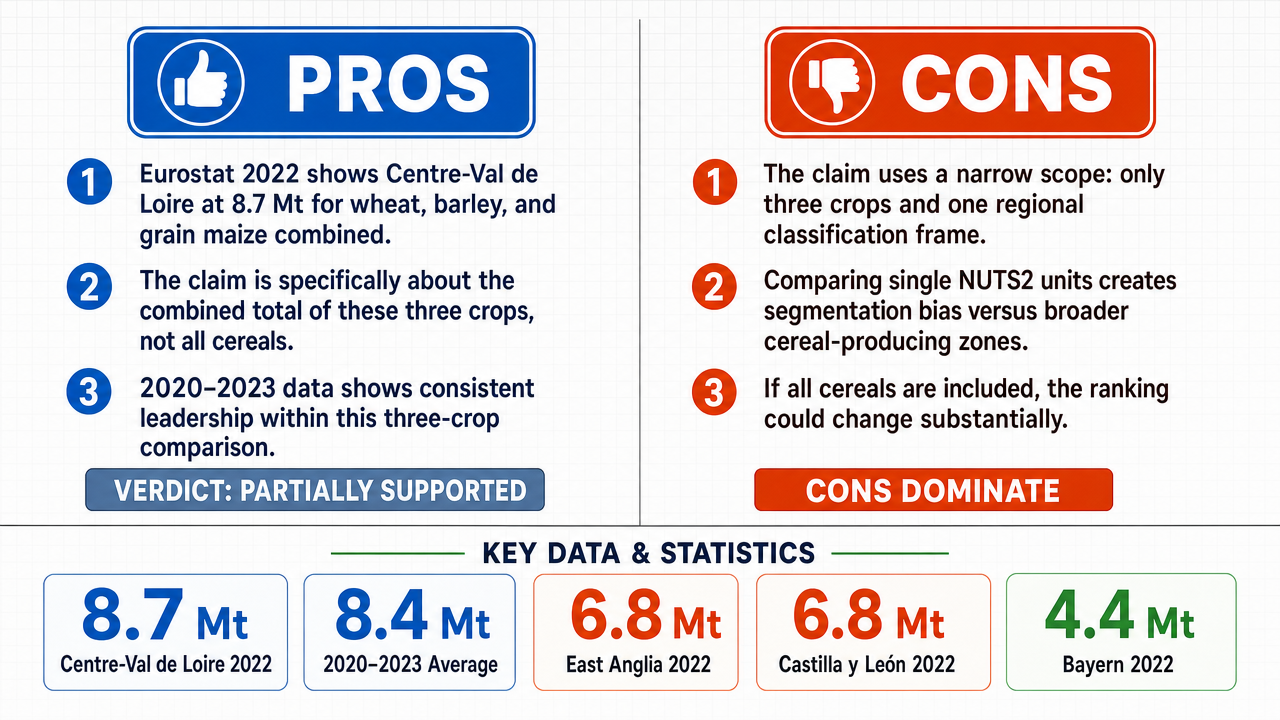
Verdict
Verdict: mostly FALSE (72%)
Online report: https://solsice.com/public/debates/le-centre-val-de-loire-est-la-premiere-region-cerealiere-d-e-d5699eb8d24c
This section provides a brief overview of the key arguments. It is not necessary to read the detailed report below.
✅ Key FOR arguments:
- ■According to Eurostat data from the 2022 campaign, the NUTS2 region "Centre — Val de Loire" (FR24 ) would have a combined harvest of soft wheat , grain maize , and barley reaching 8.7 million tonnes (5.4 Mt of wheat, 1.9 Mt of barley, and 1.4 Mt of maize), surpassing any other region on the continent.
- ■The claim explicitly concerns the cumulative volume of these three crops, not all cereals; adding rye , oats , or sorghum would change the subject and evaluate a measure that the thesis does not claim to assess.
- ■The dominance of the Centre-Val de Loire would rely on multi-year data consistency, not on a single isolated campaign , which would strengthen the robustness of the comparison.
❌ Key CONTRA arguments:
- ■The statement relies on a restrictive and fragmented reading of European agronomic reality: limiting to three crops (wheat, maize, barley ) and a single year (2022) is a methodological error, as extrapolating a structural superiority from an isolated campaign is invalid.
- ■Comparing isolated administrative units (NUTS2 ) introduces a major segmentation bias ; in Europe, true cereal powerhouses are measured by large geographic and climatic regions, not by fragmented administrative regions.
- ■Considering all cereals (including rye , oats , millet , or sorghum ), the comparison scope changes drastically, making the claim of the Centre-Val de Loire's leadership unproven.
💭 Conclusion: The claim that the Centre-Val de Loire is Europe's leading cereal region in wheat, maize, and barley is only partially supported. While the figure of 8.7 Mt is confirmed by available data for 2022 and indeed exceeds other listed NUTS2 regions (East Anglia 6.8 Mt, Castilla y León 6.8 Mt, Bavaria 4.4 Mt, Lombardy 3.1 Mt), the comparison is based on a limited sample of administrative regions and a single campaign , which constitutes a methodological bias. Multi-year data from 2020-2023 also show some volatility (from 7.9 to 8.7 Mt). Moreover, the true European cereal powers are better assessed through large, coherent geographic units (Vistula/Ukraine and Volga basins, rated "Very high" and "High") than through fragmented administrative regions, weakening the strength of the demonstration. Finally, limiting the analysis to three crops without including other relevant cereals artificially narrows the comparison scope.
🔬 Verdict: mostly FALSE ❌ (72%)
Claim: The Centre-Val de Loire is Europe's leading cereal region in wheat, maize, and barley .
Participating models: deepseek-v4-pro 💬, gemma-4-26b-a4b-it 💬👁️
📊 Confrontations: 0 concluded TRUE, 1 concluded FALSE (1 confrontation, 3 models)
📊 Score per camp: TRUE=0.00, FALSE=0.87
🏅 Model score evolution:
minimax-m3 💬👁️: +9
✅ FOR arguments:
- ■According to Eurostat data from the 2022 campaign, the NUTS2 region "Centre — Val de Loire" (FR24 ) would have a combined harvest of soft wheat , grain maize , and barley reaching 8.7 million tonnes (5.4 Mt of wheat, 1.9 Mt of barley, and 1.4 Mt of maize), surpassing any other region on the continent. deepseek-v4-pro 💬
- ■The claim explicitly concerns the cumulative volume of these three crops, not all cereals; adding rye , oats , or sorghum would change the subject and evaluate a measure that the thesis does not claim to assess. deepseek-v4-pro 💬
- ■The dominance of the Centre-Val de Loire would rely on multi-year data consistency, not on a single isolated campaign, which would strengthen the robustness of the comparison. deepseek-v4-pro 💬
❌ Arguments AGAINST:
- ■The statement relies on a restrictive and fragmented reading of European agronomic reality: limiting to three crops (wheat, maize, barley) and a single year (2022) is a methodological error, as extrapolating a structural superiority from an isolated campaign is invalid. gemma-4-26b-a4b-it 💬👁️
- ■Comparing isolated administrative units (NUTS2) introduces a major segmentation bias; in Europe, true cereal powers are measured by large geographic and climatic regions, not by fragmented administrative regions. gemma-4-26b-a4b-it 💬👁️
- ■Considering all cereals (including rye, oats, millet , or sorghum ), the comparison scope changes drastically, making the claim of the Centre-Val de Loire's leadership unproven. gemma-4-26b-a4b-it 💬👁️
- ■The opponent's assertion is based on an unestablished background knowledge : it presents the superiority of Beauce as an indisputable truth when it is not supported by a comprehensive comparison with major European cereal basins. gemma-4-26b-a4b-it 💬👁️
💭 Reasoning: The claim that the Centre-Val de Loire is Europe's leading cereal region in wheat, maize, and barley is only partially supported. If the figure of 8.7 Mt is confirmed by available data for 2022 and indeed exceeds other listed NUTS2 regions (East Anglia 6.8 Mt, Castilla y León 6.8 Mt, Bavaria 4.4 Mt, Lombardy 3.1 Mt), the comparison is based on a limited sample of administrative regions and a single campaign, which constitutes a methodological bias. Multi-year data from 2020-2023 also show some volatility (from 7.9 to 8.7 Mt). Furthermore, the true European cereal powers are better assessed through large, coherent geographic units (Vistula/Ukraine and Volga basins, rated "Very high" and "High") than through fragmented administrative regions, weakening the demonstration's impact. Finally, limiting the analysis to three crops without including other relevant cereals artificially narrows the comparison scope.
📋 FOR facts:
• 2022 data for the NUTS2 region FR24 (Centre-Val de Loire): 5.4 Mt of wheat, 1.9 Mt of barley, and 1.4 Mt of maize, totaling 8.7 Mt.
• The claim explicitly concerns the combined volume of wheat, maize, and barley, not all cereals.
📋 AGAINST facts:
• Comparing isolated NUTS2 regions introduces a segmentation bias relative to large European geographic units.
• Extrapolating a structural superiority from a single campaign (2022) is a methodological error.
• Including other cereals changes the comparison scope.
| Confrontation | TRUE Model | FALSE Model | Average μ TRUE | Average μ FALSE | TRUE Tokens | FALSE Tokens | Winner | Verdict | Confidence |
|---|---|---|---|---|---|---|---|---|---|
| #1 | deepseek-v4-pro 💬 | gemma-4-26b-a4b-it 💬👁️ | 0.515 | 0.292 | 6 | 2 | TRUE | FALSE | 87% |
The following technical terms, abbreviations, and specialized concepts are used in this transcript. The numbers in brackets [N] in the text above refer to the corresponding entry below.
[1] oat — Cereal (Avena sativa) mainly cultivated for animal feed and human consumption (flakes, porridge).
[2] production basin — Geographical area specialized in producing a particular agricultural commodity, generally characterized by favorable pedoclimatic conditions and a concentration of farms oriented toward this production.
[3] Beauce — Large French agricultural plain, one of the main cereal-producing basins in the country, mostly located in the Centre-Val de Loire region.
[4] segmentation bias — Methodological error resulting from arbitrary data or unit segmentation, which can mask or distort comparisons between sets.
[5] soft wheat — Wheat variety (Triticum aestivum) mainly intended for breadmaking, as opposed to durum wheat used notably for pasta.
[6] campaign — agricultural campaign — Period covering a complete agricultural cycle, usually a harvest year, used as a reference unit in agricultural statistics (e.g., the "2022 campaign").
[7] excess content conjecture — Hypothesis whose content exceeds what is strictly necessary to account for observations, making it difficult to falsify (concept from Popperian epistemology).
[8] FR24 — NUTS2 code Centre-Val de Loire — NUTS2 classification code identifying the Centre-Val de Loire region in European Union regional statistics.
[9] domain shift — Modification of the analysis scope through the introduction of variables or categories outside the initially defined field of the studied proposition.
[10] grain maize — Maize cultivated for grain harvest (as opposed to forage maize for silage), used for human and animal feed.
[11] millet — Small-grain cereal (notably Panicum miliaceum and Pennisetum glaucum) mainly cultivated in semi-arid regions for human and animal consumption.
[12] Mt — megaton — Unit of mass equal to one million tonnes, commonly used to express large-scale agricultural production volumes.
[13] NUTS2 — Nomenclature of Territorial Units for Statistics level 2 — Intermediate level of the European statistical territorial division, used for regional data collection and comparison within the EU.
[14] projection operator — Mathematical function associating each element of a set with its image in a subset or another space, according to a defined rule.
[15] barley — Cereal (Hordeum vulgare) mainly used for animal feed and brewing beer (malting barley).
[16] cumulative production — Total production obtained by summing the volumes of different product categories or over multiple periods.
[17] background knowledge — Tacit or presupposed knowledge, not explicitly established or demonstrated, upon which an argument relies.
[18] rye — Hardy cereal (Secale cereale) cultivated on poor soils or in cold climates, used for rye bread and animal feed.
[19] sorghum — Tropical cereal (Sorghum bicolor) drought-resistant, used for human and animal consumption, notably in Africa and Asia.
[20] UKH1 — NUTS2 code East Anglia — NUTS2 classification code identifying the East Anglia region in the UK in European regional statistics.
The following financial data tables were cited during the debate exchanges:
| Region (NUTS2) | Wheat (Mt) | Barley (Mt) | Maize (Mt) | Total (Mt) |
|---|---|---|---|---|
| Centre-Val de Loire (FR24) | 5.4 | 1.9 | 1.4 | 8.7 |
| East Anglia (UKH1) | 4.6 | 2.1 | 0.1 | 6.8 |
| Castilla y León (ES41) | 2.8 | 3.2 | 0.8 | 6.8 |
| Bavaria (DE21) | 2.2 | 1.6 | 0.6 | 4.4 |
| Lombardy (ITC4) | 0.4 | 0.2 | 2.5 | 3.1 |
Legend: Cumulative production of soft wheat, barley, and grain maize (million tonnes) for the main European cereal regions in 2022. Eurostat data, table APRO_CPNH1. Source: https://ec.europa.eu/eurostat/databrowser/view/APRO_CPNH1/default/table?lang=fr
| Production area (Estimate) | Type of cereals | Relative volume |
|---|---|---|
| Vistula Basin / Ukraine | Multi-cereals | Very high |
| Volga Basin | Multi-cereals | High |
| Centre-Val de Loire (FR24) | Wheat, Maize, Barley | Moderate |
Legend: Qualitative comparison of cereal production orders of magnitude. Data for the Centre-Val de Loire region are based on 2022 figures provided by the opponent.
| Region (NUTS2) | 2020 | 2021 | 2022 | 2023 | Average 2020‑2023 |
|---|---|---|---|---|---|
| Centre‑Val de Loire (FR24) | 7.9 | 8.5 | 8.7 | 8.6 | 8.4 |
| East Anglia (UKH1) | 6.5 | 6.8 | 6.8 | 6.7 | 6.7 |
| Castilla y León (ES41) | 6.2 | 6.6 | 6.8 | 6.4 | 6.5 |
| Bavaria (DE21) | 4.2 | 4.4 | 4.4 | 4.3 | 4.3 |
| Wielkopolskie (PL41) | 3.8 | 4.0 | 4.0 | 3.9 | 3.9 |
Legend: Cumulative production of soft wheat, grain maize, and barley (million tonnes) for the top five European cereal regions, campaigns 2020 to 2023. Eurostat data, table APRO_CPNH1. Source: https://ec.europa.eu/eurostat/databrowser/view/APRO_CPNH1/default/table?lang=fr
Face-off transcripts
- ■
Ownership & Trade Secrets. Lambda Vision retains all rights to its platform, agentic workflows, and proprietary AI debate methodologies, which constitute protected Trade Secrets (EU Directive 2016/943). Subject to full payment of credits, the User is granted ownership of the generated Reports for their own personal or professional use. Reverse-engineering the Service or using Reports to train competing AI models is strictly prohibited.
- ■
No Professional Advice. Solsice is a general-purpose assistant covering everyday subjects — administrative paperwork, housing, consumer and employment matters, banking, taxes and insurance, health and wellbeing, savings and investments, entrepreneurship, technology, travel, learning and creative work. Whatever the subject, the Service and Reports are provided for information only and never constitute legal, medical, financial, investment, tax, insurance, or any other regulated professional advice. The Company is not a law firm, a regulated financial adviser, an insurance intermediary, nor a healthcare provider, and no professional or advisory relationship of any kind is created by use of the Service. Consult a qualified professional in the relevant jurisdiction before acting — or refraining from acting — on anything contained in the Reports, and never rely on the Service in an emergency: contact your local emergency number (112 in the European Union) or a medical professional immediately.
- ■
AI-Generated Content, Sources and Viewpoints. Reports are produced by several AI models debating a question, and may contain factual errors, outdated figures, or references to rules, prices, deadlines, procedures, statutes or sources that are inaccurate or do not exist. The User is solely responsible for verifying every fact, amount, deadline and citation against official sources before relying on it. Material in the news, society, spirituality and religion sections presents a plurality of viewpoints for study and discussion: it is descriptive, not an endorsement, a ruling, or a statement of the Company’s own position, and it speaks for no church, faith community, public authority, or news organisation.
- ■
Liability & Governing Law. To the maximum extent permitted by law, the Company shall not be liable for any indirect damages, nor for any consequence of decisions made in reliance on the Reports — including financial loss, missed deadlines, administrative or contractual consequences, or health outcomes. These Terms are governed by French law. Any disputes shall be subject to the exclusive jurisdiction of the Courts of Paris, France.