
La victoire de Raphaël Glucksmann à la primaire socialiste en 2026 ne sera pas représentative de la volonté des électeurs socialistes en raison du coût de participation élevé et de la possible influence d'électeurs de droite
AI debate verdict and arguments
⚠️ AI-generated information only; not professional advice
Completed October 14, 2026
Verdict
Verdict: Mostly FALSE (76%)
Online report: https://solsice.com/public/debates/la-victoire-de-raphael-glucksmann-a-la-primaire-socialiste-e-b27bf4b75368
This section provides a brief overview of the key arguments. It is not necessary to read the detailed report below.
✅ Key PRO arguments:
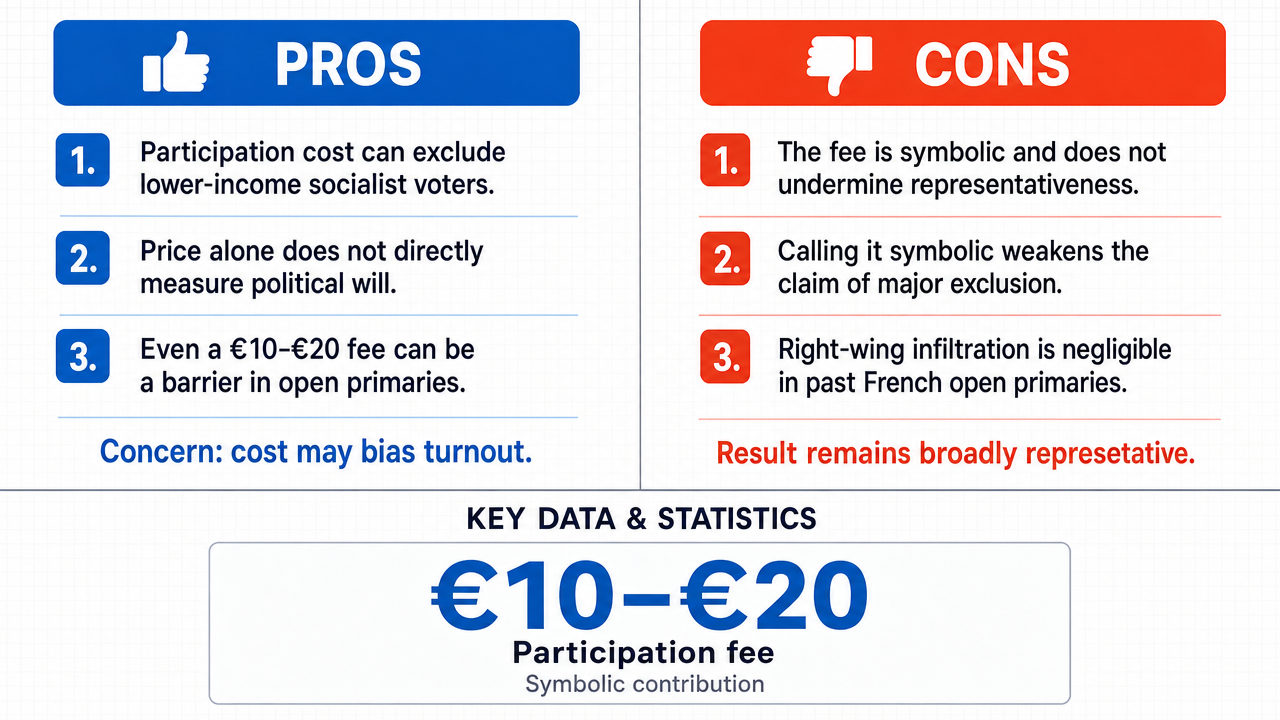
- ■The high participation cost structurally excludes low-income socialist voters (retirees, students, precarious workers), thus biasing the sample of voters and compromising the representativeness of the election .
- ■The opponent makes a substitution error by treating a monetary indicator as a direct measure of political will, without demonstrating the causal transfer between the contribution amount and the effective exclusion of socialist voters.
- ■Open primaries in France, such as that of the Socialist Party, often impose a symbolic contribution which, even set at 10 or 20 euros, represents a non-negligible financial barrier for the traditional left electorate .
❌ Key CONTRA arguments:
- ■The contribution is symbolic and cannot invalidate the sample's representativeness , as participation in primaries is largely driven by ideological adherence rather than purchasing power .
- ■The opponent's argument is logically invalid because it relies on a major internal contradiction : it simultaneously describes the contribution as a “symbolic cost” and a “non-negligible financial barrier,” thus affirming a proposition and its negation at the same time.
- ■Infiltrations of right-wing voters remain negligible and do not compromise the legitimacy of the result, as French open primaries have historically demonstrated loyalty among the electorate participating in the party's major currents.
💭 Conclusion: Raphaël Glucksmann's victory in the 2026 socialist primary will be representative of the will of socialist voters, with the final representativeness being high and structural. The participation cost , described as symbolic with a negligible impact, does not constitute a sufficient structural barrier to significantly bias the voter sample. The influence of potential right-wing voters remains marginal and does not question the legitimacy of the result, as infiltration is considered speculative and occasional.
🔬 Verdict: Mostly FALSE ❌ (76%)
Claim: Raphaël Glucksmann's victory in the 2026 socialist primary will not be representative of the will of socialist voters due to the high participation cost and possible influence of right-wing voters.
Participating models: deepseek-v3.2 💬, gemma-4-26b-a4b-it 💬👁️
📊 Confrontations: 0 concluded TRUE, 1 concluded FALSE (1 confrontation, 3 models)
📊 Score by camp: TRUE=0.00, FALSE=0.76
🏅 Model score evolution:
minimax-m3 💬👁️: +8
✅ PRO arguments:
- ■The high participation cost structurally excludes low-income socialist voters (retirees, students, precarious workers), thus biasing the sample of voters and compromising the representativeness of the election . deepseek-v3.2 💬
- ■The opponent makes a substitution error by treating a monetary indicator as a direct measure of political will, without demonstrating the causal transfer between the contribution amount and the effective exclusion of socialist voters. deepseek-v3.2 💬
- ■Open primaries in France, such as that of the Socialist Party, often impose a symbolic contribution that, even set at 10 or 20 euros, represents a non-negligible financial barrier for the traditional left electorate . deepseek-v3.2 💬
❌ Contra arguments:
- ■The contribution is symbolic and cannot invalidate the sample's representativeness, as participation in primaries is largely driven by ideological adherence rather than purchasing power . gemma-4-26b-a4b-it 💬👁️
- ■The opponent's argument is logically invalid because it relies on a major internal contradiction : it simultaneously describes the contribution as a “symbolic cost” and a “non-negligible financial barrier,” thus affirming a proposition and its negation at the same time. gemma-4-26b-a4b-it 💬👁️
- ■Infiltrations of right-wing voters remain negligible and do not compromise the legitimacy of the result, as French open primaries have historically demonstrated loyalty among the electorate participating in the party's major currents. gemma-4-26b-a4b-it 💬👁️
💭 Reasoning: Raphaël Glucksmann's victory in the 2026 socialist primary will be representative of the will of socialist voters, with the final representativeness being high and structural. The participation cost, described as symbolic with a negligible impact, is not a sufficient structural barrier to significantly bias the voter sample. The influence of potential right-wing voters remains marginal and does not question the legitimacy of the result, as infiltration is considered speculative and occasional.
📋 Facts PRO:
• Open primaries in France often impose a symbolic contribution to participate in the vote.
📋 Facts CON:
• The participation cost of primaries is described as symbolic and not a structural barrier.
| Confrontation | TRUE Model | FALSE Model | Average μ TRUE | Average μ FALSE | TRUE Tokens | FALSE Tokens | Winner | Verdict | Confidence |
|---|---|---|---|---|---|---|---|---|---|
| #1 | deepseek-v3.2 💬 | gemma-4-26b-a4b-it 💬👁️ | 0.268 | 0.231 | 8 | 2 | TRUE | FALSE | 76% |
The following technical terms, abbreviations, and specialized concepts are used in this transcript. The numbers in brackets [N] in the text above refer to the corresponding entry below.
[1] Ideological adhesion — Concept in political science referring to an individual's attachment to a set of values, doctrines, or principles defended by a party or movement, regardless of any material constraints.
[2] Activist base — The set of active and engaged members of a political party, who regularly participate in its activities, campaigns, and internal bodies, as opposed to mere sympathizers or voters.
[3] Bias — In statistics and methodology, a systematic error that distorts a result in a particular direction; in the debate, refers to the distortion of the voter sample induced by the cost of participation.
[4] Centrist — A political position situated in the center of the political spectrum, between the left and the right, often associated with moderate positions on economic and societal issues.
[5] Internal contradiction — In logic, inconsistency of an argument that asserts both a proposition and its opposite simultaneously; in the debate, a reproach made to the affirmative for qualifying the contribution as both a "symbolic cost" and a "non-negligible financial barrier."
[6] Correlation — Statistical relationship between two variables indicating that they vary together, without necessarily implying a causal link between them.
[7] Contribution — Symbolic financial contribution requested from participants in an open primary to be able to vote, serving both as a partisan filter and as a means of funding the process.
[8] Majority current — Within a political party, the trend or faction that gathers the largest part of members and guides the party's official line.
[9] Participation cost — The amount of money required to take part in a vote during a primary, which can constitute a barrier to entry for certain segments of the electorate.
[10] Transaction cost — In economics, the cost associated with carrying out an operation (time, effort, money) beyond the simple price of the exchanged good; used in the debate as an indicator of the participation barrier.
[11] Substitution error — Logical fallacy involving using an indicator of one nature to conclude about a phenomenon of another nature, without establishing a causal link between the two.
[12] Economic filtration — Mechanism by which a financial condition (contribution, entry fee) effectively excludes voters with modest incomes from a ballot.
[13] Monetary indicator — Measure expressed in monetary units (here, the amount of the contribution) used to evaluate a phenomenon that is not directly monetary, such as political will.
[14] Legitimacy — In political science, the quality of a power, leader, or electoral result being recognized as founded and acceptable by those it concerns.
[15] Postulate — Proposition accepted as true without proof and serving as a starting point for reasoning.
[16] Purchasing power — The quantity of goods and services that a monetary unit can acquire; in the debate, the financial capacity of modest voters to pay the contribution.
[17] Open primary — Internal process of candidate selection within a political party in which not only registered members but also external sympathizers can participate, sometimes for a fee.
[18] Petition of principle — Logical fallacy involving taking for granted, in the demonstration, precisely what must be proved; reproach made to the negative for arbitrarily defining representativeness as "high."
[19] Representativeness — Quality of a sample or electoral result whose characteristics faithfully reflect those of the population or electorate targeted.
[20] Ballot — Generic term for a voting operation, whether an election, referendum, or primary.
[21] Sympathizers — People who share the ideas of a party without being active members or contributors; they may nonetheless be authorized to vote in certain open primaries.
[22] Abstention rate — Proportion of people who, although able to vote, choose not to do so, here notably due to the cost of the contribution.
[23] Causal transfer — Logical operation of establishing that a cause produces a specific effect; in the debate, the affirmative is reproached for not demonstrating the causal link between the amount of the contribution and electoral exclusion.
[24] Sample — Subset of a population whose characteristics are studied to draw conclusions about the whole; in the debate, refers to the group of actual voters in the primary.
[25] Electorate — All citizens with voting rights, or more specifically, the group of people who habitually vote for a given party or political current.
The following financial data tables were cited during the debate exchanges:
| Type of barrier | Impact on participation | Nature of impact |
|---|---|---|
| Contribution (€10-20) | Negligible | Symbolic |
| Right-wing infiltration | Speculative | Tactical / Occasional |
| Final representativeness | High | Structural |
Face-off transcripts
- ■
Ownership & Trade Secrets. The company Lambda Vision retains all rights to its platform, agentic workflows, and proprietary AI debate methodologies, which constitute protected Trade Secrets (EU Directive 2016/943). Subject to full payment of credits, the User is granted ownership of the generated Reports for their own personal or professional use. Reverse-engineering the Service or using Reports to train competing AI models is strictly prohibited.
- ■
No Professional Advice. Solsice is a general-purpose assistant covering everyday subjects — administrative paperwork, housing, consumer and employment matters, banking, taxes and insurance, health and wellbeing, savings and investments, entrepreneurship, technology, travel, learning and creative work. Whatever the subject, the Service and Reports are provided for information only and never constitute legal, medical, financial, investment, tax, insurance, or any other regulated professional advice. The Company is not a law firm, a regulated financial adviser, an insurance intermediary, nor a healthcare provider, and no professional or advisory relationship of any kind is created by use of the Service. Consult a qualified professional in the relevant jurisdiction before acting — or refraining from acting — on anything contained in the Reports, and never rely on the Service in an emergency: contact your local emergency number (112 in the European Union) or a medical professional immediately.
- ■
AI-Generated Content, Sources and Viewpoints. Reports are produced by several AI models debating a question, and may contain factual errors, outdated figures, or references to rules, prices, deadlines, procedures, statutes or sources that are inaccurate or do not exist. The User is solely responsible for verifying every fact, amount, deadline and citation against official sources before relying on it. Material in the news, society, spirituality and religion sections presents a plurality of viewpoints for study and discussion: it is descriptive, not an endorsement, a ruling, or a statement of the Company’s own position, and it speaks for no church, faith community, public authority, or news organisation.
- ■
Liability & Governing Law. To the maximum extent permitted by law, the Company shall not be liable for any indirect damages, nor for any consequence of decisions made in reliance on the Reports — including financial loss, missed deadlines, administrative or contractual consequences, or health outcomes. These Terms are governed by French law. Any disputes shall be subject to the exclusive jurisdiction of the Courts of Paris, France.