
La transformation du monde ne peut s'opérer sans un changement préalable de l'état de conscience individuelle.
AI debate verdict and arguments
⚠️ AI-generated information only; not professional advice
Completed October 11, 2026
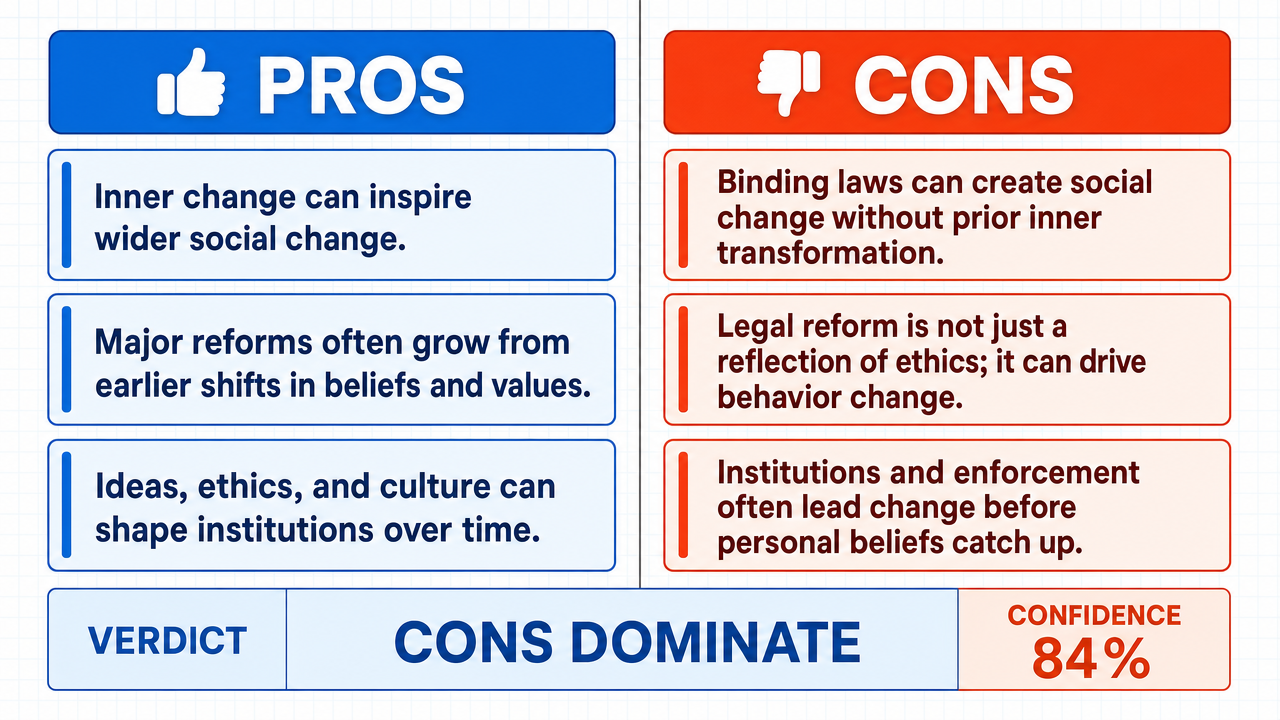
Verdict
Verdict: Mostly FALSE (84%)
This section provides a brief overview of the key arguments. It is not necessary to read the detailed report below.
✅ KEY PRO arguments:
- ■The hermetic principle of microcosm-macrocosm correspondence , as outlined in the Corpus Hermeticum ("as above, so below"), establishes an ontological link between the individual's inner state and the structure of the world, making any external transformation conditional upon a prior internal transmutation.
- ■Major legal reforms, such as the Civil Rights Act of 1964 and the Voting Rights Act of 1965 in the United States, are themselves the product of an ideological struggle and a shift in consciousness within an active minority , before being imposed on the majority, which demonstrates that law is merely a late crystallization of a prior ethical change.
- ■The tripartite synthesis (esoteric axis, ethical axis, structural axis) supports that alternative traditions, the history of social reforms, and moral philosophy all converge on the necessity of a mutation in individual consciousness as a condition for any sustainable transformation of the world.
❌ CONTRA KEY arguments:
- ■The history of civil rights and environmental standards shows that social change often results from the implementation of binding legal frameworks and sanctions that modify incentives, rather than from a prior internal conversion, which is a petitio principii in the opposing argument.
- ■The claim that legislation is merely a late crystallization of an already accomplished ethical transformation turns a correlation into an unproven causal necessity; in reality, the normative framework acts proactively and autonomously on material reality.
- ■Legal and institutional systems are not simple reflections of pre-existing ethics but are drivers capable of imposing behavioral changes through coercion and modification of economic and social incentives, demonstrating the autonomy of systemic and material structures.
💭 Conclusion: False, the debate verdict rejects the assertion that world transformation cannot occur without a prior change in individual consciousness. The defending side (FALSE) has successfully demonstrated that systemic, legal, and institutional structures possess their own autonomy to transform social reality without depending on a prior mutation of consciousness. The argument that laws are merely a "late crystallization" of pre-existing ethics has been refuted as a biased interpretation that turns a correlation into an unproven causal necessity. The examples of civil rights and environmental standards show that binding frameworks modify incentives and behaviors independently of inner conversion. Therefore, world transformation can occur through structural and material mechanisms that precede or supersede changes in individual consciousness.
🔬 Verdict: Mostly FALSE ❌ (84%)
Claim: World transformation cannot occur without a prior change in individual consciousness.
Participating models: deepseek-v3.2 💬, gemma-4-26b-a4b-it 💬👁️
📊 Confrontations: 0 concluded TRUE, 1 concluded FALSE (1 confrontation, 3 models)
📊 Score per camp: TRUE=0.00, FALSE=0.84
🏅 Model score evolution:
minimax-m3 💬👁️: +8
✅ Arguments FOR:
- ■The hermetic principle of microcosm-macrocosm correspondence , as outlined in the Corpus Hermeticum ("as above, so below"), establishes an ontological link between the individual's inner state and the structure of the world, making any external transformation conditional upon a prior internal transmutation. deepseek-v3.2 💬
- ■Major legal reforms, such as the Civil Rights Act of 1964 and the Voting Rights Act of 1965 in the United States, are themselves the product of an ideological struggle and a shift in consciousness within an active minority , before being imposed on the majority, which demonstrates that law is merely a late crystallization of a prior ethical change. deepseek-v3.2 💬
- ■The tripartite synthesis (esoteric axis, ethical axis, structural axis) supports that alternative traditions, the history of social reforms, and moral philosophy all converge on the necessity of a mutation in individual consciousness as a condition for any sustainable transformation of the world. deepseek-v3.2 💬
❌ CONTRA arguments:
- ■The history of civil rights and environmental standards shows that social change often results from the implementation of binding legal frameworks and sanctions that modify incentives, rather than from a prior internal conversion, which is a petitio principii in the opposing argument. gemma-4-26b-a4b-it 💬👁️
- ■The assertion that legislation is merely a late crystallization of an already accomplished ethical transformation turns a correlation into an unproven causal necessity; in reality, the normative framework acts proactively and autonomously on material reality. gemma-4-26b-a4b-it 💬👁️
- ■Legal and institutional systems are not simple reflections of pre-existing ethics but are drivers capable of imposing behavioral changes through coercion and modification of economic and social incentives, demonstrating the autonomy of systemic and material structures. gemma-4-26b-a4b-it 💬👁️
💭 Reasoning: False, the debate verdict rejects the assertion that world transformation cannot occur without a prior change in individual consciousness. The defending side (FALSE) has successfully demonstrated that systemic, legal, and institutional structures possess their own autonomy to transform social reality without depending on a prior mutation of consciousness. The argument that laws are merely a "late crystallization" of pre-existing ethics has been refuted as a biased interpretation that turns a correlation into an unproven causal necessity. The examples of civil rights and environmental standards show that binding frameworks modify incentives and behaviors independently of inner conversion. Therefore, world transformation can occur through structural and material mechanisms that precede or supersede changes in individual consciousness.
📋 FACTS FOR:
• The Corpus Hermeticum posits the principle of microcosm-macrocosm correspondence ("as above, so below").
• The Civil Rights Act of 1964 and the Voting Rights Act of 1965 were adopted in the United States following social struggles.
• Western esoteric traditions, including Hermeticism , consider spiritual alchemy as a path of inner transmutation.
📋 FACTS AGAINST:
• The adoption of strict environmental standards and equal opportunity laws radically transforms reality through coercion.
• Institutional mechanisms modify economic and social incentives without requiring prior internal conversion.
• The normative framework can act proactively on material reality, independently of prior ethical evolution.
| Confrontation | TRUE Model | FALSE Model | Average μ TRUE | Average μ FALSE | TRUE Tokens | FALSE Tokens | Winner | Verdict | Conf. |
|---|---|---|---|---|---|---|---|---|---|
| #1 | deepseek-v3.2 💬 | gemma-4-26b-a4b-it 💬👁️ | 0.538 | 0.368 | 12 | 3 | TRUE | FALSE | 84% |
The following technical terms, abbreviations, and specialized concepts are used in this transcript. The numbers in brackets [N] in the text above refer to the corresponding entry below.
[1] spiritual alchemy — Esoteric practice aimed at an inner transformation of the individual, presented in the debate as a prerequisite for any transformative action on the external world.
[2] system autonomy — Concept invoked by the negative side to denote the capacity of institutional, legal, and material structures to produce changes independently of individual states of consciousness.
[3] normative framework — Set of legal and institutional rules presented in the debate as a proactive driver capable of acting on material reality beyond merely codifying an existing ethics.
[4] Civil Rights Act — Civil Rights Act of 1964 — American law cited in the debate as an example of transformative legislation whose assertion is that it did not emerge ex nihilo but crystallized a long prior work on consciences.
[5] sine qua non condition — Latin expression meaning an indispensable and prerequisite condition; used in the debate to qualify gnosis as a requirement to act on matter and the cosmic order.
[6] structural constraints — Limitations imposed by social, economic, or institutional organization, opposed in the debate to internal motivations as explanatory factors of social change.
[7] Hermetic Corpus — Collection of Western esoteric texts cited in the debate as a primary source of the principle of correspondence between the individual's inner state and the structure of the world.
[8] ripple effect — Mechanism by which an initial legal transformation spreads and eventually modifies social norms; invoked by the negative side to support that law precedes and shapes consciousness.
[9] causal error — Logical fallacies involving confusing correlation with causal necessity, or attributing to consciousness what pertains to structural constraints; mutually reproached by both sides.
[10] ex nihilo — Latin expression meaning "out of nothing"; used to contest the idea that the Civil Rights Act was born from a neutral legal system without prior work on consciences.
[11] gnosis — Spiritual and intuitive knowledge described in Poimandrès as an inner process conditioning all transformative action on matter and the cosmic order.
[12] hermeticism — Western esoteric current based on texts like the Hermetic Corpus, positing the principle of correspondence between the microcosm and macrocosm.
[13] imperatives of productivity — Economic demands for yield, cost, and competition invoked by the negative side to explain industrial revolutions and technological mutations independently of consciences.
[14] economic incentives — Material stimuli (sanctions, rewards, costs) through which law and institutions modify behaviors without resorting to inner conversion.
[15] Enlightenment — philosophy of the Enlightenment — Philosophical movement mentioned in the debate as one of the intellectual sources that brought about a moral perception change prior to civil rights legislation.
[16] ideological struggle — Confrontation of ideas and value systems in which, according to the affirmative, all transformative laws are elaborated before being imposed on the majority.
[17] microcosm-macrocosm — correspondence microcosm-macrocosm — Hermetic principle whereby the structure of the world (macrocosm) reflects the inner state of the human being (microcosm), underpinning the idea that external transformation requires inner transmutation.
[18] acting minority — Small group of individuals who, through their work on consciences, make legislative reform thinkable and politically inevitable before its generalization.
[19] technological mutations — Major technical transformations presented as dictated by systemic imperatives of productivity and competition, operating independently of states of consciousness.
[20] ontological — ontological link — Relating to being and its fundamental constitution; qualifies in the debate the type of relationship established by hermeticism between the individual's inner state and the structure of the world.
[21] Poimandrès — Poimandrès (Treatises I-II of the Hermetic Corpus) — Foundational text of the hermetic tradition cited as a primary source describing gnosis as a condition for acting on matter and the cosmic order.
[22] petitio principii — Fallacy assuming what must be proved; reproached by the negative side to the assertion that a change in consciousness necessarily precedes ethical transformation.
[23] non-violent resistance — Mode of action cited in the debate as having brought about a profound change in moral perception of equality, prior to American civil rights legislation.
[24] transmutation — inner transmutation — Deep transformation of the individual's inner state, presented as a hermetic prerequisite for any lasting transformation of external reality.
[25] Voting Rights Act — Voting Rights Act of 1965 — American law cited in the debate as an example of legislation whose assertion is that it crystallized and generalized a transformation of consciences already initiated by decades of activist work.
Face-off transcripts
- ■
Ownership & Trade Secrets. Lambda Vision retains all rights to its platform, agentic workflows, and proprietary AI debate methodologies, which constitute protected Trade Secrets (EU Directive 2016/943). Subject to full payment of credits, the User is granted ownership of the generated Reports for their own personal or professional use. Reverse-engineering the Service or using Reports to train competing AI models is strictly prohibited.
- ■
No Professional Advice. Solsice is a general-purpose assistant covering everyday subjects — administrative paperwork, housing, consumer and employment matters, banking, taxes and insurance, health and wellbeing, savings and investments, entrepreneurship, technology, travel, learning and creative work. Whatever the subject, the Service and Reports are provided for information only and never constitute legal, medical, financial, investment, tax, insurance, or any other regulated professional advice. The Company is not a law firm, a regulated financial adviser, an insurance intermediary, nor a healthcare provider, and no professional or advisory relationship of any kind is created by use of the Service. Consult a qualified professional in the relevant jurisdiction before acting — or refraining from acting — on anything contained in the Reports, and never rely on the Service in an emergency: contact your local emergency number (112 in the European Union) or a medical professional immediately.
- ■
AI-Generated Content, Sources and Viewpoints. Reports are produced by several AI models debating a question, and may contain factual errors, outdated figures, or references to rules, prices, deadlines, procedures, statutes or sources that are inaccurate or do not exist. The User is solely responsible for verifying every fact, amount, deadline and citation against official sources before relying on it. Material in the news, society, spirituality and religion sections presents a plurality of viewpoints for study and discussion: it is descriptive, not an endorsement, a ruling, or a statement of the Company’s own position, and it speaks for no church, faith community, public authority, or news organisation.
- ■
Liability & Governing Law. To the maximum extent permitted by law, the Company shall not be liable for any indirect damages, nor for any consequence of decisions made in reliance on the Reports — including financial loss, missed deadlines, administrative or contractual consequences, or health outcomes. These Terms are governed by French law. Any disputes shall be subject to the exclusive jurisdiction of the Courts of Paris, France.